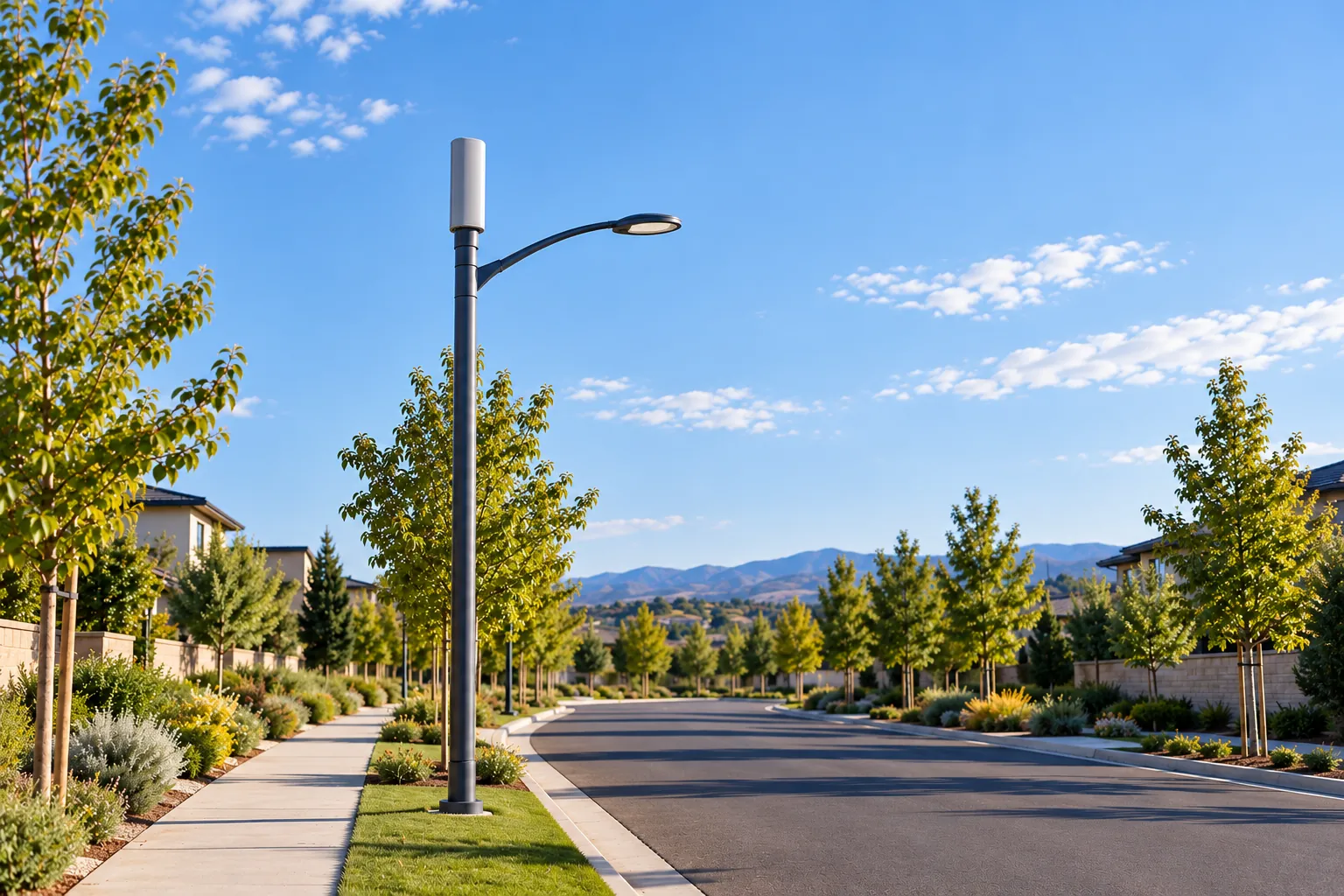
What the town still controls
When a carrier files for twenty small cells on town streetlights, the planner's first question is usually what the town is still allowed to say. The answer is more than many towns assume. Federal rules limit how long review takes, what fees cost, and whether a town can effectively block deployment. They do not take away the town's ability to set reasonable standards for location, design and appearance, provided those standards are written down before the application arrives and applied the same way to everyone.
The towns that struggle with small cells are usually the ones that try to decide each application on its own merits. The towns that do well publish a design standards document, a master license agreement for their own poles, and a fee schedule tied to their costs, and then apply all three without improvising.
What counts as a small wireless facility
The FCC defines small wireless facilities at 47 CFR 1.6002. The structure test is met if the facility is mounted on a structure 50 feet or less in height including antennas, or on a structure no more than 10 percent taller than adjacent structures, or if it does not extend an existing structure to more than 50 feet or by more than 10 percent, whichever is greater. Each antenna, excluding associated antenna equipment, must be no more than three cubic feet in volume. All other wireless equipment associated with the structure, including pre-existing equipment, must be no more than 28 cubic feet.
The definition has three more conditions. The facility must not require antenna structure registration under Part 17, must not be on Tribal lands, and must not result in human exposure to radio frequency radiation above the FCC's safety standards. A facility that fails any condition is not a small wireless facility under the federal rules, which changes its review period and its fee treatment. Your intake desk should check every condition against the plans, not take the applicant's label on faith.
The standard behind every limit
Sections 253 and 332(c)(7) of the Communications Act bar state and local requirements that prohibit or have the effect of prohibiting service. In its 2018 small cell order, the FCC read that language to reach any requirement that materially inhibits deployment, not only outright bans. The Ninth Circuit upheld that reading in City of Portland v. United States in 2020.
That standard is the lens for everything else. A requirement does not need to stop deployment to be preempted. It needs only to materially inhibit it. This is why design standards that look modest on paper can still be vulnerable if, applied together, they leave a carrier no practical place to put a facility in a whole neighborhood.
Aesthetics after City of Portland
The 2018 order set a three-part test for aesthetic requirements on small wireless facilities: they had to be reasonable, no more burdensome than those applied to other types of infrastructure deployments, and objective and published in advance. In City of Portland, the Ninth Circuit vacated the "no more burdensome" and "objective" parts. The requirements that remain are that aesthetic standards be reasonable and published in advance.
The FCC described reasonable aesthetic requirements as those that are technically feasible and reasonably directed at avoiding or remedying the intangible public harm of unsightly or out-of-character deployments. That gives a town room to address appearance, including through some judgment-based criteria such as compatibility with the character of a historic district. It does not give a town room to use aesthetics as a reason to say no. Write the standard before the application arrives, apply it the same way every time, and keep a path to approval open for the location that cannot meet it.
Published in advance means the standard exists, in writing and available to applicants, before the application is filed. A standard drafted in response to a specific application, or applied through informal guidance that exists only in a planner's memory, fails that test.
Fees the FCC presumes reasonable
The 2018 order held that fees for small wireless facilities must be a reasonable approximation of the town's costs, the costs themselves must be reasonable, and fees must be no higher than those charged to similarly situated competitors. It then set presumptively reasonable levels that a town may charge without having to justify them.
| Fee | Presumptively reasonable level |
|---|---|
| Non-recurring application fee, up to five small wireless facilities | $500 total |
| Each additional facility beyond five on the same application | $100 each |
| Non-recurring fee for a new pole intended to support one or more small wireless facilities | $1,000 |
| Recurring fees, including right-of-way access and attachment to town-owned structures in the right-of-way | $270 per facility per year |
These figures are a safe harbor, not a ceiling. A town can charge more if it can show the higher fee reflects its actual, reasonable costs. That requires records: staff hours per application, review consultant invoices, inspection time. A town that intends to charge above the presumptive levels should build that cost record before setting the fee, not after a challenge. Many states also set their own caps by statute, and where those are lower, the state cap governs what the town may charge.
What a town can and cannot require
The line between the two columns below is not always sharp, and state law can move it further toward the applicant. Use the table as a starting frame, and have your attorney review your standards against your own state statute.
| Generally permissible if reasonable and published in advance | Generally vulnerable or preempted |
|---|---|
| Design standards: color matching, shrouding, cable concealment inside the pole, antenna mounting position | Standards written after the application, or applied through unwritten guidance |
| Location preferences: preferred pole types, preferred streets, setbacks from driveways and intersections | Location rules that leave no feasible site in an area the carrier needs to serve |
| Reasonable spacing between facilities to limit visual clutter | Spacing so wide it works as a ban in practice |
| Undergrounding or flush-mounting of equipment where feasible, especially where other utilities are underground | A requirement that all wireless facilities be underground, which the FCC said would be an effective prohibition |
| Structural, electrical and safety codes, and proof of compliance with FCC radio frequency limits | Decisions based on the environmental effects of RF emissions from a facility that complies with FCC rules |
| Cost-based fees, at or below the presumptive levels or supported by a cost record | Fees above cost, or higher for one provider than another |
State small cell statutes
Many states have enacted their own small wireless facility laws, and they differ in ways that matter. Some set shorter review periods than the FCC's. Some provide that an application not acted on in time is deemed approved. Some cap application and attachment fees below the FCC's presumptive levels, set their own height limits, or restrict what a town may require in a historic district. Others are silent on topics the FCC rules cover.
Where a state statute gives the applicant more than the federal rules, the town is bound by the state statute. Where the federal rules give more, the federal rules govern. Your design standards need to satisfy both. Build a one-page summary of your state's statute next to the federal rules and check every standard against both columns. Do not borrow another state's model ordinance without that check.
Your own poles: the master license agreement
When carriers want to attach to town-owned streetlights or traffic poles, the town is acting as a property owner as well as a regulator. Most towns handle this with a master license agreement: one negotiated contract with each provider that sets the terms for every attachment, followed by a short site license or supplement for each pole.
The FCC's 2018 order counts attachment to town-owned structures in the right-of-way within the $270 annual presumptive figure, so the master license agreement cannot be used to charge rent above cost-based levels. It can, and should, address everything else that protects the town's infrastructure.
- Pole replacement. Who designs, pays for and owns a replacement pole when the existing one cannot carry the load, and the town's standard pole specifications.
- Make-ready and structural review. A structural analysis stamped by a licensed engineer for each attachment, reviewed against the pole's current loading.
- Relocation. The provider's obligation to relocate at its own cost when the town widens a road or replaces lighting, with a stated notice period.
- Power and metering. How the facility is powered, whether it shares the streetlight circuit, and how electricity is metered and billed.
- Insurance, bonding and indemnity. Coverage levels, a removal bond, and indemnity for damage to town property and third parties.
- Abandonment and removal. When a facility counts as abandoned and how quickly the provider must remove it and restore the pole.
Writing the design standards document
The design standards document is what you will point to in every approval, every denial and every dispute. It should be short enough for an applicant's engineer to read in an afternoon and specific enough that two different planners applying it to the same plans reach the same answer.
- Scope: which facilities and which areas the standards cover, using the federal definition of small wireless facility
- Pole hierarchy: an ordered list of preferred structures, such as replacement streetlights first, existing utility poles second, new poles last
- Location rules: setbacks from intersections, driveways, building entrances, curb ramps and sight-distance triangles
- Spacing: any minimum distance between facilities, with the reason for the figure stated
- Equipment placement: inside the pole, in a base cabinet, flush-mounted, or underground where feasible, in an order of preference
- Appearance: color, finish, shroud dimensions, cable concealment, signage limits and lighting
- Special districts: additional standards for historic or design overlay districts, written with the same specificity
- A deviation process: how an applicant can request an exception when a standard cannot be met, and the criteria for granting it
- Submittal requirements: the plans, photo simulations, structural analysis and RF compliance certification required, each tied to the standard it supports
- Adoption and publication: the date adopted, the body that adopted it, and where applicants can find it
The deviation process deserves the most care. Because the federal standard is whether a requirement materially inhibits deployment, a town needs a way to approve a facility that cannot meet a particular standard at a particular location. A deviation path with clear criteria, such as "no compliant location exists within the stated distance," protects the rest of the standards from a challenge built on the hardest case.
When twenty applications arrive at once
Small cells rarely come one at a time. A carrier densifying a corridor will often file a batch covering a dozen or more poles. Under the FCC's batching rule, a batch of collocations on existing structures takes the 60-day period for a single collocation, and a batch that mixes collocations with new poles takes 90 days for the whole application. The town may not refuse to accept a batch, so the review plan has to scale to the batch the day it arrives.
Review each site on its own sheet. Every pole gets its own findings against the same standards: location, spacing, equipment placement, appearance and structural capacity. A single combined finding for twenty sites makes it impossible to approve eighteen and deny two, and it gives the applicant an easy argument that the town never looked at the individual locations.
Triage first. In the first few days, sort the sites into three groups: clearly compliant, clearly missing information, and close calls that need a site visit or a deviation decision. The missing-information group drives the incompleteness notice, which for small wireless facilities must go out within 10 days of submission to reset the clock. The close calls get the reviewer's time. The compliant sites move straight to findings.
Decide each site in writing. Where your code and state law allow it, the decision can approve some sites, deny others with stated reasons, and approve still others with conditions drawn from the published standards. Each denial needs its own substantial evidence in the record. A batch handled this way takes longer to write up, but it produces decisions that hold, and it gives the carrier a clear picture of which locations to redesign.
Applying the standards the same way every time
Consistency is the town's best defense. Keep a log of every small wireless application, the standards applied, any deviations granted and the reason. When an applicant argues that a standard is applied unevenly, that log is the answer. When the council asks why a facility was approved near a resident's home, that log is also the answer.
Map every approved facility. A current inventory of small cells, poles and their attachments tells you where spacing standards are in play, where the next application is likely to land, and where the pole infrastructure is reaching its structural limits. It also gives public works the information it needs when a road project triggers relocation obligations.
Frequently asked questions
A town can deny an application that does not meet reasonable aesthetic standards published in advance, as long as the denial is in writing and supported by substantial evidence, and the standards, as applied, do not materially inhibit deployment. A denial based on unwritten preferences or general opposition is vulnerable.
No. They are presumptively reasonable levels a town can charge without further justification. A town can charge more if it can show the fee is a reasonable approximation of its reasonable costs. State law may set lower caps, and those govern where they apply.
The FCC said a requirement that all wireless facilities be underground would amount to an effective prohibition. Undergrounding or concealing equipment where it is feasible, as one option in a published preference order, is a different matter and is common in design standards.
Federal rules and many state statutes limit a town's ability to refuse access to its poles in the right-of-way and cap attachment fees at cost-based levels. The town can set reasonable terms through a master license agreement covering structural review, pole replacement, relocation, power, insurance and removal.