
A measurement agency, and why that shapes every purchase
The National Institute of Standards and Technology is a non-regulatory agency inside the Department of Commerce, created in 1901 as the National Bureau of Standards and renamed in the Omnibus Trade and Competitiveness Act of 1988 (P.L. 100-418). Its authorities sit at 15 U.S.C. 271 and following, and its charter is measurement: maintain the national standards of physical quantity, publish reference data, and build the test methods that let one lab's result mean the same thing as another lab's result. The director also serves as Under Secretary of Commerce for Standards and Technology.
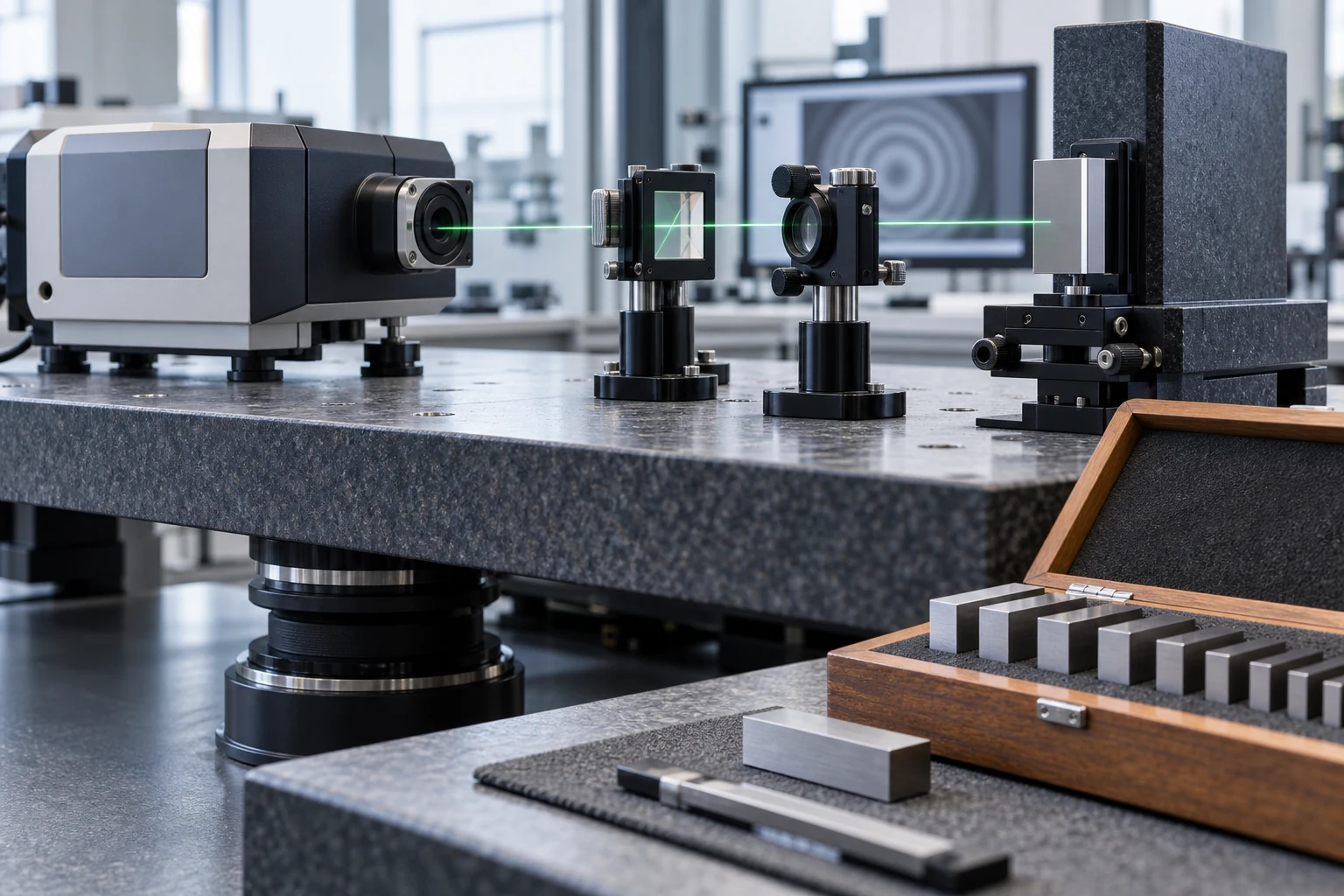
That charter explains almost everything about how NIST buys. A defense component buys capability it will operate. NIST buys instruments, datasets, evaluation infrastructure, and software supporting a measurement result someone else will rely on. The customer is a research scientist with a publication in mind, not a program office with a fielding date. Purchases run smaller, more specific, and far more tied to a technical person than to a contracting shop.
It also explains the scale. NIST's annual appropriation has run in the neighborhood of $1.5 billion across all of its accounts, smaller than a single mid-size defense program. Firms arriving in search of a large services recompete find a place that mostly writes purchase orders, schedule task orders, grants, and cooperative research agreements. The volume is low. The technical fit test is high.
How NIST is organized
Six laboratories do the science, split between the Gaithersburg, Maryland headquarters campus and the Boulder, Colorado campus, with satellite sites including the National Cybersecurity Center of Excellence in Rockville, Maryland, JILA in Boulder, and the Hollings Marine Laboratory in Charleston, South Carolina.
- Information Technology Laboratory (ITL). The one most AI and data firms care about. It publishes the SP 800 series, runs the cybersecurity and AI standards work, and houses the Information Access, Software and Systems, Statistical Engineering, and Applied Cybersecurity divisions.
- Physical Measurement Laboratory (PML). The national standards of time, length, mass, temperature, and radiation, including the atomic clocks behind the Internet Time Service.
- Material Measurement Laboratory (MML). Chemical and materials metrology, the Standard Reference Materials catalog, and the data behind the Materials Genome Initiative.
- Engineering Laboratory (EL). Building and fire research, smart grid, robotics, and the National Construction Safety Team disaster investigations.
- Communications Technology Laboratory (CTL). Spectrum, wireless, and public safety communications research, largely in Boulder.
- NIST Center for Neutron Research (NCNR). A reactor-based user facility, which brings its own class of scheduling, controls, and data-handling software work.
Outside the laboratories sits the Innovation and Industry Services side: the Hollings Manufacturing Extension Partnership, with a center in every state and Puerto Rico; the Baldrige Performance Excellence Program; the Standards Coordination Office; the Technology Partnerships Office, which owns cooperative research agreements and licensing; and the Office of Advanced Manufacturing, sponsor of NIIMBL inside the Manufacturing USA network.
Two newer offices changed the spending profile. The CHIPS Program Office and the CHIPS R&D Office administer the semiconductor programs created by the CHIPS and Science Act of 2022 (P.L. 117-167), which set aside roughly $11 billion for research and development, including the National Semiconductor Technology Center and a national advanced packaging program. And the AI standards work that began as the U.S. AI Safety Institute now runs as the Center for AI Standards and Innovation, renamed by the Commerce Secretary in June 2025.
Where the money sits
NIST's appropriation arrives in three accounts, and knowing which one funds a given office tells you what instrument the work will use. Scientific and Technical Research and Services (STRS) pays for the laboratories, their staff, and most of their contract support. Industrial Technology Services (ITS) pays the extramural programs, chiefly the Manufacturing Extension Partnership and Manufacturing USA. Construction of Research Facilities (CRF) pays for buildings and major instrumentation.
Lab software, data engineering, and evaluation infrastructure almost always come out of STRS. That is the account where a firm selling AI and data services should expect to be paid, and it is also the one under the most budget pressure, which pushes buyers toward small, bounded purchases rather than multi-year services contracts.
Entry-Channel Fit: Small AI and Data Engineering Firm
Editorial weighting from public sources and practitioner reading. Illustrative, not a measured statistic.
How work actually reaches a contractor
NIST's Office of Acquisition and Agreements Management runs the contracting function, with the Department of Commerce small business office handling outreach above it. There is no single large NIST-wide IT services vehicle to chase the way a firm would chase a defense IDIQ. Work reaches vendors through several narrow channels instead.
| Channel | Typical instrument | What it fits |
|---|---|---|
| NIST SBIR | Annual funding opportunity posted on Grants.gov, subtopics written by the labs | A measurement, data, or standards problem a scientist already wrote down |
| Simplified acquisition | FAR Part 13 purchase order below the $250,000 threshold | A bounded tool, a dataset build, a pilot, a scoring pipeline |
| Schedule order | FAR 8.4 order against GSA MAS, often SIN 54151S or the cloud SIN | Staffed engineering support with an established labor basis |
| Subcontract | Team member under an incumbent lab-support prime | Steady software, data pipeline, and sysadmin work inside a lab |
| CRADA | Cooperative research agreement under 15 U.S.C. 3710a; no federal money moves | Joint work at the NCCoE or directly with a laboratory division |
| Cooperative agreement or other transaction | CHIPS R&D and advanced manufacturing programs | Consortium-scale research, usually with cost share and partners |
Government-wide vehicles matter at the margin. NIST places orders through GSA Multiple Award Schedule contracts, NASA SEWP, GSA Alliant 2 and OASIS+, and NITAAC's CIO-SP line. Holding one is useful. None creates demand on its own.
Simplified acquisition is the real front door
A large share of NIST's technology buying happens under the simplified acquisition threshold at FAR 2.101, currently $250,000, with the micro-purchase threshold at $10,000. FAR 13.500 also permits simplified procedures for commercial products and services up to $7.5 million, which covers much of what a lab needs.
The practical consequence: the first NIST engagement is usually small, specific, and sourced by a technical person who already knows what they want. A scientist needs an extraction pipeline over thirty years of instrument logs, a reproducible benchmark suite, a data repository that survives staff turnover, an annotation workflow with measurable inter-rater agreement. Those jobs land in the $50,000 to $200,000 band and get awarded fast when the vendor is credible and already registered.
The data NIST holds
NIST's data holdings are unusual because most of them are public and the agency is custodian rather than consumer. Standard Reference Data covers thermophysical properties, atomic spectra, and the Chemistry WebBook. The Standard Reference Materials catalog spans more than a thousand certified artifacts, each with a certificate of analysis that is itself a data product. The Public Data Repository and the Materials Data Repository hold lab-generated datasets under formal identifiers.
The information-technology holdings bear directly on AI and data work. NIST operates the National Vulnerability Database, which enriches CVE records with CVSS scores, CPE product identifiers, and weakness mappings. The enrichment backlog that opened in early 2024 is the clearest public case of a federal data operation outgrowing its pipeline, and it is an engineering problem rather than a policy one. NIST also maintains the National Software Reference Library, whose hash sets underpin much of digital forensics.
The agency's special databases have a long history in machine learning. The handwriting corpora that became MNIST came out of NIST Special Databases 1 and 3. Fingerprint, face, iris, and speech corpora have been curated there for decades, with access controls that vary by dataset and sometimes require a signed agreement even when the data is unclassified.
Evaluation programs, and why they beat a capability statement
This is the part most firms miss. NIST runs open, recurring, government-administered evaluations where anyone can submit a system and receive a published, comparable score. The Text REtrieval Conference has run since 1992. Face Recognition Technology Evaluation and Face Analysis Technology Evaluation, renamed from FRVT in 2023, publish ongoing vendor leaderboards. Speaker Recognition Evaluation, the Open Media Forensics Challenge, the NIST GenAI evaluations begun in 2024, and the ARIA program all follow the same pattern.
Entering costs nothing but engineering time. The output is a result published by a federal agency, under a protocol the agency designed, on data the agency controls. For a firm building AI systems, that is a stronger past-performance signal than most contract line items, because the evaluator was the government and the conditions were identical for everyone. Our team treats these programs as a first-class business development channel.
A published NIST evaluation result also changes the tenor of a first conversation with a lab. The email is no longer a claim about capability. It is a link to a scoreboard the recipient's own colleagues maintain.
AI at NIST
The AI Risk Management Framework 1.0 published in January 2023, followed by the Generative AI Profile, NIST AI 600-1, in July 2024. Those documents now anchor AI governance language across federal solicitations, and they interlock with the security catalog most federal systems already run on: SP 800-53 Rev 5 for controls, SP 800-37 Rev 2 for the risk management process, SP 800-171 Rev 3 for controlled unclassified information on nonfederal systems, and the Cybersecurity Framework 2.0 released in February 2024. Post-quantum cryptography landed in the same window, with FIPS 203, 204, and 205 finalized in August 2024 and a fifth algorithm selected in March 2025.
Two things follow for a vendor. Work that helps NIST test, measure, or tool its own frameworks is squarely inside the mission: reference implementations, scoring pipelines, profile mappings, machine-readable control catalogs. And a firm that already builds to these documents for other customers arrives with an argument NIST staff can evaluate immediately, because they wrote the source. We cover the mapping mechanics in our practical guide to the AI RMF.
Security and access requirements
NIST is largely an unclassified environment, which lowers one barrier and raises another. There is no clearance gate on most work, so a firm without facility clearance is not excluded. In its place sits the personnel-vetting regime that applies to all federal contractor access.
Credentialing. Physical and logical access runs through HSPD-12 and the PIV standard at FIPS 201-3. A contractor badge requires a favorable determination, and the investigation tier follows the position's risk designation under 5 CFR Part 731: Tier 1 for low-risk non-sensitive, Tier 2 for moderate-risk public trust, Tier 4 for high-risk public trust. Expect weeks between award and badge.
System authorization. NIST systems are FISMA-scoped and categorized under FIPS 199. A contractor-operated system that supports NIST inherits an authorization obligation, and cloud services inside the boundary need a FedRAMP authorization at the matching impact level.
Controlled unclassified information. CUI is governed by Executive Order 13556 and 32 CFR Part 2002, with the protection requirements for nonfederal systems in SP 800-171. Some NIST program data, including pre-decisional research and certain biometric corpora, carries handling conditions even though it is unclassified.
Supply chain representations. Every offeror completes the Section 889 representation implementing the FY2019 NDAA prohibition at FAR 52.204-25, plus the standard SAM.gov certifications. Commerce also administers the export regulations at 15 CFR Parts 730 to 774, which reach some instrumentation and encryption work.
Where a small engineering firm realistically fits
Lab software and data engineering. The laboratories generate enormous instrument output and carry persistent needs in pipelines, repositories, metadata, provenance, and reproducibility. Ordinary, valuable engineering work, arriving as small purchase orders or workshare under a support prime.
Evaluation infrastructure. Running an evaluation at scale is a software problem: submission handling, scoring, statistical treatment, leaderboard publication, reproducibility of the whole chain. Firms that can build that are scarce relative to firms that can enter one.
SBIR. NIST publishes an annual SBIR funding opportunity on Grants.gov with subtopics written by lab staff against real internal needs. Phase I awards have run at about $100,000 and Phase II to roughly $400,000, so confirm current ceilings in the live notice before budgeting. That subtopic list is also a free and unusually candid statement of what the labs want built.
The NCCoE. Collaborators join through a cooperative research agreement, contribute technology and staff time, and co-author the practice guides in the SP 1800 series. No federal money changes hands. A participant gets a named role in a document thousands of security teams read, and standing with a NIST program that outlasts the project.
First 90 Days: The Concrete Entry Sequence
What does not work
Generic capability statements sent to a contracting mailbox produce nothing at NIST. Neither does a pitch built around scale, headcount, or vehicle access, because the buyer is a scientist whose problem is specific and whose budget is small. Compliance-consulting offers land especially badly: NIST staff wrote the standard you are offering to interpret.
The approach that works is the inverse. Show a measured result on a problem the agency already cares about, name the lab and the division, and propose something bounded enough to fit a purchase order. The NIST relationships that start well start with a technical artifact.
Common questions on the entry path
Does NIST work require a security clearance?
Most of it does not. NIST is largely unclassified, so the gate is credentialing rather than clearance: an HSPD-12 PIV badge with an investigation tier matched to the position's risk designation under 5 CFR Part 731. A firm with no facility clearance can compete for most NIST technology work.
Is participating at the NCCoE a paid contract?
No. Collaborators join under a cooperative research agreement authorized by 15 U.S.C. 3710a and contribute technology and staff time at their own expense. The return is a named role in a published SP 1800 practice guide and a standing technical relationship, which is why firms treat it as business development rather than revenue.
Can a firm win at NIST without a NIST past-performance record?
Yes, and more easily than at most agencies, because so much of the buying happens under the simplified acquisition threshold where past performance carries less weight than technical credibility. A published result in a NIST evaluation program substitutes for a contract history in a way that few other agencies allow.
Does NIST buy production software or only research prototypes?
Both. Research tooling comes out of laboratory budgets under STRS. Production systems appear where NIST operates public infrastructure: the vulnerability database, data repositories, the time service, evaluation platforms. Those carry real availability and security requirements.
Frequently asked questions
There is no single dominant NIST-wide vehicle. Work flows through simplified acquisition purchase orders, GSA schedule orders, subcontracts under lab-support primes, SBIR grants, cooperative research agreements, and for the semiconductor programs, cooperative agreements and other transactions.
Small. A large share of NIST technology buying sits under the $250,000 simplified acquisition threshold at FAR 2.101, and many first awards fall between $50,000 and $200,000. Firms should size the initial proposal to fit that band rather than pitching a multi-year program.
The Information Technology Laboratory is the natural fit, since it owns the SP 800 series, the AI standards work, and the evaluation programs. The Material Measurement Laboratory and Engineering Laboratory also carry real data engineering demand tied to instrument output and disaster investigations.
NIST posts a single annual funding opportunity on Grants.gov rather than multi-cycle releases through a defense portal, and its subtopics are written by lab staff against internal measurement needs. Award ceilings sit below the SBA guideline amounts most defense components use, so confirm the current figures in the live notice.
HSPD-12 credentialing under FIPS 201-3, position risk designation under 5 CFR Part 731, FISMA authorization for any supporting system, FedRAMP for cloud services in the boundary, SP 800-171 for controlled unclassified information on contractor systems, and the Section 889 representation at FAR 52.204-25.
Bottom line
NIST is a small buyer with outsized influence on how every other federal agency evaluates AI systems. The way in is not a vehicle strategy. It is a measured result on a problem a named laboratory already cares about, followed by a proposal small enough to award quickly. Firms that build first and write second do well there.