
What Interior actually is
The Department of the Interior was created in 1849 as the government's domestic housekeeping department, and it never stopped collecting responsibilities. Today it manages roughly 500 million acres of surface land, about one-fifth of the land area of the United States, plus about 700 million acres of subsurface minerals and 1.7 billion acres of the Outer Continental Shelf. It runs the national parks, the national wildlife refuges, most western water infrastructure, the federal onshore and offshore energy estate, the government's earth-science program, and the federal trust responsibility to 574 federally recognized tribes. A dozen bureaus and offices carry that work, on roughly $18 billion a year in discretionary appropriations.
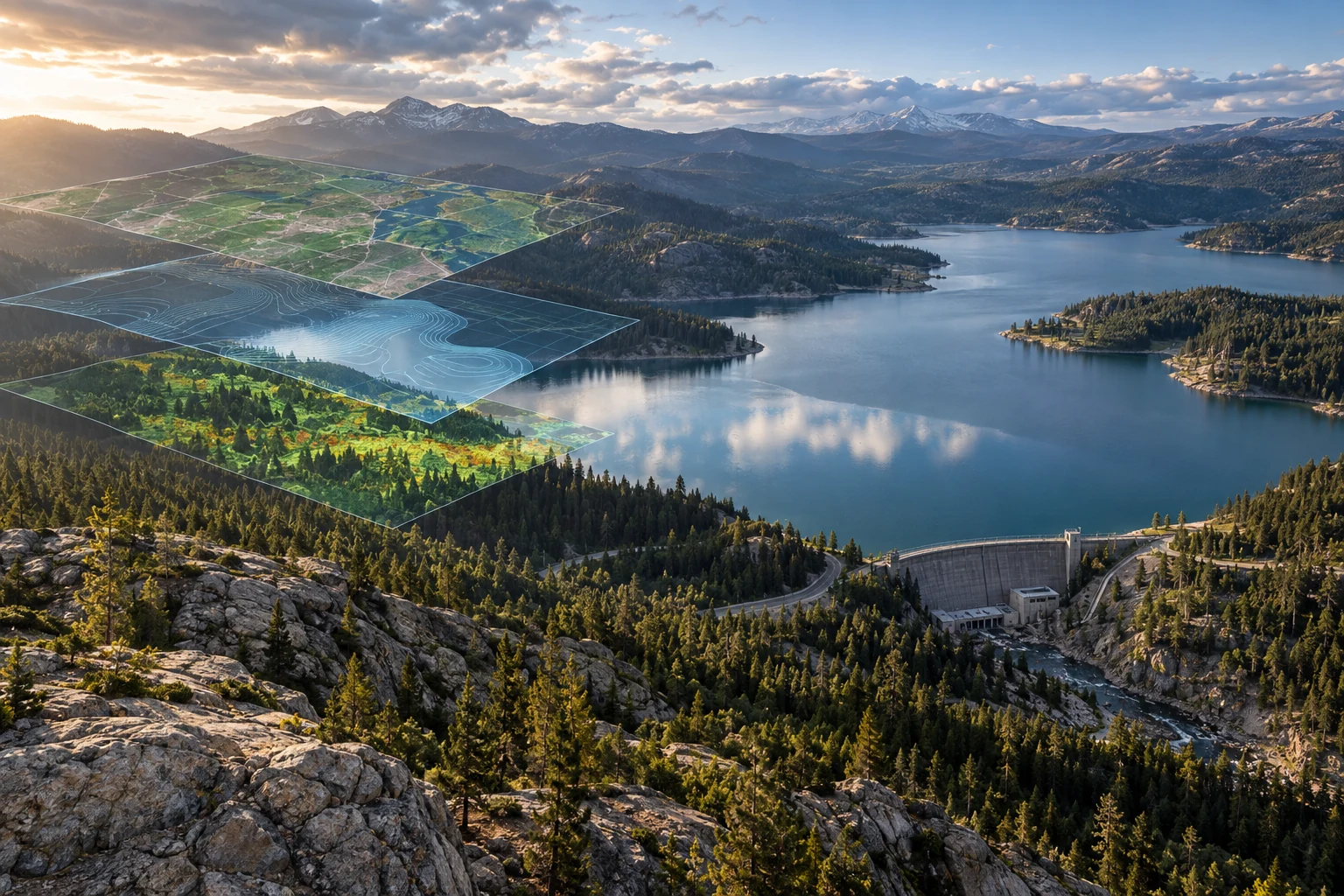
That breadth is the reason Interior is an unusual technology customer. There is no single Interior mission system the way there is a single air traffic system at FAA or a single benefits system at VA. There are hundreds of mission systems, each owned by a bureau, each built around a distinct scientific or regulatory workflow, and each generating data at a scale that outran its original software years ago. Streamgage telemetry, lidar point clouds, satellite archives, land title records, wildlife observations, well permits, dam sensor feeds, and visitor reservations all live under the same departmental roof and share almost nothing architecturally.
For a firm that builds AI, ML, data and cloud systems, that fragmentation is the opportunity. Interior's problems are almost always data problems first: records that were digitized without structure, sensor networks that produce more observations than anyone reviews, imagery archives that are queried by filename instead of content, and regulatory processes where a human reads a hundred-page document to extract eight fields. Our team works this class of problem for a living, and Interior has more of it per dollar of IT budget than almost any department in government.
Where the technology money sits
Interior reports well over a billion dollars a year in IT spending on the Federal IT Dashboard, and the department consolidated bureau IT staff under a departmental Office of the Chief Information Officer roughly a decade ago. The practical result is a two-layer structure. The departmental OCIO owns enterprise infrastructure, cybersecurity, the enterprise cloud posture, identity, and policy. Bureau CIOs and bureau program offices own the mission systems that do the science and the regulation.
Almost all of the interesting AI and data work is funded at the second layer. A USGS mission area, a Reclamation regional office, or a Fish and Wildlife regulatory program decides it needs a model or a pipeline and funds it out of program dollars. Departmental OCIO shows up later as the office that has to accredit whatever was built. Firms that pitch only to the departmental CIO are talking to the office that can say no, and rarely to the office that can say yes.
Where AI and data work concentrates — Interior bureaus
Editorial weighting from public budget documents, published system inventories and award history — illustrative, not a measured statistic.
Interior does not run an SBIR program
This is the single fact that most changes how a technology firm approaches Interior, and most people get it wrong. Eleven federal agencies run SBIR and STTR programs. Interior is not one of them. There is no Interior solicitation cycle, no Interior topic list, no Phase I to Phase II ladder inside the department.
Interior buys technology the ordinary way: contracts, task orders under existing vehicles, cooperative agreements, interagency agreements, and prize competitions. That means the entry motion is different from the one a research-heavy firm is used to. There is no annual window to write into. There is a continuous flow of requirements that appear in SAM.gov, in bureau forecasts, and in the mouths of program managers who have a problem and a small pot of end-of-year money. A firm that can move on a two-week solicitation response has an advantage over a firm organized around six-month proposal cycles.
The bureaus, one at a time
Selling to "Interior" is not a real activity. Selling to a bureau is. Each one has its own budget, its own contracting shop, its own data culture and its own tolerance for new vendors.
| Bureau | What it holds | Where technology work shows up |
|---|---|---|
| USGS | Landsat archive, 3D Elevation Program lidar, National Water Information System, earthquake and hazards networks | Science data pipelines, imagery analytics, model deployment, high-performance computing support |
| Reclamation | Dams, canals, 53 hydroelectric powerplants, western water delivery and SCADA telemetry | Forecasting, asset condition analytics, sensor data integration, prize competitions |
| Fish and Wildlife Service | ECOS, IPaC, National Wetlands Inventory, Endangered Species Act consultation records | Document processing, species and habitat modeling, permitting workflow tooling |
| BLM | Land and mineral title records, ePlanning NEPA library, rangeland monitoring data | Records modernization, geospatial services, environmental document analysis |
| National Park Service | IRMA resource data, cultural resource records, visitor-use and reservation systems | Data portals, condition assessment analytics, accessibility remediation |
| Indian Affairs | Trust asset and accounting records, roughly 180 Bureau of Indian Education schools | Trust system modernization, education data, Buy Indian Act set-aside work |
Two smaller offices matter more than their size suggests. The Office of Surface Mining Reclamation and Enforcement administers abandoned mine land grants, and the Infrastructure Investment and Jobs Act (Public Law 117-58) directed roughly $11.3 billion to that work over fifteen years, which creates a long-lived need for inventory, site prioritization and grant-monitoring data systems. The Interior Business Center, based in Lakewood, Colorado, is a federal shared-service provider whose Acquisition Services Directorate awards contracts on behalf of other agencies, so a relationship there can produce work far outside Interior's own mission.
The data, and why it is the real product
Interior's data holdings are the reason the department is worth a technology firm's attention. Most of them are public, which means a vendor can build and demonstrate against the actual data before ever holding a contract.
- Landsat. The archive at the USGS Earth Resources Observation and Science Center in Sioux Falls holds more than ten million scenes, free and open since 2008, with Landsat Next in development for the early 2030s.
- 3DEP. The 3D Elevation Program has acquired quality-level lidar across the great majority of the country, producing point clouds and derived elevation products at national scale.
- National Water Information System. Continuous records from more than 11,000 streamgages and historical data from roughly 1.9 million monitoring locations.
- ECOS and IPaC. Fish and Wildlife's species status, critical habitat and consultation systems, which sit directly on top of Endangered Species Act Section 7 review under 50 CFR Part 402.
- ePlanning. BLM's public library of NEPA documents, a large unstructured corpus that regulators, applicants and litigants all read by hand.
- Land and mineral records. Decades of case files, plats and title documents migrated across several generations of systems, with structure lost at each hop.
- ScienceBase. The USGS data catalog and repository behind a large share of the bureau's published datasets.
- Hazards networks. Seismic, volcano and landslide monitoring, including the ShakeAlert earthquake early-warning system on the West Coast.
Interior is also the statutory center of gravity for federal geospatial data. The Geospatial Data Act of 2018, enacted as Title VII of Public Law 115-254 and codified at 43 U.S.C. 2801, puts the Secretary of the Interior in the chair of the Federal Geographic Data Committee and makes the department responsible for the National Spatial Data Infrastructure. The National Geospatial Data Asset themes defined under that structure are the closest thing the federal government has to a shared vocabulary for location data. A firm that understands those themes speaks the language of every geospatial contracting officer in the department.
How the work actually flows
Interior buys under the Federal Acquisition Regulation with a departmental supplement, the Department of the Interior Acquisition Regulation at 48 CFR Chapter 14. Anyone reading a solicitation in 2026 should read the deviation text attached to it rather than a printed copy of the FAR, because the procurement overhaul launched by Executive Order 14275 in April 2025 has been implemented largely through class deviations, and the operative language now travels with the solicitation.
The vehicles are mostly borrowed. Interior places heavy volume on the GSA Multiple Award Schedule, especially SIN 54151S for IT professional services and the cloud SIN, and it uses OASIS+ for professional services, NASA SEWP for products, NITAAC's CIO-SP vehicles for health-adjacent and general IT, and 8(a) STARS III for small disadvantaged business work. Bureau-level blanket purchase agreements and single-award task order contracts carry a large share of the recurring engineering support.
Below those vehicles sits the part small firms underuse. The simplified acquisition threshold is $250,000 under FAR 2.101, the micro-purchase threshold is $10,000, and FAR 13.500 allows simplified procedures for commercial products and services up to $7.5 million. A USGS science center or a Reclamation area office can put real engineering work on contract inside those thresholds without a year of source selection. An 8(a) firm can receive a sole-source award up to $4.5 million for services under 13 CFR 124.506. Those are the doors that open first.
Interior also runs two channels that have no analogue at most departments. The Cooperative Ecosystem Studies Units network moves science work through cooperative agreements with a capped 17.5 percent indirect rate, and while the named partners are mostly universities and nonprofits, a firm that teams with a CESU partner reaches work that never appears as a contract. Reclamation runs recurring prize competitions on water and power problems, which is one of the few federal mechanisms where a small team can be paid for a result without holding a vehicle at all.
Security and access: what gates entry
Interior is a civilian department, and the security posture reflects that. Most work is unclassified. What gates entry is a stack of civil requirements that are easy to underestimate.
FISMA and NIST SP 800-53. Every Interior information system carries a FIPS 199 categorization and an authorization package built on the NIST SP 800-53 Rev. 5 control baseline. A model or pipeline that touches a system of record inherits that system's controls, and the authorization boundary question decides how much paperwork the work carries. Our team treats the boundary drawing as an engineering decision made at design time, not a document written at the end.
FedRAMP. Anything delivered as a cloud service to Interior needs a FedRAMP authorization at the right impact level. Building inside an existing authorized environment that the bureau already uses is dramatically faster than bringing a new service through authorization, and for most AI work it is the right answer.
Personnel and credentials. Interior contractors who need network access go through a background investigation and receive a PIV credential under HSPD-12 and FIPS 201. Positions are risk-designated, and moderate-risk public trust is the common case for engineering support. This is not a clearance process, and the timeline is measured in weeks to a few months rather than a year, but it has to start early because no code gets committed to an Interior repository before it finishes.
Privacy, accessibility and records. Visitor reservation data, permit applicant data and employee data all fall under the Privacy Act of 1974 at 5 U.S.C. 552a, with published system of records notices that bound what a model may be trained on. Every public-facing interface must meet Section 508 of the Rehabilitation Act at 29 U.S.C. 794d, which in practice means WCAG 2.0 Level AA. Model outputs that inform a regulatory decision are federal records, which changes how logging and retention are designed.
Trust data. Indian Affairs holds trust asset and individual account records under a fiduciary obligation with a long and consequential legal history. That data is handled with more care than almost anything else in the department, and a vendor who does not understand why will not be given access to it.
Supply chain. Section 889 of the FY2019 National Defense Authorization Act restricts covered telecommunications equipment across all federal contracts, and the American Security Drone Act of 2023 restricts federal procurement and operation of unmanned aircraft from entities on a statutory covered list. Interior operates one of the larger civilian federal drone programs, so any airborne data-collection workflow needs the airframe question answered against the statute before it is proposed.
AI policy at Interior in 2026
Federal AI governance was rewritten in 2025. Executive Order 14179 replaced the prior AI executive order, and OMB memoranda M-25-21 and M-25-22, issued in April 2025, superseded M-24-10 and M-24-18 as the operative guidance on federal AI use and AI acquisition. Interior, like every CFO Act agency, has a Chief AI Officer, publishes an annual AI use-case inventory required by the Advancing American AI Act in Public Law 117-263, and applies added scrutiny to systems classified as high-impact.
What that means commercially is simple. Interior's published inventory is a free list of exactly which AI problems the department has already decided are worth doing, which bureau owns each one, and how mature each one is. It is the best-targeted lead list a vendor can get, and it costs nothing to read. Pair it with the department's data inventories published under the Foundations for Evidence-Based Policymaking Act of 2018, Public Law 115-435, and a firm can reconstruct most of Interior's technology demand from public sources alone.
Where a small engineering firm fits
Interior awards a high share of its prime dollars to small business, consistently above the 23 percent government-wide statutory goal at 15 U.S.C. 644(g). The department's work also breaks naturally into pieces a small team can carry end to end: one bureau, one dataset, one workflow, one deliverable. That combination makes it a better fit for a focused engineering firm than for a large integrator that needs a hundred-person task order to be worth bidding.
Four entry positions work. Subcontracting to an incumbent on a bureau IT or science-support contract is the fastest, because the prime already holds the vehicle and the access, and needs bench depth in ML and cloud that it usually does not have in house. Direct award under simplified acquisition procedures is the cleanest, because a program office with a defined problem can put a right-sized task on contract without a formal source selection. Teaming through a CESU partner reaches the cooperative-agreement channel. And for Indian Affairs work, the Buy Indian Act at 25 U.S.C. 47, implemented at DIAR Part 1480, gives preference to Indian Economic Enterprises, which makes a teaming relationship with a qualifying enterprise the correct structure rather than an afterthought.
We build the systems that sit under all four: retrieval and extraction over regulatory document corpora, ML pipelines over imagery and elevation data, forecasting on sensor and hydrologic time series, and the cloud engineering that puts those things into a bureau's authorized environment and keeps them running. That is the whole scope of our practice, and it maps cleanly onto what Interior already knows it needs.
The concrete first step
Interior entry sequence for a small technology firm
Step four is the one that separates firms that get in from firms that do not. Interior's data is public. A vendor who shows up having already run a model over the bureau's own streamgage records, its own NEPA library or its own lidar tiles is having a different conversation than a vendor holding a capability statement. The demo does not need to be large. It needs to be real, reproducible, and about their data.
Common questions on approach
Should we start at the department or at a bureau?
Bureau, nearly always. Departmental OCIO owns enterprise infrastructure and the security posture. Mission money and mission problems sit with the bureaus and their program offices. Start where the problem is owned, and bring the security conversation in once there is something specific to accredit.
Does Interior work require a security clearance?
Rarely. Most Interior work is unclassified and gated by a risk-designated background investigation and a PIV credential under HSPD-12, not by a national security clearance. Moderate-risk public trust covers most engineering support roles.
Is there an Interior SBIR topic list to write against?
No. Interior is not one of the eleven agencies that run SBIR and STTR programs. Work flows through contracts, task orders on existing vehicles, cooperative agreements, interagency agreements, and prize competitions.
What is the fastest realistic path to a first Interior dollar?
Subcontracting to an incumbent on an existing bureau contract, or a right-sized direct award under simplified acquisition procedures. Both avoid the multi-year cycle of a new full-and-open competition and both can start from a single program office that has a problem.
Frequently asked questions
Through ordinary federal contracting rather than a research program. Interior uses GSA Multiple Award Schedule orders, OASIS+, NASA SEWP, NITAAC vehicles, 8(a) STARS III, bureau-level blanket purchase agreements, simplified acquisition below $250,000, and commercial simplified procedures up to $7.5 million under FAR 13.500. Cooperative agreements and prize competitions carry additional science work.
USGS, by a wide margin, because its mission is data production. Its water, geospatial, land imaging and hazards programs all generate continuous data engineering and modeling demand. Reclamation is second for operational forecasting and asset analytics, and Fish and Wildlife Service is the strongest fit for regulatory document and permitting work.
FISMA authorization on the NIST SP 800-53 Rev. 5 baseline, FedRAMP for any cloud service, a risk-designated background investigation and PIV credential under HSPD-12, Privacy Act handling for personal data with a published system of records notice, and Section 508 accessibility for anything with an interface.
It is a preference at 25 U.S.C. 47, implemented for Interior at DIAR Part 1480, directing Indian Affairs to set acquisitions aside for Indian Economic Enterprises where the requirements are met. For firms pursuing BIA or Bureau of Indian Education work, teaming with a qualifying enterprise is the structurally correct approach.
Yes, for the large public holdings. Landsat, 3DEP elevation data, the National Water Information System, ECOS, ePlanning and ScienceBase are open, and building against them before the first meeting is the most effective differentiator a small firm has. Non-public categories such as trust records and some cultural resource data are not available and should never be assumed.