
What you are actually selling into
A school district is a unit of local government that happens to run schools. It has taxing or levy authority in most states, an elected or appointed board that approves contracts above a threshold set in board policy, a business office that answers to a state auditor, and a technology director who almost never holds the signature. The federal government reports 13,318 regular public school districts and 99,388 public schools for the 2022–23 school year. That is the shape of the market: enormous in aggregate, fragmented at every point of sale, and governed by four separate bodies of rule depending on whose money is paying.
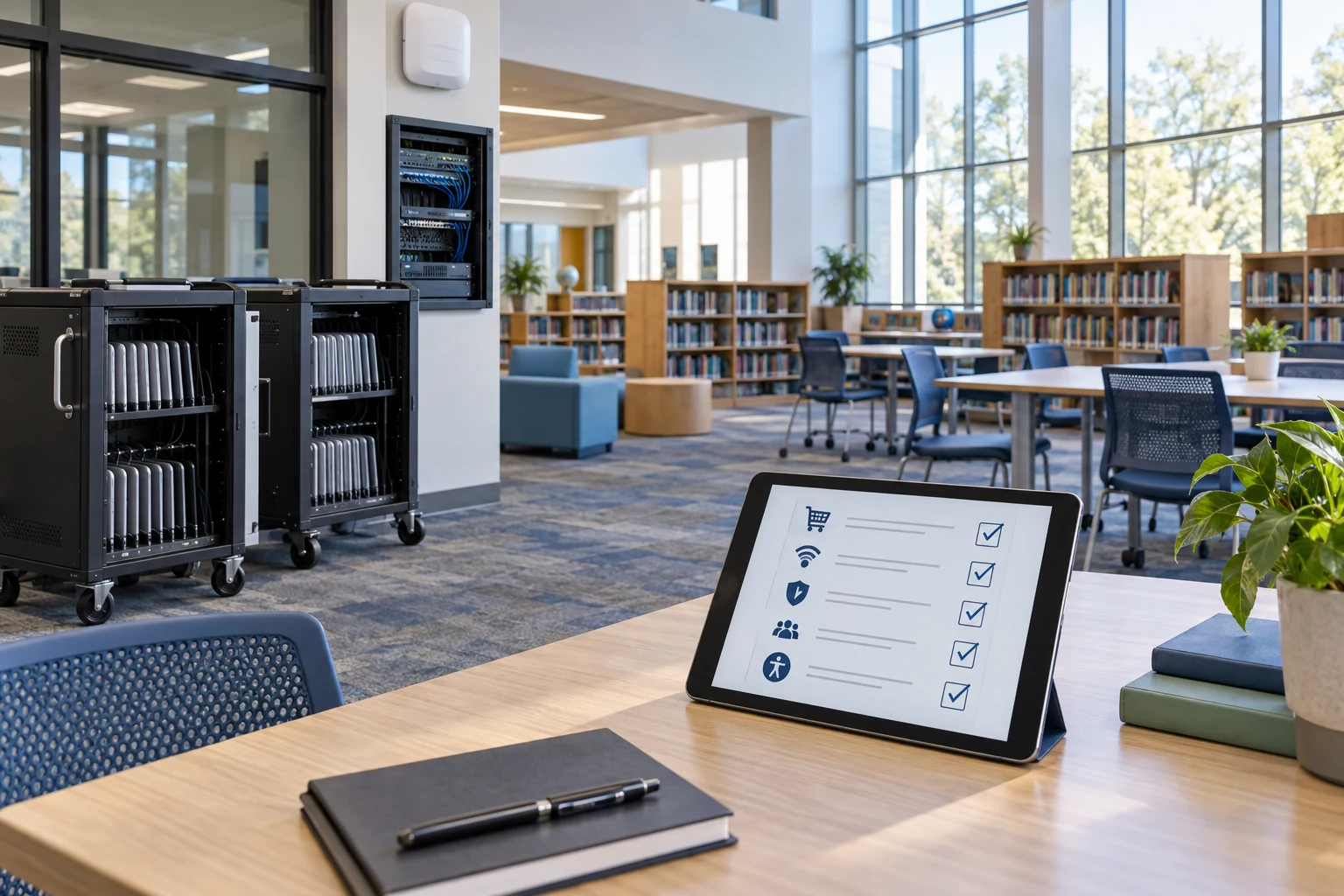
Vendors who struggle in K-12 usually struggle because they treat the district as a single decision. It is not. A district purchase clears four gates in sequence, and each gate is worked by a different person. Someone has to want the thing. Someone has to find money for it that is legal to spend on it. Someone has to establish that the purchase was competed, or is lawfully exempt from competition. And someone has to sign a data agreement that survives a parent complaint. Losing at any one of those gates looks identical from the outside: the deal goes quiet.
All four gates are documented in public. The rules are not secret and not discretionary, and a vendor who knows them can hand the district most of the answers before anyone asks. That is why the compliance file matters more than the pitch deck.
Four money sources, four rulebooks
Local funds. Property tax and levy revenue, controlled by the board. The governing rules are the state procurement code and the district's own board policy, which usually sets a quote threshold and a formal-bid threshold. These thresholds vary enormously by state and are almost always lower than what a vendor expects.
State aid and state grants. Same state procurement code, plus any conditions the state education agency attached to the appropriation. Some states run their own technology contracts districts may buy from directly.
Federal grant funds passed through the state. The moment federal grant dollars touch the purchase, the district becomes a subrecipient under the federal Uniform Guidance at 2 CFR part 200, and the procurement standards in 2 CFR 200.317 through 200.327 apply on top of state law. The stricter of the two governs.
E-Rate. Not a grant. The schools and libraries program is a universal service support mechanism run by the Universal Service Administrative Company for the Federal Communications Commission, and it has its own competitive-bidding regime, its own forms, and its own eligibility list that excludes most of what technology vendors sell.
Under the Uniform Guidance, a district may use informal methods below its simplified acquisition threshold. Micro-purchases can be awarded without competitive quotes if the district documents that the price is reasonable. The Federal Acquisition Regulation currently sets the micro-purchase threshold at $15,000 and the simplified acquisition threshold at $350,000, and a district may self-certify a micro-purchase threshold as high as $50,000 on an annual basis if it documents a justification, such as qualifying as a low-risk auditee or completing an annual internal risk assessment. Above the simplified acquisition threshold, formal methods are required: sealed bids or proposals, with public notice and evaluation factors stated in advance.
So a $12,000 pilot and a $400,000 district-wide deployment are not the same sale with different zeros. They are different legal transactions with different documentation burdens, and the second one takes months longer. Vendors who price a pilot just under a threshold and then expect a sole-source expansion are the ones rebidding against three competitors a year later.
Cooperative purchasing: the mechanism that moves most K-12 technology
A cooperative contract is a contract that one public agency competes on behalf of many. The lead agency runs a real solicitation under its own state's public contract law, awards to one or more suppliers, and then makes the resulting agreement available to other public entities that join the cooperative. The buying district cites the lead agency's competition instead of running its own.
This is not a loophole. Federal grant regulation names it directly. Under 2 CFR 200.318(e), recipients and subrecipients "are encouraged to enter into State and local intergovernmental agreements or inter-entity agreements for procurement transactions," and the rule states that documented procurement actions using strategic sourcing, shared services, and similar arrangements "will meet the competition requirements of this part." That single sentence is why a district can spend federal grant money off a cooperative contract without running its own RFP, and it is the most valuable sentence in K-12 sales that most vendors have never read.
| Cooperative | Who competes the contract | What the buying district does |
|---|---|---|
| Sourcewell | Sourcewell itself, which is a local unit of government under Minnesota state statute. It advertises the RFP, holds a public opening, scores proposals, and awards. | Registers as a member at no cost, searches awarded contracts, then contacts the supplier with the contract number and its own account number to get a quote. |
| NASPO ValuePoint | A lead state, working with a multistate sourcing team, issues the RFP and awards master agreements. Terms typically run about five years. | Buys under a Participating Addendum, a bilateral agreement between the awarded supplier and the participating entity. Without a signed addendum the supplier cannot use the contract as a sales vehicle. |
| E&I Cooperative Services | A member-driven cooperative serving higher education and K-12. Its lead public agency contracts come from an RFP issued by a lead public agency, which keeps ownership of the contract. | Joins as a member and buys off a contract whose lead agency completed the advertising and bid procedures required by its state's public contract law. |
| PEPPM | A technology purchasing cooperative operated by an educational agency, serving schools and public agencies since 1982, using sealed competitive bids. | Purchases from awarded technology contracts at the vendor's best national cooperative price, citing a contract competitively bid by a peer educational agency. |
Getting on one of these takes longer than vendors plan for. Watch the solicitation cycle in your category, respond to a real RFP with pricing you can live with nationally, and if you win, accept an administrative fee on sales made through the contract. NASPO ValuePoint collects a fee from suppliers based on portfolio sales, with the rate stated in the specific master agreement rather than published as one number. Budget for it as a cost of distribution, because that is what it is.
Where a cooperative contract stops working
A cooperative contract does not sell anything. It removes the reason a district would have to say no while it thinks about a solicitation. It does not override four things, and each of them has killed deals that looked closed.
State law on piggybacking. Some states permit a district to use any lawfully competed contract from another jurisdiction. Some require the cooperative to be named on a state-approved list. Some require the original solicitation to have disclosed that other agencies could join. Check the specific state, not a national summary.
Board policy thresholds. A district may still require board approval above a dollar figure even when the competition requirement is satisfied. That is a calendar problem, not a legal one, and it can add six weeks.
Scope. The purchase has to fall inside the awarded contract's scope. Selling a professional services engagement off a hardware contract is where audit findings come from.
The record. The district still has to document why the cooperative price is reasonable. Give the buyer that documentation in the form they need it. A one-page memo naming the lead agency, the solicitation, the award date, the contract number, and the discount off list saves a technology director an afternoon and makes you easy to buy from.
E-Rate: read the eligibility list before you build the pitch
E-Rate is the largest federal funding stream aimed at school connectivity, and the most common source of wasted vendor effort, because most technology products are not eligible for it and never have been. The Commission's rules cap aggregate annual support at $3.9 billion per funding year, of which $1 billion is set aside for Category Two, with the cap adjusted upward each year for inflation using the GDP chain-type price index. If Category One demand exceeds available funding, Category Two money shifts to cover it.
Eligibility divides into exactly two categories, and the boundary is sharp. Category One covers data transmission services and internet access — basic conduit to the internet. The rules state plainly that these services cannot include charges for content, for end-user devices, or for equipment purchases beyond what is necessary to transmit the Category One service. Voice service stopped being eligible in funding year 2019. Category Two covers the network inside the building: internal connections, managed internal broadband services, and basic maintenance of internal connections.
| What you sell | E-Rate treatment | Practical effect |
|---|---|---|
| Broadband circuit, internet access, leased lit or dark fiber, self-provisioned network | Category One | Discount of 20 to 90 percent off the pre-discount price, set by district poverty and urban or rural status. |
| Switches, routers, wireless access points, cabling | Category Two, internal connections | Discount of 20 to 85 percent, and the district must have budget headroom left in its five-year Category Two allocation. |
| Third-party operation, management, and monitoring of that internal network | Category Two, managed internal broadband services | Eligible only to the extent it directly supports broadband connectivity inside the building. |
| Repair and upkeep of eligible internal connections | Category Two, basic maintenance | Support only for actual work performed under contract. Unbundled warranties and fixed-price contracts are not reimbursable unless hours and costs can be demonstrated. |
| Student devices, curriculum, applications, analytics, assessment platforms | Not eligible | Zero E-Rate support. These are bought with local, state, or grant funds, under a different rulebook entirely. |
If your product sits in that last row, E-Rate is still worth understanding, because it consumes the technology director's spring and tells you when they will not return a call. But it is not your funding source, and proposing otherwise marks you as someone who has not done the reading.
The discount math a district is running in its head
E-Rate discounts are set by a published matrix at 47 CFR 54.505. The district divides the number of students eligible for the National School Lunch Program by total enrollment, applies that single district-wide rate to the matrix, and gets one discount percentage that applies to every school in the district. Rural districts get a slightly higher rate in the middle bands. Category Two tops out at 85 percent where Category One reaches 90.
E-Rate Category One discount — urban schools, by poverty band
Published discount rates from the Category One matrix at 47 CFR 54.505(c). Rural rates run higher in the middle bands; Category Two caps at 85 percent.
Category Two carries a second constraint that Category One does not: a five-year budget per applicant. The current cycle runs funding year 2026 through funding year 2030, replacing the 2021–2025 cycle. The school multiplier for the new cycle is $201.57 per student, and the funding floor is $30,175. A district with more than ten schools generally sums full-time enrollment across its schools and multiplies by the per-student figure; if the aggregate floor across its schools is larger, the larger amount governs.
Do this arithmetic before you propose. A 4,000-student district has roughly $806,000 of Category Two budget across five years at the 2026 multiplier, and if it refreshed its wireless network in 2026 it has little left for 2027. That is a real answer to "why did they go dark," knowable from public numbers before the first meeting.
Competitive bidding under E-Rate, from the vendor side
E-Rate has its own competition rule that operates independently of state procurement law, and both apply. The applicant certifies an FCC Form 470 in the E-Rate Productivity Center describing what it needs, and must wait at least 28 days from certification before closing bidding, selecting a provider, signing a contract, or certifying the Form 471. Material changes to the Form 470 restart the 28 days. In the evaluation, the price of the eligible products and services must be weighted more heavily than any other factor. That is not a preference; it is the rule, and it changes how you should position against a higher-priced incumbent.
Service provider path through one E-Rate funding year
Two exemptions are worth knowing because they collapse the timeline. A commercially available business-class internet offer is exempt from the Form 470 if the total annual pre-discount cost stays at or below $3,600 per school or library, the service delivers at least 100 Mbps down and 10 Mbps up, and the offer is publicly available to non-residential customers at the same rates. That last condition matters: a service sold only through a master contract for schools does not qualify. Separately, beginning in funding year 2024, libraries requesting $3,600 or less of Category Two per library in a funding year are exempt from filing a Form 470.
State master contracts interact with E-Rate in a way that is easy to get wrong. If the state files the Form 470, the district cites it on its own Form 471, needs no separate bidding documents, and the signed state master contract satisfies the FCC's signed-contract requirement. If the district files its own Form 470 and treats a state master contract as one bid received, it must then consider all other applicable state master contracts as bids too. Know which path your customer is on; it determines whether you are competing at all.
One standing obligation applies to every E-Rate provider regardless of path: lowest corresponding price. A provider may not charge a school or library more than the lowest price it charges to similarly situated non-residential customers. Price your commercial book with that in mind before you sign the annual certification.
The privacy file the district cannot sign without
Student data is where K-12 deals stall longest, because the district's counsel is looking for specific contract language rather than a general assurance.
FERPA. A vendor touching education records is normally covered by the school official exception at 34 CFR 99.31(a)(1)(i)(B). Four conditions must all hold. The vendor performs an institutional service or function for which the district would otherwise use employees. The vendor is under the direct control of the district with respect to the use and maintenance of education records. The vendor is subject to the limits in 34 CFR 99.33(a), meaning the personally identifiable information is used only for the purposes of the disclosure and is not redisclosed. And the vendor meets the criteria stated in the district's own annual notification of FERPA rights for being a school official with a legitimate educational interest. That last one is district-specific, and a vendor who asks to see it early looks like a professional.
COPPA. The Federal Trade Commission amended the children's privacy rule at 16 CFR part 312 effective in 2025, and two of the amendments change what a K-12 vendor has to build. Under 312.8(b), an operator must establish, implement, and maintain a written information security program, designate one or more employees to coordinate it, perform risk assessments at least annually, design and maintain safeguards against the identified risks, test and monitor those safeguards regularly, and evaluate and modify the program at least annually. Under 312.10, children's personal information may not be retained indefinitely; the operator must maintain a written data retention policy stating the purposes of collection, the business need for retention, and a timeframe for deletion, and must publish that policy in its online notice. Worth stating plainly: the rule text itself contains no school-consent provision. The practice of a school providing consent in place of a parent rests on Commission guidance and enforcement posture, not on codified rule language, which is exactly why districts want the FERPA analysis nailed down independently.
State student-privacy law. Dozens of states layer their own requirements on top. New York, to take one concrete case, requires every educational agency to post a Bill of Rights for Data Privacy and Security along with supplemental information for each contract under which a third-party contractor receives student data or teacher and principal data. Vendors selling nationally end up maintaining a matrix of these obligations rather than a single policy.
The standard agreement that saves everyone time. The Student Data Privacy Consortium, a special interest group of Access 4 Learning, publishes the National Data Privacy Agreement. Version 2.2 was published on November 19, 2025. The consortium reports more than 222,000 standard agreements executed since 2016. Signing the standard form where a district accepts it, rather than negotiating bespoke terms district by district, is the single best decision a K-12 vendor makes on legal cost.
The accessibility deadline that is now reshaping K-12 buying
In 2024 the Department of Justice adopted a technical standard for state and local government web content and mobile apps under Title II of the Americans with Disabilities Act. The rule, at 28 CFR 35.200, requires conformance with WCAG 2.1 Level A and Level AA. The compliance dates were amended in April 2026 and now stand at April 26, 2027 for public entities other than special district governments with a total population of 50,000 or more, and April 26, 2028 for entities under 50,000 and for special district governments.
Two details in the rule decide whether this lands on you. First, the obligation reaches web content and mobile apps that a public entity "provides or makes available, directly or through contractual, licensing, or other arrangements." A district that licenses your platform is making your interface available, and the duty follows. Second, independent school districts are explicitly carved out of the definition of special district government at 28 CFR 35.104, and their total population is measured by the Census Bureau's Small Area Income and Poverty Estimates for the district. So a district serving a population of 50,000 or more is on the 2027 date, not 2028.
The procurement consequence is already visible: districts are asking for conformance evidence rather than a checkbox. A current WCAG 2.1 AA conformance report, produced from a real audit and honest about known defects with remediation dates, is becoming a screening item. Producing one in the first meeting beats promising one later.
Integration is a procurement requirement, not a feature
Districts run a student information system as the system of record, and every application that needs class lists, enrollments, or grades has to synchronize with it. The 1EdTech standards are the common language: OneRoster, currently at version 1.2, defines rostering, gradebook, and resource services for exchanging students, teachers, courses, enrollments, and results, and LTI Advantage defines how a learning platform launches and trusts an external tool. The TrustEd Apps Directory is the official listing of products holding 1EdTech interoperability certification.
This belongs in a procurement article rather than an engineering one because "we can accept a CSV export" is a hidden cost the district will price. Every manual roster sync is staff time in the technology office, every school year, forever. A product that speaks OneRoster removes that line from the district's internal cost estimate, and the technology director knows it even if the RFP never says so.
A pre-sale checklist for a K-12 vendor
- A cooperative contract number the district can name in a board memo, with the lead agency, solicitation, and award date attached
- A signed data privacy agreement on the district's form, or the National Data Privacy Agreement standard version, ready before legal asks
- Written information security program with a named coordinator and a dated annual risk assessment
- Written data retention and deletion policy, published in your online notice, with a stated deletion timeframe
- Contract terms that place you under district control as a school official for FERPA purposes, with no redisclosure
- A WCAG 2.1 AA conformance report from a real audit, listing known defects and remediation dates
- OneRoster or LTI integration with the major student information systems, documented
- A SPIN and a current FCC Form 473 if any part of your offer is E-Rate eligible
Bottom line
K-12 is not a hard market to enter. It is a market with a long list of preconditions, most of them published, none of them negotiable, and all of them satisfiable before the first sales conversation. The vendors who win district business at scale did the unglamorous work first: they got on a cooperative contract, signed the standard privacy agreement, audited their own interface, and learned which of their products E-Rate will and will not touch. Then they sold. The order matters.
Frequently asked questions
Generally yes. 2 CFR 200.318(e) encourages intergovernmental and inter-entity agreements and states that documented procurement actions using strategic sourcing, shared services, and similar arrangements meet the competition requirements of the Uniform Guidance. State law and board policy still apply on top, and the district still documents price reasonableness.
No. Category One covers data transmission and internet access and explicitly excludes charges for content, end-user devices, and equipment beyond what is needed to transmit the service. Category Two covers the internal network: switches, access points, routers, cabling, managed internal broadband services, and basic maintenance. Curriculum, analytics, assessment platforms, and student laptops are funded from local, state, or grant sources instead.
File an FCC Form 498 to obtain a 498 ID, also known as a SPIN, and create an account in the E-Rate Productivity Center. Respond to applicants' certified FCC Form 470 postings. After winning, file the FCC Form 473 annual certification, and invoice through the FCC Form 474 or let the applicant file the Form 472 BEAR. The lowest corresponding price rule applies throughout.
Under 28 CFR 35.200 as amended in April 2026, April 26, 2027 for public entities other than special district governments with a total population of 50,000 or more, and April 26, 2028 for those under 50,000 and for special district governments. Independent school districts are excluded from the special district definition and are measured by the Census Bureau's Small Area Income and Poverty Estimates. The duty extends to content a district makes available through contractual or licensing arrangements, which includes a vendor's platform.