
What a cooperative purchasing organization actually is
A cooperative purchasing organization is a body that runs a public competitive solicitation on behalf of governments that did not run it themselves. It publishes the RFP, seats the evaluation committee, makes the award, and then makes that award available to any qualifying public agency in the country. A school district in Iowa, a water utility in Georgia, and a county sheriff in Arizona can all issue a purchase order against the same contract without any of them writing a solicitation. The organization is paid by the winning vendor, not by the buyer, through an administrative fee taken as a percentage of sales.
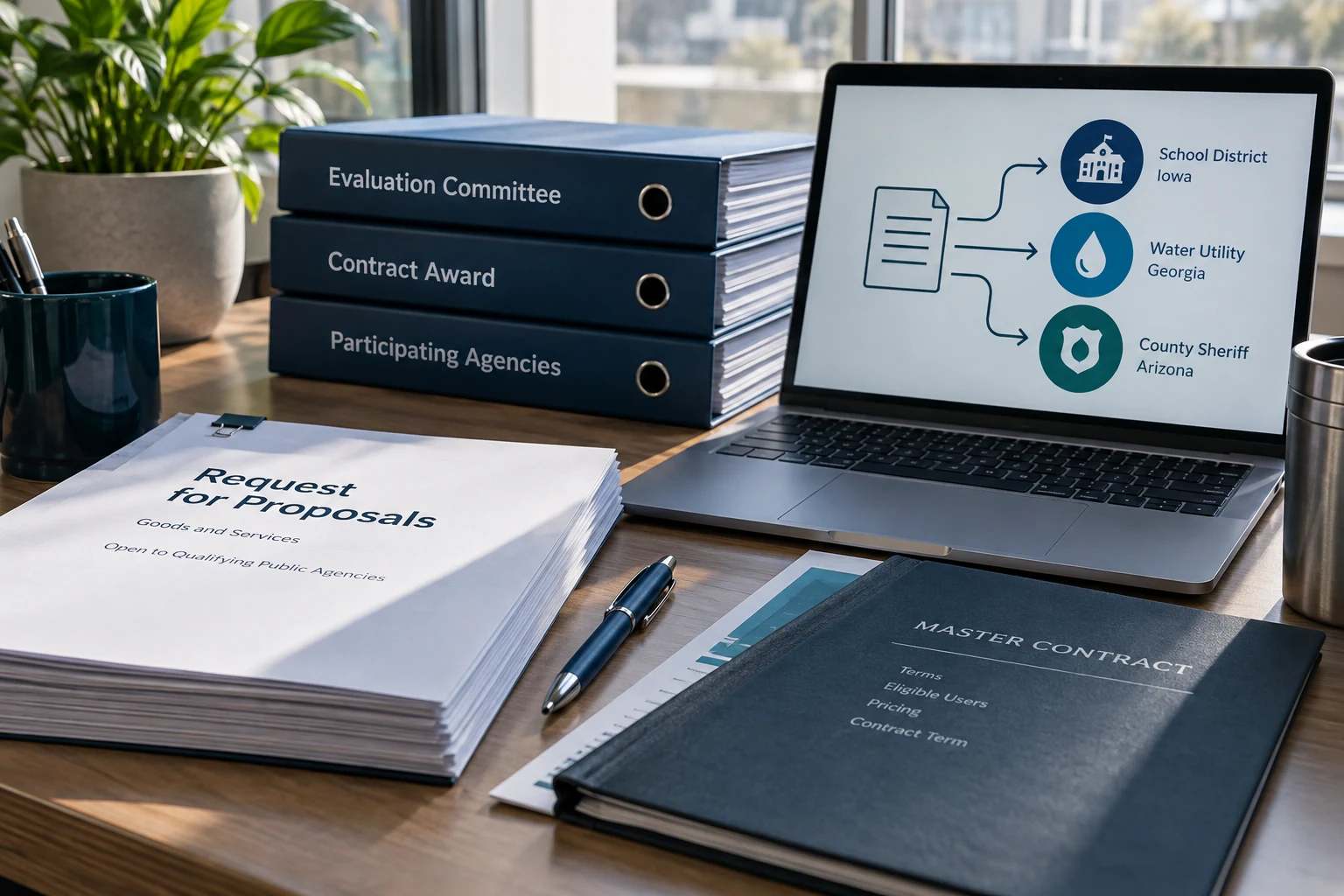
That fee is the whole business model, and understanding it explains most of the behavior you will see. The cooperative wants sales volume on the contracts it holds, because volume is revenue. It will therefore market your award, list you in a searchable catalog, introduce you at conferences, and push its member agencies toward vehicles rather than toward one-off bids. It has no incentive to police whether you are the best fit for any given buyer, and it has every incentive to award a broad enough scope that many buyers can find something to purchase.
The legal question underneath all of this is whether the buying agency's own law lets it substitute someone else's competition for its own. In most states it does, explicitly. Texas Local Government Code Section 271.102(c) states that a local government purchasing under a cooperative purchasing agreement satisfies any state law requiring that local government to seek competitive bids. The authority to enter the agreement in the first place usually comes from an interlocal cooperation statute, in Texas the Interlocal Cooperation Act at Government Code Chapter 791. Every state has some version. The wording differs, the ceiling on what can be bought this way differs, and a handful of states restrict cooperative use for professional services.
Three legal machines, one result
The lead-agency model. A single public agency runs the solicitation under its own procurement code and awards a contract whose terms expressly permit other public agencies to purchase from it. Education service centers in Texas are the most productive lead agencies in the country: Region 4 in Houston, Region 8 in Pittsburg, and Region 14 in Abilene each anchor national programs. The lead agency owns the contract file, holds the protest record, and executes amendments. Everyone else rides.
The lead-state model. NASPO ValuePoint, the cooperative arm of the National Association of State Procurement Officials, works differently. One state volunteers to lead a category, runs a multi-state sourcing team, and awards a Master Agreement. Utah has led the Cloud Solutions category. No other state can buy from that Master Agreement until its own chief procurement official signs a Participating Addendum, a short contract that adopts the master terms and layers on that state's mandatory clauses. The addendum is where the negotiation actually happens, and it is where most vendor timelines break.
The membership cooperative. Sourcewell is a Minnesota service cooperative organized under Minnesota Statutes Section 123A.21, which makes it a unit of local government rather than a private company. It solicits and awards in its own name and lets public agencies, education institutions, and qualifying nonprofits participate at no cost. E&I Cooperative Services is the member-owned version for higher education, in continuous operation since 1934. OMNIA Partners is a private aggregator that markets lead-agency awards nationally rather than holding them itself.
Who decides, at three different desks
Vendors routinely misread this as one decision. It is three, made by three different people who rarely talk to each other.
The award decision belongs to the lead agency or lead state. An evaluation committee scores proposals against published criteria and recommends award, typically to multiple vendors in the same category. Cooperative awards are almost never single-award, because a broader bench sells more.
The participation decision belongs to the buying agency's governing body or procurement officer. A city council adopts a resolution joining the cooperative. A state CPO signs the Participating Addendum. A school board approves an interlocal agreement. This step is invisible from the vendor side and is frequently the reason a "national" contract is unusable in the state where you found a buyer.
The purchase decision belongs to whoever holds the budget: a district technology director, a county CIO, a utility operations manager. That person can usually pick any awarded vendor on the vehicle without comparing quotes, because the competition already happened. Which means the selling problem is not price. It is being the name that person already knows when the money appears.
The organizations by name
The programs below cover the large majority of cooperative volume in the United States. Fee figures are the ranges these programs have commonly published in recent solicitations; always confirm against the specific contract documents, because fees vary by category.
| Organization | Model and legal home | How a vendor gets on | Typical admin fee |
|---|---|---|---|
| Sourcewell | Membership cooperative; Minnesota service cooperative under Minn. Stat. 123A.21 | Win its own competitive RFP, posted on its bid portal | 1% to 2% of sales |
| NASPO ValuePoint | Lead-state Master Agreements sponsored by NASPO | Win the lead state's solicitation, then chase Participating Addenda state by state | 0.25% to NASPO ValuePoint, plus each state's own fee |
| OMNIA Partners | Private aggregator marketing lead-agency awards nationally | Win a sponsoring lead agency's RFP, then sign OMNIA's national agreement | 1% to 3% of sales |
| TIPS | Department of Region 8 Education Service Center, Texas | Win a TIPS category solicitation; frequent award cycles | About 2% of sales |
| NCPA | Lead agency Region 14 Education Service Center, Texas | Win the Region 14 solicitation | About 2% of sales |
| E&I Cooperative Services | Member-owned nonprofit sourcing cooperative for education | Win a member-driven RFP; scope skews to higher education | Varies by contract |
GSA runs its own version
Federal supply schedules reach state and local buyers through three narrow statutory doors, and the boundaries matter. Under 40 U.S.C. Section 502(c), the GSA Cooperative Purchasing Program lets state and local governments buy information technology and security or law-enforcement items from the Multiple Award Schedule. IT professional services and cloud computing offerings under the MAS Information Technology category are generally flagged as Cooperative Purchasing eligible in the schedule solicitation, which is why a firm with a GSA schedule sometimes finds itself selling to a county without any additional vehicle.
The second door is the Disaster Purchasing Program at 40 U.S.C. Section 502(d), which opens the entire schedule to state and local buyers preparing for or recovering from a presidentially declared disaster or major emergency. The third is the 1122 Program at 10 U.S.C. Section 381, which lets state and local agencies buy equipment for counter-drug, homeland security, and emergency response purposes through federal sources. None of these three is a general license to sell anything to anybody. The eligibility flag lives at the item level, and a buyer who uses the wrong door has a protest problem, not you.
The two doors onto a vehicle
There are exactly two ways a technology firm ends up sellable on a cooperative contract, and only one of them requires winning anything.
Bid the solicitation. Cooperatives post their RFPs publicly on their own portals with their own calendars, usually with a 30 to 60 day response window and a scope written broadly ("technology solutions," "software and related services," "professional and consulting services"). Response packages want a price list or rate card, references from public-sector customers, financial statements, insurance certificates, and a written marketing plan describing how you will drive sales volume. That last item is scored, and firms with an engineering background routinely underweight it.
Ride as an authorized dealer or subcontractor. Most awarded suppliers are permitted to name authorized dealers, resellers, or subcontractors who can quote and deliver under the contract. Getting added is a commercial conversation with the contract holder, not a procurement action. It takes weeks instead of quarters, it costs nothing but margin, and it is how a specialist team with a specific deliverable most often reaches its first cooperative purchase order. Read the underlying contract before agreeing, because the contract holder remains the contractor of record and carries the reporting and warranty obligations.
Vendor Enrollment Sequence: Typical Elapsed Time
Getting found is a separate problem from getting awarded
Once you are on, you exist as a row in a searchable catalog next to dozens of other rows. Buyers search that catalog by keyword and by category code, so the words in your listing decide whether you appear at all. Category taxonomies are usually NIGP commodity codes or UNSPSC, and picking the codes a district technology director would actually search is a real exercise, not paperwork. A data engineering practice listed only under "consulting services" will not surface when someone searches for "student information system integration."
The second discovery channel is the cooperative's own field staff. Sourcewell, OMNIA, and TIPS all employ regional representatives whose job is to sit with member agencies and answer the question "who is on contract for this." Those people recommend from memory. A short, plain capability sheet in their hands, refreshed twice a year, does more for cooperative revenue than any catalog optimization. Our team treats that as a named deliverable in any state and local push, alongside the technical work.
What the contract actually says about size and term
Terms cluster tightly across the major programs. A base term of three or four years with one or two option years is standard. Awards are non-exclusive, and the contract will say in plain language that no volume is guaranteed, no minimum is promised, and the cooperative may award additional suppliers in the same category at any time. Pricing is expressed as a ceiling: your published rate card is the maximum, and buyers may negotiate below it. Price increases usually require written approval and are limited to once per contract year, often indexed.
Order sizes vary more than vendors expect. For software and data services bought by school districts, cities, and special districts, individual purchase orders commonly land between roughly ten thousand and a quarter million dollars, which places many of them near or under the federal simplified acquisition threshold of $250,000 defined at FAR 2.101. State-level enterprise buys off a NASPO ValuePoint Master Agreement run far larger, into the millions, but they arrive through a state addendum and a state-level relationship rather than through a catalog search. Reporting is the obligation vendors most often breach: monthly or quarterly sales reports plus fee remittance, due whether or not you had sales that period.
When federal grant dollars pay the invoice
A large share of state and local technology spending is federal money passed down as grants, and that changes the compliance test. Purchases made under a federal award are governed by the Uniform Guidance at 2 CFR Part 200. A state recipient may follow its own procurement policies under 2 CFR 200.317, but every other recipient, including a state's subrecipients, must follow the procurement standards at 2 CFR 200.318 through 200.327.
Two provisions matter for cooperative buys. 2 CFR 200.318(e) affirmatively encourages recipients to enter intergovernmental or inter-entity agreements for common goods and services, which is the Uniform Guidance blessing cooperative purchasing. But 2 CFR 200.319 still requires full and open competition, so the recipient has to document that the underlying cooperative solicitation was genuinely competitive and that its scope covers what is being bought. Riding a vehicle whose scope does not reach your deliverable is the audit finding that surfaces years later.
The same section carries a benefit for out-of-state firms. 2 CFR 200.319 prohibits geographic preference in procurements under federal awards except where a federal statute mandates or encourages it, with a narrow carve-out permitting geographic location as a selection criterion for architectural and engineering services when enough qualified firms compete. When federal grant dollars pay, a local preference ordinance generally cannot be applied against you.
The barriers that actually stop an out-of-state firm
Firms new to this assume the wall is the in-state preference statute. Those statutes are real. Texas Government Code Section 2252.002 bars a governmental entity from awarding a contract to a nonresident bidder unless that bidder underbids the lowest resident bidder by the amount a resident would have to underbid in the nonresident's home state. Alaska Statute 36.30.170 applies a five percent preference to Alaska bidders. Cities and counties layer their own ordinances on top. But preference statutes are arithmetic, they are published, and they are the smallest obstacle on the list.
Where the friction actually sits: out-of-state technology vendor
Editorial weighting from public procurement documents and practitioner reading. Illustrative, not a measured statistic.
The clause problem is heavier. Many states forbid their agencies from indemnifying a vendor, forbid binding arbitration, forbid any choice of law other than their own, and forbid automatic renewal. Several require conformance with accessibility standards, generally Section 508 or WCAG 2.1 Level AA, for anything with a user interface. Data clauses now routinely fix breach notification windows, require in-country or in-state data residency, and demand that student or health data be returned and destroyed on termination. These arrive in the Participating Addendum, after the award, when your pricing is already fixed.
The administrative barrier is smaller but real: foreign qualification with each Secretary of State where you transact business, a registered agent in each, annual report filings, and state tax registration. Insurance floors commonly run one million per occurrence and two million aggregate on general liability, with professional liability and cyber liability often required at one to five million each. Budget the recurring cost per state and only take on states where a buyer exists.
State cloud-security regimes are the newer wall
The barrier that has grown fastest is state-level cloud authorization. Texas Government Code Section 2054.0593 requires state agencies to contract only for cloud computing services that hold TX-RAMP certification, administered by the Department of Information Resources. Arizona operates its own program. GovRAMP, the multi-state program formerly known as StateRAMP, has become the shared alternative that a growing number of states accept, and it maps closely enough to FedRAMP that a firm holding federal authorization has a shortened path.
For a software or data platform vendor this reorders everything. A cooperative award does not waive a state cloud authorization requirement. If the target buyer is a state agency in a state with a program, the certification is the long pole and the vehicle is the easy part. If the target buyer is a school district or a city, the requirement usually does not apply, which is one reason local government is the sensible first market for a firm entering this channel.
The practical first move
Do not start with the cooperative. Start with one buyer who has a problem you can solve and a budget line to solve it with. Ask that buyer's procurement officer a single question: which cooperative contracts does this agency already use for technology purchases. The answer is short, specific, and free, and it eliminates every vehicle that does not matter.
Then check whether an awarded supplier on that vehicle will name you as an authorized subcontractor for this specific delivery. That path converts in weeks. Bid the cooperative's own solicitation on the next cycle, from a position where you can point to work already delivered through the vehicle. Foreign-qualify in that one state and nowhere else until a second buyer appears. This sequence keeps registration spending tied to revenue instead of ahead of it.
Our engineers build production AI, ML, data, and cloud systems for federal, state, and commercial customers, and we structure state and local delivery so the vehicle question is settled before the technical scope is written. That ordering is the difference between a contract you can invoice against and a certificate on a wall.
Go / no-go checklist
Run these eight before spending a dollar on a cooperative pursuit. Any two failures and the answer is no for now.
- A named buyer, named person, named budget line exists today.
- That buyer's agency has already adopted the cooperative, or can adopt it inside your sales cycle.
- The awarded scope on paper covers your deliverable, in the contract's own words.
- An existing awarded supplier will name you as a subcontractor, or the next solicitation opens within two quarters.
- Your rate card survives the administrative fee plus the state fee without breaking margin.
- You can meet the state's mandatory clauses on indemnity, choice of law, data residency, and accessibility.
- State cloud authorization is either not required for this buyer or already in hand.
- Someone owns monthly sales reporting and fee remittance by name, before the first order.
Frequently asked questions
No. You can win the cooperative's own competitive solicitation, or you can be named as an authorized dealer or subcontractor by a supplier that already holds an award. The second path takes weeks rather than quarters, and the contract holder stays the contractor of record with the reporting and warranty obligations.
The vendor pays an administrative fee as a percentage of sales made under the contract, not the buyer. Rates commonly run about 2% at the education service center programs and 1% to 3% at the large national programs. NASPO ValuePoint has run a much lower fee at the master-agreement level, with each participating state free to add its own fee on top.
Usually yes, if its own state law authorizes cooperative purchasing and it has adopted the required agreement or resolution. Texas Local Government Code Section 271.102(c), for example, provides that purchasing through a cooperative agreement satisfies competitive bidding requirements. The authorizing statute, any dollar ceiling, and any professional-services carve-out vary state to state.
Rarely, because the competition already happened at the lead agency. Preference statutes bite at the solicitation stage. And when federal grant dollars pay the invoice, 2 CFR 200.319 prohibits geographic preference except where a federal statute mandates or encourages it, with a narrow carve-out for architectural and engineering services.
Only for specific categories through specific doors. 40 U.S.C. Section 502(c) opens information technology and security items to state and local buyers under the Cooperative Purchasing Program, Section 502(d) opens the full schedule for declared disasters, and 10 U.S.C. Section 381 covers the 1122 Program. Eligibility is flagged at the item level in the schedule solicitation.