
One competition, many buyers
A city needs a records system. Its purchasing ordinance sends anything over $50,000 to formal bid, and a formal bid costs four months the department does not have. Two states away, a school-services cooperative already ran that competition: a public solicitation, a scored evaluation, awards to three vendors, and a clause on the face of the solicitation saying any other public agency may buy under the same terms. The city adopts that competition as its own, issues a purchase order, and is finished in a week. That move is called piggybacking, and it moves a very large share of state, local, and education technology.
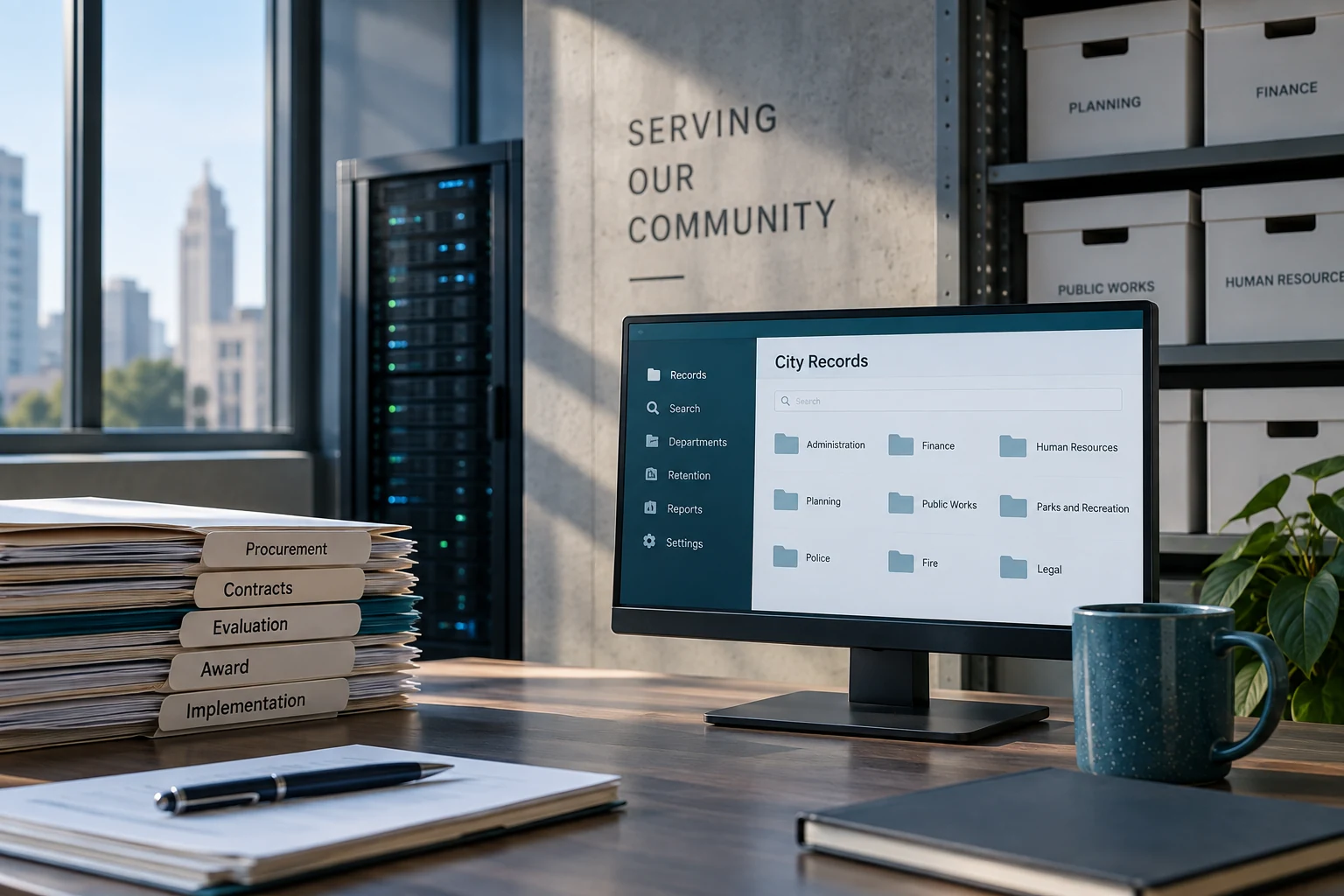
The legal theory is narrow and worth stating plainly. Statutes that require competitive procurement generally require a competition, not necessarily your competition. A rider borrows someone else's. That borrowing holds up when the original process was open and adequately advertised, when the original solicitation put bidders on notice that other agencies could purchase from the award, and when the rider's own charter, statute, or board policy authorizes reliance on an outside contract. Remove any one of those three and the purchase starts to look like a sole-source award wearing a contract number.
For a seller, the arithmetic is the point. The Census Bureau's 2022 Census of Governments counted 90,837 local governments in the United States, on top of the fifty states. Each is a separate buying authority with its own dollar thresholds, board approvals, and protest process. Chasing them one at a time is not a business model for a small firm. One award that several thousand of them can buy from is a different proposition.
Piggybacking is a state and local move
Federal agencies share contracts constantly, but the vocabulary and the rules are different, and confusing the two costs people money. Federal sharing happens through vehicles designed for it: governmentwide acquisition contracts such as NASA's SEWP program, NITAAC's CIO-SP family, and GSA's Alliant 2, VETS 2, and 8(a) STARS III; the GSA Multiple Award Schedule, ordered against under FAR Subpart 8.4; and interagency acquisitions under FAR Subpart 17.5, with the Economy Act (31 U.S.C. 1535) as the fallback authority when no more specific statute applies. FAR 17.502-1 requires the requesting agency to determine that the interagency route is the best procurement approach before using one.
What a federal contracting officer cannot do is the classic state and local move: find another agency's single-award contract, like the price, and attach a new requirement to it. That is an out-of-scope modification, treated under the cardinal change doctrine as a fresh sole-source award and protestable at the Government Accountability Office. When someone in a federal program office says "we will just piggyback off their contract," the accurate translation is almost always "we will place an order under a multiple-award vehicle they already competed."
GSA's three doors to non-federal buyers
Federal Schedule contracts are the one place where the federal and non-federal systems actually touch, and Congress opened that door deliberately, in stages. Section 211 of the E-Government Act of 2002 (Pub. L. 107-347) amended 40 U.S.C. 502 to let state, local, and tribal governments buy information technology from Schedule contracts. Section 833 of the John Warner National Defense Authorization Act for FY2007 (Pub. L. 109-364) extended that to security, alarm, and law enforcement items, and separately created disaster purchasing at 40 U.S.C. 502(d). The 1122 Program, codified at 10 U.S.C. 381, is a third and older door, limited to equipment for counter-drug, homeland security, and emergency response work.
Two facts about Schedule cooperative purchasing get missed by sellers and buyers alike. First, a contractor's participation is voluntary. A Schedule holder elects in, and may decline a state or local order it does not want. Second, the resulting order is not a federal contract action. FAR clauses do not automatically flow down to it, GSA is not a party, and GSA does not adjudicate a dispute between the vendor and the city. The Schedule sets a ceiling price and a set of pre-negotiated terms; a large county can and should negotiate below the ceiling. The 0.75% Industrial Funding Fee still applies and still gets reported.
| Model | Authority or sponsor | Who ran the competition | Typical friction |
|---|---|---|---|
| GSA Cooperative Purchasing | 40 U.S.C. 502(c); E-Gov Act Sec. 211; Warner NDAA Sec. 833 | GSA, at the Schedule level | Limited to IT and security categories; vendor participation is optional |
| GSA Disaster Purchasing | 40 U.S.C. 502(d) | GSA, all Schedules | Use must tie to a declared major disaster or a specified attack |
| 1122 Program | 10 U.S.C. 381 | Federal sources of supply | Equipment only; state coordinator gatekeeps; narrow mission purposes |
| Lead-agency cooperative | Sourcewell, NCPA, TIPS, OMNIA Partners, HGACBuy, BuyBoard | One public lead agency, nationally advertised | Administrative fee; scope written broadly enough to invite audit questions |
| NASPO ValuePoint | State procurement officials, lead-state model | A single lead state | Nothing happens in a second state until it signs a participating addendum |
| State term contract or alternate source | State central procurement office | The state | Local access varies by statute; some states require written approval |
The lead-agency model, and why it scales
The national cooperatives all run the same play. One public entity, the lead agency, writes a solicitation for a category, advertises it, evaluates responses, and awards. The solicitation states on its face that any participating public agency may purchase under the resulting contract. The cooperative then markets the award, collects an administrative fee from the winning vendor, and audits reported sales. Sourcewell is a Minnesota service cooperative organized under Minn. Stat. 123A.21 that operates nationally. NCPA and TIPS are hosted by Texas education service centers, Region 14 and Region 8 respectively. OMNIA Partners assembled its public-sector business from National IPA and U.S. Communities. HGACBuy sits inside the Houston-Galveston Area Council. BuyBoard belongs to the Texas Association of School Boards. E&I Cooperative Services is member-owned and serves higher education.
NASPO ValuePoint works differently and matters more for statewide technology. A lead state runs the solicitation and awards a master agreement. Nothing then happens in a second state until that state executes a participating addendum, which can add state-specific terms, insurance requirements, reporting, and its own fee. Local governments inside that state buy off the addendum only if state law lets them. A NASPO ValuePoint award is therefore an option on fifty markets, exercised one addendum at a time, and the exercise is the vendor's job.
Administrative fees commonly run from a quarter of a percent to about three percent of reported sales, and a participating state can layer a fee of its own on top. Bid the fee into the price from the start. A vendor that discovers the fee after award either eats it or renegotiates, and renegotiating a published cooperative price is a slow and public exercise.
What makes a contract eligible to ride
The cooperative clause was in the solicitation, not added afterward. This is the test that fails most often. If bidders were never told other jurisdictions could buy from the award, they priced for one buyer, and a later amendment adding nationwide use changes the deal the losers competed for. Auditors look for the language in the original solicitation, not the executed contract.
The original competition was real. Advertised publicly, open for a reasonable period, evaluated against published criteria, awarded to a responsible bidder. A rider inherits the strength of that record and every weakness in it.
The rider's own law permits reliance. This is jurisdiction by jurisdiction. California Public Contract Code 20118 lets a school district buy through another public agency's contract without re-advertising, by action of its governing board. Texas builds it into Local Government Code Chapter 271, Subchapter F, with the Interlocal Cooperation Act at Government Code Chapter 791 supplying the agreement mechanics. Florida requires the Department of Management Services to approve an alternate contract source before a state agency rides another government's award, under section 287.042(16) of the Florida Statutes. Virginia's Public Procurement Act allows cooperative procurement at section 2.2-4304 but restricts its use for construction. Read the actual provision; vendor-website summaries are frequently a decade stale.
The purchase sits inside the awarded scope. A contract for network hardware is not a contract for a hosted software platform, however friendly the vendor and however convenient the contract number.
The vendor consents and the term is live. Cooperative language permits, it does not compel, and a vendor can decline a jurisdiction it cannot serve. The order also has to land inside the base or exercised option period. A master contract that lapsed last quarter cannot carry this quarter's purchase order.
Federal money changes the analysis
This is the part that turns a convenient purchase into a repayment demand. When federal grant or disaster dollars pay for a piggyback purchase, the Uniform Guidance at 2 CFR part 200 applies on top of everything above. Section 200.318(e) actively encourages intergovernmental and inter-entity agreements to get economies of scale, so cooperative buying is not disfavored. The conditions attached to it are the problem.
States use their own procurement policies under 2 CFR 200.317 but still have to satisfy the domestic-preference, small-business, and required-clause provisions. Every other recipient follows 2 CFR 200.318 through 200.327 in full, including a cost or price analysis for any procurement above the simplified acquisition threshold, which 2 CFR 200.1 puts at $250,000. Appendix II to part 200 lists the clauses that must appear in the contract itself: suspension and debarment under 2 CFR part 180, Byrd anti-lobbying certification, equal employment opportunity, Davis-Bacon and Contract Work Hours where applicable, rights to inventions, Clean Air Act and Clean Water Act provisions, recovered-materials requirements, the domestic preference at 200.322, and the covered-telecommunications prohibition at 200.216 implementing Section 889 of the FY2019 NDAA (Pub. L. 115-232).
Cooperative contracts usually do not carry Appendix II clauses
Master agreements written for general state and local use rarely include the Uniform Guidance clause set, because most purchases under them involve no federal money. Ride one with grant or disaster funds and those clauses are simply missing from your file. FEMA's Procurement Disaster Assistance Team has published repeated guidance on this pattern, and the remedy arrives as a disallowed cost long after the money is spent. If federal funds are in the purchase, read the master contract for the clauses before the purchase order goes out, and add them to your own order document if they are not there.
The buyer's diligence, in order
A defensible piggyback file takes about a day of work. An indefensible one takes ten minutes, which is why so many of them exist. The order below is the order an auditor will walk in reverse.
- Pull the original solicitation, not just the contract, and find the cooperative-use language in it.
- Confirm your own authority in writing: the statute, the ordinance, the board resolution, or the interlocal agreement that lets you rely on another entity's award.
- Map your line items against the awarded scope and the awarded price list, item by item.
- Verify the contract term, including whether the current option year was actually exercised.
- Document why the cooperative price is reasonable for your quantity, since volume tiers and freight terms often assume a larger buy.
- Get the vendor's written agreement to serve you under the contract, naming your entity.
- Identify the funding source. If any of it is federal, run the Uniform Guidance analysis before you commit.
- Keep the administrative fee visible in the file so the price you approved is the price you can explain.
How well purchase types travel across jurisdictions
Editorial weighting from public solicitations and cooperative program rules. Illustrative, not a measured statistic.
The pattern in that ranking is scope stability. A laptop is the same laptop in Dubuque and in Tucson, so a catalog price transfers cleanly. An hourly rate for a data engineer transfers reasonably well because the unit is defined even when the work is not. A fixed-price custom build barely transfers at all, because the thing being bought differs for every buyer. Cooperatives handle that by awarding hourly-rate schedules, or by awarding a solution category and letting each participating agency issue its own statement of work under it. Design the pricing sheet around that before bidding.
What a seller is actually signing up for
A cooperative contract is a distribution agreement in the shape of a public solicitation. The lead agency's evaluation usually weights national service capability, financial stability, references, discount structure, and a marketing plan, and it will ask how the firm reaches agencies in states where it has no presence. Answering that honestly matters more than a polished response. A single-state software firm claiming national coverage is easy to check and easy to score down.
Getting onto a cooperative vehicle, realistically
Two obligations catch new holders. Reporting is one: most cooperatives require quarterly or monthly sales reports whether or not there were sales, and missed reports are a common cause of contract termination. Price discipline is the other: a published cooperative price is public, and quoting one agency below the posted rate invites every other agency to demand the same. Build the discount structure once, publish it, and hold it.
Where these purchases fall apart
Scope drift leads the list. A contract awarded for network equipment becomes the vehicle for a hosted case-management system because the vendor sells both and the number is convenient. Stale pricing is second: multi-year cooperative pricing for compute, storage, and software subscriptions can drift well above market by year three, and the buyer who never checks has paid a premium for skipping a bid.
Third is habitual use. A purchasing office that rides cooperative contracts for every services buy has effectively stopped competing services, and services are where scope varies most between buyers. State auditors and inspectors general look for that pattern specifically. Fourth is term blindness, where a master contract expired and both sides kept quoting the number.
Venue is worth knowing before anything is challenged. GAO's bid-protest jurisdiction under 31 U.S.C. 3551 and following runs to federal agency procurements. A vendor upset about a city's piggyback purchase does not go to GAO. It goes to that jurisdiction's own protest process or its courts, which vary enormously in speed and in appetite for second-guessing a purchasing officer. The practical consequence: a well-documented file is the defense, because the review will be about process far more than about which product was better.
How a small technology firm should sequence this
Start with the buyer already talking to you and ask their purchasing office which vehicle they use. That one question routes the effort better than any market study, because the answer is usually a single named cooperative, a state term contract, or a GSA Schedule.
The GSA Multiple Award Schedule is the broadest single move for a software or data firm, since IT special item numbers such as 54151S for professional services, 518210C for cloud, and 54151HACS for cybersecurity services are eligible for cooperative purchasing once the contractor elects to participate. One contract, federal ordering plus non-federal access. It carries a real obligation as well: the contract sales criteria clause, I-FSS-639, requires $25,000 in reported sales within the first 24 months and $25,000 in each 12-month period after, and GSA does cancel contracts that miss it.
A state term contract in the one state where a firm already has a customer is often faster and more productive than a national cooperative award, because the sales motion is local and the reference is real. A firm with no vehicle at all can still deliver today as a subcontractor to a holder, which is how most small technology companies earn their first cooperative revenue and their first reference. The vehicle is a permission slip. The work still has to be won.
Frequently asked questions
A purchase made by one public agency under a contract that a different public agency competitively awarded. The rider relies on the original competition to satisfy its own competitive-procurement requirement. It works when the original solicitation authorized other agencies to buy, the original competition was open and adequate, and the rider's own law permits reliance on an outside award.
Yes, within limits. The Cooperative Purchasing authority at 40 U.S.C. 502(c) covers information technology plus security and law enforcement categories, and Disaster Purchasing at 40 U.S.C. 502(d) opens all Schedules for declared-disaster and specified-attack purposes. Contractor participation is voluntary, and the resulting order is a contract between the vendor and the non-federal buyer, with GSA not a party to it.
Often yes, since 2 CFR 200.318(e) encourages inter-entity agreements. The catch is that the underlying contract must satisfy the Uniform Guidance, including the required clauses in Appendix II to 2 CFR part 200 and a cost or price analysis above the $250,000 simplified acquisition threshold. Most cooperative master agreements do not carry those clauses, so the rider has to add them to its own order.
The awarded vendor pays an administrative fee on reported sales, commonly between a quarter of a percent and about three percent depending on the program and category. Participating states can add a fee of their own through a participating addendum. The buying agency pays no membership charge in most programs.
Not in the state and local sense. Federal agencies share pre-competed vehicles such as governmentwide acquisition contracts and the GSA Schedules, and they use interagency acquisitions under FAR Subpart 17.5. Attaching a new requirement to another agency's single-award contract would be an out-of-scope modification and is protestable at GAO.