What the Navy's AI posture looks like in 2026
The practical question in 2026 is no longer whether the Department of the Navy is buying AI. It is which office, through which pathway, and on what timeline. The department now has a Chief Data and AI Officer who owns a joint Navy and Marine Corps data and AI strategy, the enterprise cloud and data environments that make fielded AI possible are in production, and the program that networks the fleet together has moved from concept to ships at sea. The posture has shifted from writing strategy to standing up the plumbing that lets strategy ship.
The through-line across the public documents is speed of fielding rather than novelty of model. Stuart Wagner, the department's Chief Data and AI Officer, frames the goal as moving from "bits to effect" and has described a strategy built around rapidly transitioning AI systems from pilot to operational use, equipping the workforce with data and AI skills, and deepening collaboration with industry, academia, and allies. For a small software firm, that emphasis is favorable: the reward goes to teams that can put working, accredited software into an operator's hands, not to teams with the most impressive demo.
Engagement-Fit Signals — What Navy AI Buyers Reward (public reading)
A generic reading of what Navy AI buyers consistently reward, not a claim about any single solicitation.
Public-record figures from Navy and Defense Department releases.
Where AI authority sits inside the Department of the Navy
Two civilian offices set direction. The Department of the Navy Chief Information Officer owns policy, including the department's guidance on generative AI and its zero-trust direction. The Chief Data and AI Officer owns the data and AI strategy and the effort to move capability from pilot to production. These offices do not buy software directly; they set the rules and the priorities the acquisition organizations execute against.
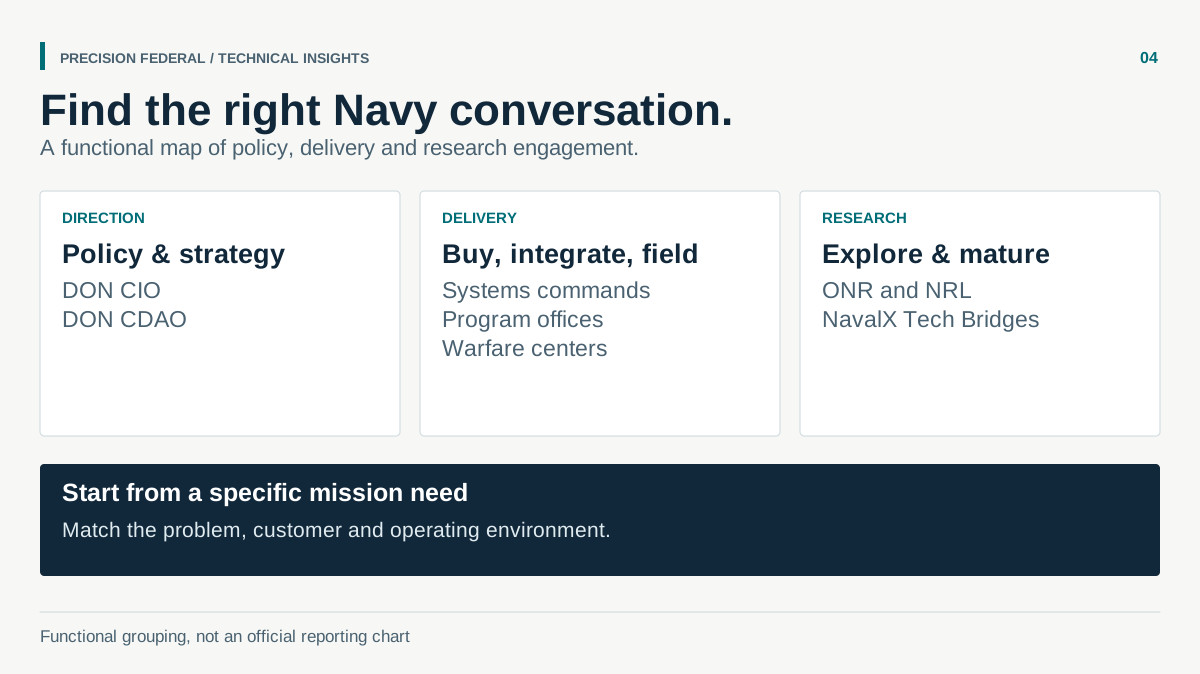
Below them, the buying and fielding happens in the systems commands and the program executive offices. A firm that understands this split saves itself months. Direction and policy questions belong to the CIO and CDAO orbit; a working capability, a contract, and a fielding decision belong to a systems command, a program office, or a warfare center. The map below names the public offices most relevant to an AI software firm.
The public offices that matter most
- DON CIO — Department AI policy, generative-AI guidance, and zero-trust direction.
- DON CDAO — The data and AI strategy and the pilot-to-operational push.
- PEO Digital — Flank Speed and the enterprise IT and zero-trust backbone.
- NAVWAR — Command, control, and networks, and the home of Project Overmatch.
- NIWC Atlantic and Pacific — The engineering workforce that builds and sustains.
- ONR and NRL — Basic and applied research, the science on-ramp.
- NavalX Tech Bridges — Regional front doors built for small firms.
PEO Digital and the enterprise IT backbone
The Program Executive Office for Digital and Enterprise Services, known as PEO Digital, was established in May 2020 and runs an integrated Navy and Marine Corps portfolio spanning cybersecurity, the digital workplace, and IT infrastructure. Its most visible product is Flank Speed, the Navy's enterprise Microsoft 365 cloud, which serves on the order of 700,000 users across shore, ship, and the tactical edge. PEO Digital reported that Flank Speed met all 91 target zero-trust activities well ahead of the Defense Department's 2027 deadline.
For a vendor, PEO Digital matters because it sets the accreditation floor. Fielded Navy AI does not run in a vacuum; it runs on accredited infrastructure with zero-trust and controlled-unclassified-information requirements already baked in. A firm that designs for that floor from the start looks credible to a program office. A firm that treats accreditation as a later problem tends to discover the rework is not small.
NAVWAR and Project Overmatch
Naval Information Warfare Systems Command, NAVWAR, is the Navy's command for information warfare, command and control, and networks. Its two large engineering centers, NIWC Atlantic in Charleston and NIWC Pacific in San Diego, are where much of the department's C4ISR software is developed, integrated, tested, and sustained. For software work tied to networks and decision systems, NAVWAR and its warfare centers are the technical center of gravity.
NAVWAR is also the home of Project Overmatch, the Navy and Marine Corps contribution to Combined Joint All-Domain Command and Control. Created in 2020 under the Chief of Naval Operations, Overmatch builds the networks, data architecture, tools, and analytics that connect platforms, sensors, and weapons into one operational picture. At the public level, the Navy has reported more than 80 ships deploying with Overmatch-provided capabilities, a formal project arrangement with the Five Eyes partners, and integration exercised at RIMPAC 2026. The program has drawn sustained funding across the future years defense program.
The systems commands as different AI buyers
The four materiel commands buy AI through the lens of their missions, and the differences are real. NAVAIR, the air systems command, is oriented toward aviation autonomy and aircraft sustainment. NAVSEA, the sea systems command, is oriented toward ships, platforms, and maintenance. NAVWAR is oriented toward command, control, communications, and networks. Marine Corps Systems Command procures the materiel behind the Marine Corps AI plan. A firm that treats these as one customer usually underperforms a firm that picks a command, learns its language, and commits to it. Our companion piece on the two largest commands goes deeper on how they differ as buyers.
ONR and NRL: the research on-ramps
Not every entry point is a program office. The Office of Naval Research coordinates the Navy's science and technology, funds basic and applied research, and runs its own small-business research programs alongside broad agency announcements, including a standing effort in the science of AI for naval applications. ONR is the door for work that is a step earlier than a program of record: higher risk, longer horizon, and often the seed of a future fielded capability.
The Naval Research Laboratory sits under ONR as the department's corporate research lab. NRL established its Navy Center for Applied Research in Artificial Intelligence in 1981 and has worked in autonomy, cognitive science, machine learning, and human-centered computing for decades. For a science-forward firm, an ONR announcement or an NRL collaboration can be a more natural first fit than a tightly scoped acquisition program, and the two paths often converge over several years.
NavalX and the Tech Bridges network: the small-firm front door
The Navy built an explicit front door for small and nontraditional firms. NavalX operates a network of 18 Tech Bridges, regional innovation hubs aligned to naval commands and warfare centers that connect industry, academia, and government in commercial space off base. Their stated purpose is to lower the barrier for firms, traditional and nontraditional alike, to work with the Department of the Navy and to scout technology into naval commands.
For a firm with no prior Navy relationship, a Tech Bridge is often the lowest-friction way to make first contact, learn a command's priorities in plain language, and meet the people who own the problems. That relationship work, done before any solicitation opens, is the single most consistent differentiator practitioners report between firms that win Navy work and firms that submit cold.
Enterprise infrastructure: Flank Speed, Jupiter, and GenAI.mil
Three named environments shape where Navy AI runs and where its data lives. Flank Speed, run by PEO Digital, is the enterprise cloud and collaboration layer. Jupiter is the Department of the Navy's enterprise data environment, launched in 2020, which draws on the Defense Department's Advana analytics platform and offers a web-based toolkit for large-scale queries, data science, and building AI and machine-learning models on naval data. GenAI.mil is the Defense Department's generative-AI platform, which the department has moved to adopt for controlled-unclassified and IL5 data.
A vendor does not have to master each of these, but should know which one the target customer uses. Software written against the environment where the data already lives has a shorter path to a fielding decision than software that assumes a bespoke stack the program office would then have to accredit and sustain on its own.
The Marine Corps AI implementation plan
The Marine Corps side of the department published its inaugural Artificial Intelligence Implementation Plan for fiscal years 2025 through 2030, with the stated aim of becoming an AI-enabled force by 2030. The plan sets five goals: aligning AI with mission, building an AI-competent workforce, deploying AI at scale, establishing governance, and building partnerships with academia and industry.
One instruction inside the plan is directly relevant to industry. It directs the commander of Marine Corps Systems Command to establish cooperative agreements and contracting vehicles for AI development and adoption, and to run regular industry-focused events for information sharing and capability demonstrations. That is an explicit, published invitation to engage, and firms that read the plan will meet a customer that has been told, on the record, to work with them.
What the Navy repeatedly asks small vendors to bring
Read across the strategies, the plans, and the program pages and the same asks recur. The Navy wants software it can field, not a study; it wants that software to integrate with something it already owns; and it wants the security accreditation posture handled as a first-class part of the design rather than a bolt-on.
Fieldable software. A working capability an operator can use, sustained on accredited infrastructure, beats a research artifact that stops at the demo.
Integration with a program of record. The transition path is a named program, office, or warfare center that can carry the work past the initial award. Software that plugs into an existing system of record has a real Phase III story.
Accreditation readiness. Zero trust, controlled-unclassified-information handling, and a credible authority-to-operate plan are expected. Designing for them up front is the published guidance and the practical reality.
A measurable operational improvement. A defined metric moved on a defined mission, in the customer's own language, outperforms a general capability pitch every time.
Engagement pathways compared
Five public pathways carry most small-firm access to Navy AI work. They are not mutually exclusive, and a patient firm uses several in sequence.
| Pathway | What it is (public) | Best fit for a small software firm |
|---|---|---|
| SBIR / STTR | Navy, ONR, and systems-command solicitations on the DoD SBIR/STTR portal. | The lowest barrier, and the entry most new firms start with. |
| NavalX Tech Bridges | 18 regional hubs linking warfare centers, industry, and academia. | First contact and relationship-building before any solicitation opens. |
| ONR broad agency announcements | Basic and applied research funding, including the science of AI. | Science-forward work with a longer horizon than a program of record. |
| Consortia and OTAs | Vehicles such as the Naval Aviation Systems Consortium and S2MARTS. | Faster awards once the firm is a member and teamed. |
| SeaPort-NxG | NAVSEA's professional-services multiple-award vehicle. | Subcontract entry to funded services work; most primes are small businesses. |
Sequencing a 12 to 24 month approach
A realistic on-ramp does not try to do everything at once. In the first half-year, a firm gets its SAM.gov registration and capability statement clean, picks one command to learn, and makes contact through a Tech Bridge or a component industry day while watching the SBIR and STTR cycles for a fitting subject area. The goal of this window is relationships and a defensible first proposal, not volume.
Across the following year, the firm delivers a Phase I or a research award, builds the operational relationship that names a transition customer, and gets its software onto the infrastructure the customer already uses. By the 18-to-24-month mark, the aim is a Phase II with a named path forward and a credible route into services work, whether through a consortium award or a subcontract on a vehicle like SeaPort-NxG. The Navy rewards patience and technical depth more than most of the department, and its transition pull is among the strongest once a firm earns it.
Common questions on the public-record framing
Why write a public map of Navy AI at all?
The organizational structure, the named strategies, and the enterprise environments are all published on navy.mil, defense.gov, and official program pages. Assembling them into one readable map is public commentary, not a preview of any approach.
Where is the line this article does not cross?
It stays at the level of offices, programs, and pathways. It does not discuss any specific technical problem class, mission-system method, or the way any particular capability would be built.
Does naming Project Overmatch reveal anything sensitive?
No. Every fact here about Overmatch, including the ship count and the Five Eyes arrangement, comes from Navy public affairs releases and open reporting. The program's internal details are not discussed.
What does this article deliberately leave out?
Any specific named customer in active engagement, any solicitation identifier, and any Precision Federal positioning. Those belong in a proposal, not on a public page.
Department of the Navy — Artificial Intelligence
Direction sits with the DON CIO and the Chief Data and AI Officer; buying and fielding sit with NAVAIR, NAVSEA, NAVWAR, and Marine Corps Systems Command; research on-ramps run through ONR and NRL. Flank Speed, Jupiter, and GenAI.mil form the enterprise backbone, and NavalX Tech Bridges are the published front door for small firms.
Frequently asked questions
Two civilian offices set direction: the Department of the Navy Chief Information Officer, which owns policy including generative-AI guidance and zero trust, and the Chief Data and AI Officer, who owns the data and AI strategy and the push to move capability from pilot to operational use. The systems commands and program offices do the buying and fielding.
Project Overmatch is the Navy and Marine Corps contribution to Combined Joint All-Domain Command and Control, run out of NAVWAR. It builds the networks, data architecture, and tools that connect the fleet into one operational picture. The Navy has publicly reported more than 80 ships deploying with Overmatch capabilities and a formal arrangement with the Five Eyes partners.
The NavalX Tech Bridges are the published front door. The network of 18 regional hubs connects small firms to warfare centers and command priorities before any solicitation opens. From there, SBIR and STTR solicitations on the DoD portal are the most common first funded work, and ONR announcements suit earlier-stage research.
Flank Speed is the enterprise cloud run by PEO Digital; Jupiter is the department's enterprise data environment, drawing on the Defense Department's Advana platform; and GenAI.mil is the department's adopted generative-AI platform for controlled-unclassified and IL5 data. Knowing which environment a target customer uses shortens the path from prototype to a fielding decision.