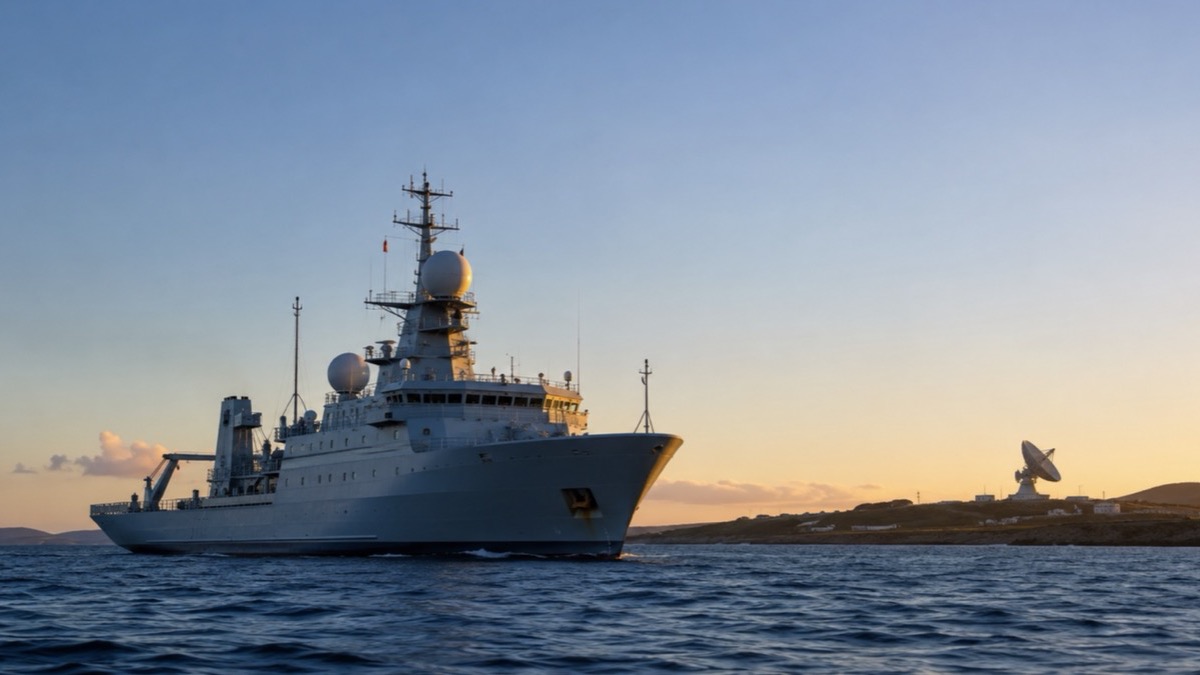
DMO Software Pathways — Engineering Surface for Software-First Firms
Editorial weighting from public sources and practitioner reading — illustrative, not a measured statistic.
Higher score = more transferable engineering surface for software-first DMO contributions.
The DMO concept in public
Distributed Maritime Operations is the publicly named Navy operating concept emphasizing geographically dispersed forces, networked decision-making, and resilience under contested communications. Several public Navy strategy documents describe DMO at varying depths. For software-first firms, the relevant translation is: how do you build software that works when the communications environment is low-bandwidth, intermittent, or actively contested, and when the operational mission spans many platforms with different sensors and decision authorities.

Multi-agent coordination, low-bandwidth tactics, and resilient autonomy under contested communications. Methods designed for cloud-class connectivity do not transition; methods designed for the bandwidth budget first do.
Multi-agent coordination at scale
The open multi-agent systems literature is decades deep and growing. Recent work on graph-neural-network coordination (the GNN-MARL family of methods at NeurIPS and ICML), distributed constraint optimization (DCOP work from the AAMAS community), and large-scale RL for swarm and team tasks all maps to DMO-shaped problems. The published methods that survive realistic communication assumptions — intermittent peer-to-peer with bounded delay — are the ones operationally relevant. Methods that assume a centralized controller or a fully-connected high-bandwidth network do not translate.
Specific peer-reviewed substrates worth naming: decentralized partially-observable Markov decision processes (Dec-POMDPs) and their tractable approximations; centralized-training-decentralized-execution paradigms (MADDPG, QMIX, MAPPO and successors) where the training-time assumptions are honest about the deployment-time communication budget; and emergent-communication research that learns compact protocols rather than assuming them. DARPA's OFFSET, CODE, and Mosaic Warfare programs produced public artifacts that practitioners can cite, and the AFRL and ONR-funded academic work on resilient swarm control covers similar ground.
The methodological cut that distinguishes operationally relevant work from research-grade work is the communication model. A method evaluated on a fully connected graph at every timestep produces results that do not predict performance on a contested-comms platform. Reviewers know this, and offerors who present results under realistic comms assumptions — intermittent peer-to-peer, bounded delay, message loss — score better than offerors who report idealized results.
Low-bandwidth tactics
Communication in contested maritime environments is constrained by bandwidth, latency, and adversary action. The public research literature on low-bandwidth distributed AI — model partitioning, gossip protocols, predictive caching, opportunistic synchronization — has matured substantially. The methodological pattern is to design for the bandwidth budget first and treat additional bandwidth as a bonus. Methods designed for cloud-class connectivity do not gracefully degrade.
The peer-reviewed toolkit includes federated learning's communication-compression literature (signSGD, FedPAQ, gradient quantization), gossip and consensus protocols from the distributed-systems community, named-data-networking and information-centric-networking research from the NSF FIA programs, and delay-tolerant networking work originally driven by DARPA and NASA deep-space communications. Each contributes a piece of the puzzle that DMO software has to solve.
Predictive caching and opportunistic synchronization deserve attention. The methodological pattern is that platforms maintain enough local model and data to operate when isolated, share compressed updates when connectivity exists, and reconcile divergent state when reconnected. The published research on conflict-free replicated data types, operational-transformation systems, and CRDTs in adversarial settings provides directly applicable substrate.
Resilient autonomy
Resilient autonomy in DMO contexts means that a platform can continue meaningful action when its connections to other platforms or to higher echelons are degraded. The open research community has published on this from several angles — fault-tolerant control (the classic Patton and Frank work and successors), partial-information game theory, distributed Bayesian inference, and Byzantine-robust consensus protocols. The methodological discipline is to specify what the platform does in each plausible degraded state, not to assume the degradations are rare.
The verification side of resilient autonomy matters as much as the design side. Public formal-methods work on hybrid systems (KeYmaera, dReal), runtime assurance (the Simplex architecture and Skywatch successors), and probabilistic model checking (PRISM, Storm) all give offerors a way to reason about behavior in degraded states without relying on Monte Carlo simulation alone. Programs from AFRL and the broader DoD verification community publish artifacts that map directly to DMO platforms.
Operator interaction at the edge
DMO software does not relieve operators; it changes the texture of their work. A bridge watch team in a DMO context manages more autonomous and remote assets than in legacy operations. The publicly published human-factors literature on this kind of supervisory control — the Sheridan-tradition work on levels of automation, the trust-in-automation literature led by Lee and See, and the more recent NIST AI RMF guidance on human-AI teaming — is rich, and the methodological convergence is that interfaces have to be calibrated, explainable, and resilient to operator workload spikes.
Software firms that treat interface design as a research deliverable, not a polish step, perform better in fielded use. Public reference points that signal a serious posture include conformal-prediction-based uncertainty display, calibrated confidence visualization, and workflow design that respects operator span-of-attention limits. The HFES, IEEE SMC, and CHI venues publish steady streams of relevant work.
Engagement opportunities
The publicly published Navy research, NAVWAR, and NAVAIR documents describe specific software shortfalls aligned with DMO. Software-first SBIR firms can engage these directly through open-topic submissions or component-specific program releases. The honest posture is to identify a specific shortfall, demonstrate a prototype against it, and align the Phase II SOW with a transition partner who has the appropriations to scale the prototype operationally.
The reading list that informs a credible engagement includes the CNO Navigation Plan, the public DMO concept documents released through the Naval War College and the Center for Naval Analyses, ONR's published research portfolio, and the academic literature cited above. Offerors who can cite these in customer language, not in pure research vocabulary, signal that they have done the translation work the program office values.
Concrete engagement artifacts that work: a one-page capability summary tied to specific DMO subject areas; a public technical-writing record that demonstrates the firm reads the relevant peer-reviewed literature; participation in the appropriate component-level industry days; and prior responses to RFIs that touched the same problem class. Reviewers see these signals indirectly through the proposal narrative and award patterns over multiple cycles.
DMO Methodological Reading List — Public Substrates
| Surface | Public methods | Operational test |
|---|---|---|
| Coordination | Dec-POMDPs, MADDPG/QMIX/MAPPO, GNN-MARL, DARPA OFFSET/CODE | Honest comms model; results under realistic assumptions |
| Comms | signSGD/FedPAQ, gossip/consensus, NDN/ICN, DTN, CRDTs | Bandwidth-budget-first design that degrades gracefully |
| Resilience | Fault-tolerant control, Byzantine consensus, KeYmaera/dReal, Simplex | Specified behavior in each degraded state |
| Operator surface | Sheridan LoA, Lee-See trust, NIST AI RMF human-AI teaming | Calibrated uncertainty; workload-aware workflow |
How we use this site
We write articles like this to make our reading visible — what we think the open literature says, what we think the open gaps are, and where careful work might land. We do not use these pages to preview proposed approaches in active program spaces. Precision Federal is a software-only SBIR firm. If your office is funding work in this area and would value a software-first partner with a documented public-reading habit, we welcome the introduction.
Common questions on the public-record framing
Why are intermittent communications the binding assumption?
The realistic communications environment is intermittent peer-to-peer with bounded delay and possibility of full loss. Methods that assume continuous high-bandwidth networking do not transition.
Where does the multi-agent open literature meet operational realism?
Graph neural networks for coordination, Dec-POMDPs for partial-information decisions, distributed constraint optimization. The methods that survive realistic comms — gossip, opportunistic synchronization, predictive caching — are the operationally relevant subset.
What does this article not cover?
Specific Navy platforms, specific named exercises, or any Precision Federal DMO software architecture.
Frequently asked questions
Distributed Maritime Operations is the publicly named Navy operating concept that emphasizes geographically dispersed forces, networked decision-making, and resilience under contested communications. The software implications include low-bandwidth coordination, partial-information decision-making, and resilient autonomy across heterogeneous platforms.
Because the operational environment cannot be assumed to provide cloud-class connectivity. Software designed for fully-connected, high-bandwidth, low-latency networks does not gracefully degrade when one or more of those assumptions fails, and DMO scenarios assume failure is the normal case.
It means the platform can continue meaningful action when its connections to other platforms or to higher echelons are degraded. The methodological discipline is to specify, for each plausible degraded state, what the platform does — not to assume the degradations are rare and ignore them.
Through open-topic submissions or through component-specific program releases that name DMO-aligned shortfalls. The honest posture is to identify a specific shortfall, prototype against it in Phase I, and align the Phase II SOW with a transition partner who has the appropriations to scale the prototype operationally.