NAVAIR vs NAVSEA: mission profiles and organizational structure
The Navy buys AI from two different worlds. NAVAIR, the Naval Air Systems Command, is responsible for every aircraft, helicopter, unmanned air system, and aviation weapon in the Navy and Marine Corps inventories. It is headquartered at Patuxent River, Maryland, and runs through a structure of program offices (PMAs) organized by platform and mission — PMA-265 for F/A-18 and Growler, PMA-231 for E-2/C-2, PMA-290 for P-8 Poseidon, PMA-299 for H-60 helicopters, PMA-275 for V-22, and many more. Each PMA is a distinct buyer with its own budget line, technical director, and SBIR topic sponsorship.
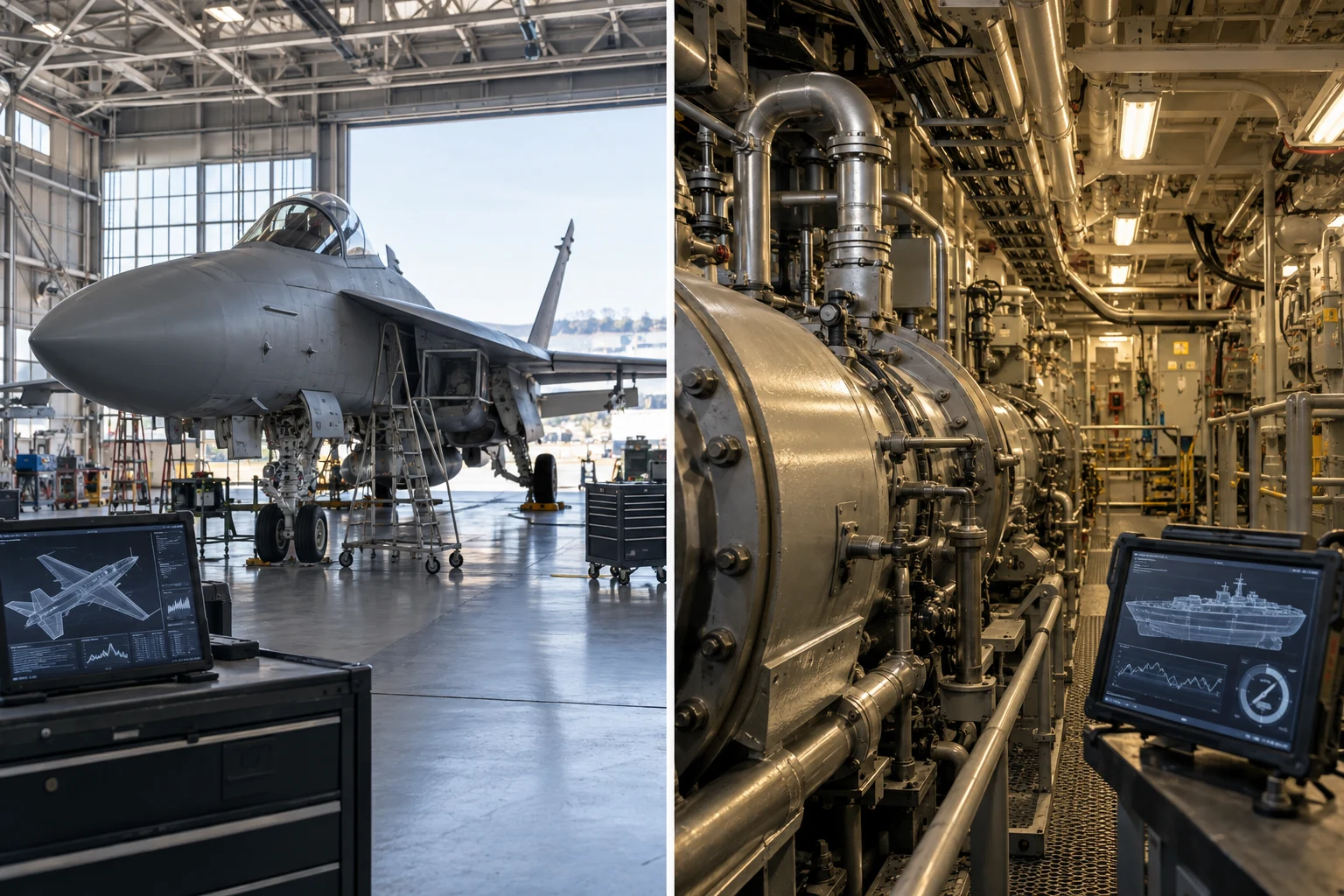
NAVSEA, the Naval Sea Systems Command, is responsible for ships, submarines, shipboard weapons, and undersea systems. It is headquartered at Washington Navy Yard and runs through Program Executive Offices and directly managed program offices — PEO Ships (DDGs, FFGs, amphibious), PEO Submarines (Virginia, Columbia), PEO Aircraft Carriers, PEO Integrated Warfare Systems, PEO Unmanned and Small Combatants, and the naval warfare centers (NSWC Dahlgren, NSWC Crane, NSWC Port Hueneme, NUWC Newport, NUWC Keyport, NSWC Carderock, NSWC Philadelphia). Each PEO and warfare center has its own AI interests and its own SBIR footprint.
Both commands sit alongside the Office of Naval Research (ONR), which is not an acquisition command but funds the research that feeds eventual procurement. ONR runs through its own topic lines and has its own SBIR and STTR programs. Understanding the interplay between ONR (science), NAVAIR/NAVSEA (acquisition), and the fleet (end user) is central to positioning an AI firm in the Navy ecosystem.
NAVAIR vs NAVSEA — AI Priority Comparison
Editorial weighting from public sources and practitioner reading — illustrative, not a measured statistic.
NAVAIR's AI priorities
NAVAIR's AI priorities follow its aviation mission. Autonomy is the top-line story. The MQ-25 Stingray, the CMV-22B, and the emerging manned-unmanned teaming (MUM-T) programs all need AI for mission planning, autonomous flight, and coordinated operations. NAVAIR has invested heavily in autonomy enablers through ONR's research portfolio and through recurring SBIR topics on autonomous behavior verification, multi-agent coordination, and onboard perception for degraded GPS environments.
Predictive maintenance is the second pillar and arguably the most money-in-motion area in NAVAIR AI. Aircraft are expensive to operate, availability drives readiness, and unscheduled maintenance is the biggest availability killer. NAVAIR runs large digital twin and prognostics programs for the F/A-18, E-2/C-2, P-8, and H-60 communities. These programs generate enormous telemetry streams that need AI-driven anomaly detection, remaining useful life estimation, and decision support for maintainers. SBIR topics in this space are consistent across cycles.
Sensor fusion and electronic warfare round out the top three. Maritime patrol aircraft, airborne early warning, and carrier-based strike aircraft all carry dense sensor suites, and the fusion of radar, ESM, IR, and intelligence data into actionable operator displays is a long-running AI application. NAVAIR's Electronic Warfare community runs recurring AI-for-EW topics, often classified but with unclassified Phase I precursors.
NAVSEA's AI priorities
NAVSEA's AI priorities look quite different. The top-line story is ship health monitoring and damage control. Navy ships carry thousands of sensors, and the path from raw telemetry to actionable damage control guidance is an open problem. NAVSEA programs — Smart Ship, CANES, and numerous in-theater digital twin efforts — drive AI investment in shipboard analytics, real-time state estimation, and operator decision support during casualty events. The naval warfare centers, especially NSWC Philadelphia (machinery systems) and NSWC Carderock (hull and naval architecture), are active SBIR sponsors in this space.
Undersea AI is the second pillar, and it is where NAVSEA's investment is most differentiated from any other service. Submarine warfare, undersea surveillance, mine warfare, and large unmanned undersea vehicles (LDUUV, XLUUV) all depend on signal processing in environments with extreme propagation physics. NUWC Newport and NUWC Keyport sponsor a consistent pipeline of SBIR topics on sonar classification, undersea communications, autonomous undersea behavior, and signature analysis. This is a technically deep niche with limited competition and long Phase III tails.
Hull and propulsion analytics — predictive maintenance for ships — is the third pillar. Ship maintenance is a longer cycle than aircraft maintenance but carries even higher stakes, because a ship in the yard for unplanned repair is a fleet readiness problem that ripples across months. Topic families here focus on machinery analytics, corrosion modeling, and shipyard process optimization. NSWC Philadelphia and the regional maintenance centers are the usual sponsors.
SBIR topic patterns: NAVAIR vs NAVSEA
A look at recent DoD SBIR cycles shows clear topic-shape differences between the two commands.
NAVAIR topics are typically platform-specific. A topic might read "Prognostics for F/A-18 E/F Engine Health Management" or "Autonomy Assurance for MUM-T Operations" — tied to a named aircraft and a named program office. The scope is bounded, the customer is identifiable, and the Phase III transition path (into the relevant PMA) is visible in the topic itself. Competition is real but legible; a firm with credible aircraft data experience and a specific technical approach has a real shot.
NAVSEA topics are more systems-level. A topic might read "Machine Learning for Shipboard Machinery Condition Monitoring" or "Autonomous Contact Management for Undersea Surveillance" — often without a named platform, but with a named warfare center and a specific phenomenology. The scope can be broader, and the Phase III transition path is to a program office or fleet user that the small firm must cultivate during Phase II. The competition profile is different — fewer specialized firms, but each one tends to be technically deep.
Both commands publish recurring topics cycle over cycle, which means a firm that misses a topic one year can often pursue a similar topic the next. Tracking the topic cadence in a specific technical niche is more valuable than trying to respond to everything in a single cycle.
Key program offices and their AI procurement patterns
A partial map of the AI-relevant offices, with their typical topic cadence:
- PMA-265 (F/A-18 & Growler) — prognostics, EW AI, sensor fusion. Consistent SBIR cadence.
- PMA-290 (P-8 Poseidon) — maritime patrol sensor fusion, acoustic AI, mission management. Strong Phase III pull.
- PMA-275 (V-22) — airframe prognostics, tiltrotor-specific flight analytics. Narrower but consistent.
- PMA-263 (Navy UAS) / PMA-281 (Cruise missiles) — autonomy, targeting, decision aids. Active across cycles.
- NSWC Dahlgren — combat systems, missile defense, weapons AI. Deep technical community.
- NSWC Carderock — hull analytics, hydrodynamics, ship design ML.
- NSWC Philadelphia — shipboard machinery analytics, propulsion AI.
- NUWC Newport / Keyport — undersea AI, sonar, torpedo and UUV systems.
- PEO IWS (Integrated Warfare Systems) — combat system AI across surface platforms.
- PEO Submarines — submarine combat and sensor AI, strategic systems.
ONR and the research-to-fleet pipeline
The Office of Naval Research funds the basic and applied research that feeds eventual acquisition. For an AI firm, ONR matters for two reasons. First, ONR runs its own SBIR program with topics that tend to be more science-forward than NAVAIR or NAVSEA topics — higher risk, longer horizon, but often the seed of future acquisition capability. Second, ONR manages discovery and invention contracts, Swampworks (ONR's rapid prototyping arm), and the Future Naval Capabilities program, which bridges research to acquisition. A firm with a credible research program can enter the Navy through ONR and transition through NAVAIR or NAVSEA over several years.
How to engage: SBIR, SeaPort NxG, OTA consortia
Three vehicles dominate small-firm access to Navy AI work. SBIR/STTR is the most accessible — the barrier to entry is a good proposal, and the Phase III transition into program-of-record work is a real path. SeaPort NxG is the Navy's primary services contract vehicle for engineering, technical, and program management services. Getting on SeaPort NxG requires a prime contract or a teaming arrangement with an existing SeaPort NxG holder. For a small AI firm early in its Navy journey, subcontracting to a SeaPort NxG holder is the common entry.
OTA consortia are the third vehicle and the fastest when they apply. The Naval Aviation Systems Consortium, the Undersea Technology Innovation Consortium, and the Strategic and Spectrum Missions Advanced Resilient Trusted Systems (S2MARTS) OTA are the relevant consortia for AI work. Membership is open and relatively inexpensive, and awards can move from announcement to contract in 60 to 90 days — an order of magnitude faster than traditional FAR contracting.
Bottom line
NAVAIR and NAVSEA are very different customers. A firm that wants to serve both must develop command-specific narratives, command-specific references, and command-specific teaming relationships. A firm that picks one and commits will see faster traction than a firm that spreads across both. Navy AI work rewards technical depth and patient relationship-building more than most of DoD — but the Phase III conversion rate is the best in the department, and the fleet is a long-term customer that does not churn. For the right small AI firm, Navy is one of the most sustainable long-horizon homes in federal AI.
Frequently asked questions
NAVAIR, the Naval Air Systems Command headquartered at Patuxent River, Maryland, is the Navy's acquisition command for aircraft, weapons, and airborne sensor systems. It procures AI across autonomous aircraft (UAS and MUM-T), sensor fusion for maritime patrol and electronic warfare, predictive maintenance for airframes and engines, and digital twin tooling for aircraft sustainment.
NAVSEA, the Naval Sea Systems Command headquartered at Washington Navy Yard, is the Navy's acquisition command for ships, submarines, and shipboard systems. Its AI procurement centers on ship health monitoring, damage control automation, undersea and sonar signal processing, hull and propulsion analytics, and shipyard modernization. NAVSEA AI work tends to be more systems-integration heavy than NAVAIR.
Navy SBIR topics are published in the DoD SBIR/STTR solicitation cycles on the DSIP portal. NAVAIR, NAVSEA, ONR, and NAVWAR each release topics tied to their missions. The pre-release window is the right time to contact the TPOC with clarifying questions. Navy has one of the strongest Phase III transition rates in DoD, so proposals should explicitly address the transition path.