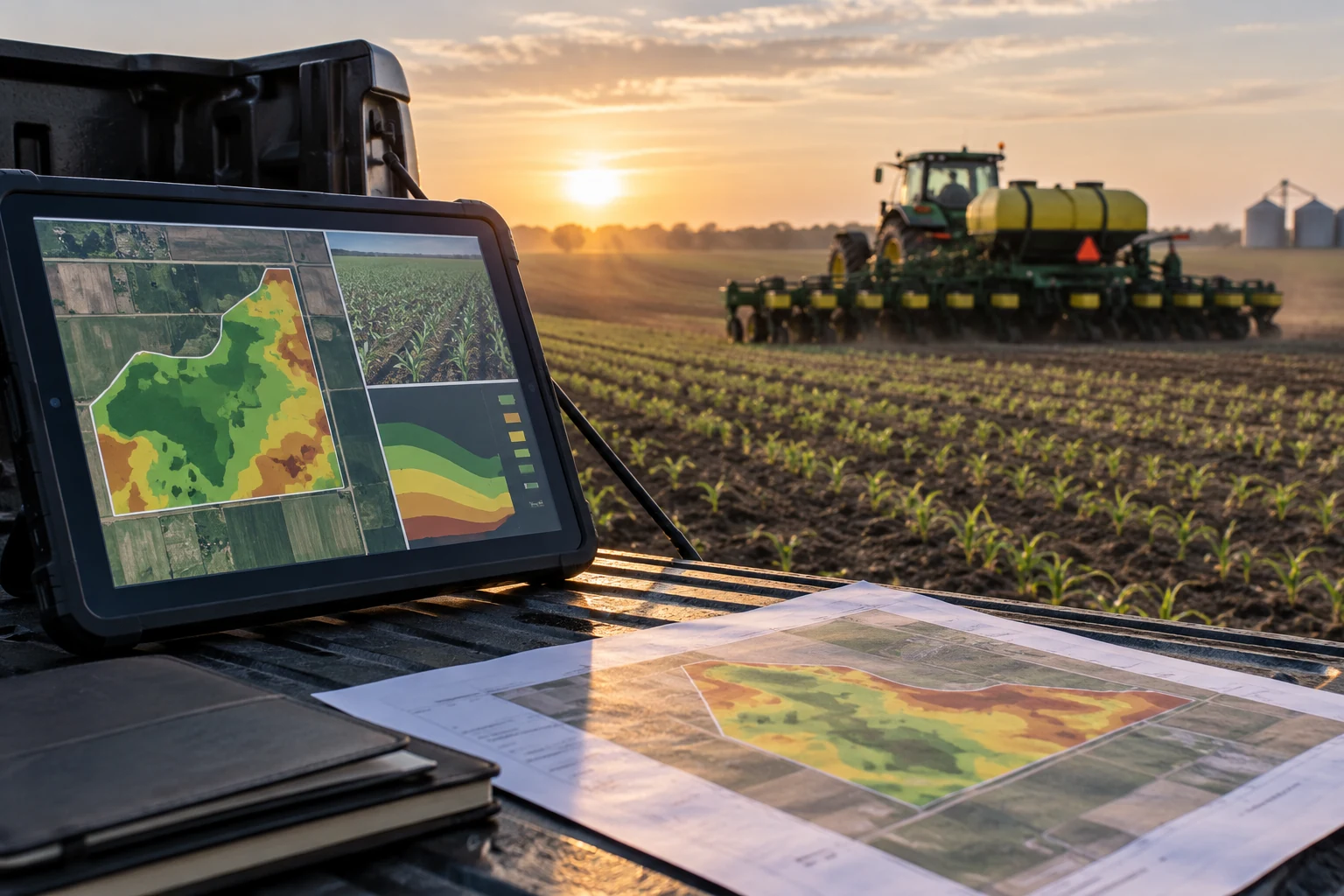
Most decision support operates in domains where a bad recommendation is caught before it costs anything. Agriculture is not one of them. A prescription goes to the equipment, the equipment executes it across the field, and whether it was right becomes clear at harvest.
Three properties that change the engineering
The first is irreversibility. Applied product cannot be recalled. The second is scale: the same recommendation is executed across an entire management zone, so an error is not one bad decision but thousands of identical ones. The third is feedback delay — the outcome signal arrives once per season, which means the learning loop most software relies on runs at a rate of one iteration per year.
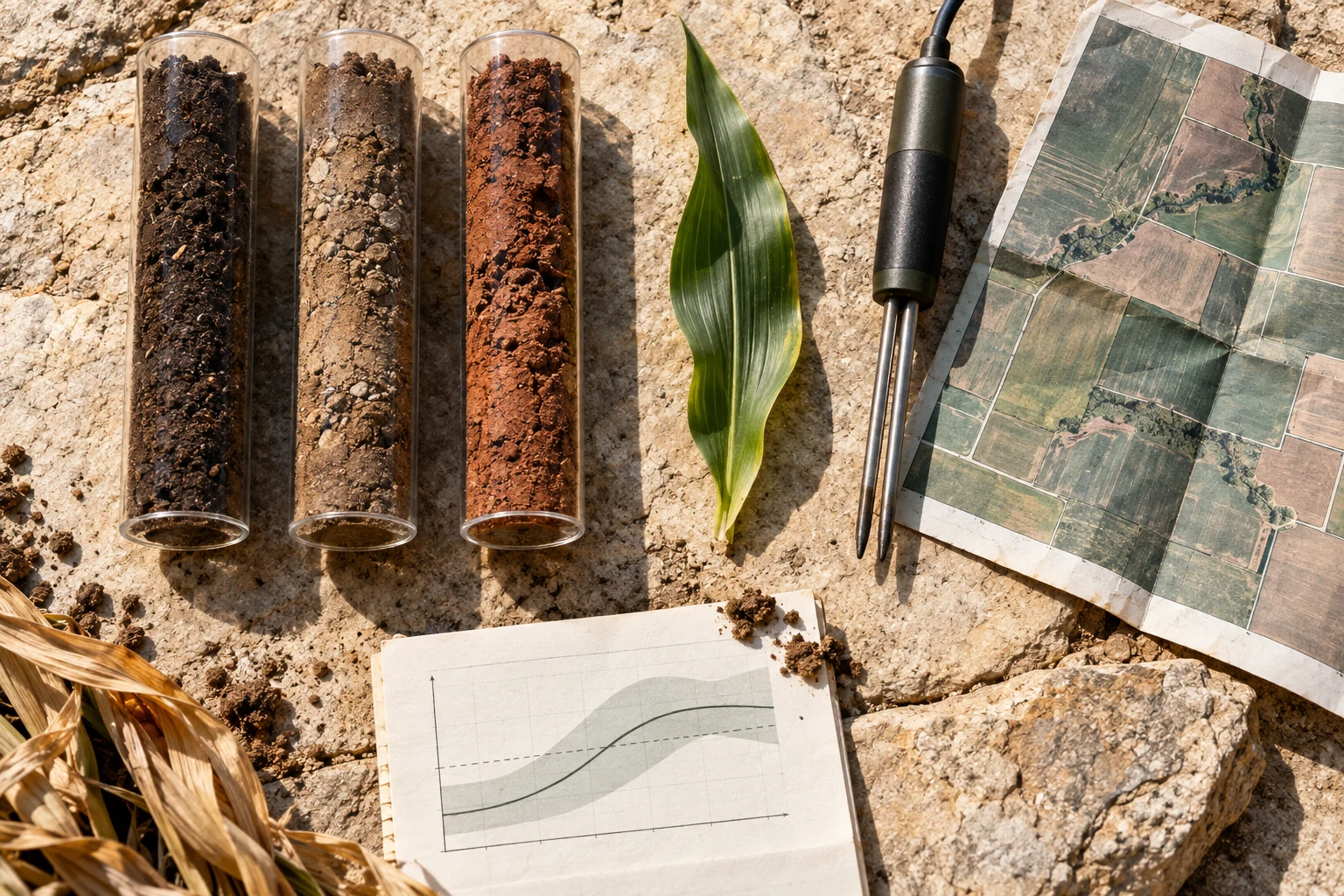
A model with a season-long feedback loop gets roughly forty chances in a career. Design accordingly.
What that implies about confidence
In a fast-feedback domain, shipping a moderately confident recommendation is reasonable because errors surface quickly. Here they do not, so the honest expression of uncertainty is not a nicety — it is the mechanism by which the grower decides whether to follow the prescription or their own judgment.
- Report intervals, not point recommendations, and make the interval width visible
- Name which inputs drove the recommendation, so local knowledge can override it
- State when a field falls outside the conditions the model was fit on
- Distinguish measured field data from interpolated or modeled inputs
- Keep the recommendation record, so the harvest outcome can be attributed back to it
The out-of-distribution problem is the practical one
Models are fit on the conditions that occurred in the training years. The seasons where a recommendation matters most — unusual moisture, an early frost, an atypical pest year — are precisely the seasons least represented in that history.
A system that reports the same confidence in an unusual season as a typical one has failed at the moment it was most needed. Detecting that the current conditions are outside the fitted range, and saying so, is more valuable than a marginal accuracy improvement in normal years.
What makes agronomic decision support hard
Relative weighting from delivery practice, not a measured statistic — shown to rank where attention belongs.
Where the data work sits
Field records arrive from equipment monitors, soil labs, imagery, and the grower's own notes, in incompatible formats with inconsistent boundaries. The same field is identified three ways. Boundaries shift as land is rented in and out.
This is the entity resolution and normalization problem again, and as elsewhere it consumes more of the project than the modeling. The advantage is that a resolved, longitudinal field history is independently valuable — for compliance reporting, for lease negotiations, for land valuation — regardless of what model sits on top.
What forty iterations means for how you build
The season-long feedback loop is worth taking seriously as an engineering constraint rather than an inconvenience, because it invalidates several habits that work everywhere else.
| Habit | Why it fails here | What replaces it |
|---|---|---|
| Ship and iterate | The iteration arrives once a year | Simulation and backtesting against historical seasons |
| A/B testing | Field variation swamps the treatment effect | Paired strips within field, replicated across sites |
| Online learning | No online signal exists during the season | Within-season proxies, explicitly labeled as proxies |
| Optimize the mean | A grower's downside year is not averaged away | Optimize with an explicit floor on bad outcomes |
| Trust the training range | The seasons that matter are the unusual ones | Out-of-distribution detection as a first-class output |
The fourth row is the one that separates a good agronomic model from a technically strong one that growers do not adopt. A recommendation that improves the average across a portfolio while increasing the severity of the worst year is a bad trade for an operator whose business does not survive the worst year.
Uncertainty has to be actionable, not decorative
Every model can emit an interval. Most emit one nobody uses, because it is not connected to a decision.
An interval becomes actionable when it maps to the choice in front of the grower. If the recommendation is a rate, the useful expression is the range over which the expected return is flat — because that range tells the grower how much their own judgment can move the number without cost. If the recommendation is timing, the useful expression is the window, not the optimal day.
The other half is naming what drove it. A recommendation whose inputs are visible can be overridden intelligently by someone who knows the field has a wet corner, a compaction layer, or a history the data does not capture. A number with no visible basis can only be accepted or rejected wholesale, and it usually gets rejected.
Out-of-distribution detection is the safety feature
The seasons where a recommendation carries the most consequence are the seasons least represented in the training history, which is an unfortunate structural property of the domain.
A model that reports uniform confidence regardless of how unusual the conditions are has failed precisely when it mattered. Detecting that current conditions sit outside the fitted range — and saying so plainly — is more valuable than incremental accuracy in normal years, and it is considerably easier to build.
- Compare current-season conditions against the distribution the model was fit on, per input
- Report which specific inputs are out of range, not just a composite flag
- Widen intervals rather than suppressing the recommendation entirely
- Preserve the flag in the recommendation record, so post-season attribution can account for it
- Make the flag visible to the grower in plain terms, not as a confidence percentage
Field identity is the data problem underneath
The same entity resolution problem appears here with agricultural specifics: fields are identified inconsistently across equipment monitors, soil labs, imagery providers, agronomist notes, and the grower's own naming.
Boundaries make it harder. Fields are split and combined, rented in and out, and partially enrolled in programs. A field that was two units last season and one this season has a history that must be reconciled rather than restarted, or the longitudinal signal disappears exactly where it would be most useful.
The practical requirement is a stable field identity with boundary versioning — geometry with effective dates, lineage across splits and merges, and every observation bound to the geometry in force when it was collected. Building it is not glamorous and it is what makes multi-year analysis possible at all.
Recommendation records and the conversation afterward
When a season goes badly, the conversation about whether the recommendation contributed is going to happen. Whether it happens on facts depends on what was retained.
The record should hold the recommendation, the inputs it used with their sources and dates, the interval and any out-of-distribution flags, the model version, and what was actually executed — which frequently differs from what was recommended, for entirely legitimate operational reasons.
That last item is the one most often missing and the one that most often resolves the question. A recommendation applied at a different rate, on a different date, or under different conditions than assumed is not the recommendation that was made, and without execution data nobody can tell the difference. Equipment records generally contain it; the work is binding them to the recommendation rather than storing them separately.
What to measure at season end
Yield outcome is the obvious metric and a noisy one, because weather dominates. More informative measures are available and underused.
Measure agreement rate — how often the grower followed the recommendation, which is the adoption signal and usually more diagnostic than accuracy. Measure override direction, because a systematic bias in one direction is the model telling you about a variable it lacks. And where paired strips were run, measure the treatment difference within field rather than across the portfolio, because that comparison actually isolates the recommendation from the weather.
The recommendation reaches the grower through someone else
Agronomic advice is rarely consumed directly. It travels through a retailer agronomist, a co-op, or an independent advisor who has their own relationship with the grower and their own professional judgment.
That intermediary is the actual user, and designing for the grower while selling through the advisor produces a tool nobody adopts. The advisor needs to be able to explain the recommendation in their own words, override it without friction, and be confident it will not embarrass them in front of a customer they have served for fifteen years.
Practically this means the interface has to expose reasoning rather than conclusions, make overrides first-class rather than exceptional, and never present a recommendation the advisor cannot defend from what is on screen. A system that makes a trusted advisor look uninformed will be quietly stopped regardless of its accuracy.
Data ownership is unsettled and worth settling in writing
Field data is generated by the grower, captured by equipment from one manufacturer, processed by an agronomy platform, and analyzed by a service. Who owns it, who may aggregate it, and what happens at contract exit are frequently unspecified.
- Whether the grower's data may be aggregated into benchmarks other growers see
- Whether it may train models the provider sells elsewhere
- What is returned, in what format, if the relationship ends
- Whether the equipment manufacturer's terms conflict with the platform's
- Who may see field-level data at a landlord, lender, or buyer's request
Growers have become appropriately cautious here, and a provider that answers these plainly earns trust that no accuracy claim buys. A provider that cannot answer them is asking for data on terms it has not defined.
Measure the seasons that were hard
Aggregate performance across normal years is close to uninformative, because normal years forgive a wide range of decisions. The seasons that discriminate are the ones the model was least prepared for.
Reporting performance separately for out-of-distribution seasons — and reporting how often the system correctly flagged that it was outside its range — is the honest presentation. It will show worse numbers than the aggregate and it is the number a grower deciding whether to trust the tool in a difficult year actually needs.
Frequently asked questions
It broadens coverage and does not replace calibration. Imagery-derived indices need ground truth to mean anything specific, and the value of the combination is much higher than either alone.
A commercial question with a technical prerequisite: the recommendation, its inputs, and its stated uncertainty must be retained. Without that record the conversation cannot be had on facts.