What "beats" has to mean before the word is worth anything
A leaderboard says one model beats another. That claim is about a benchmark, not about your work. On a real workload the sentence only means something once three things are pinned down: the task, the quality bar the output has to clear, and the budget in latency and money you are willing to spend clearing it. Pin those three and the comparison becomes an experiment with an answer. Leave any of them loose and model selection turns into buying a laptop by picking the biggest number printed on the box.
The largest model is a safe answer to a question nobody asked precisely. That is exactly why it wins by default. Nobody gets criticized for running the strongest thing available, the same way nobody used to get criticized for buying the incumbent vendor. The cost of the default is invisible because it never shows up as a defect. It shows up as a monthly invoice that grew faster than usage, a product that feels sluggish for reasons no profiler explains, and a deployment conversation that stalls the first time someone asks where the data goes.
This piece is about the comparison itself: what a small model can and cannot do, the number that actually decides the question, and how to run the head-to-head in a week.
The default is not free
Three costs come with defaulting to the largest model, and only the first one is on the invoice.
Unit cost. Inside a single vendor's published list prices, the spread between the small tier and the top tier commonly runs five to ten times per token, in both directions — input and output. That ratio is unremarkable in a chat product where a person types a question and waits. It stops being unremarkable inside an agent loop, where one user action can produce dozens of model calls, most of them narrow and repetitive. Self-hosting an open-weight small model changes the unit of account entirely: you stop paying per token and start paying for GPU-hours, which is a fixed cost you can size, cap, and amortize.
Latency. Smaller models start producing tokens sooner and produce them faster. When the model is the last step before a person reads the answer, a second or two is a preference. When it sits inside a loop that runs five times before anything reaches the screen, that second is multiplied by five, and users experience it as the product being slow.
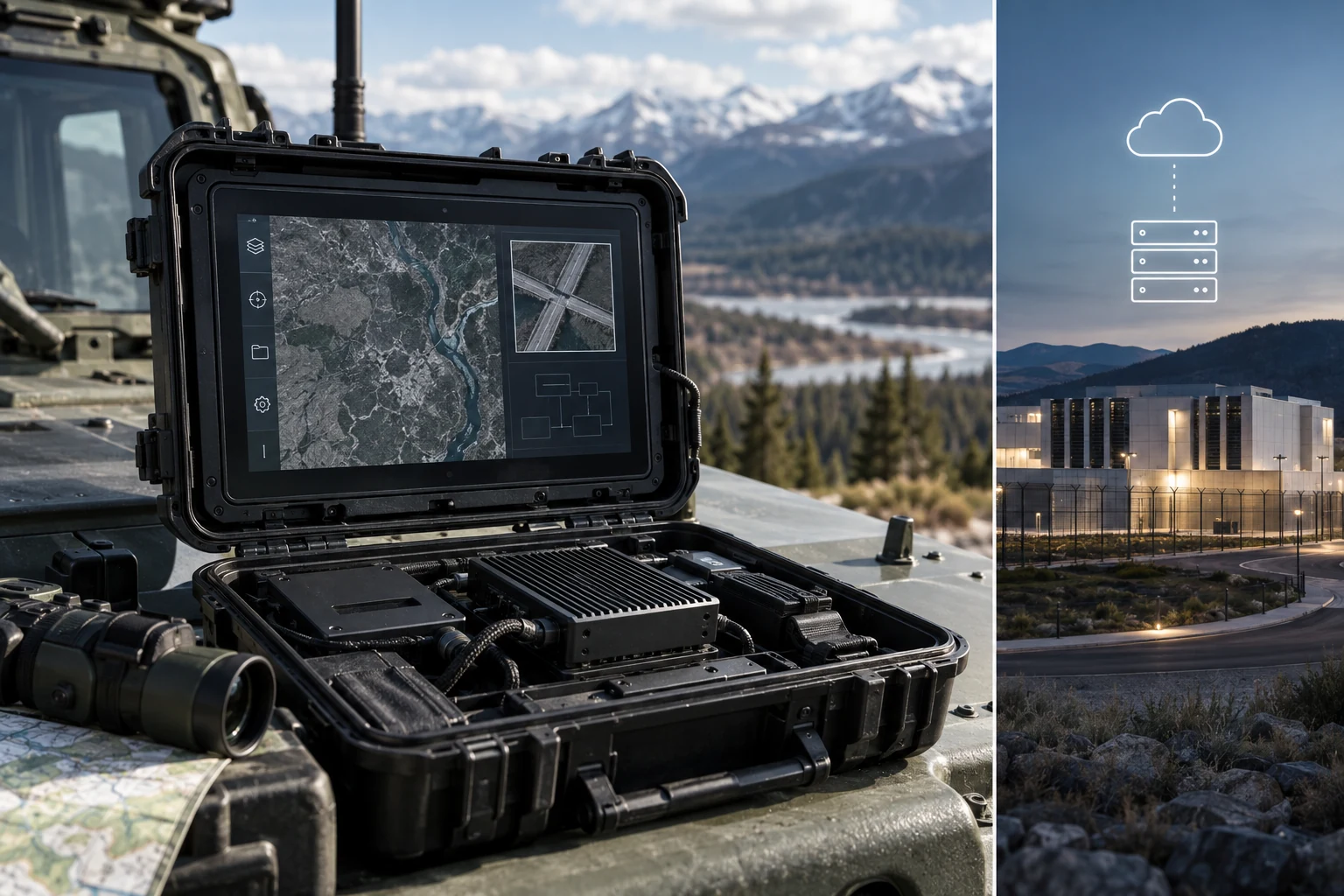
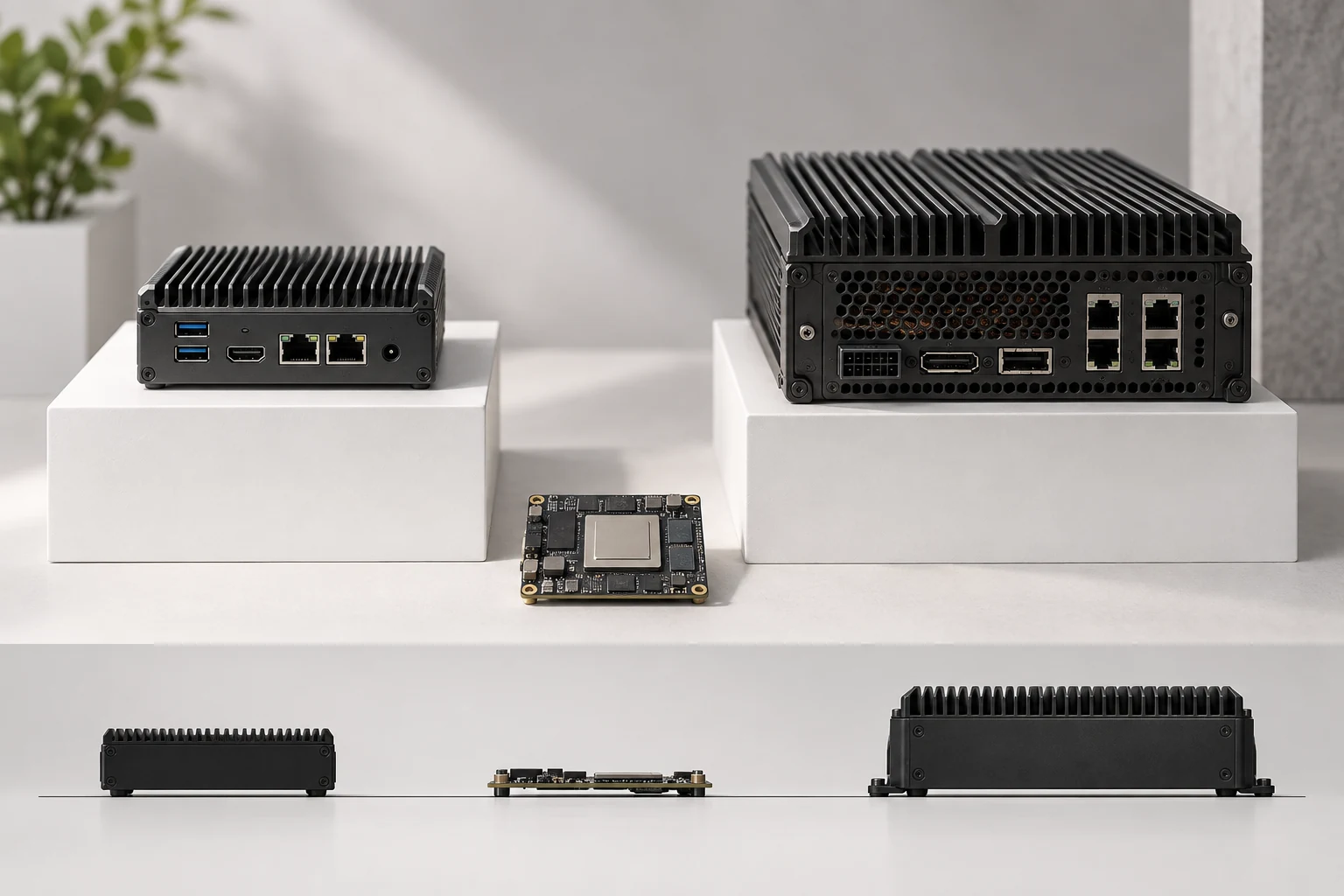
Where the weights are allowed to live. This is the cost that ends projects. A hosted frontier model means your inputs cross a boundary. Depending on the data, that is either a routine vendor-review item or a hard stop. An open-weight model in the 1B to 14B range runs on a single GPU, which means it can run inside your environment, on your accredited enclave, on a disconnected machine, or on hardware in a vehicle. No benchmark score changes that constraint, and no amount of capability compensates for a model that is not allowed to see the data.
NVIDIA researchers made the systems argument for this directly. In Small Language Models are the Future of Agentic AI (Belcak et al., arXiv:2506.02153, June 2025), the authors argue that small models are "sufficiently powerful, inherently more suitable, and necessarily more economical for many invocations in agentic systems," because agentic software performs "specialized tasks repetitively and with little variation." Their conclusion is not that large models are unnecessary. It is that heterogeneous systems, where different models handle different calls, are the natural shape once the work is broken into steps.
The leaderboard cannot settle this for you
The instinct is to look up published scores. It fails here for three reasons, and they compound.
The first is saturation. The benchmarks most often quoted in vendor material were designed years ago and have been solved. When every serious model scores in the same narrow band at the top, the difference between two scores is smaller than the noise in the measurement, and the ranking flips depending on prompt formatting and sampling settings.
The second is contamination. Benchmark questions and text derived from them appear in the web crawls used to build pre-training corpora. When that happens, a score reflects recall as much as reasoning, and the effect is uneven across models depending on what each one ingested. There is no reliable way to correct for this from the outside.
The third is the one that matters most and gets the least attention: the benchmark measures a distribution that is not yours. Your documents have a house style. Your users phrase requests in a way that is specific to your domain. Your failure modes are concentrated in a handful of edge cases that a general benchmark does not contain a single example of. A model that is better on average and worse on the cases you care about is not better. We wrote a buyer's checklist for interrogating a published number in how to verify an AI vendor's benchmark claim; the short version is that a number without a protocol is not a result.
Task classes where a tuned small model is a live candidate
Editorial weighting of how often a tuned small model is worth testing first, by task class. Practitioner reading, not a measured statistic — the point of the article is that you measure your own.
The shape of a task that small models handle well
The bars above are a summary of one underlying pattern. Five properties predict whether a small model is worth testing, and they matter more than the specific task name.
The output space is bounded. One of eleven categories, a JSON object with six known fields, a yes or no with a span of supporting text. Bounded outputs are easy to constrain at decode time and easy to check afterward, and both of those help the smaller model far more than they help the larger one.
The output is verifiable without a human. A schema either validates or it does not. An extracted date either appears in the source text or it does not. When you can check cheaply, you can catch the small model's mistakes cheaply, and its error rate stops being a reason to avoid it.
The instruction fits in the prompt. If the rule can be written down in a page, the model does not need to have absorbed your domain during pre-training. If the rule is "apply the judgment of someone who has done this job for ten years," it does.
One domain, one format, repeated. Repetition is what makes a small model tunable. A thousand real examples of the same task are worth more than any amount of general capability, because they let you close the specific gap rather than pay for general headroom you never use.
The horizon is short. One step, or a few. Long chains of dependent reasoning are where small models degrade fastest, because an error in step two is not recoverable by step seven.
Where the large model earns its price
There are categories where the frontier model is the right answer and no amount of prompt work closes the gap.
Long-horizon work with dependent steps. Planning a multi-file change, carrying a constraint from the second step through to the ninth, noticing at step six that the approach chosen at step two was wrong. Recovery from your own earlier mistakes is a capability, and it is one of the sharpest dividing lines between tiers.
Ambiguous or novel instructions. When the request is underspecified and the right move is to infer intent rather than follow the letter, the larger model infers better. Small models follow instructions literally, which is a feature in a pipeline and a liability in a conversation.
Wide context that has to be held together. Reading a long document set and producing an answer that depends on reconciling material from opposite ends of it. Context window size is table stakes; using the whole window well is not.
The rare, high-consequence case. Every workload has a tail. If a tail case produces a wrong answer that a person acts on, the tail is where your budget belongs, and it is often the only part of the workload that needs the expensive model at all.
Being the teacher and the judge. The frontier model is frequently the most valuable component of a small-model pipeline without ever serving a request: it generates the training targets, labels the evaluation set, and scores the candidates offline. That is a different cost line than inference, and a much smaller one.
| Dimension | Small model (roughly 1B–14B) | Frontier model |
|---|---|---|
| Unit economics | A fraction of the per-token price hosted; a fixed GPU-hour cost self-hosted, independent of volume | Per-token pricing that scales linearly with usage, multiplied by every call in an agent loop |
| Latency | Faster first token and higher throughput; usually the difference between an interactive feel and a spinner | Slower per call, and the gap compounds when the model is invoked repeatedly per user action |
| Where it can run | Single GPU, inside your boundary, on an accredited enclave, disconnected, or at the edge | Vendor-hosted in most cases, which makes data handling and authorization the gating question |
| On the task you tuned it for | Frequently matches the larger model once fine-tuned on real examples with a constrained output | Strong out of the box with no tuning investment, which is worth real money early in a project |
| On inputs you did not anticipate | Degrades sharply and sometimes confidently; the tail is where it is weakest | Degrades gracefully; this headroom is the product you are actually buying |
| Change control | Weights you hold, version, and re-test on your schedule | Endpoints that change under you, which means re-running your evaluation on someone else's calendar |
The number that decides it is cost per accepted answer
Cost per token is the wrong denominator and it is the one everybody uses, because it is the one printed on the pricing page. The number that decides the architecture is the fully loaded cost of one answer that clears your quality bar.
That figure includes the retries. It includes the verifier call, if you added one. It includes the escalation to the larger model when the small one declines or scores low, and it includes the human review on the fraction of cases that reach a person. Work it out honestly and the ranking sometimes reverses: a model that is ten times cheaper per token but needs a second pass on a third of inputs, plus human review on one in ten, may cost more per accepted answer than the expensive model that gets it right the first time, and it will certainly be slower.
The reverse also happens, and it is the more common finding. A narrow, high-volume, verifiable task run on a small model with a schema-constrained decoder produces an answer that validates on the first attempt nearly always, and the cost difference is not five times. It is the difference between a per-call charge and a machine you already own.
The head-to-head you can run in a week
Teams skip this because they imagine a research effort. It is a week of ordinary engineering, and it produces an answer that survives being questioned by someone who was not in the room.
From decision to answer
Four things about that sequence do the work. Real traffic, not synthetic examples — a set you wrote yourself will accidentally exclude the inputs that break things, because you were thinking about the task working. An identical harness — a prompt tuned for one model and ported unchanged to another is a rigged comparison, and it usually rigs it in favor of whichever model the prompt was written against. A middle tier in the run — the answer is often neither end of the ladder, and testing only the extremes hides that. Reading the failures individually — the aggregate number tells you which model to pick, and the failure list tells you whether the loss is fixable with a schema, an example, or a fine-tune. That second finding is worth more than the first.
One statistical caution. Run each item several times and report the spread alongside the mean. Model outputs vary between runs, and a three-point difference measured once, on 40 items, is not a difference. Teams have shipped architecture decisions on gaps that were inside their own measurement noise. If your evaluation set is small enough that this is a real risk, it is too small.
Cascades: the answer is usually both
Framing the question as small model or large model is what makes it hard. The production answer is frequently a cascade: send everything to the cheap model, check the result, escalate only what fails the check.
The canonical treatment is FrugalGPT: How to Use Large Language Models While Reducing Cost and Improving Performance (Chen, Zaharia and Zou, arXiv:2305.05176, May 2023). The paper reports that a learned cascade can "match the performance of the best individual LLM (e.g. GPT-4) with up to 98% cost reduction or improve the accuracy over GPT-4 by 4% with the same cost" on the tasks studied. Those are the paper's own numbers on the paper's own datasets, and they should be read as a demonstration that the technique works, not as a forecast for your workload.
The condition that makes a cascade pay is a cheap and trustworthy signal for when to escalate. Sometimes that signal is free: the schema failed to validate, the extracted value is absent from the source, the classifier returned a label outside the allowed set. Sometimes it requires a second model call to judge the first, which eats the savings and adds latency. And sometimes no reliable signal exists, because the failure mode is a fluent, confidently wrong answer. There a cascade adds cost while catching nothing, and the honest move is to route that whole class of work to the model that gets it right.
Decide the escalation rule before you build the cascade, and log every escalation. The escalation rate is the single most useful operational metric in this architecture: it tells you what fraction of your traffic actually needed the expensive model, and it is the number that shows whether the design is working six months after launch.
Moving a task down the ladder
If the head-to-head says the small model loses today, that is a starting position, not a verdict. Four techniques move tasks down the ladder, and they compose.
Distillation. Train the small model on the large model's outputs for your specific task. The technique goes back to Hinton, Vinyals and Dean's Distilling the Knowledge in a Neural Network (arXiv:1503.02531, 2015), and it is now standard practice: several widely used open-weight small models are distilled variants of larger teachers. Read the terms of service on the teacher first. Some providers restrict using their outputs to train competing models, and that is a contract question with real consequences, not a technicality.
Parameter-efficient fine-tuning. LoRA (Hu et al., arXiv:2106.09685, 2021) freezes the base weights and trains small rank-decomposition matrices instead, cutting trainable parameters and memory by large factors. In practice this means a task-specific adapter is cheap enough to train, version, and re-train when the task drifts, and you can keep several adapters over one base model rather than several full models.
Constrained decoding. Enforce the output schema at generation time rather than validating and retrying afterward. This closes a category of failure that disproportionately affects small models, which are more likely to produce a structurally malformed answer than a semantically wrong one.
Retrieval. If the small model's loss is knowledge it never absorbed, put the knowledge in the prompt rather than in the weights. This converts a capability problem into a retrieval-quality problem, which is usually the easier of the two to engineer and measure.
One deployment note that belongs with these. Quantization to lower precision shrinks memory and speeds up inference, and it costs some accuracy. That trade is normally worth it, but measure it on your evaluation set rather than assuming, because the accuracy cost is uneven across tasks and hits the hardest cases first.
On weights themselves: families such as Qwen, Llama, Gemma, Phi and Granite publish models in the range that runs on a single GPU. Their licenses differ. Some are Apache 2.0; others ship under vendor-specific community terms carrying use restrictions and field-of-use conditions. That is a question for counsel reading the actual license text, not for an engineer reading a release blog post.
Where the model runs is part of the answer
For regulated and federal work, the deployment question often decides the model question outright, and it decides it before capability enters the conversation.
Federal AI acquisition policy has been explicit about the surrounding obligations since April 2025, when the Office of Management and Budget issued M-25-21 on federal AI use and M-25-22 on AI acquisition, both implementing Executive Order 14179, Removing Barriers to American Leadership in Artificial Intelligence (signed January 23, 2025, published in the Federal Register January 31, 2025). M-25-22 directs agencies through the AI acquisition lifecycle with specific attention to performance monitoring and protection against vendor lock-in. Both of those cut in the same direction as the analysis above. A system that can swap models, that measures its own performance on a held-out set, and that is not welded to one endpoint is easier to defend on both counts.
On the measurement side, the NIST AI Risk Management Framework (AI RMF 1.0, January 2023) remains the finalized core framework, with the Generative AI Profile (NIST AI 600-1, July 2024) mapping its functions onto generative-AI-specific risk categories. NIST has said a revision of the core framework is underway; it is not final, and anyone telling you the requirements here are settled is telling you something the record does not support. Plan for the measurement discipline rather than for a specific document version.
The practical consequence is worth carrying into a design review. If the data cannot leave your boundary, the comparison is not small model against frontier model. It is small model against nothing, and the engineering question becomes how good you can make the model that is allowed to run. We covered the fielding side of that in small language models for federal edge deployments, and the specific trap where a system that looks offline still reaches for the network in air-gapped inference: what actually runs with no network.
What belongs in the statement of work
If you are buying this rather than building it, five clauses convert the analysis into something enforceable.
Name the task and the bar. Not "an AI system for document processing." The task, the metric, the threshold, and the input distribution the threshold applies to.
Require the evaluation set and its provenance. Who assembled it, when it was drawn, whether it came from real traffic, and whether it was held out of any training. A vendor who cannot answer this has not measured what they are claiming.
Require model portability. No hard-coded vendor client in the application layer. The ability to swap the model behind an interface, and a re-run of the evaluation whenever the model changes, is what keeps you from being repriced by someone else's decision.
Require the escalation rule to be explicit and logged. If the design is a cascade, the routing logic is part of the deliverable and the escalation rate is part of the reporting.
Require cost reported per task, not per token. Token totals are not a management number. Cost per accepted answer, broken out by model tier, is the number that tells you whether the architecture is doing its job.
Bottom line
Small models beat large ones when the task is narrow, the output is checkable, the volume is high, the latency budget is tight, or the data cannot leave the building. Large models earn their price on long-horizon work, on ambiguity, on the tail, and as the teacher and judge inside a pipeline they never serve. Which of those describes your workload is a question with an answer, and the answer takes about a week to obtain.
The failure worth avoiding is not choosing wrong. It is never running the comparison and calling the default a decision.
Frequently asked questions
Run a head-to-head on your own data with a fixed quality bar and a fixed latency budget. Include a middle tier, run each item several times, and read the disagreements by hand. Published benchmark scores cannot answer this, because they measure a distribution that is not yours and several of the most-quoted ones are saturated.
No. It behaves differently, not merely worse. Small models follow instructions more literally, hold fewer dependent steps in play, and degrade sharply rather than gracefully on inputs outside what they were tuned for. That profile is an advantage in a constrained pipeline and a liability in open-ended conversation.
About a week of engineering time plus a modest inference bill, most of it spent assembling and labeling an evaluation set from real traffic. That set is reusable for every model decision afterward, so the cost is paid once.
Technically yes, and it is standard practice. Check the teacher provider's terms of service first, because some restrict using outputs to train competing models. Treat that as a contract review item before the training run, not after.
It is often the only option that exists. Open-weight models in the single-GPU range can run inside your own boundary, on an accredited enclave, or on a disconnected machine. When that is the constraint, the design question stops being which model is strongest and becomes how good you can make the model that is permitted to run.