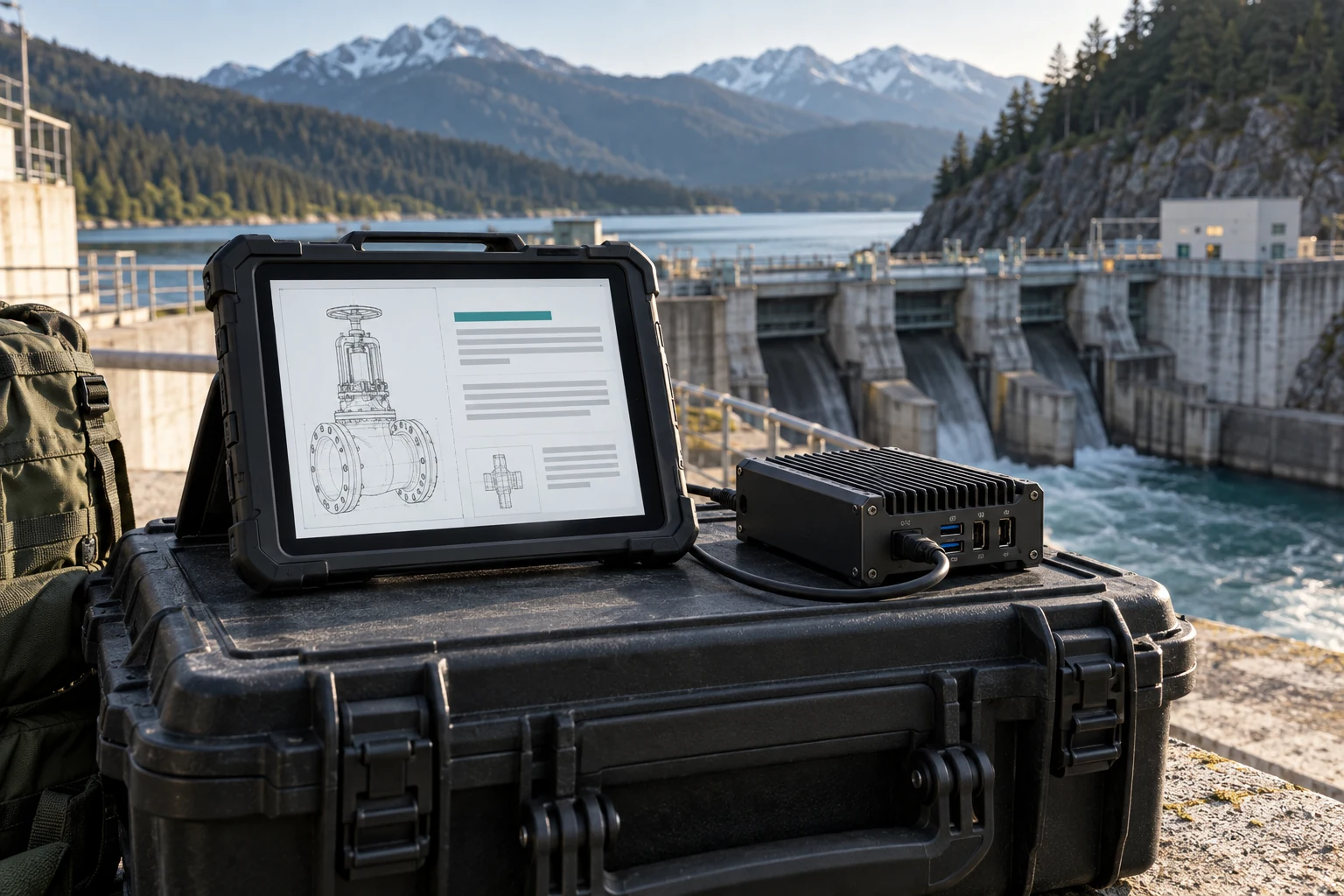
Why disconnected federal environments push toward smaller models
Most language-model work assumes a large model behind an API and a network that is always there. In many federal settings that assumption fails. A classified enclave has no path to a commercial endpoint; a forward node on an intermittent link cannot wait on a round trip that may never complete; a ship at sea or an inspection team in a facility with no wireless has to run the model where the work happens. Once the model runs locally, its size stops being a detail and becomes the governing constraint: a model that needs eight high-end accelerators is not a candidate, and one that runs on the hardware already in the room is.
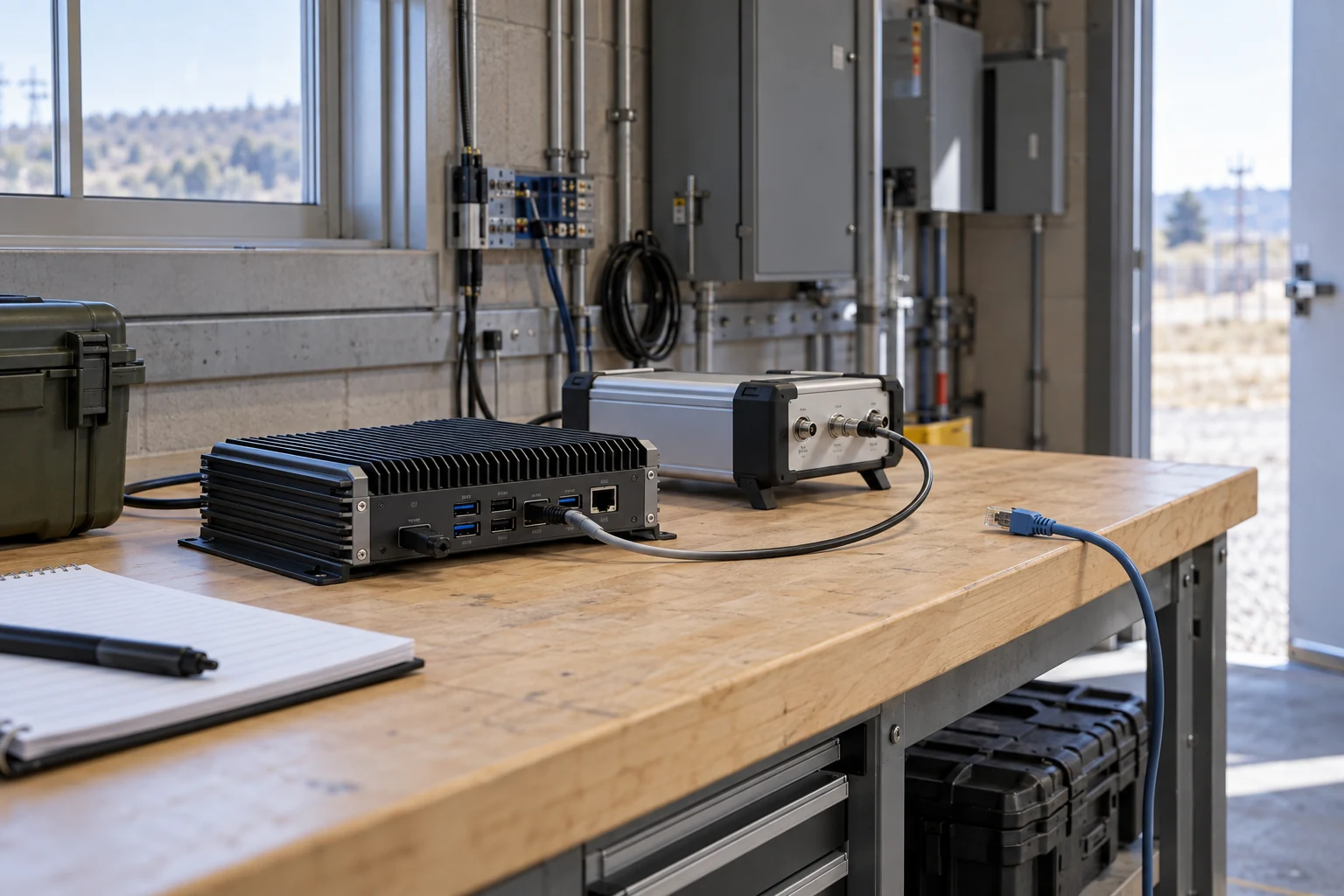
Bandwidth is the second forcing function. Where a link exists it is often narrow, contested, or metered, and policy may forbid moving text across it at all, while data-sovereignty rules keep sensitive inputs inside an accredited boundary. A large share of federal language work therefore has to be served locally, with no reachback assumed. "Small" here is a working range: roughly the one-to-fifteen-billion-parameter class, wide enough to be useful and small enough to fit on a single accelerator, or in its lower half a CPU. The question is not whether a small model matches a frontier model in the abstract; it is whether one prepared with care clears the bar for a specific, bounded job inside a place the frontier model can never reach.

What the 1-15B class does well
A model in this class is strong at bounded, well-specified work. Structured extraction is the clearest case: pulling named fields, dates, quantities, and relationships out of forms, reports, and message traffic into a schema. Classification is close behind, routing a document to a category or scoring a passage against a rubric. Constrained drafting is a third strength, filling a template or reformatting a passage when the shape of the output is given and the content is already present. Retrieval-augmented answering over a curated corpus is the fourth and often the most valuable: when the relevant text is fetched and placed in front of the model, a small model answers from it with accuracy that belies its size, because the hard part, knowing the facts, has moved out of the weights and into the retrieval layer. The more a design leans on retrieved context and explicit structure, the smaller the model can be.
Deployment-Fit Criteria — Disconnected Environment
Editorial weighting from public sources and practitioner reading — illustrative, not a measured statistic.
Where the small-model class breaks
The honest boundary is reasoning. A small model handles a short chain of steps, but as a task requires holding many facts at once, tracking state across a long document, or reasoning several inferences deep before it answers, reliability falls off, and it falls off quietly: the output stays fluent while it stops being correct. Long-horizon planning, multi-constraint optimization expressed in prose, and novel synthesis that connects fields the model was thinly trained on are where the class struggles. It produces something plausible, and plausible is exactly the failure mode to fear, because a fluent wrong answer costs more to catch than an obvious one. Naming this boundary is the design, not a concession: systems that field well are scoped to what the small class does reliably, with the hard reasoning removed from the requirement or handed to a larger model when a link allows.
Quantization, described honestly
A model's weights are stored at some numerical precision, and quantization lowers it to shrink the memory footprint and speed up inference. The step to eight-bit integers is close to free for many models: memory drops by roughly half against a sixteen-bit baseline (and by about four times against full 32-bit precision), throughput improves, and accuracy on well-behaved work moves little. This is the lever that turns a model that almost fits into one that fits.
Below eight bits the trade becomes real. Weights-only quantization to four bits keeps activations at higher precision and quantizes only the stored parameters; for many extraction and classification jobs the accuracy cost is small enough to accept. Activation-aware methods go further, measuring which weights matter most to the outputs and protecting them, recovering much of what naive low-bit quantization gives up. Neither is magic: push the precision low enough and the model degrades, sometimes sharply and sometimes on exactly the inputs that matter most. A model quantized to fit is a different model, and the only way to know it still works is to test it against a representative set after the change, not before.
- Weights-only quantization — Lowers the precision of stored parameters; the standard way to fit a model into tight memory.
- Activation-aware quantization — Protects the weights that most affect outputs, recovering accuracy that naive low-bit methods lose.
- Structured pruning — Removes whole heads, channels, or layers so the smaller model actually runs faster on real hardware.
- Knowledge distillation — Trains a compact student to imitate a larger teacher, moving capability into a fieldable size.
- Context management — Caps and prunes the prompt so memory and latency stay inside the hardware budget.
- Retrieval offload — Moves knowledge out of the weights into a searchable corpus, letting a smaller model carry the load.
Distillation from frontier models, and the licensing questions it raises
Distillation trains a small student to reproduce a larger teacher's behavior, and it is one of the most effective ways to get a fieldable model that punches above its parameter count on a defined class of work. When the teacher is an open model whose license permits it, the path is clean. When the teacher is a commercial frontier model reached through an API, the picture changes, because many commercial terms of service restrict using the model's outputs to train or improve a competing model. Whether a given effort is permitted turns on the exact wording of the provider's terms, a question for counsel rather than an assumption for engineers. The safe posture is to distill from teachers whose licenses allow it and keep records of which model produced which training signal; a model with murky provenance cannot be defended when a government customer asks how it was built.
Open-weight licensing families and what federal counsel checks
Open-weight models fall into a few license families, and the differences matter more to a government deployment than to a hobby project. Permissive licenses, chiefly Apache 2.0 and MIT, grant broad commercial rights with no field-of-use, revenue, or user-count conditions, and are the easiest to defend. Custom community or open-weight licenses are the second family: the weights download freely, but the license adds an acceptable-use policy, sometimes a naming requirement for derivatives, sometimes a restriction on training competitors, and occasionally a scale threshold that changes the terms for very large deployers. The third family is research or non-commercial licensing, which permits study but not fielded government use, and quietly disqualifies a model that otherwise looks attractive.
"Open weights" and "open source" are not the same thing. The Open Source Initiative published a formal Open Source AI Definition in October 2024, and by that standard most downloadable models, whose weights ship but whose training data and full training code do not, are open-weight rather than open-source. What counsel actually checks is specific: whether commercial and government use is permitted without a separate agreement, whether acceptable-use terms conflict with the mission, whether fine-tunes inherit obligations, whether the license survives redistribution inside a delivered system, and whether any clause is triggered by scale or by the identity of the end user. Answering these before a model is chosen is far cheaper than finding a blocking clause afterward.
Hardware envelopes, in general terms
The hardware target shapes every other decision, and three envelopes cover most federal edge work. CPU-only inference is the most constrained and most portable: a quantized model in the lower part of the range runs on the processors already in a laptop, server, or accredited workstation, with no accelerator to procure. Throughput is modest and latency higher, but for batch extraction, classification, and occasional question answering it is often enough, and it sidesteps a hardware supply chain entirely.
A single consumer-class GPU is the middle envelope and the sweet spot for interactive use: one card with enough memory to hold a quantized mid-range model serves responsive drafting and retrieval answering for a handful of concurrent users, at a footprint that fits a modest enclave. The ruggedized edge box is the third, a compact thermally managed unit for a vehicle, shelter, or field site, where power and cooling are the binding limits rather than raw compute, and the model is sized to the box rather than the box chosen for the model.
| Dimension | Small on-device model | Frontier model behind an API |
|---|---|---|
| Inference latency | Local and predictable; no network round trip | Depends on a reachable link and provider load |
| Memory footprint | Fits a single accelerator, or a CPU | Requires a large served cluster |
| Air-gap fit | Runs fully inside the boundary | Unusable where no external link is allowed |
| Licensing clarity | Open-weight license the deployer controls | Commercial terms set by the provider |
| Update cadence | Deliberate, staged, offline | Continuous, provider-driven, opaque to the user |
| Reasoning depth | Strong on bounded jobs, weak on open-ended | Deepest available, when it can be reached |
Evaluation before fielding, not a leaderboard
Public leaderboards answer a question no federal deployment is asking. A benchmark rank shows how a model does on a shared academic set that has often leaked into training data and rarely resembles the documents, formats, and stakes of the real work. The right substitute is a mission-representative test set: a few hundred to a few thousand real or realistic examples of the exact inputs the system will see, labeled with the answers it should produce, held aside and never used in training. Built once, it becomes the instrument for every later decision, measuring whether a candidate model is good enough, whether a quantization step cost more accuracy than expected, and whether a new version is a real improvement or a lateral move. It also encodes the failure modes that matter: the rare high-consequence input, the malformed document, the edge case a leaderboard would never contain.
Guardrails and offline update workflows
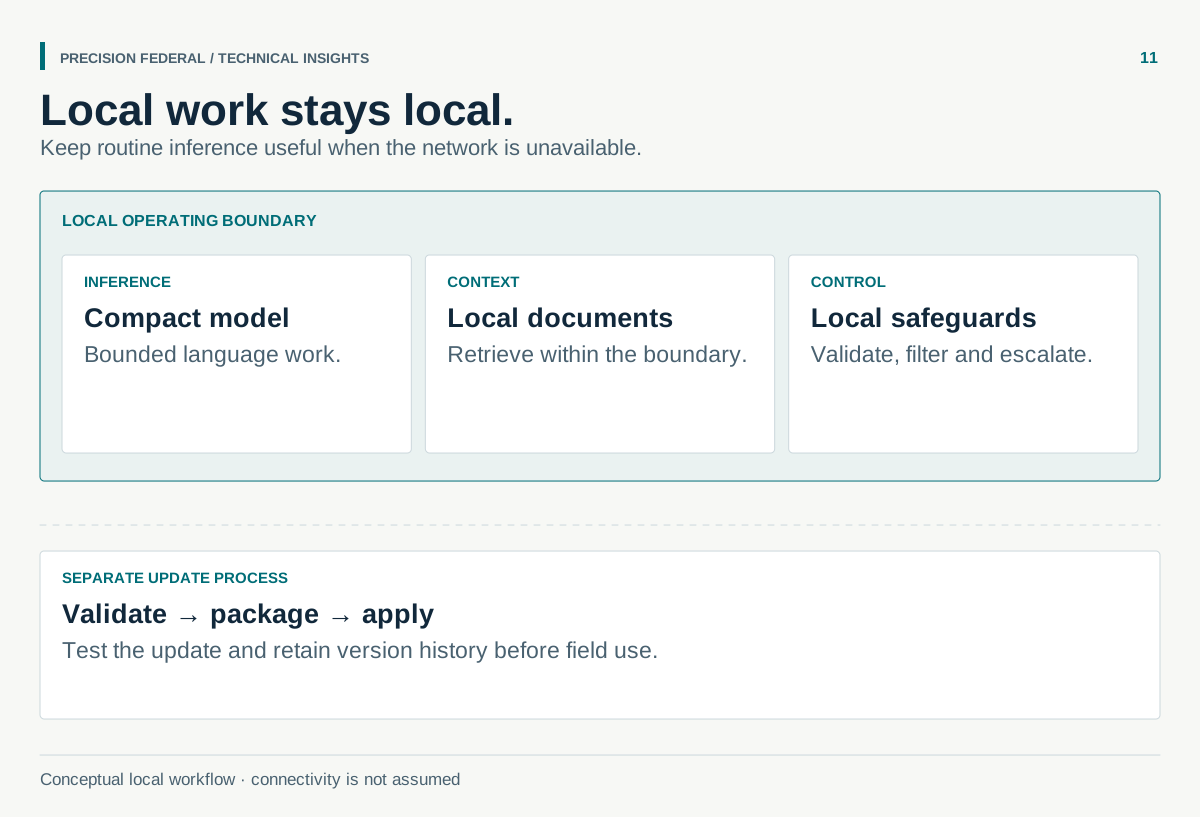
A model that runs where no one is watching needs its guardrails on the device, not in a monitoring service it cannot reach. Input validation, output filtering, refusal on out-of-scope requests, and confidence thresholds that route uncertain cases to a human all live in the local stack, and the goal is graceful degradation: when the model is unsure, the system says so and hands off rather than emitting a confident answer no one can check. Updates are their own discipline offline, since new weights and rules cannot be streamed to a device with no link. The path is deliberate and staged: a validated package is built and tested against the mission test set at a known base, carried to the device through an accredited channel, and applied under version control so the field state is always known. The slowness is a feature, because a bad update on an unreachable device is far harder to recover than one on a service you can roll back.
When the right answer is a hybrid
Not every deployment has to choose one model. A durable pattern puts a small model on the edge for the routine, bounded work and reaches back to a larger model hosted inside an enclave for the harder cases, used only when a link allows. The edge model does structured extraction, classification, and grounded answering continuously; the enclave model handles the long-horizon reasoning and novel synthesis the small class cannot, when it can be reached; and when the link is down the system keeps doing the local work and defers the rest. The design cost is in the seams: deciding which requests stay local and which wait for reachback, keeping the two models coherent, and making the handoff invisible to the user. Because the larger model lives in an accredited enclave rather than a commercial cloud, the data-sovereignty posture holds even when the reasoning is bigger than the edge can carry.
Bottom line
Small language models are not a downgrade accepted under protest; they are the right tool for a large, specific class of federal work, the work that happens inside boundaries a frontier model cannot enter. The teams that succeed treat model size as a first-order constraint, scope the system to what the small class does reliably, compress and evaluate against the real job rather than a benchmark, resolve the license before they build, and reach for a hybrid only when the reasoning truly exceeds the edge. The teams that struggle try to shrink a frontier workflow into a box it was never going to fit, and are surprised when a fluent model quietly gets things wrong.
Common questions on scoping a small-model deployment
Is a smaller model just a worse model?
For open-ended reasoning, yes. For bounded, grounded work, a well-prepared small model can meet the bar the deployment needs, in a place the larger model cannot run at all. The comparison that matters is a model that fields against one that never arrives.
Which license family is safest for government delivery?
Permissive licenses, Apache 2.0 and MIT, are the least encumbered. Custom community licenses can work but need a clause-by-clause read for acceptable-use terms and scale triggers. Research or non-commercial licenses disqualify fielded government use no matter how good the model is.
What hardware do we actually need?
CPU-only for batch extraction and classification, a single consumer-class GPU for interactive drafting and retrieval answering, and a ruggedized box for vehicle or field sites. Size the model to the envelope, not the envelope to the model.
When is a hybrid worth the added complexity?
When the mission has a real tail of hard reasoning the small class cannot serve and an accredited enclave can host the larger model for reachback. If the work is all bounded and grounded, stay fully local and keep it simple.
Frequently asked questions
Roughly the one-to-fifteen-billion-parameter class: large enough to be useful on real language work, small enough to fit on a single accelerator or, in the lower half of the range, a CPU. It is distinct from frontier models that require a served cluster and a reachable network.
They are strong at bounded work: structured extraction, classification, constrained drafting, and answering over a retrieved corpus. They break on long-horizon reasoning and novel synthesis, where the output stays fluent while it stops being correct.
Eight-bit quantization is close to free for many models; four-bit weights-only is usually acceptable for extraction and classification, and activation-aware methods recover much of what naive low-bit quantization loses. The only reliable way to know the cost is to measure against a representative test set.
It depends on the provider's terms; many restrict using a model's outputs to train a competing model, so it is a question for counsel. The safe posture is to distill from teachers whose licenses permit it and to keep provenance records.
Build a mission-representative test set of real inputs labeled with correct answers, held aside from training, and use it for every model, quantization, and prompt decision. Public leaderboards measure a different question and often reflect data that has leaked into training.