
What a consolidation initiative actually is
A state IT consolidation initiative is a statute or executive order that moves technology money, staff, and buying authority out of individual agencies and into one central organization. That organization runs the network, the data centers or the cloud tenancy, the identity system, the help desk, and increasingly the data platform. Agencies stop owning servers and start renting services. The Georgia Technology Authority was created in statute in 2000. Virginia stood up VITA in 2003. Minnesota moved every executive-branch IT employee into MNIT in 2011. Oklahoma consolidated the same year under its Information Technology Consolidation and Coordination Act. Utah went first, in 2005, and still publishes a rate schedule its agencies pay from.
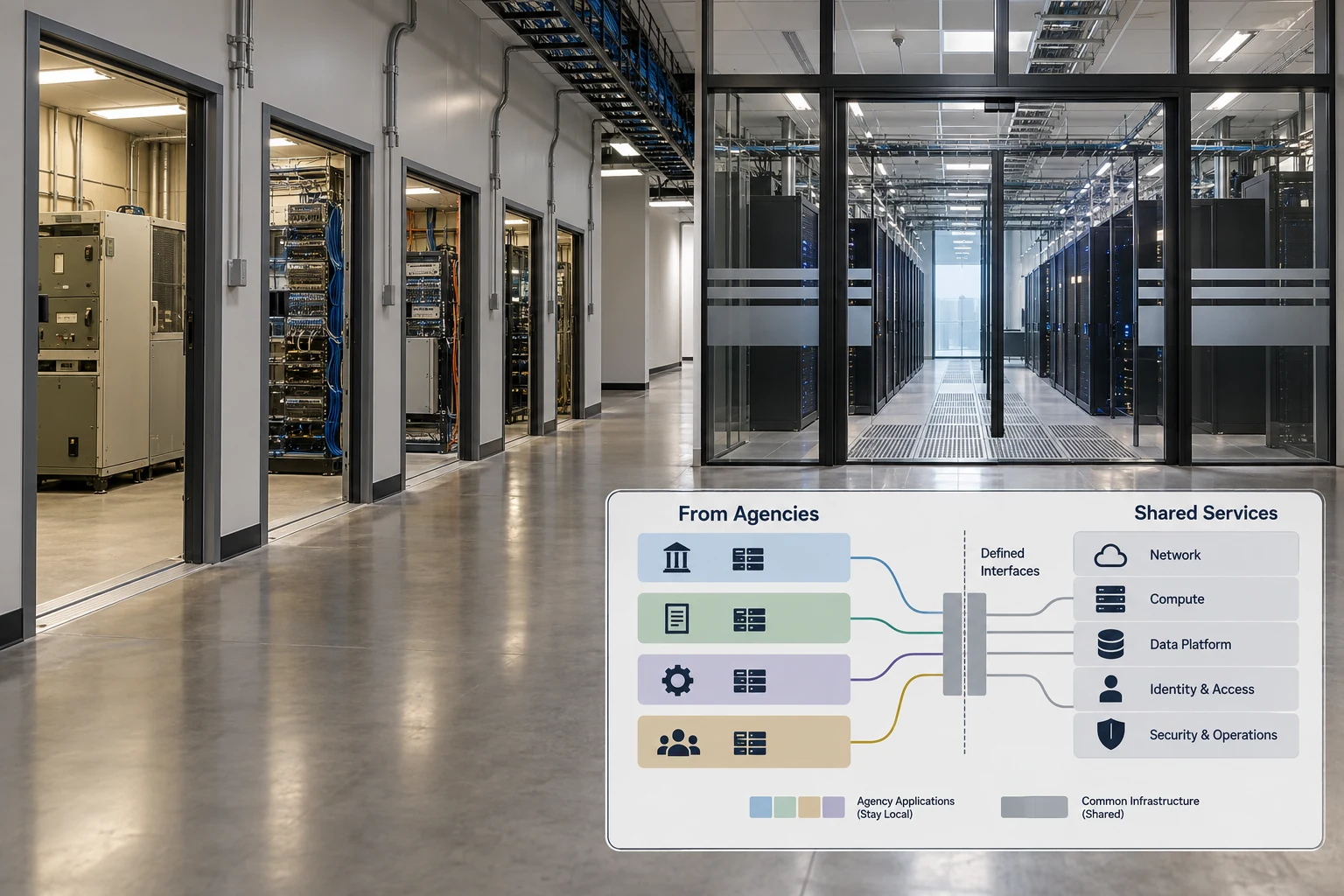
The stated reasons are always the same three: cost, security, and the fact that fifteen agencies were each running a slightly different version of the same thing. The unstated reason is control. A governor who cannot get a straight answer about a failed project has a governance problem, and consolidation is how legislatures answer it. Consolidation and optimization has been a recurring item on the annual state CIO priority survey published by NASCIO for well over a decade, which tells you it is never finished.
For a firm selling engineering work, the practical consequence is narrow and important. In a consolidated state, the agency that has the problem often does not hold the money to solve it, and the office that holds the money did not experience the problem. Selling into that gap is a different motion than selling into a federal program office.
The three governance models, and why the model decides everything
States sort into roughly three patterns, and every question you will ask about a state has a different answer depending on which one you are looking at. Read the model first. Everything else follows from it.
| Governance model | Who holds budget and decision | Where an outside firm enters |
|---|---|---|
| Fully consolidated | Central IT office owns staff, infrastructure, and most application spend. Agencies pay published rates. | Central office vehicles and its prime suppliers. Agency-level selling has almost no purchasing power behind it. |
| Consolidated infrastructure, federated applications | Central office owns network, hosting, identity, security. Agencies keep program application budgets. | Agency-funded application and analytics work, with a central security and architecture review you must pass. |
| Federated with a strong CIO | Agencies own budgets. Central CIO sets standards, approves projects above a threshold, and runs statewide contracts. | Agency buys, central office approves. You need both conversations and they are different conversations. |
| Decentralized | Agencies own nearly everything. Central office is a standards body and a contract shop. | Direct agency relationships, statewide term contracts used as a convenience. |
| Broker or service-integrator model | Central office buys through a multi-supplier arrangement coordinated by a service integrator. | Subcontract to a supplier already inside the arrangement. Direct entry is rare between competitions. |
The broker model deserves a note because it is where the largest states have landed. Virginia's first consolidation contract was a single ten-year outsourcing deal signed in 2005 worth roughly two billion dollars, and it went badly enough in public that the state restructured into a multi-supplier arrangement with a service integrator sitting on top. Georgia's enterprise services program runs the same way. When you read that a state has "one big IT contract," check the date. Most of those single-prime deals were broken into towers years ago, and each tower is a separate door.
You can identify a state's model in an afternoon without talking to anyone. Read the enabling statute for the central IT organization and note whether it says agencies "shall" transfer resources or "may" participate. Pull the organization chart and see whether agency IT directors report to the state CIO or to their own agency head. Then open any mid-sized agency's budget document and look for how technology appears: a personnel and equipment line means the agency still buys, and a payment to a central services fund means it does not. Those three documents settle the question that all your other questions depend on.
Who signs, and who can stop it
Four offices matter, and only one of them is the CIO.
The state CIO. Sets standards, owns the enterprise services, and in a consolidated state controls whether your product is allowed on the network at all. In California, the Department of Technology operates under Government Code section 11545 and runs a four-stage Project Approval Lifecycle. A project that has not cleared Stage 2, the alternatives analysis, cannot be procured. Knowing which stage a project sits in tells you how far away the money is.
The chief procurement officer. A separate office in most states, usually inside a Department of Administration or General Services. The CIO can want you. The CPO decides whether the contract is legal.
The oversight board. Many states seat a technology board or council with statutory authority to approve projects above a dollar threshold. These bodies meet on a published calendar and post their packets. They are the single best free intelligence source about what a state is about to buy.
The legislature. Consolidation programs live on appropriations, and appropriations are annual or biennial. A contract signed against an unfunded second year is a contract with a non-appropriation clause in it, and that clause is real.
There is a fifth person who signs nothing and decides a great deal: the program business owner inside the agency. The Medicaid director, the workforce agency's data lead, the corrections records manager. They cannot execute a contract in a consolidated state and they are the only people who know whether the requirement as written will solve anything. Sell to them for the requirement and to the central office for the contract, and never let one of those conversations be the only one you are having. A firm that has the business owner and not the CIO gets a scope that never gets funded. A firm that has the CIO and not the business owner gets a contract nobody uses.
Entry routes into a consolidated state, by practical traction
Editorial weighting from public procurement records and practitioner reading. Illustrative, not a measured statistic.
The money: internal service funds and the rate card
Consolidated IT organizations are usually funded as internal service funds. They do not receive a general appropriation for operations. They bill agencies for what agencies consume, at rates published in advance and approved by a board or the budget office. Per seat. Per virtual machine. Per terabyte. Per ticket.
This matters to a vendor for one reason. If your work can be folded into a rate, the central office can buy it once and recover the cost across every agency, and your addressable customer is the state. If it cannot, an individual agency has to find discretionary program dollars, and your addressable customer is one program manager with a tight budget. The first conversation to have with a consolidated CIO's office is not about your product. It is about whether the thing you do becomes a line on the rate card or stays a project.
What consolidated offices are buying right now
The first wave of consolidation was infrastructure: close the agency server rooms, standardize the network, put everyone on one email tenant. That wave is largely done in the states that started early, and it produced a second problem the central office now owns. Forty agencies' worth of data landed in one place with forty different schemas, forty different retention rules, and no shared definition of a person, a case, or an address.
So the current buying is concentrated in a short list. Cloud landing zones and the governance to keep agency workloads inside them. Enterprise identity, because a consolidated help desk cannot support forty directories. Statewide data platforms with a lakehouse pattern underneath and agency-scoped access on top. Master data management and record matching across health, human services, and corrections, which is where machine learning actually earns its place in state government. Legacy application remediation, including the mainframe work that never went away. Accessibility remediation across inherited web properties. And service management data, because an internal service fund has to be able to prove what it billed for.
Every one of those is an engineering problem with an auditable output, which is the useful thing about state work. The buyer can check whether the records matched, whether the query returns, whether the page passes a conformance scan. That is a market where a firm that builds carefully has an advantage over a firm that presents well.
Where the federal government sits inside a state IT program
A large share of state technology spending is federal money moving through a state agency, and that changes the rules on top of the state's own.
Medicaid systems carry the richest match in government. Under section 1903(a)(3) of the Social Security Act and the implementing rules at 42 CFR 433.111 through 433.120, federal financial participation covers 90 percent of design, development, and installation for mechanized claims processing and information retrieval systems, and 75 percent of operations for an approved system. Child support enforcement systems draw 66 percent under 45 CFR 304.20. Those systems are procured through the Advance Planning Document process at 45 CFR Part 95, Subpart F, which means the federal awarding agency reviews the acquisition before the state may sign, and above a federally set dollar threshold that review is a hard prior approval.
Everything funded by a federal award also carries the Uniform Guidance at 2 CFR Part 200. The provision most often misread is 2 CFR 200.317: a state, unlike other recipients, follows its own documented procurement procedures when spending federal award money, subject to the specific sections listed there and the contract provisions in Appendix II. So the state's rules govern the competition, and the federal rules govern the clauses. The federal thresholds still show up in the state's own policy language: the micro-purchase threshold of $10,000 and the simplified acquisition threshold of $250,000 defined in 2 CFR 200.1 are quoted in state manuals constantly. And any subrecipient expending $1,000,000 or more in federal awards in a fiscal year triggers a single audit under 2 CFR 200.501.
How a vendor gets registered and found
Registration is cheap, slow, and non-negotiable. There is no shortcut and no reason to delay it.
First, the corporate step. Register as a foreign corporation with the secretary of state, appoint a registered agent with a physical address in the state, and get a state tax account. Buyers verify this before award, and in some states before you can even complete portal registration. It typically costs a few hundred dollars plus an annual agent fee.
Second, the portal. Every state runs one system of record for bidders. Virginia uses eVA and mandates it for state agency purchasing, with vendor registration and transaction fees attached. Texas maintains the Centralized Master Bidders List and posts solicitations to the Electronic State Business Daily. California runs Cal eProcure. Georgia buys through Team Georgia Marketplace. Registration is where you attach commodity codes, and codes are what generate the emails that tell you a solicitation exists.
Third, and this is the step most firms skip, get onto a vehicle. In Texas, the Department of Information Resources holds cooperative contracts under Government Code chapters 2054 and 2157 that state agencies, local governments, and school districts buy from directly, and a vendor gets one by responding to a DIR Request for Offer when the category reopens. Cooperative master agreements run through NASPO ValuePoint on a lead-state model: one state competes the award, other states join by signing a participating addendum, and the administering association takes a fraction of a percent on sales. California's multiple award schedule program lets a vendor build a state contract on top of a competitively awarded federal schedule, which is the one place a federal GSA position converts into state access almost directly.
Entry sequence into one consolidated state
Typical contract sizes and terms
Four size bands cover almost everything a consolidated state buys.
Enterprise services towers. Network, hosting, end-user computing, service desk. Hundreds of millions of dollars across five to ten years, competed on a multi-year cycle, and essentially closed to newcomers except as subcontractors.
Major program modernizations. Medicaid systems, unemployment insurance, tax and revenue, child welfare. Tens of millions to a few hundred million, multi-year, federally matched and federally reviewed. These are integrator-led and subcontractor-rich.
Task orders under a statewide vehicle. The working band for an engineering firm, commonly $50,000 to $2,000,000. Competed among vehicle holders, awarded in weeks rather than quarters, and where a data platform, an ML pipeline, or an analytics product actually gets bought.
Informal and small purchases. Below the state's formal bid threshold, often somewhere between $10,000 and $100,000 depending on the state, a buyer can award with a handful of quotes. Small, fast, and the cheapest way in the world to become a known quantity.
Price the vehicle fee before you price the work. Cooperative contracts recover their administration through a percentage of sales that the vendor remits, and the participating state sometimes adds its own on top. The rates are small, commonly a fraction of a percent up to about two percent depending on the program, but they come off your margin rather than the customer's budget, and they compound with the reporting burden: most vehicles require quarterly sales reporting whether or not you sold anything that quarter. Missing those reports is one of the more common ways a firm quietly loses a contract it worked nine months to get.
On terms, expect a base period with renewal options rather than a long firm term, a non-appropriation clause, state-law venue, and a prompt-payment statute that both binds the state and caps your remedy. Texas is a clean example: Government Code chapter 2251 makes payment due within 30 days and accrues interest at the prime rate plus one percent when the state is late.
What actually blocks an out-of-state firm
Preference law is the barrier everyone expects and it is rarely the one that stops the deal. We cover the arithmetic of resident and reciprocal preference in a separate piece. Four other things do more damage.
The security regime attached to the data. This is the real gate. Criminal justice data brings the FBI CJIS Security Policy, including fingerprint-based background checks and a signed security addendum for every person with access. Federal tax information brings IRS Publication 1075, with its own personnel screening and reporting obligations. Health agency data brings HIPAA. Cloud services in Texas must hold a TX-RAMP certification under Government Code section 2054.0593, created by Senate Bill 475 in 2021. A growing group of states recognize GovRAMP, the program formerly known as StateRAMP, and some require it outright. Each of these is months of work and none of them can be started the week the solicitation drops.
Terms you cannot sign. Unlimited or uncapped liability, full IP assignment of pre-existing tools, broad indemnification, and cyber liability limits that outrun a small firm's policy. Read the standard terms attached to the vehicle before you chase the opportunity, because those terms usually are not negotiable at the task-order stage.
Insurance and residency of people. Professional liability and cyber coverage in the low millions is standard. Some solicitations require key personnel to be physically present, or require that data never leave the state, which is a data center question and a staffing question at the same time.
Being invisible when the requirement forms. By the time an RFP publishes, the requirement has usually been shaped by someone the buyer already knows. That is not corruption. It is what happens when a program manager needs help writing an alternatives analysis and calls whoever answered last time.
The accessibility deadline sitting on top of all of this
One rule is reshaping state digital work right now and belongs in every conversation this year. In April 2024 the Department of Justice issued a final rule under Title II of the Americans with Disabilities Act, codified at 28 CFR Part 35, requiring state and local government web content and mobile applications to conform to WCAG 2.1 Level AA. For state governments and public entities serving populations of 50,000 or more, the compliance date is April 24, 2026. Smaller entities and special districts have until April 26, 2027.
Section 508 of the Rehabilitation Act binds federal agencies, not states directly, though it reaches state purchasing through Assistive Technology Act grant assurances. The Title II rule is different. It applies to the state itself, it has a date on it, and consolidated IT offices are the ones being asked to answer for hundreds of agency sites and applications they inherited. Remediation, automated conformance testing, accessible data visualization, and document pipelines are live budget lines in most states this year.
The first move that actually works
Pick one state. Not a region, not a tier of states. One.
Read three documents before you spend a dollar: the state's current IT strategic plan, the consolidated office's published rate schedule, and the last two years of technology board meeting packets. Between them you will learn what the state says it is doing, what it charges for, and what it is about to buy. Then do the registration work in parallel with a single specific pursuit, and make the first pursuit small on purpose. A $60,000 scoped deliverable that lands on time is worth more to a second bid than a lost $3,000,000 proposal.
Our team does exactly this work for state and local customers alongside our federal practice: the data platform, the model, the pipeline, and the evidence that it holds up under audit. We take work directly where the vehicle allows it and as a partner where the program is already staffed.
Go / no-go: is this state worth a quarter of your effort?
- You can name the governance model and the office that signs the contract.
- A vehicle exists that you can realistically join inside two quarters, or an incumbent will sub to you now.
- Foreign registration, registered agent, and state tax nexus are priced into the bid, not discovered after award.
- You have read the standard terms and you will sign them without a fight over liability or IP.
- The data class is identified and you know which security regime it drags in.
- The funding source is named, and the appropriation runs at least as long as the period of performance.
- Preference math has been run against the in-state firm most likely to bid the same scope.
- There is one named person inside the agency or the central office who answers your email.
Six or more yes answers means commit the quarter. Four or five means find a subcontract instead of a prime bid. Three or fewer means the state is not ready for you or you are not ready for the state, and either way the money is better spent elsewhere.
Common questions on entering a consolidated state
Does consolidation shrink the market for outside firms?
It concentrates it. Fewer buyers, larger contracts, and a higher barrier at the front door. What it does not do is reduce the amount of engineering work, because a central office running services for forty agencies has more integration and data work than any single agency ever had.
Do we have to open an office in the state?
Usually no. Foreign corporation registration and a registered agent satisfy the legal requirement in most states. A physical office matters when a preference statute rewards it, when a solicitation requires on-site key personnel, or when a data residency clause applies.
Is a federal GSA Schedule worth anything at the state level?
Sometimes directly and always indirectly. California's multiple award schedule program builds state contracts on top of competitively awarded federal schedules. Elsewhere a federal award is evidence of responsibility and pricing reasonableness, which is not nothing when the state has never heard of you.
What happens to our contract when the CIO changes?
The contract survives. The roadmap does not. New CIOs arrive with a priority list, and work that was not on it gets slowed at renewal. The protection is having your work embedded in a rate-recovered service or a federally matched program rather than in a discretionary initiative.
Bottom line
State IT consolidation moved the buying decision, not the work. The engineering still has to be done, and consolidated offices are chronically short of people who can build a data platform, stand up a model, and document it well enough to survive an auditor. The firms that win in that market treat registration as infrastructure, pick one state at a time, read the rate card before the RFP, and get their first contract small and clean. That is the whole method, and it is available to anyone willing to do the unglamorous part first.
Frequently asked questions
A statutory or executive action that moves technology staff, infrastructure, and buying authority from individual agencies into one central state IT organization. Agencies then consume services from that organization and pay published rates rather than owning their own systems.
Typically four parties in sequence: the sponsoring agency, the state CIO's office for architecture and security, the chief procurement officer for contract legality, and a technology oversight board for projects above a dollar threshold. Federally funded systems add a federal prior-approval step.
Register with the secretary of state and the bidder portal first, then respond to the solicitation that competes the vehicle itself. Cooperative master agreements are joined by signing a participating addendum with a state that wants to use the award.
When federal award money is involved, 2 CFR Part 200 applies. Under 2 CFR 200.317 a state uses its own procurement procedures, subject to the listed sections and the contract provisions in Appendix II. Program-specific rules add more, such as the Advance Planning Document process at 45 CFR Part 95 Subpart F for Medicaid and child support systems.
Yes, routinely. Preference statutes usually apply a percentage adjustment during evaluation rather than an outright bar. The harder barriers are security certifications tied to the data class, contract terms around liability and intellectual property, and simply not being known before the requirement is written.