The requirement arrives as a sentence about someone else's network
It rarely arrives as a specification. It arrives mid-meeting, as an aside: the data cannot leave our environment. For a team built on hosted model APIs, the instinct is to treat that as a hosting change — same product, different address. It is not. Egress is load-bearing in almost every modern AI stack, and removing it changes model selection, evaluation, release engineering, and support all at once. The projects that go badly are the ones that discover this one surprise at a time, after a date has been promised.
Pin the requirement down first, because "cannot leave" means at least four different things and each costs differently. It can mean a customer-controlled cloud tenancy with egress blocked by network policy, where instances still get patched through an approved path. It can mean their own datacenter behind an outbound proxy and a narrow allow-list. It can mean genuinely disconnected — no route outward at all, updated only by physical media through a documented transfer procedure. Or it can mean an accredited enclave at a stated impact level, where the binding constraint is not network topology but the authorization package the system has to fit into.
These are not points on a spectrum you slide along later; they imply different architectures. Ask which one, in writing, before quoting anything — what air-gapping actually costs walks the commercial consequences, and what impact levels change for an AI workload covers the federal side.
You will not be picking the hardware
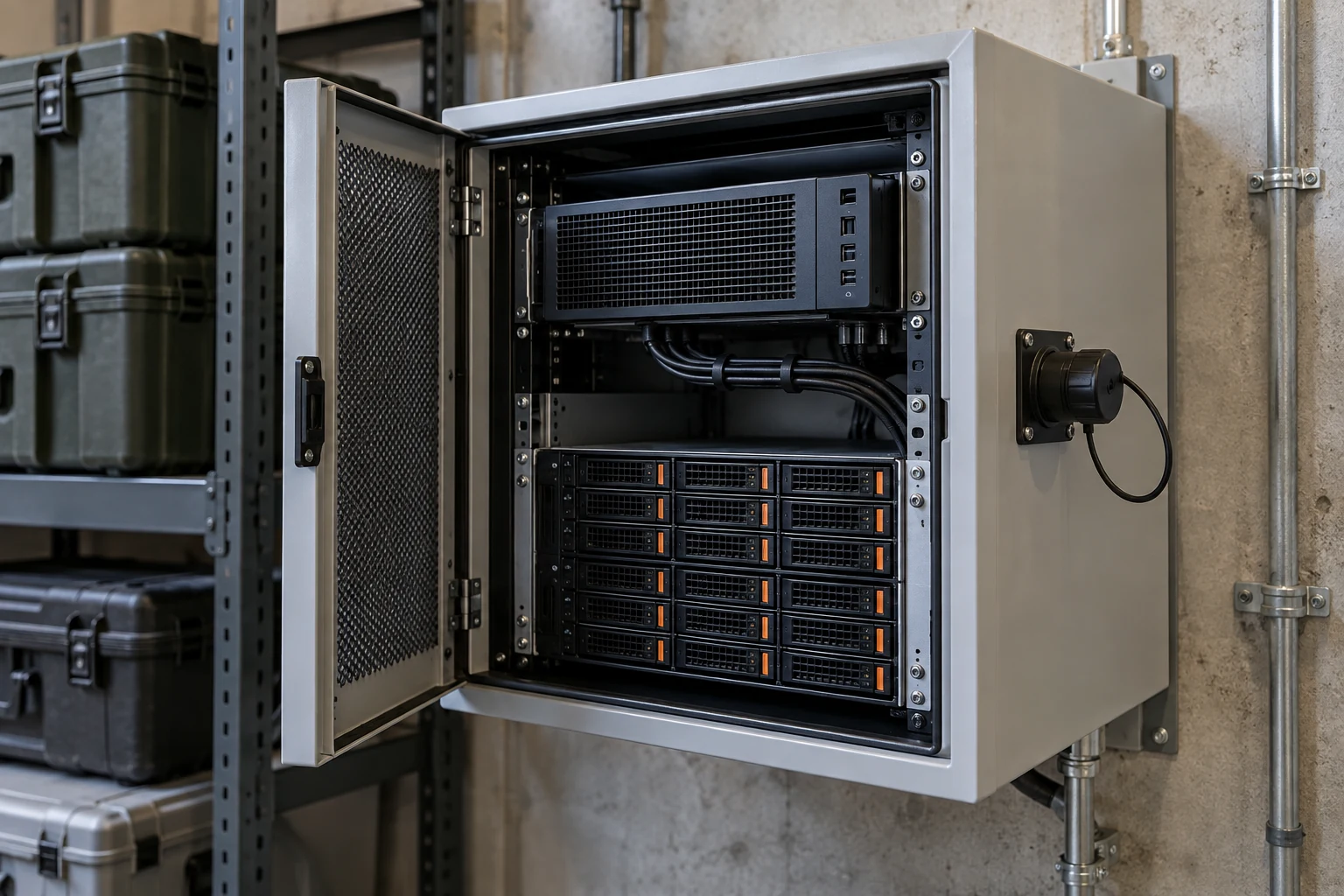
In a hosted deployment you choose the instance type. Inside someone else's boundary the compute already exists, is already authorized, and is already inventoried in a system security plan. That inverts the usual order of decisions, and the inversion is the most useful thing to internalize early.
Adding a card is not a purchase, it is a configuration change. NIST SP 800-53 Rev. 5 routes changes through a configuration change control process (CM-3), and a large enough change becomes a "significant change" under NIST SP 800-37 Rev. 2 — defined there as one likely to substantively affect the security or privacy posture of a system — which can trigger reauthorization. "We will just add a GPU" is a schedule item measured in months, not a line item measured in dollars.
The installed hardware is usually a generation or two behind current, and the number that matters is memory, not throughput. From NVIDIA's published datasheets: the A100 ships in 40 GB and 80 GB configurations, the H100 SXM at 80 GB of HBM3, the inference-oriented L40S at 48 GB of GDDR6. Capacity decides whether a model runs at all; bandwidth only decides how fast once it fits. At the most sensitive tiers the hosting question is settled before you arrive — DISA's Cloud Computing Security Requirements Guide, which defines the DoD impact levels, places controlled unclassified information at IL4 and IL5, with IL5 also covering unclassified National Security Systems, and reserves IL6 for information classified up to Secret on infrastructure connected to a classified network. The practical translation: the reachback a commercial design assumes is not merely discouraged. There is nothing on the other end of it.
The memory arithmetic almost nobody does up front
Most model-selection conversations start with quality and end in a surprise. Reverse the order. The memory ceiling produces a short list, and you choose the best model on that list — not the other way around.
Three things consume GPU memory. Weights are the obvious one: parameter count multiplied by bytes per parameter, plus the per-group scales and zero points that quantized formats carry. The KV cache is the one that surprises people, because it grows with context length and with the number of requests in flight simultaneously. Per token it costs two tensors (keys and values) for every layer, for every key/value head, at the head dimension, in whatever precision the cache is held. Grouped-query attention — introduced in "GQA: Training Generalized Multi-Query Transformer Models from Multi-Head Checkpoints" (Ainslie et al., EMNLP 2023) and now standard in open-weight models — shrinks that by letting several query heads share one key/value head. Third is runtime overhead: activations, framework allocations, and fragmentation. The vLLM paper, "Efficient Memory Management for Large Language Model Serving with PagedAttention" (Kwon et al., SOSP 2023), measured that prior serving systems held actual token state in only 20.4%–38.2% of the KV-cache memory they allocated, the rest lost to fragmentation and over-reservation; the paged allocator that fixes it works by reserving a pool up front, which is memory you must budget rather than memory you get back.
| Memory consumer | What sets it | Illustrative figure |
|---|---|---|
| Model weights | Parameter count × bytes per parameter, plus per-group scales and zero points | A 32-billion-parameter model at 4-bit weights is roughly 16 GB before quantization metadata |
| KV cache, per token | 2 (keys and values) × layers × key/value heads × head dimension × bytes per element | 32 layers, 8 KV heads, head dimension 128, 16-bit cache → 128 KiB per token |
| KV cache, per sequence | Per-token cost × context length actually used | An 8,192-token context → about 1 GiB for one in-flight sequence |
| KV cache, at concurrency | Per-sequence cost × sequences served simultaneously | 16 concurrent users at that context → about 16 GiB, on top of the weights |
| Runtime and fragmentation headroom | Serving framework, batch shape, allocator behavior | Reserved explicitly by the server; not free space you can spend twice |
| What is left | Card capacity minus everything above | On a 48 GB card the two figures above already account for most of it |
Illustrative arithmetic, not a measurement of any deployed system. The per-token expression is the standard one for a transformer with grouped-query attention; substitute the real layer count, KV-head count, head dimension, and cache precision for the model under consideration. Sources: Ainslie et al., EMNLP 2023 (GQA); Kwon et al., SOSP 2023 (PagedAttention).
The row that decides the design is concurrency. A model that fits comfortably for one analyst at an 8,000-token context may not fit for sixteen analysts at once, and concurrency is almost always what the customer actually needs. Two numbers — peak simultaneous users and maximum context length — constrain the candidate list more than any benchmark score does. Get both in the first conversation.
What quantization buys, and what it costs
Quantization is the standard lever for fitting under the ceiling. The two post-training methods most widely implemented in open tooling are GPTQ, from "GPTQ: Accurate Post-Training Quantization for Generative Pre-trained Transformers" (Frantar et al., ICLR 2023), and AWQ, from "AWQ: Activation-aware Weight Quantization for LLM Compression and Acceleration" (Lin et al., MLSys 2024). Four-bit weight quantization cuts the weight footprint to roughly a quarter of 16-bit, which is frequently the difference between fitting on the installed card and not.
It is not free, and the honest version of the cost is that it is task-dependent and not predictable from published averages. Those averages are measured on public benchmarks. Your customer's corpus — open-source intelligence reporting, claims files, maintenance narratives, sensor logs — is not those benchmarks, and degradation on a specialized corpus can differ sharply from the aggregate. The only number that means anything is measured on their data, inside their boundary; anyone quoting a quality delta before that measurement exists is quoting somebody else's result. Quantizing the KV cache is a separate lever with a separate cost, and often the one that actually buys the concurrency, so evaluate it on its own rather than folding it into a single "we quantized it" claim. For the smaller end of the range, small language models for federal edge deployments covers what that class does well and where it breaks.
The weights have to get through the door too
Model files are software, and they enter the boundary the way software enters it: on approved media, hash-verified against a value obtained through a separate channel, scanned, and recorded. Two details matter more than teams expect.
The first is file format. Checkpoints serialized with Python's pickle protocol reconstruct arbitrary objects on load, so loading an untrusted checkpoint can execute arbitrary code — a property acknowledged in the PyTorch documentation and the reason Hugging Face introduced safetensors, a container holding raw tensor data with no embedded executable logic, subsequently put through a published security audit. Where you cannot simply re-download and try again, prefer safetensors and record the format in the package rather than leaving it implicit.
The second is that nothing installs itself. No package resolution at runtime, no weight download at first boot, no license or telemetry handshake. Every dependency is mirrored and carried in as a fixed set — an offline install against a local wheel directory with the public index disabled, and a container image built outside and transferred whole. That is the shape of the build we describe on our classified AI capability page: open-weight models imported through the accredited transfer path with SHA-256 verification and registration in a model registry, served on vLLM, TensorRT-LLM, llama.cpp, or Triton with nothing reaching outward, retrieval self-hosted on Qdrant, Milvus, Weaviate, or pgvector with classification labels carried at the chunk level.
Evaluating when nothing can be sent out
The standard evaluation loop assumes egress in three places at once: a hosted judge model, a public leaderboard for comparison, and telemetry reporting how the deployed system behaves. All three are gone, and what replaces them has to be built before the install — because afterward, the people who can see the data are not you.
The golden set is the center of it. It is assembled inside the boundary by people authorized to see the data, and it never leaves, which makes the customer's staff time a line item in your plan rather than an assumption. Judging can still be automated — the LLM-as-judge method from "Judging LLM-as-a-Judge with MT-Bench and Chatbot Arena" (Zheng et al., NeurIPS 2023) works offline — but the judge is now a model you carried in, and a judge from the same family as the system under test will flatter it. Report per-item results the customer can inspect rather than one average, because averages hide exactly the failures that matter in a mission workflow. Our piece on red flags in an AI benchmark goes further into how these numbers get inflated.
- Real documents — drawn from the corpus the system will actually serve, not synthetic stand-ins written to be easy.
- The failures they already know about — every organization has a list of cases their current process gets wrong. That list is the most valuable test data in the building.
- Abstention items — questions the correct answer to which is "not in the corpus." A model that never declines is a liability in an analytic workflow.
- Long-context items at the real ceiling — quality at 2,000 tokens tells you very little about quality at 100,000.
- Latency under concurrency — measured at peak simultaneous users on the actual hardware, not single-request timings.
- A frozen version and a changelog — an evaluation set that quietly changes between runs cannot support a claim about a release.
Determinism is what they will actually test
Assessors and customer engineers reach for reproducibility early, because it is easy to check and it reveals whether a system is understood. Be precise about what can honestly be promised. PyTorch's own reproducibility documentation states that "completely reproducible results are not guaranteed across PyTorch releases, individual commits, or different platforms," and that results "may not be reproducible between CPU and GPU executions, even when using identical seeds." The torch.use_deterministic_algorithms() switch forces deterministic kernels where they exist and raises an error where they do not, at a performance cost the documentation is explicit about.
There is a second effect specific to serving. Continuous batching changes the shape of the reductions inside a forward pass, and floating-point summation is not associative, so identical prompts can produce slightly different logits depending on what else happened to be in the batch. If a claim of determinism goes into an authorization package, scope it to a stated configuration — greedy decoding, fixed batch composition, pinned framework and driver versions — and say so in that language. A promise that quietly depends on an idle server is a promise that fails during the customer's own testing.
The update path is the architecture
In a connected product, release cadence is yours to choose. Inside a boundary it belongs to the transfer window. Media transfers are scheduled, reviewed, and often mediated by a cross-domain solution from the certified baseline maintained by the National Cross Domain Strategy and Management Office at NSA. If transfers happen monthly, the patch clock is monthly, regardless of what upstream projects do.
Three design consequences follow. Ship a bundle rather than a stream: one signed artifact carrying weights, container images, dependency wheels, the evaluation set, release notes, and a bill of materials. That bill of materials is not decorative — NTIA's Minimum Elements for a Software Bill of Materials, published 12 July 2021 under Executive Order 14028, defines the baseline data fields and names SPDX, CycloneDX, and SWID as acceptable formats, and it is how the receiving security team decides whether your update contains anything they must act on. Second, treat patching as a control rather than a courtesy: SI-2 (flaw remediation) and SA-22 (unsupported system components) in NIST SP 800-53 Rev. 5 are the ones that bite, and SA-22 requires replacing components once the developer or vendor stops supporting them, or arranging alternative support. A dependency you pinned and forgot becomes a finding when it goes end-of-life inside an enclave nobody can reach. Third, keep expensive changes rare — swapping model families or inference runtimes can meet the significant-change threshold in NIST SP 800-37 Rev. 2 and pull the system back through reauthorization, so design an interface and container that stay stable while the weights behind them change.
- Which of the four meanings of "cannot leave" applies — in writing
- The exact installed hardware, including memory per card and card count
- Maximum context length and peak concurrent users
- Who builds the evaluation set, when, and who is cleared to see the data
- Transfer window cadence and who approves a transfer
- What the customer's logging platform ingests, and in what format
- Who signs the authorization, and what evidence they expect from you
Support with the telemetry switched off
No crash reports arrive, no usage analytics accumulate, no remote session is possible. Logs go to the customer's own monitoring stack and stay there, so the system has to explain itself locally: visible version stamps, health endpoints stating what is loaded, and a diagnostic bundle the customer can generate, review, and choose whether to release. The first responder to any incident is their engineer, not yours — so documentation and error messages carry weight they never carry in a hosted product, and the support contract has to price that rather than assume it away. The companion piece on headless deployment into a customer-controlled sandbox covers the interface contract in more depth.
Where our scope ends
Being specific about refusals is more useful than claiming breadth, so here is ours on this subject.
We do not issue authorizations and will not quote you an accreditation date
An authorization to operate is a government authorizing official's decision. We build to the control set, produce the evidence, and write the sections of the security plan that describe what we built. Any date beyond that is the authorizing official's to set, and a vendor promising one is promising something outside their control.
We will not tell you a model or container arrives pre-accredited, because nothing does
Platforms carry authorizations; components inherit controls from them, and inheritance has to be documented as inheritance — provider-side, shared, or ours. Letting a hosting platform's authorization stand in for a statement about the code and weights we delivered fails on first contact with anyone who reads the package carefully.
We will not promise an accuracy number on data we have never been allowed to see
This is the one most specific to disconnected work. We can commit to a measurement method, an evaluation set design, and a threshold that triggers a rebuild — all agreed in advance. We cannot commit to a score before the corpus has been measured inside the boundary, and a firm that does is guessing with your schedule.
We hold no facility clearance today and do not perform classified work on classified networks
Much of what this article describes applies at controlled-unclassified sensitivity, where this is not a limitation. But if the work itself must be executed on a classified network, it goes to a cleared performer rather than to us. Better established at the outset than discovered at a kickoff.
We do not assess our own work, and we are not a training vendor
If we built the system, an independent party assesses it; grading our own homework is not an assessment and an evaluator who notices the arrangement discounts everything attached to it. We are also not a C3PAO and cannot certify you for CMMC, we do not run courses, and we do not write proposals for other firms.
How an engagement starts
The first conversation is short and mostly diagnostic. Which of the four constraints applies. What hardware is already installed and authorized. What peak concurrency and context length really are. Who can build an evaluation set, and when. What the transfer cadence is. Those answers decide whether the honest recommendation is a bespoke small model, an off-the-shelf open-weight model with retrieval, or a different architecture entirely — and they decide it before anyone has spent money on the wrong one. Reach us through the contact form; a paragraph describing the situation is enough to start, and if the work belongs somewhere else we will say so. Our standing scope and refusals are written out at what we build and what we decline.
Where to check this yourself
Every external claim above traces to a primary document. These are the documents, not summaries of them.
- NIST SP 800-37 Rev. 2 — the Risk Management Framework, including significant change, ongoing authorization, and reauthorization. csrc.nist.gov
- NIST SP 800-53 Rev. 5 — CM-3 configuration change control, SI-2 flaw remediation, SA-22 unsupported system components. csrc.nist.gov
- DoD Cloud Computing Security Requirements Guide — the definition of impact levels IL2 through IL6, published by DISA. cyber.mil
- NTIA, The Minimum Elements For a Software Bill of Materials, 12 July 2021, issued under EO 14028. ntia.gov
- National Cross Domain Strategy and Management Office — the NSA office maintaining the certified cross domain solution baseline. nsa.gov
- Kwon et al., "Efficient Memory Management for Large Language Model Serving with PagedAttention," SOSP 2023 — KV-cache fragmentation and paged allocation. arXiv:2309.06180
- Ainslie et al., "GQA: Training Generalized Multi-Query Transformer Models from Multi-Head Checkpoints," EMNLP 2023. arXiv:2305.13245
- Frantar et al., "GPTQ," ICLR 2023 and Lin et al., "AWQ," MLSys 2024 — the two widely implemented post-training quantization methods. arXiv:2210.17323 · arXiv:2306.00978
- Hugging Face safetensors security audit — the format and what it removes relative to pickle-based checkpoints. huggingface.co
- PyTorch reproducibility notes — determinism guarantees, and their limits. docs.pytorch.org
Related reading on this site: air-gapped inference and what actually runs with no network, GPU capacity planning for federal AI workloads, and SBOM and software supply chain for federal AI.
Frequently asked questions
Work it out from memory rather than from model reputation. Weights cost parameter count times bytes per parameter; the KV cache costs two tensors per layer per key/value head per token, multiplied by context length and by the number of requests in flight; the serving framework reserves additional headroom. Peak concurrency and maximum context length usually constrain the answer more than the weights do.
Yes, by an amount that depends on the model and the task, and published averages on public benchmarks are a poor predictor for a specialized corpus. Treat quantization as a hypothesis to be tested on the customer's own data inside their boundary, and evaluate weight quantization and KV-cache quantization separately, since they trade off differently.
The evaluation set is built and held inside the boundary by people authorized to see the data, and any automated judge is a model carried in with the release rather than a hosted API. Budget the customer's staff time for it explicitly, freeze and version the set, and report per-item results that can be inspected rather than a single aggregate score.
Only within a stated configuration. PyTorch's documentation says reproducible results are not guaranteed across releases, commits, or platforms, and continuous batching alters floating-point reduction order so batch composition can shift logits slightly. Scope any determinism claim to greedy decoding, fixed batching, and pinned versions, and write it that way in the package.
As often as the transfer window allows, which is a customer process, not an engineering choice. Ship one signed bundle containing weights, images, dependencies, evaluation set, notes, and a software bill of materials, and design so that routine updates change weights behind a stable interface — larger changes can meet the significant-change threshold in NIST SP 800-37 Rev. 2 and pull the system back through reauthorization.