
The spreadsheet is a strong incumbent and it deserves respect
Walk into a mechanical contractor, a sign shop, a custom fabricator or a staffing firm and you will find the same thing: one workbook, owned by one person, refined over years, that turns a set of requirements into a price. It is fast. It bends to any job. The estimator trusts it because they built it, and they can explain every number in it to the owner. Any replacement is competing against that, and most replacements lose. Understanding why the spreadsheet wins is the only useful starting point.

What it is genuinely bad at is a shorter list, and each item costs real money. Version drift, so three estimators are pricing off three different labor burdens. No history, so nobody can compare what was bid to what the job actually cost. Stale cost, because the copper or resin or freight number was pasted in eight months ago. Single-person risk, because the person who understands the formulas is one resignation away. And no quote log, which means you cannot answer the question that matters most: which quotes did we lose, and by how much.
Notice that four of those five are about information, not speed. Speed is what estimators complain about, and it is usually not the biggest number in the business case.
You are probably here because
- Quotes take days and the fast competitor is winning work you should have won
- A job came in far under its estimate and nobody can reconstruct how it was priced
- Your best estimator is retiring in two years and it is all in their head
- Discounts are being given at the salesperson's discretion and margin is drifting down
Those are four different projects. The first is workflow, the second is history, the third is knowledge capture and the fourth is a rules problem. Deciding which one you are actually solving is most of the work.
Two different jobs share one word
Configure and price means the thing you sell is assembled from a catalog with rules. A window manufacturer with frame types, glazing packages, sizes and finishes. A machine builder with option modules. A distributor pricing a bill of material at a customer's contract terms. The pricing is largely deterministic once the configuration is valid. The hard part is the rules — which options are incompatible, which combinations require an engineering review, and what each combination costs to make.
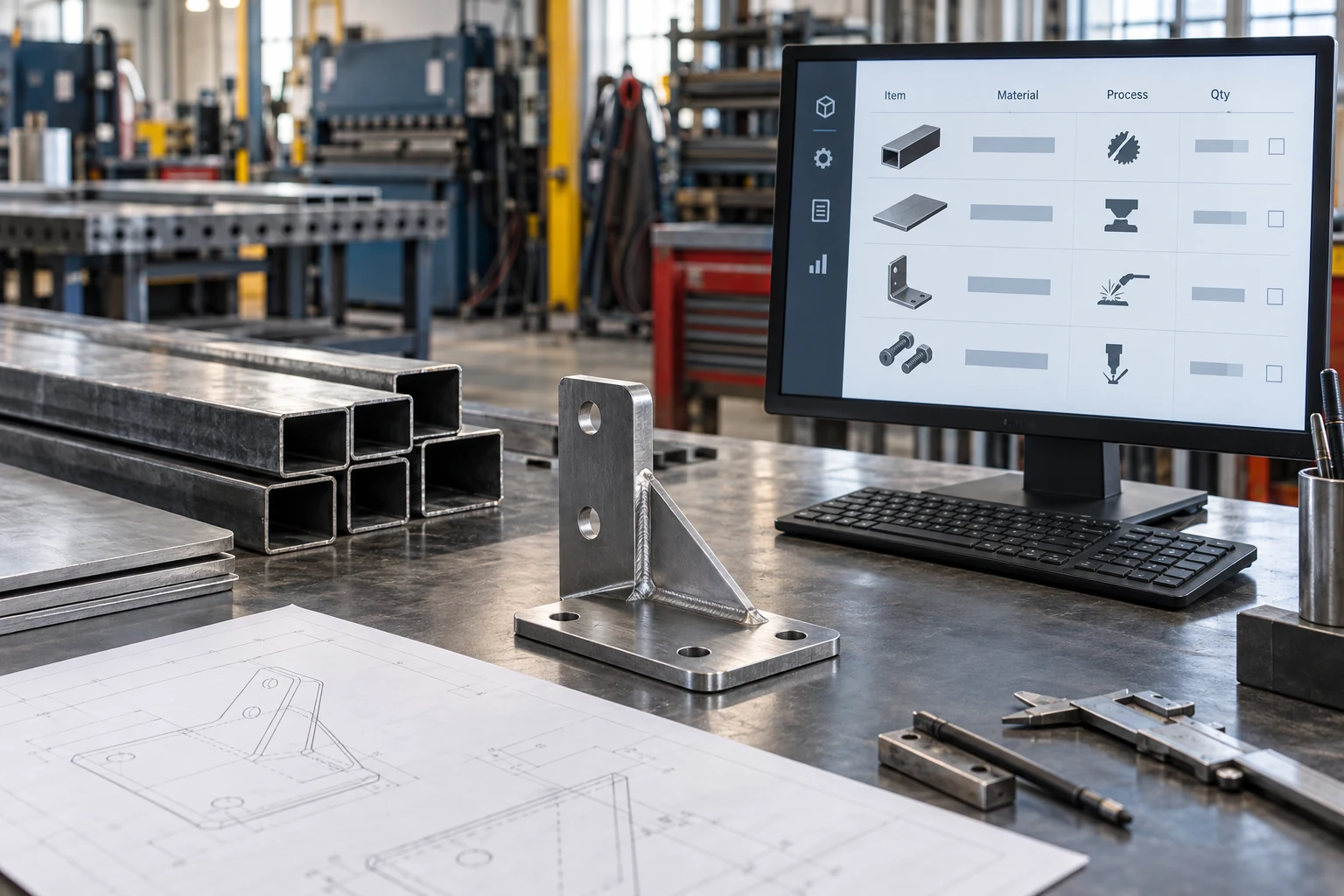
Estimate from scratch means the thing you sell is different every time and someone has to build it up. A mechanical contractor doing a takeoff from a drawing set: linear feet of duct by gauge, fittings counted, hangers, labor units per fitting, crew mix, a factor for working in an occupied building. A custom fabricator quoting a weldment nobody has ever made. A services firm scoping a project. The hard part here is judgment, and no software removes it. The software's job is to make the judgment faster to record, easier to review, and possible to learn from.
Most companies need one of these and buy the other, usually because the vendor demo looked impressive. A contractor buying a configure-and-price product will spend eighteen months trying to model a takeoff as a product configuration and will end up back in the spreadsheet. A manufacturer buying an estimating package will find it has no concept of option rules.
| Business | What "quoting" means there | Where the money leaks | What software fixes |
|---|---|---|---|
| Mechanical contractor | Takeoff from drawings, labor units, crew mix, conditions factors | Missed scope, and labor factors nobody has revisited since 2019 | Reusable assemblies, and comparing bid hours to job-cost hours |
| Custom fabricator | Material, cut and weld time, finishing, setup amortised over quantity | Material cost that is months old on a volatile input | Cost dated per line, and a validity date the customer can see |
| Window or cabinet maker | Configuration from a catalog with option rules | Invalid configurations reaching the floor and getting remade | Rules enforced at quote time rather than at the saw |
| Industrial distributor | Pricing a bill of material at contract terms | Off-contract discounting and expired special pricing | Price sourced from the agreement, with a floor and an approval |
| Staffing firm | Bill rate from pay rate, burden, overtime rules and margin target | Burden assumptions that are stale by a year | One burden model everyone uses, versioned by effective date |
Measure what it costs you today, before you shop
Five numbers, and most companies can get them in a week from their existing records.
Turnaround. Hours or days from request to quote out the door, and the spread, not the average. If the median is a day and the top quartile is nine days, the nine-day quotes are where you are losing.
Volume per estimator. Quotes per estimator per week. This is the ceiling on how much work you can chase, and it is usually the constraint nobody has named.
Error rate. How many quotes went out with something wrong that had to be corrected or eaten. Count the ones you ate.
Cost currency. Take fifty quoted lines at random and check how old the cost figure behind each one is. In companies without a disciplined price book we routinely find a meaningful slice carrying costs more than ninety days old, and on materials with real volatility that is the whole margin.
Discount distribution. Plot every quote's realised margin. You are looking for a long tail below the intended floor, and for whether it clusters by salesperson, by customer, or by product line. That plot is often the single most persuasive page in the business case.
The price book is the product
Whatever tool you buy or build, the thing that makes it worth having is a maintained cost and price basis with dates on it. Every cost element needs three properties: a value, an effective date, and a source. Where the source is a supplier quote with its own validity window, carry that window through to your quote.
This is what turned into an existential problem for a lot of fabricators and builders during the input-cost swings of the last several years, and the fix is structural rather than clever. If your material quote from the mill is good for seven days and your customer quote says thirty, you have written an option and given it away. Either shorten your validity, add an escalation clause tied to a published index, or price the risk in. All three are legitimate. Doing none of them is a decision too, just not one anybody made on purpose.
Put an owner on the price book with a review cadence, and put the last-reviewed date on the screen the estimator works in. A number with a visible date gets questioned. A number with no date gets trusted forever.
Where a quoting tool actually pays back — our weights
Weights sum to 100. How we would rank the payback on a first build for a mid-size firm. Judgment, not a benchmark; the order matters more than the values.
Margin floors and the approval ladder
This is the least glamorous part of a quoting system and usually the highest-return. Encode the rules that today live in the owner's head: a floor margin by product line or job type, a discount ladder by role, and a threshold above which a second person has to look.
Keep the ladder short enough that people use it. Something like: a salesperson can price down to the floor, a sales manager can go a few points below it, and anything past that needs the general manager. Two levels of approval is a control. Four levels is a workaround generator, and the workaround will be a phone call and a manual invoice.
Make the approval fast. If an approval takes a day, estimators will pre-emptively price above the floor to avoid it, which costs you the quotes you should have won cheaply. Approval on a phone in under a minute, with the margin and the reason visible, is the design target.
The quote document is a risk instrument
For a contractor, the exclusions page is not paperwork. It is the difference between a profitable job and a fight. What is not included, what the price assumes about site access and schedule, what happens if the drawings change, how long the price is good for, and what the customer has to provide and by when.
A tool earns its cost here by making the exclusions structural rather than remembered. Standard exclusions attach automatically by job type. Adding an assembly adds the assumption that goes with it. The estimator can add job-specific language, and the whole thing renders into a document a customer can read. The alternative is what most firms have: a boilerplate page that has not been reviewed since a lawyer wrote it, plus whatever the estimator remembered to add at 6pm.
Two mechanical details worth insisting on. Every quote carries a version, and the version is on the customer's copy, because "which revision are we talking about" is a real conversation that happens under pressure. And a validity date that is enforced — a quote past its date should require a re-price, not be silently accepted three months later at last spring's steel price.
Alternates and options belong on the quote, priced
The quote that offers one number gives the customer one decision: yes or no. A quote with a base scope plus two or three priced alternates gives them a way to say yes to something. It also protects you, because "we can do it in the lighter gauge for this much less" is a much better conversation than a flat discount request. Most estimating spreadsheets make alternates painful, which is why they rarely appear.
The handoff to the order is where the savings live
Here is the most common way a quoting tool fails to pay for itself: the quote is produced beautifully, and then someone re-keys it into the business system to create the order or the job. Half the labor you set out to save is still being spent, and now there is a second place for an error to enter — one that nobody will catch until the invoice does not match the quote.
Insist on the round trip in the scope from day one. Won quote becomes an order, a job, or a project with its budget and its bill of material intact. Lost quote gets a reason code. Every quote, won or lost, keeps its line detail, because that detail is the dataset in the next section.
The reverse trip matters too. When the job is done, the actual cost has to land back beside the estimate at a level that can be compared. Not just total job cost against total bid — that comparison tells you the answer and never the reason. Hours by phase against estimated hours by phase is where an estimator learns that hangers always run over and the labor factor on rooftop work has been wrong for six years.
Your bid history is a better dataset than anything you can buy
Three years of quotes with outcomes, joined to actual job costs, is a genuinely valuable asset and most companies do not have it because the quotes lived in individual files. Once you do have it, a few unremarkable analyses pay for the whole system.
Win rate by job type, size band and customer, which usually shows that you win a specific slice and lose the rest, and that your estimators know this and have never been able to prove it. Estimated versus actual hours by phase, which corrects the labor factors. Margin realised versus margin quoted, which quantifies what the change orders and the field give back. And the loss reasons, if the salespeople can be persuaded to record them honestly — an honest "price" versus "lead time" split changes what you fix.
This is also the only responsible foundation for anything predictive. Suggesting a price or flagging a risky bid needs a few hundred comparable jobs with known outcomes at minimum, and it needs them to be clean. Companies that skip straight to the model without the history end up with a system that confidently reproduces their old mistakes.
Where the newer tools actually help, and where they do not
Digitising drawings and specifications. Extracting quantities from a drawing set, or reading a customer's requirements document to build a line list, genuinely works now and saves real hours. It also makes mistakes that are expensive, so it belongs in a review workflow where the estimator confirms quantities rather than accepting them. Treat it as a fast assistant with a checker, not as automation.
Finding the comparable job. "We did something like this in 2024 for a hospital in Ottumwa" is the question estimators ask constantly and their systems answer badly. Search over past quotes and jobs by similarity is one of the more useful things you can build, and it is not hard once the history exists.
Writing scope narrative. Useful for a first draft, dangerous for exclusions. Generated scope language is smooth and agreeable, and agreeable is exactly wrong in a document whose job is to say what you are not doing. Have a person own the exclusions, always.
Predicting the price that wins. Requires a volume and cleanliness of data most mid-size firms do not have. Be very skeptical of a vendor claim here unless they can tell you what data it was fitted on and how it performs on your own historical bids.
Send us the estimating workbook.
Email the spreadsheet your estimators actually use, plus a sentence on your quote volume and how quotes become jobs, to contact@precisionfederal.com. You get back a written note on whether this is a configure-and-price problem or an estimating problem, what we would keep, and the one change we would make first. One business day, no charge, no meeting.
contact@precisionfederal.comBuy, build, or improve the spreadsheet
Improve the spreadsheet when you have one or two estimators and fewer than roughly fifteen quotes a month. Lock the formulas, move the cost basis into a single shared file with an owner and a date, add a quote log with outcomes, and put the whole thing under version control of some kind. That is a few weeks of work and it captures most of the value at a small fraction of the cost. A lot of companies are told this is not a real answer. It is.
Buy when your industry has mature packages that match how you actually work. Several trades have estimating products with labor databases and takeoff tools that would take years to reproduce, and the cost basis alone justifies the license. Buy also when what you sell is configurable in a fairly standard way and your business system already has a quoting module you are not using.
Build when the pricing logic is the thing that makes you money, or when the shape of your quoting genuinely does not fit any product. Firms whose pricing model is their competitive edge should not push it into someone else's data model. Build also when the integration to your business system is the whole point and every product you have looked at treats it as a data export.
A hybrid is common and sensible: buy the estimating engine, build the thin layer that carries your pricing rules and pushes the won quote into the business system.
The mistakes we get called in to fix
- Buying a configuration product for a takeoff business, or the reverse
- No date or source on any cost, so nobody knows what is stale
- A quote that has to be re-keyed into the business system, spending the savings twice
- An approval ladder so slow that estimators price high to avoid it
- Losing the line detail on lost quotes, which throws away the most useful half of the data
- Boilerplate exclusions nobody has reviewed since a lawyer wrote them
- Quotes with no enforced validity date, accepted months later at last year's cost
- A configurator that permits combinations the shop floor then cannot build
A ten-week path that leaves something working
Quoting: First Working Version
Doing the most common job type first, completely, beats doing all job types partially. An estimator who can run their most frequent quote end to end in the new tool will start using it. One who has to switch back to the spreadsheet for a third of jobs will use the spreadsheet for all of them, because keeping two systems in their head is worse than keeping one.
Before you call it done
- Every cost carries a value, an effective date and a source
- The price book has a named owner and a review cadence
- Margin floors exist and the approval ladder has at most two levels
- Approval can be granted from a phone in under a minute
- The quote document carries a version, a validity date and structured exclusions
- Alternates can be priced and shown without rebuilding the quote
- A won quote becomes an order or job with no re-keying
- Lost quotes keep their line detail and carry a reason code
- Actual cost lands back beside the estimate at the phase level
- The most common job type runs end to end without touching the spreadsheet
Bottom line
Decide first whether you are configuring from a catalog or estimating from scratch, because they are different products and buying the wrong one costs a year. Then put your effort where the money is: a cost basis with dates and an owner, margin floors with an approval fast enough that people use it, and a handoff to the order that involves no re-keying. Keep the line detail on every quote, won or lost, and get actual cost back beside the estimate. If you are small, doing all of that inside a disciplined spreadsheet is a completely respectable answer, and it is the one we recommend more often than clients expect.
Frequently asked questions
Roughly when a third estimator joins, or when quote volume passes about fifteen a month, or when the same job priced by two people comes out meaningfully different. The trigger is usually consistency rather than speed. Before that point, a locked spreadsheet with a shared dated cost file and a quote log captures most of the benefit for a fraction of the cost.
Quoting, in the configure-and-price sense, prices a selection from a catalog with rules about what can go together. Estimating builds a price up from quantities, labor units and judgment for something that has never been made before. Products in each category are poor at the other job, and buying the wrong one is the most expensive mistake in this whole category.
Give every cost element a value, an effective date and a source, and show that date on the estimator's screen. Then reconcile your quote validity to your supplier's: if their quote holds for a week and yours holds for a month, you are carrying the risk. Shorten the validity, add an escalation clause tied to a published index, or price the exposure in.
Only with a few hundred comparable bids with known outcomes and clean cost data behind them, which most mid-size firms do not have yet. What is achievable much sooner and worth more: finding comparable past jobs quickly, correcting labor factors from estimated-versus-actual hours, and seeing win rate by job type and size band.
Inside, if the module fits how you quote, because the handoff to the order comes free and that handoff is where much of the value is. Separate, when your estimating is genuinely specialised or your pricing rules are a competitive advantage. If you go separate, treat the integration back to the order as part of the first release, not a later phase.