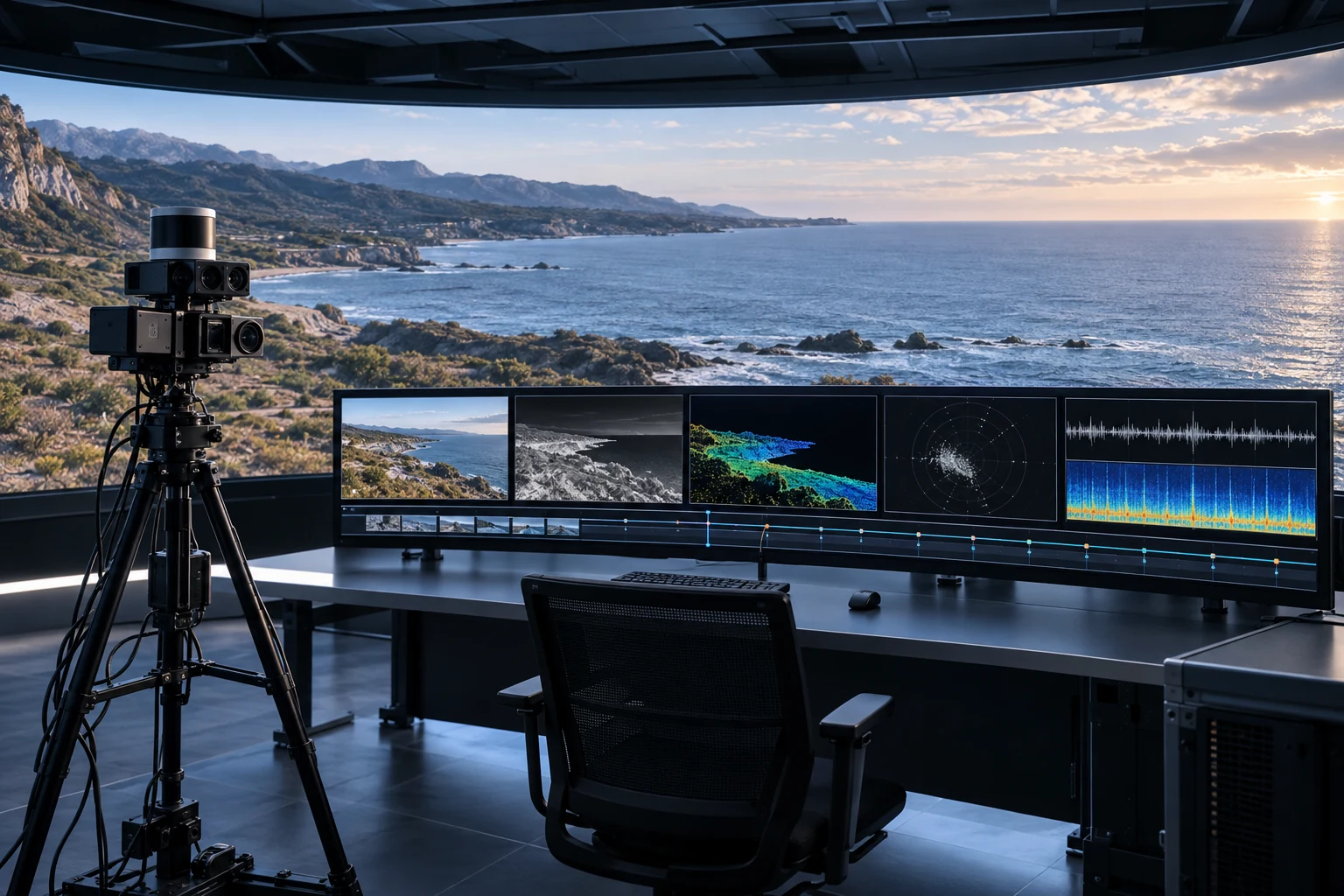
 AI-generated conceptual illustration
Editorial weighting from public sources and practitioner reading — illustrative, not a measured statistic.
Higher score = stronger evidence in published mission-exercise simulation work.
What “multi-modal M&S” means
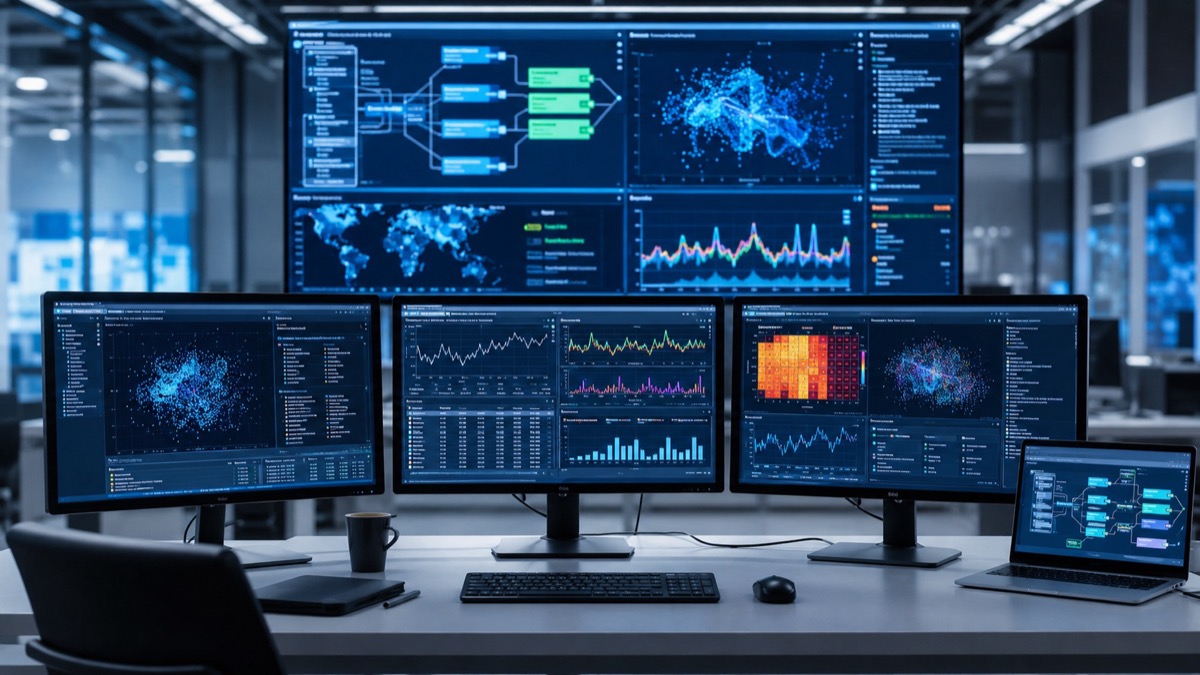
Multi-modal modeling and simulation (M&S) is the practice of building a virtual environment that is rich enough to feed multiple kinds of sensors at once — cameras, lidar, radar, infrared, audio — and to do so in a way that is consistent across all of them. The goal in mission-exercise contexts is to let trainees and AI systems practice in a synthetic world that behaves enough like the real one that lessons learned actually transfer.
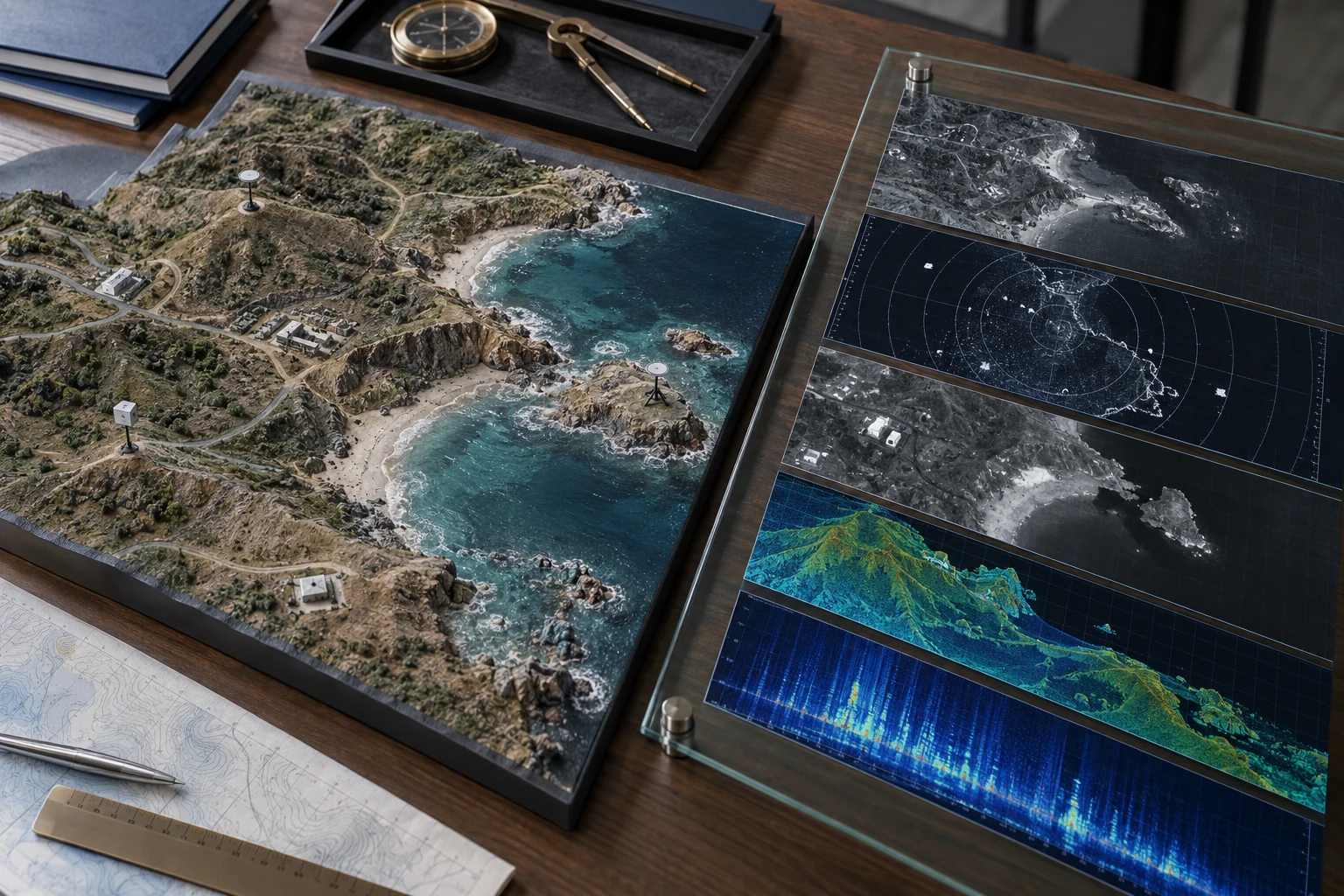
The published literature treats this as three distinct problems stacked together. First, generate the environment. Second, simulate each sensor modality with enough physical realism to fool the consumers of that data. Third, design an evaluation harness that tells you when the simulation is faithful enough and when it has drifted away from reality.
Synthetic environment generation
A synthetic environment is the digital terrain the simulation runs on — the ground, buildings, vegetation, weather, lighting. Generating such environments at scale is the first hurdle. Hand-built environments are realistic but expensive and slow to produce. Procedurally generated environments are cheap and fast but can look and feel synthetic in ways that AI systems learn to exploit.
The published research has converged on a hybrid approach. A small number of high-fidelity, hand-built environments anchor the dataset. Procedural generation, often using rules tied to satellite imagery and OpenStreetMap data, fills out the diversity. Generative AI models — diffusion models for textures, language-conditioned scene generators for layouts — supplement both. The combination produces enough diversity for meaningful AI training without the cost of hand-building everything.
A specific published concern is what is called domain randomization — deliberately varying lighting, materials, and clutter across simulated runs so that a model trained on the simulation does not overfit to any single look. The technique is most associated with NVIDIA and OpenAI robotics work and has crossed into mission-exercise simulation as a standard discipline rather than an enhancement.
Sensor-data simulation
Each sensor modality has its own physics and its own simulation literature. Cameras are simulated with rasterization or path tracing — the latter being more accurate at modeling how light actually behaves but more expensive. Lidar is simulated by ray casting through the scene to compute time-of-flight returns. Radar is simulated through electromagnetic propagation models that account for material properties and wavelength. Infrared imaging requires thermal models of the environment and its objects.
The hard part is keeping these modalities consistent. A vehicle in the synthetic environment must produce a camera image, a lidar point cloud, a radar return, and an infrared signature that all describe the same vehicle in the same place. Inconsistency is fatal: a fusion-trained AI system that learns inconsistent cross-modal patterns from simulation will not transfer to the real world, where the consistency constraint is automatic.
Published toolchains that have become reference points include NVIDIA Omniverse for multi-modal scene generation, Microsoft AirSim and its successors for camera and depth simulation, and CARLA for ground-vehicle scenarios. Each has trade-offs in physics fidelity, computational cost, and integration complexity, and the published work tends to use more than one tool rather than committing to a single platform.
Sim-to-real transfer
Sim-to-real transfer is the central question of the entire field: when a model is trained in simulation, how well does its performance hold up when it is deployed against the real world? The published research is consistent that the answer is never “perfectly” and is sometimes “not at all.” The discipline is to measure the gap, report it honestly, and design the simulation pipeline so that the gap shrinks over time.
Three patterns dominate the published work. The first is domain randomization (mentioned above), where the simulation is intentionally diverse so that the model sees real-world conditions as “just another variation.” The second is sim-to-real fine-tuning, where a model trained on simulation is briefly fine-tuned on a small real-world dataset to bridge the residual gap. The third is iterative simulator improvement, where each round of real-world data informs adjustments to the simulator itself.
The biggest published lesson is that sim-to-real performance depends on the specific failure modes of the simulator. A simulator that gets the average case right but misses tail behaviors will train models that fail in tail conditions. The published evaluation discipline is to identify the operationally important tail conditions early and to focus simulator engineering on getting those tails right.
Generative environment construction
Generative AI has changed what is possible in environment construction. Diffusion models trained on aerial imagery can synthesize textures that match arbitrary geographies. Language-conditioned scene generators can produce environments from short text descriptions. NeRFs (neural radiance fields) and 3D Gaussian splatting reconstruct full 3D scenes from a small number of photographs.
For mission-exercise simulation, this matters because the bottleneck has historically been content. Building enough environment variety to train robust AI was a multi-million-dollar effort. Generative methods drop that cost order-of-magnitude and let teams produce environments that are matched to specific mission profiles rather than picked from a small library.
The published caveat is that generative content has its own failure modes. Diffusion-generated textures may contain artifacts that are imperceptible to humans but learnable by AI systems — producing models that perform well on simulation and fail when those artifacts are absent. NeRF reconstructions have geometric inaccuracies that propagate to lidar simulation. The published practice is to verify generated content against ground truth before letting it into the training pipeline.
Eval harness design
An evaluation harness is the test rig that tells you whether a simulation is good enough. The published harnesses for mission-exercise M&S are layered. At the lowest layer is per-modality fidelity — does the simulated camera image look right; does the simulated radar return obey the right physics. At the middle layer is cross-modal consistency — do the modalities agree about what is in the scene. At the top layer is end-to-end task performance — can a model trained on the simulation do the operational task on real-world data.
The research norm is to evaluate at all three layers and to report disagreements between them. A simulator that passes per-modality fidelity tests but fails end-to-end task transfer is hiding an inter-modal inconsistency or a covariate shift; the harness exposes that mismatch.
A specific discipline that recurs in published work is the use of held-out real-world evaluation sets that the simulator is never tuned to match. The published consensus is that any evaluation conducted on data the simulator has seen during development is suspect; only held-out real-world performance numbers are credible.
Operator and trainee fidelity
Mission-exercise M&S is not only training data for AI systems — it is also a rehearsal environment for human operators and trainees. The fidelity requirements differ. A trainee’s eyes and judgment are different consumers from an AI system’s feature extractor, and a simulation that satisfies one may fail the other.
For human trainees, the published research emphasizes scenario fidelity (the events unfold in operationally realistic ways), interaction fidelity (the trainee’s actions produce realistic consequences), and tempo fidelity (the timing of events matches operational expectations). Visual photorealism matters less than these dynamic properties.
For AI systems, the priorities invert: photorealistic per-pixel fidelity matters more, interaction fidelity matters less, and tempo can often be accelerated for training efficiency. The published systems that target both audiences typically build a dual-output simulator: a high-fidelity render for AI consumption alongside a behaviorally-rich, faster scenario engine for human trainees.
Synthetic environment. The digital terrain — ground, buildings, weather, lighting — the simulation runs on.
Sensor simulation. The physics engines that turn the environment into camera images, lidar clouds, radar returns, and infrared signatures.
Sim-to-real gap. The performance loss between training-on-simulation and deployment-on-reality, reported as a methodology number.
Domain randomization. Deliberate variation of simulator parameters so models do not overfit to any one synthetic look.
| Open toolchain | Modality strength | Best fit | Limitation |
|---|---|---|---|
| NVIDIA Omniverse / Isaac Sim | Multi-modal scene generation; physics | Large-scale multi-modal pipelines | Tooling complexity; GPU dependency |
| Microsoft AirSim (and successors) | Camera, depth, IMU | Aerial and ground vehicle research | Active maintenance varies; check fork status |
| CARLA | Ground-vehicle camera, lidar | Autonomous-driving-style scenarios | Mostly tuned to urban driving environments |
| NeRF / 3D Gaussian Splatting | Photoreal environment reconstruction | Geographically specific environments from photos | Geometric accuracy gaps for non-visual modalities |
Where the field is going
Three trends are visible in recently published work. The first is consolidation around a small number of open simulator stacks rather than the proliferation of bespoke simulators that characterized the previous decade. The second is increasing use of generative AI to fill content gaps, paired with stricter verification of generated content. The third is more disciplined sim-to-real evaluation, with held-out real-world test sets becoming standard rather than optional.
An emerging area is on-the-fly scenario generation driven by large language models. The pattern is to describe a scenario in natural language — the operational profile, the environmental conditions, the adversary disposition — and to let an LLM plus a generative pipeline produce a runnable simulation. The published systems are early but credible; the discipline of verifying that the generated scenarios are not subtly biased toward LLM-friendly patterns is the open methodological question.
For federal mission-exercise applications, the trajectory is clear: cheaper environment construction, better cross-modal consistency, more honest sim-to-real measurement, and gradually closing the gap between synthetic rehearsal and real-world performance.
Frequently asked questions
It varies, but the discipline is improving. The published norm is now to measure performance on held-out real-world data and to report the gap as a number, not to hand-wave it. Systems that report only simulation-only metrics are increasingly seen as incomplete in peer review.
Sometimes, but the priorities differ. Human trainees need scenario, interaction, and tempo fidelity; AI training needs per-pixel sensor fidelity. Published systems that serve both audiences typically build a dual-output simulator with the same scenario engine driving two different rendering paths.
Not entirely. Generative methods are good enough to dramatically reduce the cost of producing diverse environments, but they introduce their own failure modes — hidden artifacts, geometric inaccuracies, biased distributions. The published practice is hybrid: hand-built anchors plus procedural and generative fill.
Evaluating against the simulation itself rather than against held-out real-world data. A model that performs well in simulation has demonstrated only that the simulator and the model agree; it has not demonstrated that the simulator agrees with reality. Held-out real-world evaluation is the discipline that catches this.
How we use this site
We write articles like this one to make our public reading visible — what we think the open methods literature shows, where the methodological gaps sit, and how the open simulator toolchain composes. We do not preview proposed approaches in active program spaces. Precision Federal is a software-only SBIR firm. If your office is exploring multi-modal mission-exercise simulation and would value a software-first partner with a documented public-reading habit, we welcome the introduction.