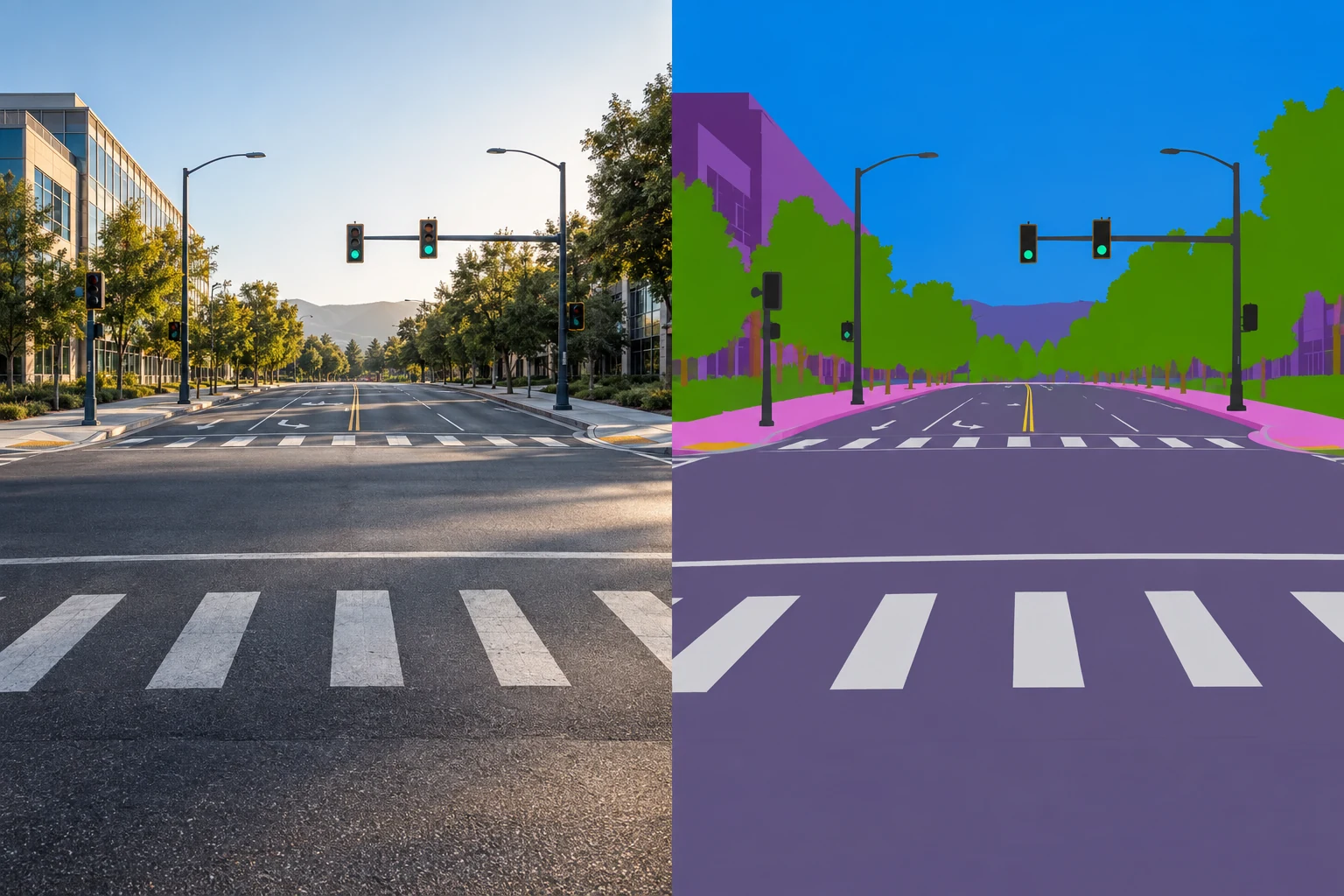
 AI-generated conceptual illustration
Synthetic perception data — methodological signals
Higher score = stronger public-literature anchoring for synthetic-data pipeline credibility.
Why synthetic training data matters

Real training data for defense perception systems is scarce, expensive to collect, and often constrained by classification or operational sensitivity. Synthetic data — generated from physics-based simulators or learned generative models — has become a standard part of the perception ML toolchain. The open literature is clear that synthetic data is useful, that it is not free, and that the validation discipline is what separates success from self-deception.
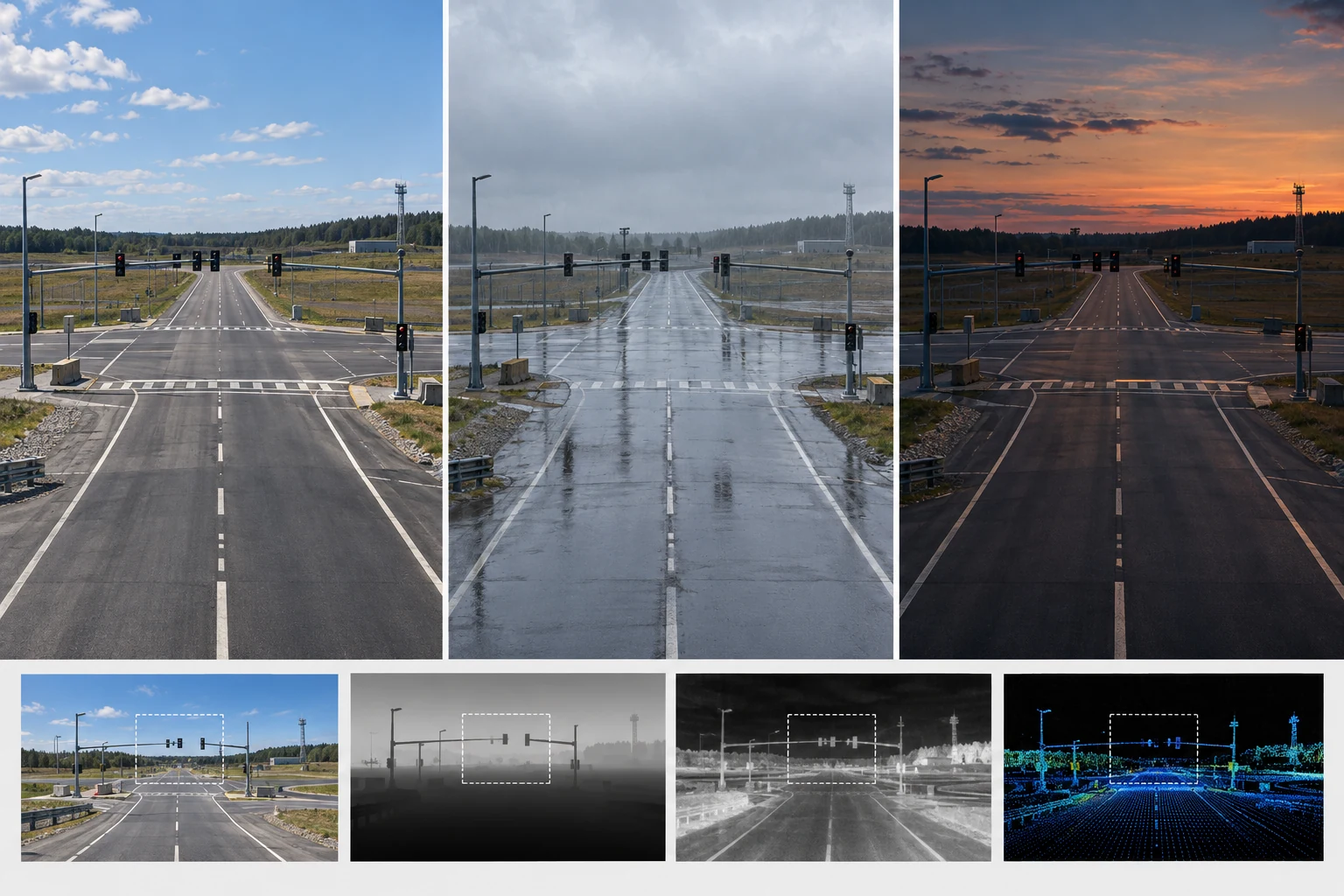
Domain randomization works for some tasks; sim-to-real gaps remain task- and modality-specific. Validation discipline is the difference between useful pipelines and self-deception.
Domain randomization and sim-to-real
The domain-randomization line of work — popularized by Tobin et al. (2017) and extended by many academic groups since — frames the problem as: train on a wide enough distribution of simulated scenes that the real distribution is in-distribution. The methodology is well documented and works for several specific tasks (object pose estimation, simple manipulation, drone target tracking in cluttered backgrounds). The OpenAI work on dexterous manipulation, NVIDIA's work on object pose, and academic follow-ups on driving and aerial perception all draw on the same randomization template.
It does not work uniformly across tasks. Published failure modes include sensor-modality mismatches (the simulator's image statistics differ enough from real cameras that the learned representations don't transfer), distributional gaps the simulator did not capture (lighting transients, fog, ground clutter outside the randomization range), and over-randomization (so much variance is injected that the model fails to learn useful features at all). The published mitigations — guided randomization, learned randomization parameters, and curriculum schedules — improve transfer in specific tasks but do not generalize as a recipe.
The structured-domain-randomization line of work, by Prakash et al. and others, retains scene-level structure (e.g. road geometry, plausible obstacle distributions) while randomizing surface appearance and lighting. For perception tasks where scene structure matters, this is materially more transferable than full uniform randomization. Domain-adversarial training (Ganin and Lempitsky's DANN, and follow-ups in the unsupervised-domain-adaptation literature) provides another lever, complementary to randomization, for narrowing the train-test gap.
Generative augmentation
Diffusion models, neural radiance fields, and Gaussian splatting have changed what "synthetic data" can look like. NeRFs (Mildenhall et al.) and the 3D Gaussian splatting work (Kerbl et al.) made photorealistic novel-view synthesis fast and accessible, and the published generative pipelines now produce photorealistic multi-view scenes with sensor-specific characteristics — though sensor accuracy varies. Latent-diffusion models (Stable Diffusion, Imagen, and follow-ups) have been adapted to controllable scene generation conditioned on layout, semantics, or driving-scenario specifications.
For multimodal generation — synchronized RGB, depth, IR, and other modalities — the open methods are improving rapidly but are not yet fully reliable across all combinations. Diffusion-based joint synthesis of RGB and depth has reached usable quality in published work; synchronized synthesis with thermal IR is harder because the underlying physics (emissivity, surface temperature) is not captured by visible-band generative models without explicit physics-aware conditioning.
The most disciplined published pipelines combine physics-based simulation as the geometry source with generative models as a photorealism layer — a hybrid that gets the benefits of both without the failure modes of either. The NVIDIA Omniverse and Unreal Engine ecosystems provide one substrate for the geometry side; learned style transfer and diffusion-based refinement provide the photorealism layer.
The validation problem
The methodologically critical question for any synthetic-data pipeline is: how do you validate that training on the synthetic data produces a model that performs well on real data? The published literature offers several validation strategies, none perfect: held-out real data, cross-domain benchmarking, and analytical performance bounds based on simulator-real distance metrics such as Fréchet Inception Distance, Maximum Mean Discrepancy, and task-specific transfer-gap measurements.
The honest practitioner reports performance on both synthetic and real held-out sets, with the gap between them as a key methodology number. NIST's evaluation lineage, including the FRVT methodology in face recognition, has been influential as a template for how to report synthetic-data-trained model performance: explicit operating points, documented test populations, confidence intervals, and disclosure of known biases or coverage gaps.
A second validation discipline that the literature has converged on is the "real-data efficiency" metric: how many real samples does the synthetically-pretrained model need to match a real-only baseline? When the answer is "fewer than you have," synthetic data is paying its way; when the answer is "more than you have," the pipeline is not earning its complexity. Published case studies in autonomous driving and medical imaging report this metric in a form that program offices can interpret.
Modalities that synthesize well versus poorly
The open literature is consistent that synthetic-data quality varies sharply across modalities. Passive-imaging modalities (visible RGB, depth) synthesize well when simulator geometry is accurate; the gap between rendered RGB and real RGB has narrowed steadily as path-tracing and learned style transfer have matured. Thermal IR is harder because it depends on surface-temperature physics; the better simulators model emissivity and heat transfer, but the open quality bar is below that of RGB.
Active-sensor modalities (radar, SAR, LiDAR) depend heavily on the fidelity of the simulator's electromagnetic or geometric phenomenology, and the published quality varies widely. LiDAR synthesis has progressed through public work on simulators that model beam divergence, multi-return behavior, and weather effects; radar and SAR phenomenology require explicit electromagnetic modeling and rough-surface scattering models, with several university and FFRDC efforts publishing simulators of varying fidelity. The honest position in the published record is that the active-sensor group together represents the harder synthesis challenge, and pipelines that handle them credibly tend to call that out explicitly.
Multispectral and hyperspectral synthesis is case-by-case depending on whether the simulator models per-band physics; spectral signatures of materials are well-tabulated for many cases (the ASTER spectral library and follow-ups) but the per-pixel rendering pipeline that ingests them is bespoke per simulator. Any pipeline claim has to be specific about which modalities it actually handles credibly.
Engineering posture
For software-first SBIR offerors, the right posture is to treat synthetic-data generation as a software engineering problem with a validation harness as the primary deliverable. A pipeline that produces beautiful images is worth less than a pipeline that produces useful training data, and the difference is measurable. Program offices that have funded synthetic-data work are well aware of this distinction.
The harness components reviewers expect to see include: a documented simulator configuration (or generative-model checkpoint with parameter set), a frozen real-data evaluation set with disclosed construction methodology, transfer-gap measurements at multiple training-set sizes, and an explicit statement of which modalities the pipeline supports credibly versus aspirationally. Treating any of these as a finishing detail is read as inexperience.
Published agency funding patterns for synthetic-data work — across DARPA, AFRL, ARL, and ONR — have been consistent in funding teams that lead with the validation harness rather than with the data-generation pipeline. The reason is institutional memory: program offices that have funded synthetic-data work before know the difference between a beautiful simulator and a useful training pipeline, and the validation harness is what distinguishes them.
Concept terms in this problem class
Domain randomization. Training on a distribution of simulated scenes wide enough that the real distribution is in-sample, an approach with a known but bounded set of working tasks.
Sim-to-real gap. The performance difference between a model evaluated on synthetic data and the same model evaluated on real-world data — the validation number that matters most.
Validation harness. The software discipline of treating evaluation infrastructure as a primary engineering deliverable, separate from the data-generation pipeline itself.
Common questions on the public-record framing
Which generative pipelines are now standard for synthetic data?
Diffusion models (Stable Diffusion, Imagen), neural radiance fields (Mildenhall), and 3D Gaussian splatting (Kerbl). NVIDIA Omniverse provides hybrid synthesis at scale; Tobin et al. (2017) popularized the domain-randomization line.
How is sim-to-real validation done in published work?
Held-out real data, cross-domain benchmarking, and analytical bounds based on simulator-real distance. The honest practitioner reports both synthetic and real held-out performance, with the gap as a methodology number.
Which modalities synthesize cleanly versus poorly?
Passive imaging (visible RGB, depth) synthesizes well with accurate geometry. Active sensors (radar, SAR, LiDAR) depend heavily on EM or geometric phenomenology fidelity. Multispectral and hyperspectral are case-by-case.
What does this article not cover?
Specific phenomenology models in proprietary tools, specific scene libraries, or any Precision Federal generation methodology.
Frequently asked questions
When real data is scarce, expensive, or constrained by classification or operational sensitivity, and the task is one where the published literature has demonstrated synthetic-to-real transfer for similar modalities and conditions.
Passive imaging (RGB, depth) is reliable when geometry is accurate. Active sensors (radar, SAR, LiDAR) depend on simulator phenomenology and quality varies. Multispectral and hyperspectral are case-by-case.
By reporting performance on both synthetic and real held-out sets, treating the gap between them as a methodology number, and using cross-domain benchmarking and analytical distance metrics where possible.
A pipeline that produces visually impressive scenes without a validation harness or a documented sim-to-real gap. Reviewers experienced with synthetic-data work distinguish "beautiful" from "useful for training," and the latter is what counts.
Why this work matters to us
Precision Federal is a software-only SBIR firm. The reason articles like this one exist on this site is simple: federal program offices fund teams whose principal investigators have demonstrated, in public, that they think carefully about the problems the program is trying to solve. We write to demonstrate that posture, not to telegraph any particular technical approach. If your office is exploring the problem class above and wants a partner who reads the literature, codes the prototypes, and ships under a Phase I or Direct-to-Phase-II SOW, we are listening.