Multi-modal in federal, plainly
Multi-modal models — systems that jointly process text, images, and increasingly audio — have become reliable enough in 2026 to show up in real federal workloads. The deployment patterns are less exotic than the models themselves. On one end, hosted frontier models via Azure Government and GovCloud handle the bulk of unclassified and CUI workloads where sending data to a FedRAMP-authorized cloud service is acceptable. On the other end, open-weight vision-language and audio models deployed on-prem handle workloads where nothing leaves the boundary.
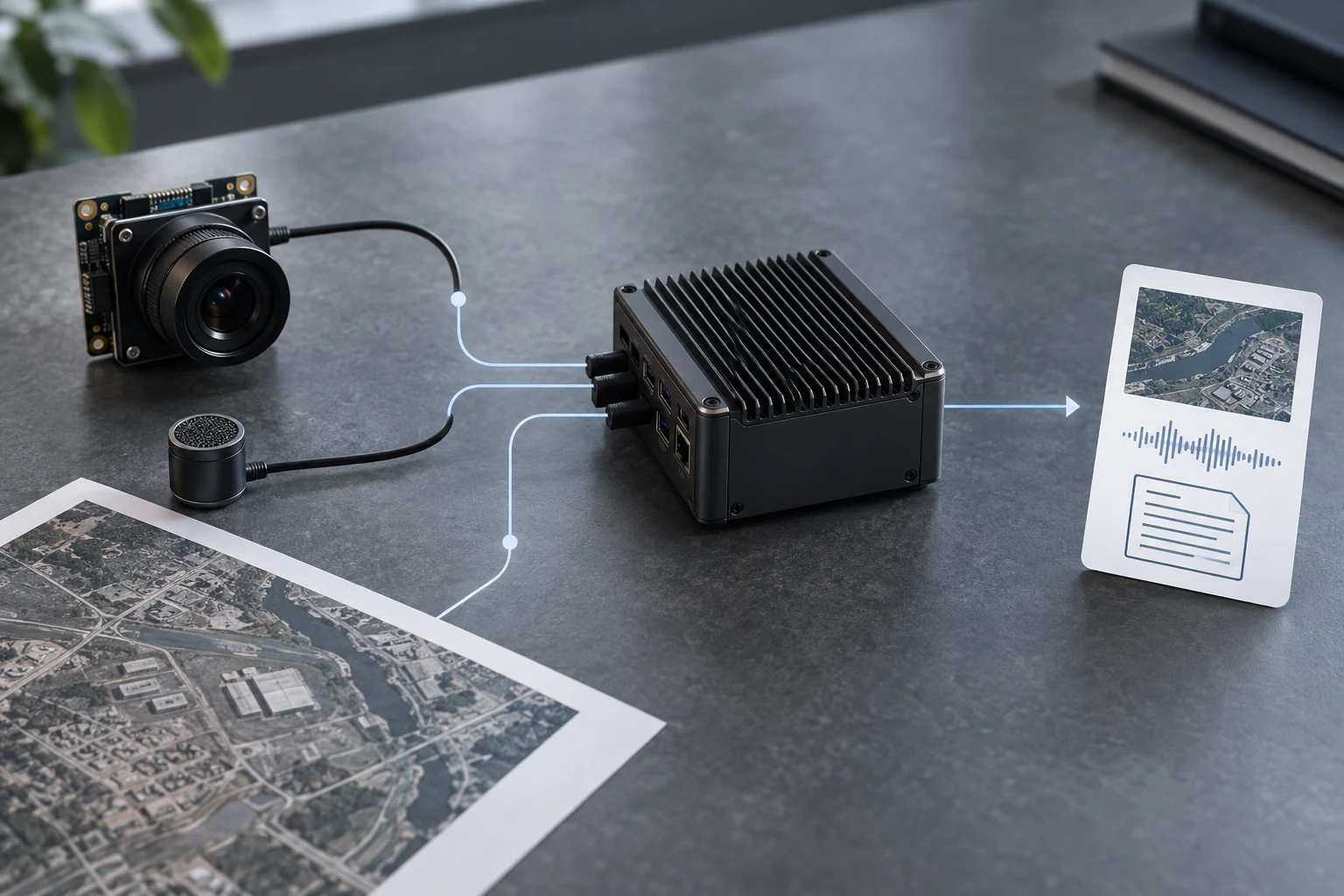
Multi-modal models process text + images + audio in a single pass. Federal use cases: ISR imagery captioning, satellite change detection, medical imaging + clinical notes, and scanned document understanding.
Federal use case readiness for multimodal AI (2026)
Editorial weighting from public sources and practitioner reading — illustrative, not a measured statistic.
The real capabilities worth deploying
- Vision-language QA. Ask questions about an image and get grounded answers. Useful on document images, chart understanding, imagery, screenshots.
- Image captioning and description. Generate descriptions for accessibility, indexing, and search.
- Multi-modal extraction. Extract structured fields from documents that combine text, tables, and figures.
- Audio transcription with speaker diarization. Meeting transcripts, interview records, call analysis.
- Audio understanding. Answer questions about audio content without a full transcription step.
- Cross-modal retrieval. Search a text-plus-image corpus with either text or image queries.
Frontier hosted options
| Model family | Federal cloud | Strengths | Watch-outs |
|---|---|---|---|
| GPT-4o / GPT-4.x multimodal | Azure OpenAI Gov (FedRAMP High) | Vision, audio, strong reasoning, wide deployment | Feature availability lag; token pricing at scale |
| Claude 3.7 / 4.x vision | AWS Bedrock GovCloud (FedRAMP High) | Strong document understanding, long context | Audio support lag vs OpenAI |
| Gemini 2.x multimodal | Check current federal availability | Very long context, native video | Federal availability moving |
| Amazon Nova | GovCloud (FedRAMP High) | Native to AWS ecosystem | Newer; evaluate carefully |
On-prem open-weight options
Vision-language
LLaVA-NeXT and derivatives
Vision-language models built on Llama / Vicuna. Permissive licensing, wide community. Typical sizes 7B-34B.
Qwen-VL 2.x
Strong performance on document and general vision-language tasks. 2B-72B variants.
Pixtral (Mistral)
Apache 2.0, strong document QA.
Phi-3.5-vision (Microsoft)
Smaller model (4.2B) with strong relative performance; good for edge.
InternVL 2.5
Strong open-weight model, particularly on OCR-heavy tasks.
Molmo (Allen AI)
Fully open (weights and training data), strong on visual grounding.
Audio
Whisper large-v3 (OpenAI)
Open-weight, strong on English. Distilled variants run faster.
SeamlessM4T (Meta)
Speech-to-speech, multilingual.
Canary / Parakeet (NVIDIA NeMo)
Optimized for NVIDIA hardware; strong ASR.
AudioGPT or audio-capable Qwen
Audio-understanding LLMs for question-answering over audio.
Embedding and retrieval
- SigLIP, OpenCLIP. Vision-language embeddings for retrieval.
- ImageBind. Joint embedding across modalities.
Serving on-prem multi-modal
vLLM has added vision-language support for several model families; TensorRT-LLM supports LLaVA and Qwen-VL. SGLang is competitive. Multi-modal serving introduces extra considerations:
- Input preprocessing (image resizing, normalization) must be consistent with training.
- KV cache memory grows with image token count — budget accordingly.
- Batching is trickier when prompts have variable image counts; continuous batching still works but tuning matters.
- GPU memory footprint is higher than text-only for the same model class.
Federal use cases that actually ship
Document triage at scale
Classify incoming documents (FOIA, claims, casefiles) by content using vision-language models on page images. Faster to stand up than a dedicated document AI pipeline.
Chart and figure understanding in reports
Extract data from embedded charts, describe figures for downstream analysis.
Imagery-assisted analyst workflows
VLM answers questions about satellite or aerial imagery as a first-pass filter before dedicated geospatial models.
Accessibility
Auto-describe images in published agency content for screen-reader users.
Meeting and hearing transcription with summarization
Whisper + LLM for searchable transcripts and summaries.
Multi-modal RAG
Retrieval across a corpus of text and images; answer queries with passages and relevant figures.
Redaction review
VLM flags PII visible in document images (IDs, handwritten names, license plates) before public release.
Evaluation for multi-modal
- Build task-specific eval sets with image or audio inputs paired with expected outputs.
- Measure extraction accuracy at the field level, not just complete quality.
- For audio, measure WER on transcription and separately measure downstream QA accuracy.
- Test on degraded inputs: low-resolution images, noisy audio, rotated documents. Robustness matters in federal.
- Evaluate refusal behavior on classified or sensitive inputs; test that the model respects classification markings when they are visible in the image.
Privacy and classification considerations
- Images carry incidental PII (faces, badges, IDs, license plates). Treat multi-modal inputs with equal or greater care than text.
- Audio carries voiceprints; retention and access policy for audio should be explicit.
- Classification markings visible in document images must be extracted and propagated; do not rely on image-level filename metadata alone.
- Redaction and blurring where feasible before ingestion into a multi-modal system.
- Prompt injection risk in multi-modal models is real (text embedded in images can act as prompts). Sanitize and isolate.
Cost reality check
Hosted multi-modal API calls are substantially more expensive than text-only when images and audio are included. Token counts for images can be 500-3000 tokens per page depending on model and resolution. At million-document scale this adds up. Run the math before committing.
On-prem multi-modal requires larger GPU memory per serving instance than text-only. A serving cluster that happily runs Llama 70B may need Qwen-VL 72B on H200s instead of H100s.
Where this fits in our practice
We integrate multi-modal models into federal pipelines where they add value and leave them out where dedicated tooling is still superior. See our on-prem LLM deployment for serving infrastructure and our document AI for federal PDFs for the dedicated document pipelines that multi-modal complements.