
Editorial weighting from public sources and practitioner reading — illustrative, not a measured statistic.
Higher score = stronger methodological discipline in published constellation-T&E work.
Why a constellation is not just "more satellites"
Test and evaluation (T&E) is the work of proving a system does what it is supposed to do. For traditional space programs, T&E was built around a handful of expensive satellites — each instrumented heavily and tested against a custom checklist. Proliferated constellations — hundreds or thousands of small satellites in low Earth orbit working as one network — break that model. The system under test is now the constellation as a whole, not any single vehicle.
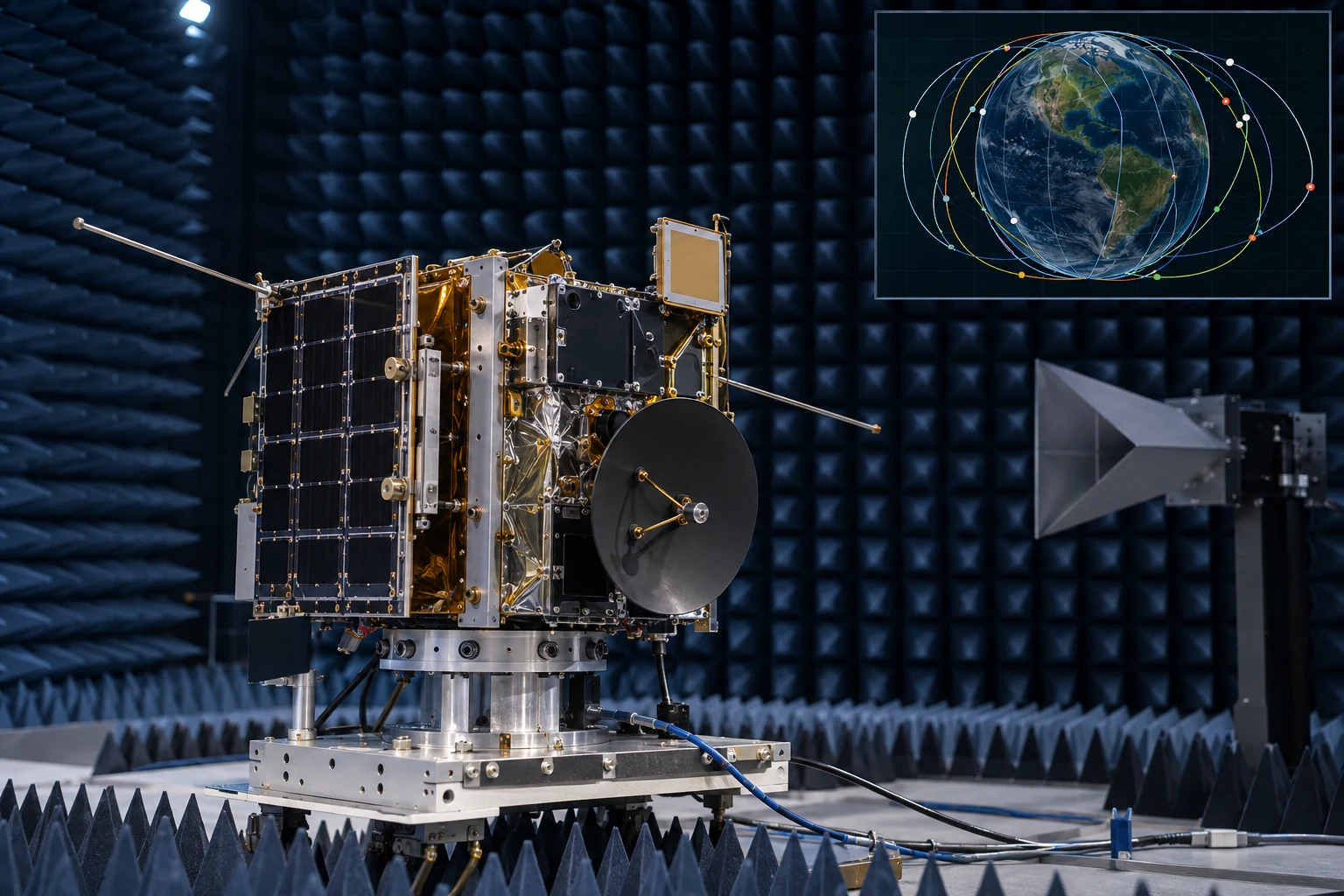
That shift changes the questions T&E has to answer. How do you verify a network of vehicles, most of which you cannot directly observe at any given moment? How do you tell a normal failure (one satellite dropping out) from a system-level problem (correlated failures across many)? Knowledge-guided T&E — an approach that feeds domain knowledge directly into the verification system, instead of leaving it in design documents — is the public literature's most promising answer.
The rest of this article walks through the building blocks: model-based T&E, simulation, knowledge graphs, anomaly classification, and the eval harness that ties them together.
Model-based T&E: treat the model as the source of truth
The simplest definition: instead of writing test cases by hand, you generate them from a structured model of the system. Model-based test and evaluation (MBT&E) takes that system model — a digital description of the satellite, payload, ground segment, and how they interact — and uses it to derive the test cases, the expected telemetry, and the evidence the program needs to certify the system.
For constellations, the model is layered. Vehicle bus, payload, communications link, mission planner, ground segment — each is its own subsystem, and a serious test has to cross all of them. The INCOSE Systems Engineering Handbook and the public literature on model-based systems engineering (MBSE, the broader discipline that MBT&E sits inside) treat this as the modern verification baseline.
The catch: the model only works if the program treats it as the truth. A model that is updated at design milestones and ignored afterward produces verification theater — the appearance of rigor without the substance. A model that is version-controlled, peer-reviewed, and used as the reference for every test case produces real traceability from "what the mission requires" to "what the telemetry shows."
MBT&E, in other words, is a discipline first and a tool second. Buying the modeling software is the easy part. Changing how the program produces and audits verification artifacts is the hard part — and where the published gains live.
Simulation: stress-test the mission before flight
You cannot run a thousand-satellite test on hardware. Simulation-driven verification — running the mission concept against a high-fidelity virtual environment — is the only way to find problems at constellation scale before launch. The publicly available toolchain is mature: GMAT (NASA's General Mission Analysis Tool) and Orekit cover orbit propagation; the SPICE toolkit handles ephemeris (the math of where each body is, and when); link-budget and payload simulators round out the picture.
The danger is over-believing the simulation. A metric that looks great in simulation can fall apart in flight because the simulation missed an environmental factor or an interaction between vehicles. The published discipline is to keep a portion of real flight telemetry as a held-out set — never used during simulation tuning — and to report the gap between simulation and real performance as a numbered metric, not a hand-wave.
Co-simulation, where the system model, the simulator, and the eval harness exchange data through a documented interface, is increasingly the norm. The pattern itself is old — hardware-in-the-loop testing has done this for decades — but the scale required for constellations is new, and so is the requirement that the simulation infrastructure itself be tested for performance and correctness.
Knowledge graphs: a structured way to ask questions of telemetry
A constellation produces a flood of telemetry — data from many vehicles, each instrumented unevenly, each in contact with the ground only intermittently. Making sense of that flood requires a structure. A knowledge graph is one such structure: it stores the entities (vehicles, payloads, ground stations), the relationships between them (this payload belongs to that vehicle), and the rules they should obey (this temperature should never exceed that limit during this mission phase). With the graph in place, you can ask questions like "which vehicles are out of spec right now, and why?" and get a structured answer.
The published research in IEEE Aerospace and AIAA SciTech proceedings documents three common patterns: architectural graphs (mirroring the system design), operational graphs (encoding mission rules), and hybrid graphs that combine the two. Each has different update rates, different schema challenges, and different query-cost characteristics.
The make-or-break discipline is schema governance — the rules for how the graph itself can change over time. Without governance, new entity types and relationships get added ad hoc, the graph drifts into inconsistency, and the analytics built on top stop being trustworthy. With governance — versioned schemas, peer-reviewed changes, automated checks for orphaned or contradictory entries — the graph remains a durable source of analytical value.
Anomaly classification: catching the failures that matter
Detecting that something is "off" in one satellite is a familiar problem. Doing it well across thousands of satellites is a different problem. The base rate of unusual events is much higher, false positives are more expensive (because operator attention is finite), and what counts as normal depends on the constellation's current mission phase.
The published norm is a multi-stage pattern: a fast first-pass detector at the raw telemetry layer flags candidates, a knowledge-graph-aware classifier assigns each candidate to a category (sensor noise, link gap, real fault, etc.), and a human-in-the-loop review queue handles the novel or high-impact cases.
Calibration is the hidden requirement. A detector that fires too often desensitizes operators (alarm fatigue). One that fires too rarely lets real failures through. Published evaluations report calibration metrics — precision at a fixed recall level, expected calibration error, lift over operator-only baselines — as part of the standard methodology, not as a footnote.
Subject-independent evaluation is the other guardrail. Borrowed from medical AI, the idea is simple: hold out entire vehicles, mission phases, or environmental conditions during training, so the model is tested on conditions it has never seen. This prevents the model from quietly memorizing vehicle-specific quirks and producing inflated benchmark numbers.
The eval harness: where verification actually runs
The eval harness is the software that runs the test cases, captures the results, and produces the verification evidence. For distributed systems, it has to be itself distributed, reproducible, and (when needed) deterministic — meaning the same inputs produce the same outputs every time. The patterns translate, with adaptation, from large-scale software-engineering practice in cloud platforms, autonomous-vehicle programs, and internet systems.
Reproducibility is non-negotiable. A harness that produces different results on different runs erodes confidence in every verification artifact it produces and makes regressions hard to localize. The remedy is determinism where possible and "controlled non-determinism" where not — meaning random seeds, environmental inputs, and configuration are recorded with each run, so the run can be replayed.
Telemetry capture is the other core function. The harness has to gather time-stamped telemetry from many sources, reconcile clock skew, and produce a coherent run record that can be queried weeks or months later when something unexpected gets investigated. Mature observability patterns from distributed systems — structured logs, traces with span context, metric stores with adequate retention — apply directly.
| Eval pillar | What it provides | Common failure mode |
|---|---|---|
| Model-based T&E | Authoritative reference behavior, traceability requirement-to-test | Model treated as documentation rather than truth |
| Simulation-driven verification | Stress-tests at scales hardware can't reach | Simulation-real gap not reported as a metric |
| Knowledge-graph reasoning | Structured queries over heterogeneous telemetry | Schema drift, no governance, orphaned nodes |
| Anomaly classification | Triages telemetry into actionable categories | Calibration drift, no subject-independent eval |
| Eval harness | Runs the verification, records evidence | Non-determinism, weak telemetry capture |
| Operator review loop | Closes loop on novel or high-impact anomalies | Review queue overruns operator attention |
Held-out flight data: the most expensive evidence is also the most informative
Flight data — telemetry from real vehicles in real orbits — is the truest evaluation surface available. The published discipline is to set aside a portion of that data as a strict "held-out" set: never used to train models, build knowledge graphs, or tune anomaly classifiers. The metrics computed on that held-out set are the ones that survive contact with the real mission.
Skip the discipline and the verification numbers from simulation drift away from the numbers seen in flight. Once that drift is visible, program offices stop trusting any simulation-derived evidence — and the program loses the ability to verify cheaply.
Cross-program evaluation, where telemetry from multiple constellations or program phases is combined under appropriate data-sharing rules, is an emerging theme in the literature. The pool gets larger and more diverse, but the discipline is to track which subset of the pool each claim was tested on, and to report results stratified by program rather than as a pooled average.
Operator integration: evidence that operators cannot use is wasted
Constellation operators run the system in the loop. An eval framework that produces evidence they cannot consume contributes nothing operationally, no matter how rigorous the underlying methodology is. The published baseline is straightforward: anomaly outputs come with calibrated confidence (a probability the operator can interpret), automated decisions leave audit trails, and there is a clear visual line between "the system suggests" and "the operator decided."
Display integration is the practical instrument. Existing operations consoles, anomaly review tools, and mission-planning interfaces represent years of operator training. T&E artifacts that augment those existing surfaces (overlays, markers, audit trails) get adopted. Parallel tools that ignore established workflow get worked around.
What the literature has not yet settled
Two debates remain unresolved. First: which metrics matter most for constellation-scale verification? Per-vehicle metrics averaged across the constellation and constellation-level metrics that measure network properties are both in use, and the choice changes what the verification claim actually means. Second: how much simulation fidelity is enough? Programs make pragmatic tradeoffs that are often not justified in the verification report.
The most contested question is whether learned (ML) models can produce verification claims directly. Using ML for fast first-pass anomaly detection is well-accepted. Using ML to assert "this constellation meets requirement X" is not, because the verification chain has to be auditable in a way ML outputs typically are not. The literature is converging on a hybrid: ML accelerates the eval, but rule- and model-based reasoning still produces the formal verification artifacts.
Common questions on the public-record framing
Why does the constellation level matter for T&E framing?
Per-vehicle metrics aggregated to a constellation average can hide distributed failures — correlated outages, link-layer interactions, mission-planner errors. Constellation-level metrics capture properties no single-vehicle metric does.
What's the simulation-real gap discipline?
Treat it as a numbered metric, not a qualitative caveat. Maintain held-out flight data, report the gap on the metrics the mission cares about, and invest in fidelity that closes the gap on those metrics.
What does this article not cover?
Specific constellation programs, specific mission concepts under restriction, or any Precision Federal architectural approach. The framing is general public methodology only.
Frequently asked questions
It's verification that uses your engineers' domain knowledge — the system architecture, the mission rules, the expected behaviors — as direct input to the test infrastructure, instead of leaving that knowledge in design documents. Knowledge graphs and model-based T&E are the two most common ways to do it.
Constellation telemetry is messy — high volume, uneven coverage, partial visibility. A graph stores not just the data but the relationships and rules around it, so you can ask structured questions like "is this temperature reading consistent with this mission phase?" A flat database can store the same data but cannot answer those questions natively.
It means its confidence numbers can be trusted at face value. If the classifier reports 80% confidence in a fault, then 80% of those reports actually are faults. The published norm is to measure calibration on held-out flight data and to split the data across vehicles and mission phases so the metric is honest.
If your test infrastructure produces different results on different runs, no one can tell whether a failing test indicates a real bug or a flaky test. Reproducibility — or at least recording random seeds and configuration so a run can be replayed — is a precondition for any serious verification at constellation scale.
How we use this site
We write articles like this to make our reading visible — what we think the open literature says, what we think the open gaps are, and where careful work might land. We do not use these pages to preview proposed approaches in active program spaces. Precision Federal is a software-only SBIR firm. If your office is funding work in this area and would value a software-first partner with a documented public-reading habit, we welcome the introduction.