
CB threat-detection ML — methodological signals
Higher score = stronger public-literature support for a CBDP-adjacent ML threat-detection method.
The problem class, in public terms
Chemical and biological threat detection sits at the intersection of analytical chemistry, signal processing, and machine learning. The publicly stated problem — by the Chemical and Biological Defense Program (CBDP) and adjacent offices — is that field-deployable detection has historically depended either on costly laboratory-grade instruments or on lower-fidelity portable sensors that produce noisy, modality-specific signals. The open research question is whether modern learning methods can extract more reliable threat calls from less expensive sensor stacks.
Reduce false-alarm burden in the field by combining physics-grounded signal pipelines with learned classifiers, validated against publicly published benchmarks. Operational data — concentration thresholds, agent libraries, deployment locations — stays out of public articles.
The framing matters because it sets the success metric. The published goal is rarely "higher absolute sensitivity" — laboratory-grade instruments already meet that bar. Instead, it is "comparable sensitivity at a fraction of the SWaP-C envelope, with operator-comprehensible confidence." That metric — receiver operating characteristic at a fixed false-alarm rate, with explicit calibration of the decision threshold — is the one that recurs across published evaluations from ECBC, DEVCOM CBC, and the Joint Program Executive Office for Chemical, Biological, Radiological, and Nuclear Defense (JPEO-CBRND).
The methodological line that follows is straightforward. The open community has converged on hybrid pipelines — analytical front ends that extract chemically meaningful features, learned back ends that classify or score those features — over end-to-end deep models that treat raw spectra as opaque tensors. The reason is partly explainability and partly data scarcity, and the rest of the article unpacks both.
Sensor modalities the open literature treats seriously
The peer-reviewed work falls into a small set of buckets. Mass-spectrometry adjacent methods — including ion-mobility spectrometry (IMS) — are well represented for chemical agents. Optical methods, including Raman, infrared, and hyperspectral imaging, dominate the standoff-detection literature. Bioaerosol detection couples fluorescence-based collection (LIF — laser-induced fluorescence) with downstream PCR or sequencing. Each modality produces a different signal shape, and each rewards a different learning architecture. None of the published methods substitutes for trained operators or laboratory confirmation; the goal in the literature is consistently to reduce false-alarm burden in the field.
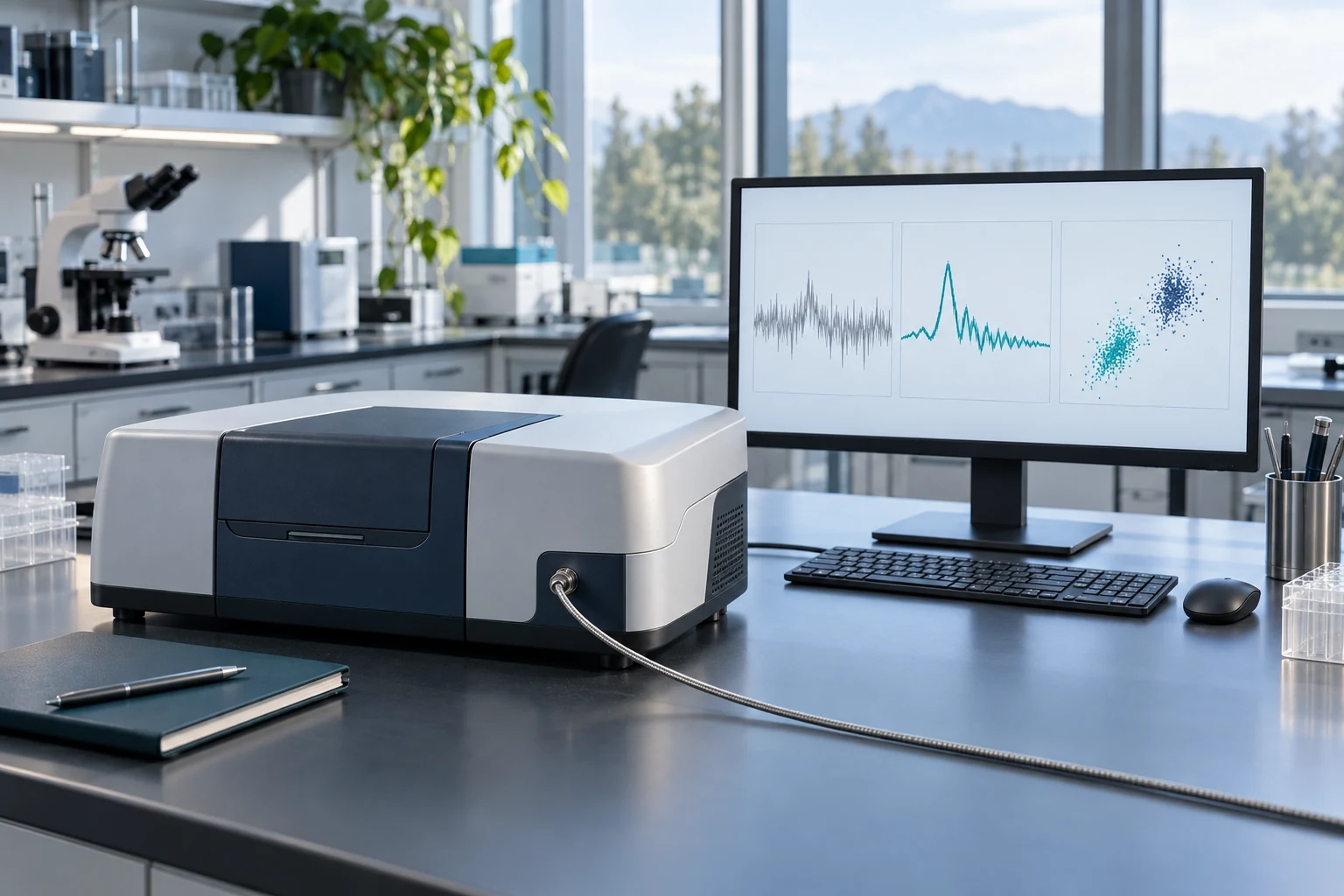
For mass-spectrometry-style data, one-dimensional convolutional networks and attention models over m/z bins dominate the published comparisons; for hyperspectral cubes, two- and three-dimensional CNNs, vision transformers, and unmixing networks built on the linear-mixing model are common. The bioaerosol literature has historically leaned on classical statistical clustering — Gaussian mixtures, random forests over fluorescence-channel features — because labeled threat-organism data is scarce and class boundaries are biology-soft.
The cross-modality finding worth naming: published reviews from the Defense Threat Reduction Agency basic-research portfolio and from groups at MIT Lincoln Laboratory, Sandia, and Pacific Northwest National Laboratory consistently report that fusion of two complementary modalities (for example, IMS plus Raman for chemicals, or LIF plus PCR for bio) yields larger false-alarm reductions than any single-modality model improvement. The published literature recommends modality fusion as the first place to spend evaluation effort.
Open datasets and benchmark gaps
Compared to image classification, public CBRN detection datasets are sparse. Researchers commonly rely on partial releases from academic labs, simulation-generated spectra, or proprietary corpora published only as summary statistics. This data scarcity is itself a research subject: domain randomization, physics-based simulators, and small-data learning techniques (few-shot, contrastive) appear repeatedly because there is no equivalent of ImageNet for chemical signatures. Any practitioner working in this space has to make explicit what training distribution their model assumes and what the domain shift looks like at the field deployment site.
The publicly accessible reference libraries that anchor much of the work — the NIST Mass Spectral Library, the SDBS spectral database, the USGS spectral library for hyperspectral material identification — are reference compendia, not benchmark datasets. They tell a model what a clean spectrum of a known compound looks like; they do not tell it how a noisy field spectrum of a mixture in a humidity-laden environment looks. Bridging that gap is where physics-based forward models — atmospheric radiative transfer codes such as MODTRAN, finite-element molecular simulations, and synthetic-mixture generators — earn their place in the pipeline.
Public-Source Reference Libraries Worth Naming
NIST Mass Spectral Library / NIST WebBook. The reference corpus for electron-ionization mass spectra; standard against which IMS classification claims are anchored.
USGS Spectral Library Version 7. Reflectance and emissivity spectra of minerals, vegetation, and engineered materials; the public anchor for hyperspectral material identification.
SDBS (AIST). NMR, IR, Raman, and mass spectra for organic compounds; widely cited as a clean-spectrum reference in the open literature.
HITRAN / MODTRAN. Line-by-line and band-model atmospheric transmission codes used to forward-model standoff-detection scenarios.
Signal-processing pre-stages
The less-publicized half of this problem is the deterministic signal pipeline that precedes the learned classifier. Baseline correction, peak alignment, isotope deconvolution, and noise whitening all occur before a single weight update. Skipping or mis-tuning these stages is the most common reason a published end-to-end deep-learning approach fails to reproduce on independent data. The literature increasingly treats the pipeline as a hybrid: a physics- or chemistry-informed front end feeding a learned back end. That posture is consistent with DOT&E and CDAO public guidance on AI test & evaluation, which emphasize traceability and human review of model behavior.
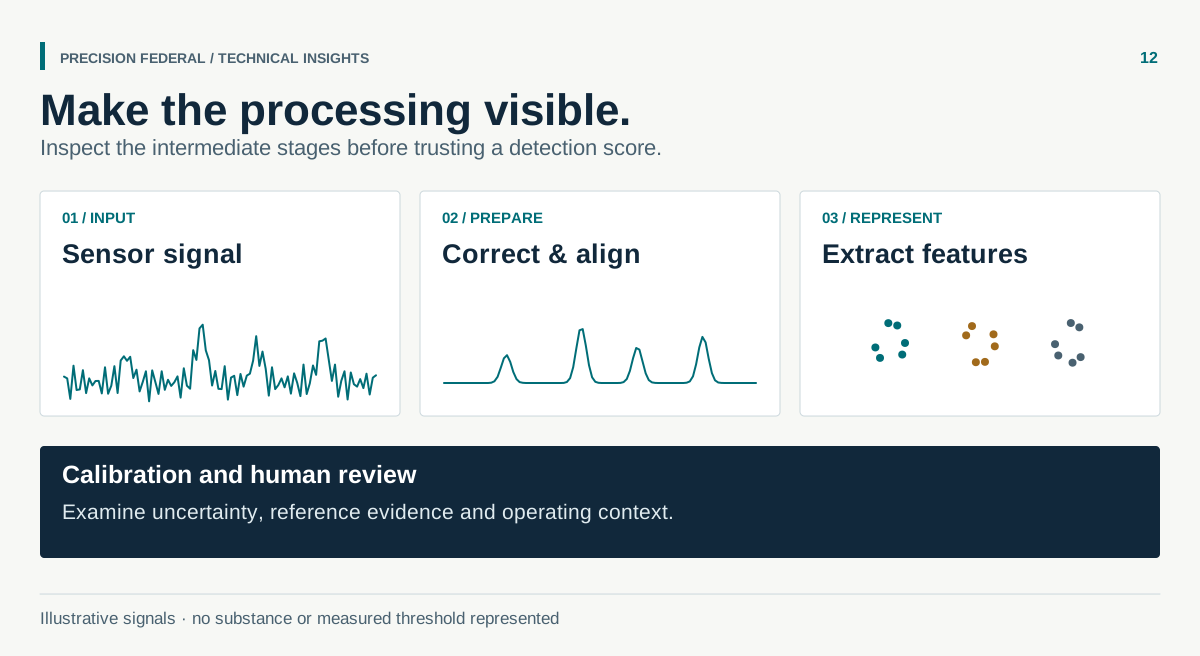
The specific techniques that recur in published comparisons are well-known to chemometrics: asymmetric least-squares (AsLS) baseline correction, Savitzky-Golay smoothing, standard-normal-variate (SNV) and multiplicative-scatter-correction (MSC) normalization, parametric time warping for peak alignment, and orthogonal signal correction for removing systematic interferents. These are not novel methods. What is contested is when they should be applied, in what order, and whether they should be learned end-to-end (as in differentiable signal-processing layers) or fixed (as in classical chemometrics). The research literature in Analytical Chemistry, Chemometrics and Intelligent Laboratory Systems, and IEEE T-GRS contains active comparisons.
The auditability angle is what makes this matter for federal deployment. NIST AI 100-1 (the AI Risk Management Framework) and the CDAO Responsible AI Toolkit both call out interpretable intermediate stages and the ability to inspect model behavior on representative data. A pipeline that exposes a deconvolved spectrum, the matched library entries, and the learned-classifier confidence as separate stages is auditable in a way an end-to-end black-box network is not. The methodological choice therefore tracks a policy expectation as well as an engineering one.
What CBDP-adjacent programs tend to ask for
Reading the publicly available BAA history of CBDP-affiliated SBIR solicitations, the recurring asks are: reduce false-positive rate at fixed sensitivity; quantify confidence in a way operators can act on; and operate under the size-weight-power constraints of a wearable or vehicle-mounted form factor. These three asks are also where the published research community has the most active disagreement, which is helpful — disagreement is where novel SBIR work earns its keep.
The "operator-actionable confidence" requirement deserves separate attention. Published work on conformal prediction (Vovk and colleagues; the rapidly growing 2020-onward applied literature) and on calibration of deep classifiers (Guo et al. 2017 on temperature scaling; subsequent work on focal-loss calibration) gives a principled handle on the problem. A model that says "threat present, confidence 0.78, with a 90 percent prediction-set guarantee" gives the operator something to act on; a softmax score absent a calibration regime does not. Public DoD test-and-evaluation guidance is explicit that calibrated confidence beats uncalibrated point predictions.
The SWaP-C envelope is where software meets hardware reality. A wearable detector running on a microcontroller-class compute budget cannot host a hundred-million-parameter transformer. The published edge-deployment literature has settled on quantization-aware training, structured pruning, and knowledge distillation as the toolkit for shrinking models, and the chemistry-informed front end matters here too: feature engineering that compresses a noisy spectrum to a small, physically meaningful vector reduces the model size at the back end. The design discipline is to push as much of the work as possible into deterministic, cheap pre-stages.
What does not belong in a public article
Concentration thresholds, agent-specific signature libraries, deployment locations, sensor-network topologies, and any operationally derived false-alarm statistics are out of scope for any public-facing piece. The public version of this conversation stops at methodological claims and open-literature evidence. Anyone writing publicly in this space should respect that line, and any program office reading public material should expect to see it respected.
The reason for the line is operational. Published threshold tables and signature libraries can be useful to an adversary in two ways: they reveal the sensitivity floor below which an evasion attempt would not be detected, and they reveal which compounds the deployed library is blind to. Even the appearance of pattern-matched specifics — "the sensor responds best at concentrations above X ppb" — sits on the wrong side of the line. Methodological claims are safer because they describe a process, not a system characterization.
Where this connects
For software-first small businesses, this problem class rewards teams that can engineer the unglamorous parts — pipelines, simulators, calibration tooling, and evaluation harnesses — rather than only the model itself. The principal-investigator posture our firm takes is to build the harness first and the model second, because the harness is what survives review by an independent T&E authority.
The adjacent insight is that the most credible offerors in this space publish on benchmarks the community recognizes — chemometrics challenges hosted by ASMS or PittCon working groups, Kaggle-style hyperspectral classification competitions, the DARPA-public datasets where they exist — before they propose. Public publication is the most reliable evidence that the principal investigator can run the data-engineering pipeline that the program office will eventually have to evaluate. It is also a credible alternative to past performance for a new firm that does not yet have a portfolio of executed contracts.
How we use this site
We write articles like this to make our reading visible — what we think the open literature says, what we think the open gaps are, and where careful work might land. We do not use these pages to preview proposed approaches in active program spaces. Precision Federal is a software-only SBIR firm. If your office is funding work in this area and would value a software-first partner with a documented public-reading habit, we welcome the introduction.
Common questions on the public-record framing
Where does the public literature stop and the operational record begin?
The published methodology is what we cite. Operational data — concentration thresholds, agent libraries, deployment locations, false-alarm statistics — is out of scope by design.
What does T&E discipline look like for ML in this domain?
DOT&E and CDAO public guidance emphasize traceability, calibrated confidence, and human review. Inspectable intermediate representations help; black-box pipelines do not.
Why does data scarcity drive synthetic and few-shot methods here?
Public datasets are sparse compared to image classification. Domain randomization, physics-based simulators, and small-data techniques appear because the equivalent of ImageNet does not exist.
What does this article deliberately not cover?
Agent-specific signature libraries, sensor-network topologies, deployment locations, and operational alarm rates. Public articles stop at method-class claims.
Sensor modality public-literature treatment
| Modality | Strengths | Constraints |
|---|---|---|
| Mass spectrometry / IMS | Strong for chemical agents | Cost; field SWaP |
| Optical (Raman, IR, hyperspectral) | Standoff detection literature | Background and atmospheric effects |
| Bioaerosol fluorescence | Non-destructive collection | Confirmation requires PCR or sequencing |
| Edge inference | Reduces false-alarm burden | Hardware constraints in field |
Frequently asked questions
Mass-spectrometry-adjacent methods including ion-mobility spectrometry for chemical agents; optical methods including Raman, infrared, and hyperspectral imaging for standoff detection; and bioaerosol detection coupling fluorescence-based collection with downstream PCR or sequencing for biological agents. Each modality produces a different signal shape and rewards a different learning architecture.
Public CBRN detection datasets are sparse compared to image classification, so practitioners rely on partial academic releases, simulation-generated spectra, and small-data techniques like domain randomization, physics-based simulators, few-shot, and contrastive learning. Any practitioner has to make explicit what training distribution their model assumes and what the domain shift looks like at the field deployment site.
DOT&E and CDAO public guidance on AI test & evaluation emphasize traceability, reproducibility, and human review of model behavior. Hybrid pipelines — physics- or chemistry-informed front ends feeding learned back ends — are consistent with that posture because they preserve interpretable intermediate stages.
Concentration thresholds, agent-specific signature libraries, deployment locations, sensor-network topologies, and any operationally derived false-alarm statistics. Public conversation stops at methodological claims and open-literature evidence.