
Why model documentation matters in federal AI procurement
For much of the past decade, AI model documentation was academic — a research-community good-hygiene practice popularized by Mitchell et al's 2019 model cards paper and Gebru et al's datasheets-for-datasets proposal. In the federal space, this was aspirational. Program offices bought AI models by procurement, deployed them on contractor-defined terms, and occasionally asked questions about accuracy. That era is ending. Under pressure from NIST AI RMF, CDAO assurance requirements, and the governance expectations that followed EO 14110, federal buyers are formalizing documentation expectations into contractual requirements.
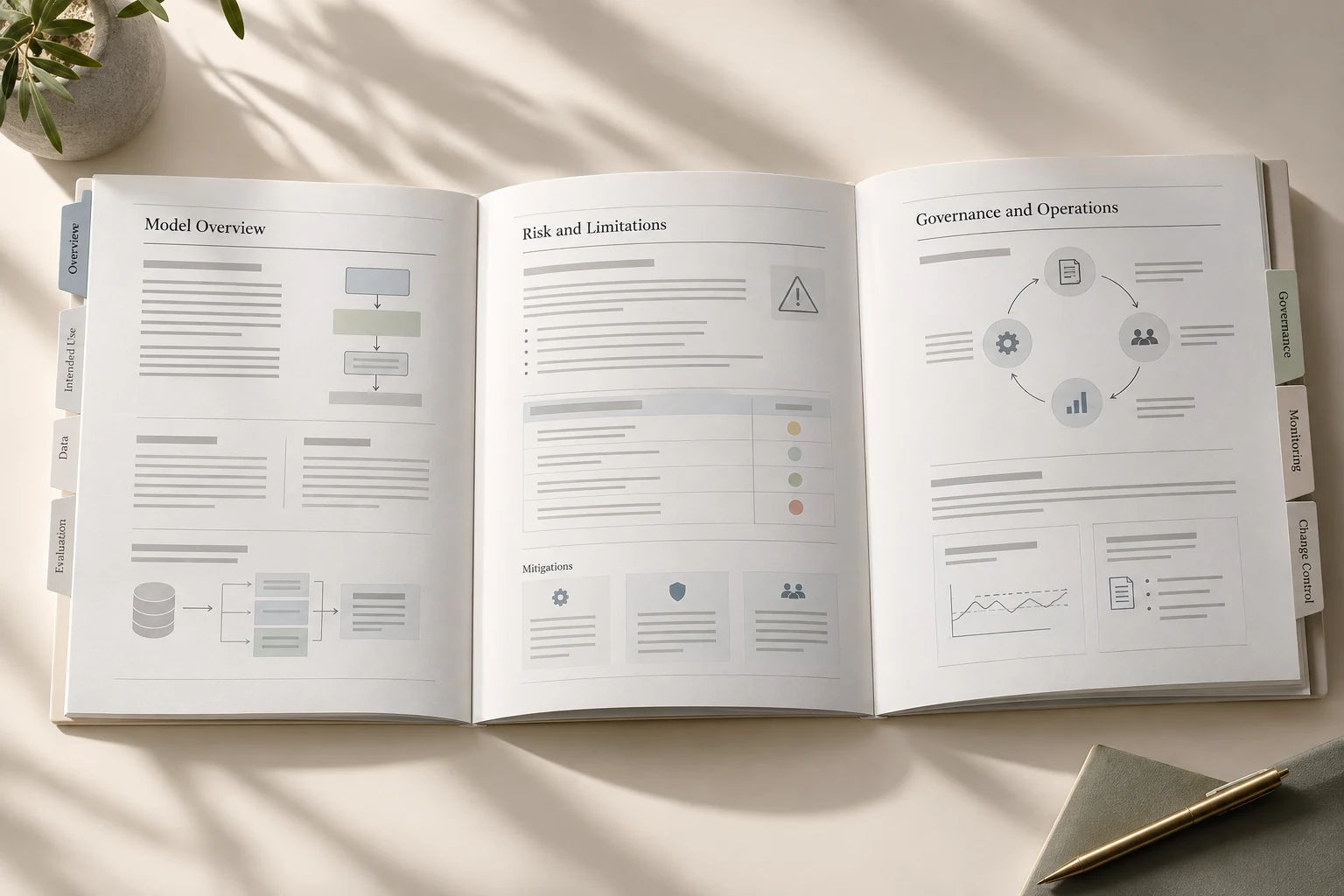
The practical consequence for contractors is that model documentation is becoming a deliverable. Not a nice-to-have appendix, not a PR artifact, not a mention in the README — a structured document with specific required sections, tied to specific controls, reviewed as a condition of authorization. Firms that anticipate this shift will be positioned for the next generation of federal AI contracts; firms that do not will face retrofit pressure when their existing systems come up for re-authorization.
Documentation does three things at the system level that no amount of technical polish can substitute for: it makes the system's intended use explicit (so misuse is clearly off-scope), it establishes the baseline against which drift and degradation can be measured, and it captures the institutional knowledge that otherwise walks out the door when the team changes. None of these is a marketing benefit. All three are operational necessities for fielded AI.
Model Documentation Coverage — Federal AI Deployment Checklist
Editorial weighting from public sources and practitioner reading — illustrative, not a measured statistic.
NIST AI RMF: Govern and Map functions
The NIST AI Risk Management Framework is the reference text for federal AI governance in 2026. Of its four functions, Govern and Map are the ones that drive documentation requirements. Govern establishes the organizational accountability structures — who owns the risk, who approves use, who handles exceptions. Map establishes the specific context — what is the system, who are the users, what data does it consume, what decisions does it inform or make.
Specific subcategories of the framework translate into documentation expectations. Govern 1.4 addresses policies and procedures. Map 1.1 addresses intended purposes. Map 2.3 addresses scientific integrity and TEVV. Map 3.4 addresses procurement processes. An AI system that cannot produce documentation against each of these creates gaps that an agency reviewer will flag. Agencies using the framework as an acquisition reference — and more are, every cycle — translate these subcategories into explicit contract requirements.
The NIST AI RMF Playbook, published alongside the framework, gives concrete suggested actions for each subcategory. These are not binding, but they are the closest thing to a template for what "good" documentation looks like. Firms that map their model documentation sections to Playbook actions produce artifacts that reviewers immediately recognize. Firms that invent their own taxonomy force reviewers to do the mapping, which reviewers do not do.
What a model card must contain for a federal deployment
A federally-usable model card covers, at minimum, the following sections. Model details: architecture, parameter count, training date, training compute, version. Intended use: primary use cases, intended users, out-of-scope uses, operational context. Training data: sources, provenance, collection methodology, known biases, quality assessment. Evaluation data: held-out sets used for performance claims, representativeness assessment. Performance metrics: aggregate and disaggregated by relevant subgroups, with confidence intervals where appropriate.
Additional sections that distinguish a federal-ready card from an academic one: ethical considerations and risk assessment tied to NIST AI RMF, human oversight and escalation procedures, safety-critical failure modes and mitigations, operational monitoring plan, change-control procedure, and version history with dates and responsible parties. For high-impact systems, a red-team summary section referencing external evaluation (see our piece on AI red-teaming) is increasingly expected.
The format matters less than the content, but the agencies converging on preferred formats are worth knowing. CDAO has published templates for DoD system cards. NIST references the Mitchell et al format as a baseline. HHS components (FDA for SaMD, CMS for programmatic AI) have their own variants. A firm operating across agencies should produce an internal canonical form and map it to agency-specific formats as needed, rather than maintaining multiple parallel documents.
CDAO's AI assurance framework
Within DoD, the Chief Digital and Artificial Intelligence Office is the center of gravity for AI assurance expectations. The CDAO framework layers mission-specific considerations on top of NIST AI RMF: adversary threat models, classified data handling, supply-chain assurance at the model-weights level, and operational-consequence-proportionate rigor. For a model being fielded in a targeting-adjacent or lethality-adjacent role, the documentation requirements are substantially heavier than for a model supporting administrative decisions.
Contractors should expect CDAO references in DoD AI solicitations across FY2026 and beyond. The references typically ask for alignment with CDAO evaluation frameworks, production of system cards to CDAO specification, and willingness to participate in CDAO-led T&E. These are not boilerplate — they translate into specific deliverable requirements and specific evaluation criteria.
The practical upshot: a firm proposing AI work to a DoD customer needs to demonstrate familiarity with CDAO assurance expectations, willingness to produce artifacts to those expectations, and a credible approach to integrating assurance work into development from the start rather than retrofitting it at the end.
Federal reporting requirements for high-impact systems
Executive Order 14110 established the foundation for federal AI reporting on dual-use foundation models and high-impact systems. The order was revoked in January 2025, but the underlying reporting practice — what constitutes a reportable model, what must be reported, to whom, on what cadence — has persisted in agency practice. The Center for AI Standards and Innovation (CAISI, formerly the AI Safety Institute) under NIST is the operational home for much of the technical reporting guidance.
For contractors, the EO's practical legacy is that "high-impact" has become a recognized category in federal AI governance, and systems in that category face heightened documentation expectations. The categorization criteria vary by agency but typically include some combination of deployment scale, decision consequence (especially on rights, liberties, access to benefits), and safety implications. If a system falls into the category, its documentation burden is higher — and the definition is expanding, not contracting.
The quiet reality is that most federal AI systems will eventually be reviewed against high-impact criteria at least once in their lifecycle, and firms that produce high-impact-grade documentation from the start avoid costly retrofit later.
How to write a system card that survives ATO review
ATO review is different from technical review. The Authorizing Official is deciding whether to accept operational risk, not whether the engineering is clever. A system card that reads as a technical brochure will not serve that decision. A system card that reads as a risk-informed operational document will.
The operational posture starts with honesty about limitations. A card that claims "robust performance across all conditions" without evidence is worse than a card that says "performance degrades below X confidence in the following operational conditions" with a mitigation plan. AOs prefer bounded claims with mitigations to unbounded claims without evidence. The second is unactionable; the first is something they can accept, transfer, or require a compensating control for.
The second practice is traceability. Every performance claim in the card should reference an evaluation artifact — a test run, a benchmark result, a formal evaluation report. A claim without a reference is an assertion; a claim with a reference is evidence. AOs who have read a lot of these can tell the difference at a glance.
The third practice is explicit tie-back to controls. The NIST AI RMF Measure and Manage subcategories should be referenced wherever the documentation addresses them. Tie-back does not have to be heavy — a short parenthetical citation in each relevant section is enough. It signals that the author knows the framework and that the artifact will survive integration into a broader SSP.
Documentation requirements by classification level
Classification level changes the documentation burden in specific ways. For unclassified systems processing public data, standard model card plus deployment notes is sufficient. For CUI-processing systems, additional sections on data handling, access control, and audit logging are required, and the card itself may need to be marked CUI if it contains sensitive information about training data or system vulnerabilities.
FOUO (For Official Use Only) sits between public and CUI and is used inconsistently across agencies; the trend has been to consolidate FOUO into CUI categories, but both still appear. Documentation for FOUO systems typically needs to be accessible to a broader federal audience than CUI documentation while still controlling for sensitive technical detail.
Classified systems — collateral, SCI, SAP — add layers of control and typically require two parallel documents: an unclassified summary usable in broader contracting and oversight contexts, and a classified detailed system card that lives in appropriately-controlled repositories. The split is not optional for most classified AI work; it is required by the combination of acquisition transparency and classification protection.
What's coming: OMB and OSTP proposed requirements
The regulatory direction for federal AI documentation is toward more formalization, not less. OMB memoranda on federal AI use — revised periodically and with implementation dates rolling through FY2026 and FY2027 — push agencies toward standardized inventories, impact assessments, and documentation consistency. OSTP guidance on AI in scientific research layers additional documentation expectations on research-funded AI, relevant for NIH, NSF, DOE, and NASA-funded systems.
The specifics will continue to evolve, but the direction is clear. Expect more standardization of model card formats, more explicit linkage between documentation and ATO decisions, more cross-agency harmonization of documentation requirements, and more routine use of structured model documentation as a contracting deliverable. Firms that treat documentation as an afterthought will be disadvantaged; firms that treat it as a first-class deliverable will be positioned for the next cycle of federal AI contracts.
Bottom line
Federal AI documentation has shifted from academic practice to operational requirement. Model cards, system cards, and datasheets are being integrated into ATO processes, CDAO assurance frameworks, and the post-EO-14110 governance infrastructure. Contractors that produce high-quality documentation as a core deliverable — not as an afterthought — will find it a competitive advantage across procurement, transition, and sustainment. Those that do not will find themselves retrofitting documentation under deadline pressure, at higher cost, with worse artifacts.
Frequently asked questions
A structured document describing an AI model's intended use, training data, performance, limitations, and failure modes — tied to specific controls and suitable for integration into ATO packages. Distinct from academic model cards because it must support authorization decisions.
The framework itself is voluntary, but Govern and Map functions presume documented intended use, data provenance, and performance characterization. Agencies referencing the framework in acquisitions translate these into required artifacts.
CDAO is the most explicit within DoD. DHS, HHS components (FDA, CMS), NIH, and a growing set of civilian agencies have distinct documentation expectations. Expect more formalization through FY2026 and FY2027.
Format varies by agency. CDAO has published DoD system card templates; NIST references the Mitchell et al baseline; HHS components have their own. Most firms maintain an internal canonical form and map to agency-specific formats as needed.
At minimum, on every model version that changes performance characteristics, training data, or intended use. Many agencies also require annual review regardless of model changes. Version control and change history are required sections of a federal-grade card.