What AI red-teaming means in a federal context
Commercial AI red-teaming, as practiced by frontier labs, is a broad exercise: scrape together a team of creative attackers, point them at a model, and see what breaks. Federal red-teaming is narrower and more structured. It is adversarial evaluation against a documented threat model, tied to a specific system boundary, producing evidence that feeds an authorization decision. The question is not "can we make this model do something embarrassing" — it is "does this system tolerate the adversary we have to assume in this mission context."
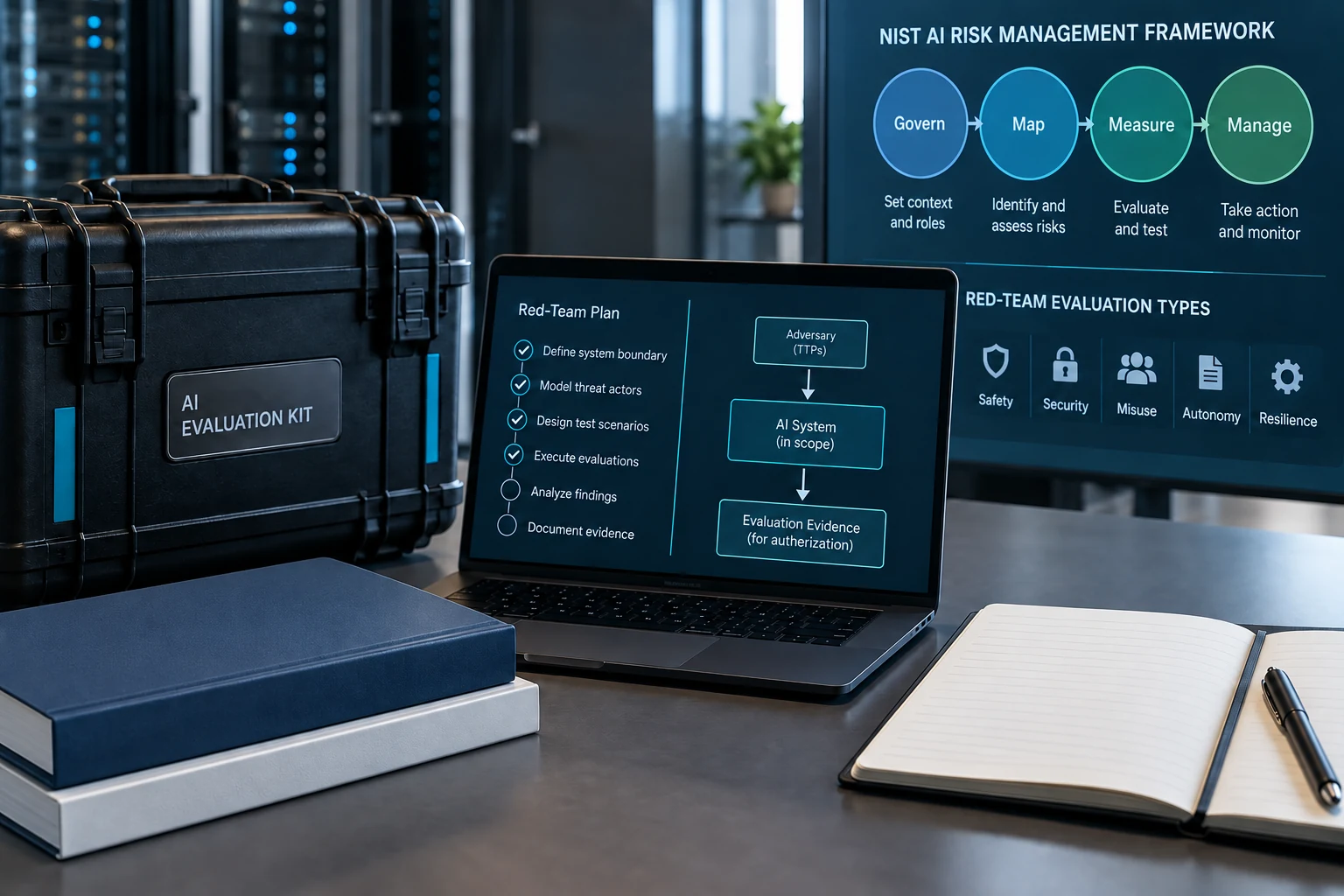
That framing matters, because it changes what the engagement produces. A commercial red-team report often reads like a tasting menu of jailbreaks. A federal red-team report must map each finding to a control, a risk statement, and a recommended mitigation that an authorizing official can accept, transfer, or defer. If the artifact does not survive an ATO package review, the engagement did not do its job.
The other structural difference is scope. Federal engagements typically cover five attack surfaces: the prompt interface (adversarial inputs), the model itself (inversion, extraction, membership inference), the training pipeline (poisoning, backdoor injection), the supply chain (compromised weights, dependencies, base models), and the inference environment (evasion, query abuse, rate-limit bypass). A report that covers only prompt-level attacks is not a federal red-team — it is a partial evaluation that leaves most of the system unassessed.
Federal AI Red-Team Coverage by Attack Vector
Editorial weighting from public sources and practitioner reading — illustrative, not a measured statistic.
NIST AI RMF alignment — Govern, Map, Measure, Manage
The NIST AI Risk Management Framework is the lingua franca of federal AI governance. Its four core functions — Govern, Map, Measure, Manage — give red-teaming a clear home. Red-team evidence lives primarily in Measure, with secondary outputs feeding Manage. Govern and Map set the context; you cannot red-team a system meaningfully if you do not know its intended use, its users, or its data provenance.
In practice, a federal red-team engagement opens with a Map phase — confirming system boundary, intended use, data flows, and threat model — before any testing. This is not bureaucratic overhead. It is the only way to produce findings that the government can act on. A finding without a mapped control is an anecdote; a finding tied to NIST AI RMF Measure 2.7 or 2.11 is actionable evidence.
The RMF Playbook, which NIST publishes alongside the framework, gives concrete test suggestions for Measure. Federal red-teams that reference the Playbook directly in their reports — tying each test case to a specific Measure subcategory — produce artifacts that authorizing officials recognize immediately. Firms that ignore the Playbook and write reports in their own taxonomy force AOs to do the mapping themselves, and AOs do not do that work.
DoD requirements: CDAO and AI Assurance
The Chief Digital and Artificial Intelligence Office is the center of gravity for DoD AI evaluation. CDAO's AI Assurance directorate publishes evaluation frameworks that operational components use when buying or fielding AI. For high-impact systems — anything touching targeting, lethality, critical logistics, or personnel decisions — CDAO expects red-team evidence as part of the T&E package. The assurance framework explicitly borrows from NIST AI RMF but layers DoD-specific threat considerations on top: adversary nation-state capability, classified data handling, and the possibility of supply-chain compromise at the weights level.
Operational components — Army, Navy, Air Force, SOCOM — are inheriting these expectations into their own acquisition language. An Army SBIR topic that touches AI-enabled targeting will increasingly require red-team evidence before Phase III. A Navy topic that uses models in a shipboard decision-support role will expect documented evaluation. The contractor who can produce this evidence credibly has a structural advantage over one who treats assurance as an afterthought.
A practical note: CDAO does not typically run the red-team itself. It reviews the evidence. The red-team is performed either by the system developer (with appropriate independence controls), by a subcontracted third-party assessor, or by a government lab. For small firms, the opportunity is to be the subcontracted third-party — the independent evaluator that a prime brings in to produce the red-team artifact.
Types of red-team evaluations
The canonical taxonomy for AI red-team evaluations has stabilized into five families, and every federal engagement should address each or explicitly scope it out with justification.
Adversarial prompting targets the input interface: prompt injection, jailbreaks, instruction override, and role-confusion attacks. For LLM-backed systems, this is the most visible surface and the one stakeholders ask about first. Techniques range from trivial (ignore-previous-instructions payloads) to sophisticated (multi-turn social engineering, encoded payloads in retrieved context, unicode confusables). A credible engagement uses both hand-crafted and automated attack generation.
Data poisoning and training manipulation targets the pipeline. If an adversary can influence training data — by polluting a public scrape, by compromising an annotation vendor, by introducing backdoors via fine-tuning data — the model can be made to behave normally in evaluation and adversarially in deployment. Testing requires access to the training pipeline and provenance records, which is why federal red-teams often expand scope beyond the model to include the data supply chain.
Model inversion and extraction targets the model's memory. Membership inference asks whether a specific record was in the training set. Inversion reconstructs training data from model behavior. Extraction creates a functional copy of the model by querying it. For models trained on sensitive federal data — PII, health records, classified operational data — inversion and extraction attacks are primary risks, not edge cases.
Supply chain attacks target the base model, the weights, the dependencies, and the runtime. A red-team must ask: who signed these weights, can you prove provenance, what is the SBOM for the inference stack, and what happens if a pinned dependency is compromised between audits. For systems built on open-weights foundation models, this is often the highest-impact attack surface and the most frequently under-tested.
Inference-time evasion targets the deployed system: adversarial examples crafted to evade a vision classifier, query patterns designed to bypass rate limits or content filters, and environmental manipulation (physical-world attacks on sensors). These attacks are concrete and measurable, which makes them attractive to reviewers looking for quantitative evidence.
From EO 14110 to CAISI
Executive Order 14110 — the 2023 AI executive order — created the first federal reporting regime for frontier-model red-teaming. The order was revoked in January 2025, and the NIST body it stood up was renamed the Center for AI Standards and Innovation (CAISI) in June 2025. The technical infrastructure survived the turnover: CAISI evaluation methodology, NIST's red-team guidance documents, and the dual-use foundation model evaluation practice continue to shape agency expectations.
The practical upshot is that when a solicitation references "alignment with NIST guidance" or "AI safety evaluation," it almost always means the CAISI-published methodology (much of it issued under the AISI name). A firm proposing red-team capability should cite CAISI's evaluation protocols by name, describe how its test harness implements them, and show prior application. This is a short, defensible signal that the proposer reads the actual guidance rather than marketing material.
AISI has also been publishing benchmark suites and red-team collaboration patterns. Referencing these — and where appropriate, having run against them — is table stakes for proposals targeting CDAO, NIH AI safety programs, or DHS AI-for-critical-infrastructure work.
How to scope a red-team engagement
Scoping is where most engagements succeed or fail. A scope that is too broad produces a tasting menu and no actionable findings. A scope that is too narrow leaves critical surfaces untested. The right scope starts with a threat model — who are the adversaries, what are their capabilities, what are their objectives against this specific system — and derives the test cases from there.
A defensible scope document names the system boundary, lists the five attack surfaces and explicitly marks which are in-scope and out-of-scope (with justification for each exclusion), references the NIST AI RMF subcategories covered, and defines the deliverable format. The deliverable almost always includes a findings report with severity ratings, reproducer artifacts (prompts, payloads, scripts), and a mitigations section written against the system's actual architecture.
Timeline matters. A meaningful red-team on a non-trivial federal system runs six to twelve weeks. Anything shorter either skims the surface or reuses off-the-shelf attack suites without tailoring. Agencies that have been through a few engagements can tell the difference.
SBIR topic opportunities in AI evaluation and assurance
Federal AI evaluation is a rich topic area for SBIR across multiple agencies. CDAO has funded topics on AI T&E tooling, assurance automation, and evaluation-pipeline scaling. Army and Navy have funded red-team-adjacent work under broader AI assurance topics. DARPA's GARD program pioneered much of the adversarial ML test infrastructure and its successors continue to fund adversarial ML research. NIH has begun funding AI safety evaluation work in biomedical contexts. DHS is interested in AI evaluation for critical-infrastructure applications.
For a small firm, the most winnable topics are tooling and methodology topics: a novel evaluation technique, a test-harness that scales, an automation approach that reduces human evaluator hours. Agencies are aware that red-teaming done entirely by humans does not scale; any proposer with a credible automation angle — automated attack generation, test-case prioritization, continuous red-teaming — starts from a strong position.
The positioning for an SBIR proposal in this area is: specific attack surface, specific agency mission context, specific NIST AI RMF subcategory, and specific deliverable that an authorizing official could use. Generic "we do AI red-teaming" proposals lose to proposers who name what they are evaluating, for whom, against what threat, and in what authorization context.
Bottom line
Federal AI red-teaming is becoming a distinct discipline — neither a subset of traditional penetration testing nor a repackaging of commercial AI safety work. It sits at the intersection of NIST AI RMF, DoD assurance requirements, and the authorization decisions that gate production deployment. Firms that can produce evidence usable in those decisions will find a growing market; firms that treat it as a marketing add-on will not.
Frequently asked questions
Structured adversarial evaluation of an AI system against a documented threat model, tied to the NIST AI RMF Measure and Manage functions, producing evidence that feeds an authorization decision. It is narrower and more procedural than commercial red-teaming.
CDAO leads inside DoD. DHS, IC components, and parts of HHS are requiring red-team artifacts for high-impact systems. NIST AISI publishes the methodology that others reference. Expect explicit language in more RFPs during FY2026.
Red-team findings feed the risk assessment and the AI-specific SSP addenda that agencies are adding. Under CDAO assurance, the red-team report is an input to the AI system card and the authorization decision. FedRAMP has not yet finalized AI overlays, but AOs are increasingly requesting red-team evidence.
Yes. Primes often bring in independent third-party assessors to produce red-team artifacts, and SBIR topics in AI evaluation and assurance specifically target small-firm innovation in tooling and methodology.
Six to twelve weeks for a meaningful engagement on a non-trivial system. Anything shorter usually skims surfaces or reuses generic attack suites without tailoring to the threat model.