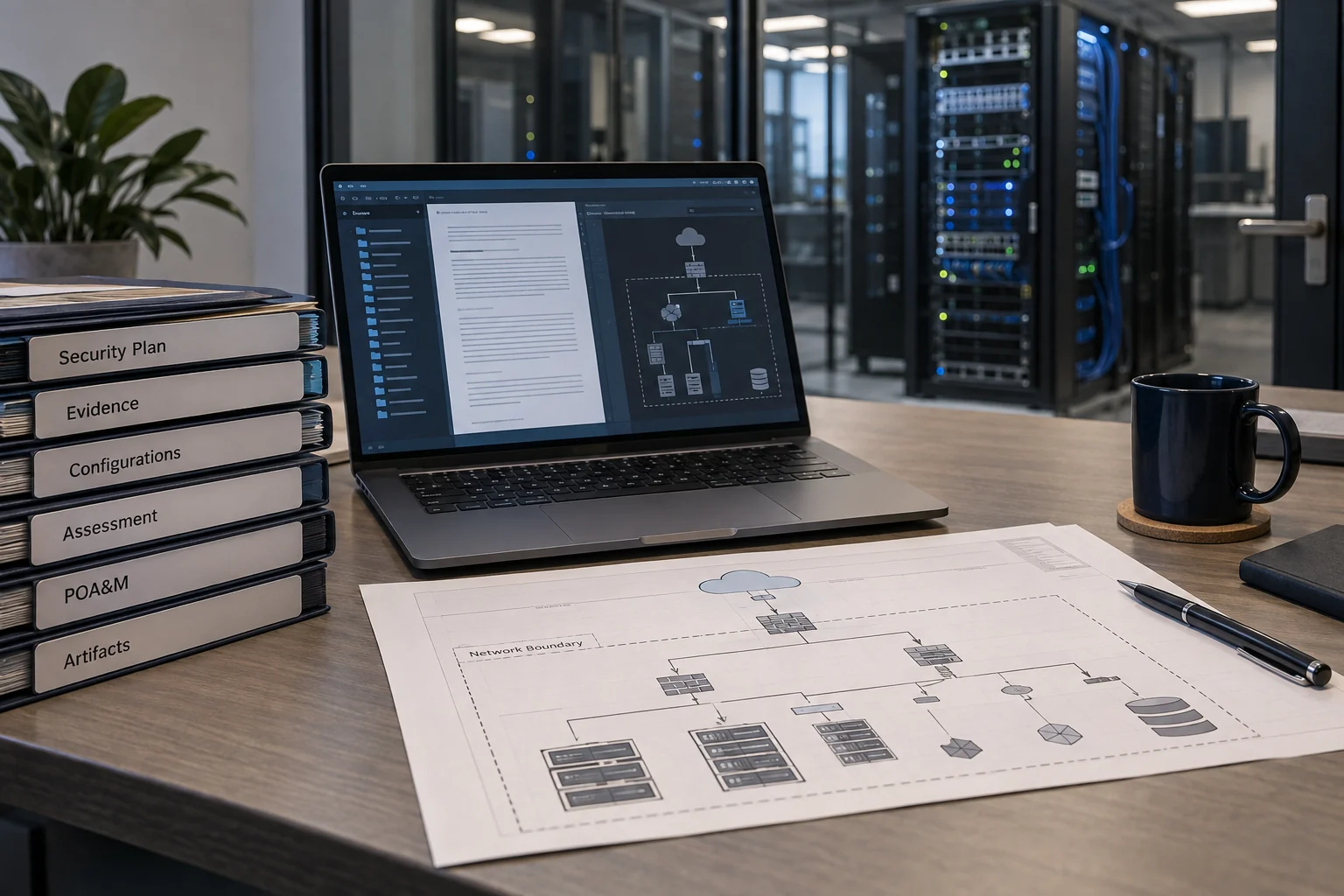
Overview — why FedRAMP exists and how it actually works
FedRAMP is the Federal Risk and Authorization Management Program, created by OMB memorandum in 2011 and codified in the FedRAMP Authorization Act of 2022. Its purpose is do-once-use-many: assess a cloud service once to a consistent NIST 800-53 baseline, then allow any federal agency to reuse that authorization package for their own Authority to Operate. Without FedRAMP, every federal agency would separately assess every cloud vendor they wanted to use — a quadratic cost that would strangle federal cloud adoption.
In practice FedRAMP has three routes to authorization: JAB P-ATO (Joint Authorization Board provisional ATO, the highest bar), Agency ATO (an individual agency authorizes the CSO and uploads the package to the FedRAMP Marketplace for reuse), and FedRAMP Tailored Low-Impact SaaS (LI-SaaS) for lower-risk SaaS products. In 2025 FedRAMP introduced FedRAMP 20x, a modernization initiative shifting toward continuous, automated, machine-readable authorization evidence — OSCAL at the center, smaller assessment scopes, faster reauthorization cycles.
Precision Federal engineers the authorization-ready side of FedRAMP. We are not a 3PAO — we do not perform independent assessments. We design, build, document, and operate systems so that when a 3PAO arrives for assessment, the evidence already exists, the controls are already implemented, and the SSP is already accurate. This is the difference between systems that achieve ATO and systems that stall for 18 months explaining why they cannot.
FEDRAMP ENGINEERING ENGAGEMENT
Our technical stack
| Layer | Technology | FedRAMP use |
|---|---|---|
| OSCAL authoring | compliance-trestle, OSCAL-CLI, oscal-editor, custom Python | SSP, POA&M, SAP, SAR, profile authoring in machine-readable form |
| GRC platforms | Xacta 360, RegScale, Telos Xacta, eMASS integration | Package management, workflow, submission to agency ATO platforms |
| Control baselines | NIST SP 800-53 Rev 5 Low/Moderate/High, NIST SP 800-53B profiles | Baseline selection, tailoring, overlay application |
| Foundational clouds | AWS GovCloud, Azure Government, GCP Assured Workloads | FedRAMP-authorized cloud foundations for inheritance |
| Infra hardening | CIS Benchmarks, DISA STIG, Packer, OpenSCAP, Ansible | CM-6 config settings, RA-5 vulnerability scanning |
| Evidence automation | AWS Config, Azure Policy, GCP Security Command Center, Prowler, Steampipe, Cloud Custodian | Continuous evidence of control effectiveness |
| Vulnerability management | Tenable Nessus, Qualys, Rapid7, Trivy, Grype, Anchore, Crowdstrike Falcon | RA-5 scans at required cadence, SCA for containers |
| SIEM / ConMon | Splunk Enterprise Security, Microsoft Sentinel, Elastic Security, Chronicle, Panther | AU-6 audit review, IR-5 monitoring, SI-4 system monitoring |
| Documentation | GitHub, GitLab, Confluence, generated Word/PDF from OSCAL sources | Living SSP with version control and diff |
| Network boundary | AWS Network Firewall, Azure Firewall Premium, Palo Alto VM-Series, Fortinet | SC-7 boundary protection with TLS inspection |
Federal use cases
Our FedRAMP engineering applies wherever federal agencies consume cloud services or build cloud systems that will cross agency boundaries. Representative engagements:
- ISV pursuing Agency ATO. Commercial SaaS vendor targeting HHS or VA as a sponsor. We build Moderate baseline, author SSP, coordinate 3PAO, and manage the agency review.
- ISV pursuing JAB High. CSO targeting FedRAMP Marketplace broad adoption. We prepare the JAB prioritization package, fix gaps, and manage the 12–18 month JAB path.
- Agency internal system. An agency-built cloud system subject to FISMA with FedRAMP-equivalent rigor. We author the SSP, deploy continuous monitoring, and support the agency AO's authorization decision.
- Reauthorization for aging package. CSO with a FedRAMP Moderate authorization nearing the three-year boundary. We modernize the control implementations, refresh evidence, and move to Rev 5.
- Inheritance architecture for PaaS on GovCloud. Custom platform built on AWS GovCloud where most controls inherit from AWS. We author the clear inheritance matrix and add customer-responsible control implementations.
- Rev 4 to Rev 5 transition. Existing FedRAMP package on Rev 4 controls. We map delta controls (supply chain risk, privacy enhancements), implement additions, and rewrite affected SSP sections.
- LI-SaaS tailored path. Low-impact SaaS targeting Tailored baseline. Smaller scope, faster path, lower cost.
- FedRAMP 20x pilot participation. CSO participating in the FedRAMP 20x modernization program with OSCAL-first evidence.
- StateRAMP adjacency. Dual StateRAMP/FedRAMP preparation for CSOs selling to both state and federal.
- DoD IL4 and IL5 path. Leveraging FedRAMP authorization as the foundation for DoD Provisional Authorization under the Cloud Computing SRG.
Reference architectures
Reference 1: FedRAMP Moderate agency ATO on AWS GovCloud
A federal agency stands up a custom application processing CUI. We deploy a Control Tower landing zone in GovCloud, a dedicated workload account, VPC with private subnets only, RDS Aurora PostgreSQL with CMK and IAM database authentication, ALB terminating TLS 1.2+ with AWS-managed certificates, ECS Fargate for the application with STIG-scanned base images, GuardDuty + Config + Security Hub aggregating findings, and CloudTrail + VPC Flow Logs streaming to a Splunk SIEM in a separate account. Control inheritance flows from AWS GovCloud's FedRAMP High package (the relevant subset for a Moderate system), leaving around 100 customer-responsible controls to implement. We author an SSP in OSCAL JSON, generate a Word document from it, and coordinate with the customer's selected 3PAO for a SA&A cycle aligned to agency ATO timelines.
Reference 2: FedRAMP High JAB CSO on Azure Government
A commercial SaaS vendor targets FedRAMP High JAB. We build a hub-spoke Azure Government topology with Azure Firewall Premium TLS inspection, hub-routed egress, private endpoints on every PaaS service, Entra ID Government with phishing-resistant MFA and PIM, AKS clusters with Confidential VMs and Defender for Containers, PostgreSQL Flexible Server with CMK and auditing, and Microsoft Sentinel as SIEM. All 421 High baseline controls are mapped, approximately 70% inherit from Azure Government's FedRAMP High authorization, and we implement the 30% customer-responsible controls with OSCAL-backed narratives. The JAB package goes through Readiness Assessment Report, prioritization review, and full SA&A with the 3PAO over 12–18 months.
Reference 3: Tailored LI-SaaS for agency pilot
A smaller ISV with a low-impact SaaS targets FedRAMP Tailored. We deploy on AWS GovCloud inside a FedRAMP-authorized PaaS like Elastic Beanstalk or App Runner, document the ~125 applicable LI-SaaS controls, and coordinate sponsor agency authorization on an accelerated timeline (often 3–6 months). Continuous monitoring via AWS-native Config and Security Hub meets the reduced LI-SaaS reporting cadence.
Delivery methodology
- Discovery and scoping (weeks 1–3). FIPS 199 categorization, impact level selection, boundary diagram draft, authorization path selection (JAB vs Agency vs LI-SaaS), 3PAO shortlist, control tailoring decisions.
- Gap analysis (weeks 3–6). Against the chosen baseline (Low/Moderate/High, Rev 5). Readiness Assessment Report equivalent for JAB aspirants. Risk-ranked remediation plan.
- Remediation and implementation (weeks 6–20+). Control implementations in infrastructure and application. Evidence collection pipelines. SSP authoring in OSCAL. Network and data flow diagrams generated from Terraform state and Config data.
- 3PAO engagement and SA&A (weeks 20–32). Security Assessment Plan review, 3PAO testing window, Security Assessment Report, POA&M disposition, authorization memo.
- ConMon (ongoing). Monthly vulnerability scans, quarterly access reviews, continuous drift detection, annual assessment support, reauthorization at year three.
Engagement models
Fixed-price full ATO preparation
From gap analysis through ATO issuance, defined scope and milestones.
Fixed-price gap analysis
Stand-alone readiness assessment with remediation roadmap.
SSP authoring fixed-price
OSCAL-native SSP authoring with evidence hooks to the customer's infrastructure.
T&M ConMon support
Monthly POA&M maintenance, vulnerability scan review, evidence refresh.
Partner team
FedRAMP engineering with partner firms that bring the specialties a larger program needs.
SBIR
Phase I/II funding paths where FedRAMP readiness is a required prototype outcome.
Maturity model
Level 1 — Unaware
Cloud workloads deployed, no FedRAMP mapping, no evidence collection, authorization out of reach.
Level 2 — Mapped
Controls documented in spreadsheet, SSP drafted manually, evidence collected ad hoc for assessments.
Level 3 — Automated
SSP in OSCAL, evidence collection via AWS Config / Azure Policy / Security Command Center, continuous POA&M, 3PAO-ready.
Level 4 — Continuous
FedRAMP 20x-aligned continuous authorization, OSCAL throughout, auto-regenerated evidence, reauthorization is a routine operation.
Level 5 — Federated
Platform exposes FedRAMP inheritance services to tenant applications with self-service control documentation and automated boundary management.
Deliverables catalog
- FIPS 199 categorization memo
- Authorization boundary diagram (from Terraform, always current)
- Data flow diagram and hardware/software inventory
- System Security Plan in OSCAL JSON + generated Word/PDF
- Control implementation narratives (421 controls for High baseline)
- Plan of Action and Milestones (POA&M) in OSCAL
- Continuous monitoring strategy document
- Vulnerability management plan (scan cadence, SLA, scanners)
- Incident response plan and annual tabletop artifacts
- Contingency plan and annual test results
- Configuration management plan and baseline inventory
- Security Assessment Plan inputs for 3PAO
- Post-assessment POA&M disposition and remediation evidence
- Agency Authorization Package or JAB submission package
- Continuous Monitoring monthly deliverables (scan results, POA&M updates, deviation requests)
Technology comparison — GRC tooling
| Dimension | compliance-trestle | Xacta 360 | RegScale | Manual Word/Excel |
|---|---|---|---|---|
| OSCAL-native | Yes (open source) | Yes | Yes | No |
| License cost | Free | Enterprise | Enterprise | Free (but catastrophic human cost) |
| Evidence integration | Custom pipelines | Out-of-box scanner integration | Out-of-box CSP integration | None |
| eMASS interop | Via export | Direct | Direct | Manual |
| Best fit | Engineering-heavy CSOs | Large federal primes | Cloud-native ISVs | Avoid |
Honest tradeoff: compliance-trestle gives maximum control and zero license cost but requires engineering investment. RegScale and Xacta 360 shorten the authoring path with per-seat licensing. Manual Word/Excel is what most teams start with and what they regret.
Federal compliance mapping — NIST 800-53 Rev 5 at High
The FedRAMP High baseline under Rev 5 maps to approximately 421 controls and enhancements across 20 control families. We apply the following implementation patterns:
AC (Access Control)
PIV/CAC federation (AC-2), role-based access (AC-3), information flow enforcement via Transit Gateway / Azure Firewall / VPC-SC (AC-4), separation of duties (AC-5), least privilege (AC-6), unsuccessful logon attempts (AC-7), session lock (AC-11), permitted actions without identification (AC-14), remote access via IAP/Bastion (AC-17), wireless (AC-18), mobile device (AC-19), external systems (AC-20), information sharing (AC-21), publicly accessible content (AC-22).
AU (Audit)
Log events (AU-2), content (AU-3), storage capacity (AU-4), response to processing failures (AU-5), review and analysis (AU-6 via Sentinel/Splunk/Chronicle), reduction and report generation (AU-7), time stamps (AU-8), protection of audit information (AU-9), non-repudiation (AU-10), retention (AU-11), audit generation (AU-12).
CA (Assessment)
Control assessments (CA-2), information exchange (CA-3), POA&M (CA-5), authorization (CA-6), continuous monitoring (CA-7), penetration testing (CA-8), internal system connections (CA-9).
CM (Configuration Management)
Baseline configuration (CM-2) from IaC, change control (CM-3), impact analysis (CM-4), access restrictions for change (CM-5), configuration settings via STIG (CM-6), least functionality (CM-7), information system component inventory (CM-8) from AWS Config / Cloud Asset Inventory, software usage restrictions (CM-10), user-installed software (CM-11).
CP (Contingency Planning)
Contingency plan (CP-2), training (CP-3), testing (CP-4 tabletops), alternate storage site (CP-6), alternate processing site (CP-7), telecom services (CP-8), system backup (CP-9), system recovery and reconstitution (CP-10).
IA (Identification and Authentication)
Organizational users (IA-2 with MFA, PIV), device identification (IA-3), identifier management (IA-4), authenticator management (IA-5), authentication feedback (IA-6), cryptographic module authentication (IA-7), non-organizational users (IA-8), service identification (IA-9), re-authentication (IA-11), identity proofing (IA-12).
IR (Incident Response)
IR policy (IR-1), training (IR-2), testing (IR-3), handling (IR-4), monitoring (IR-5), reporting (IR-6), assistance (IR-7), plan (IR-8).
RA (Risk Assessment)
Security categorization (RA-2), risk assessment (RA-3), vulnerability monitoring and scanning (RA-5), technical surveillance countermeasures (RA-6), risk response (RA-7), privacy impact assessments (RA-8), criticality analysis (RA-9).
SA (System and Services Acquisition)
SDLC (SA-3), acquisition process (SA-4), system documentation (SA-5), security engineering principles (SA-8), external system services (SA-9), developer configuration management (SA-10), developer security testing (SA-11), supply chain protection (SA-12/SR family).
SC (System and Communications Protection)
Application partitioning (SC-2), denial-of-service protection (SC-5 via Shield/DDoS Protection), boundary protection (SC-7), transmission confidentiality (SC-8 with TLS 1.2+), trusted path (SC-11), cryptographic key establishment (SC-12 via KMS/Key Vault), cryptographic protection (SC-13 FIPS 140-2), network disconnect (SC-10), collaborative computing (SC-15), transmission of security attributes (SC-16), public key infrastructure certificates (SC-17), mobile code (SC-18), session authenticity (SC-23), protection of information at rest (SC-28).
SI (System and Information Integrity)
Flaw remediation (SI-2), malicious code protection (SI-3), system monitoring (SI-4), security alerts (SI-5), software/firmware/information integrity (SI-7), spam protection (SI-8), information input validation (SI-10), error handling (SI-11), information management and retention (SI-12), memory protection (SI-16).
SR (Supply Chain Risk Management) — new in Rev 5
Policy and procedures (SR-1), supply chain risk management plan (SR-2), supply chain controls and processes (SR-3), provenance (SR-4), acquisition strategies (SR-5), supplier assessments (SR-6), supply chain operations security (SR-7), notification agreements (SR-8), tamper resistance (SR-9), inspection of systems (SR-10), component authenticity (SR-11), component disposal (SR-12). Our supply chain security capability covers this family in detail.
Sample technical approach
A federal agency asks us to prepare a custom case-management application for a FedRAMP Moderate agency ATO on AWS GovCloud. Week-by-week:
- Weeks 1–2. FIPS 199 categorization (Moderate, confirmed), boundary definition, stakeholder map (system owner, ISSO, AO, 3PAO shortlist), Rev 5 baseline selection with tailoring decisions documented in OSCAL profile.
- Weeks 3–6. Gap analysis against Moderate baseline. Current state: Control Tower deployed, workloads running, but no central logging, partial MFA, no STIG compliance on AMIs, POA&M is a spreadsheet. Risk-ranked remediation plan with cost and effort estimates.
- Weeks 6–14. Remediation: Packer pipeline for STIG-hardened AMIs, CloudTrail + Config aggregated to Log Archive account, Security Hub with NIST 800-53 conformance pack, GuardDuty enabled all regions, Inspector for vulnerability scanning, IAM Identity Center with PIV federation, Session Manager replaces SSH bastions, Secrets Manager for credentials with rotation, WAF on public endpoints, Shield Advanced for DDoS protection.
- Weeks 10–18 (overlapping). OSCAL SSP authoring: 325 Moderate controls mapped, of which ~230 inherit fully from AWS GovCloud, ~45 are hybrid, ~50 are customer-responsible. Narratives generated from infrastructure metadata where possible, authored by hand where necessary. Data flow diagrams generated from VPC Flow Logs + ALB access logs. Word/PDF SSP rendered from OSCAL for AO review.
- Weeks 18–24. 3PAO engagement: Security Assessment Plan review, testing window scheduled, 3PAO performs control testing, vulnerability scans, and penetration testing. Findings tracked in POA&M with disposition decisions.
- Weeks 24–28. POA&M remediation for high/moderate findings, evidence update, Security Assessment Report finalized, authorization memo issued by agency AO.
- Ongoing. Monthly vulnerability scans, monthly POA&M update, quarterly access reviews, annual assessment, three-year reauthorization cycle with OSCAL-native evidence regeneration.
Related capabilities, agencies, contracts, and insights
FedRAMP engineering spans every cloud foundation we deliver on: AWS GovCloud, Azure Government, GCP Assured Workloads. It pairs with cybersecurity and DevSecOps, supply chain security, Kubernetes for federal, Terraform IaC, and federal CI/CD. Agency-specific ATO patterns: HHS, DoD, VA, DHS, FBI, GSA. Contract vehicles: SBIR, 8(a) pathway, OTA consortia. Long-form insights: FedRAMP 20x, Agency ATO playbook.