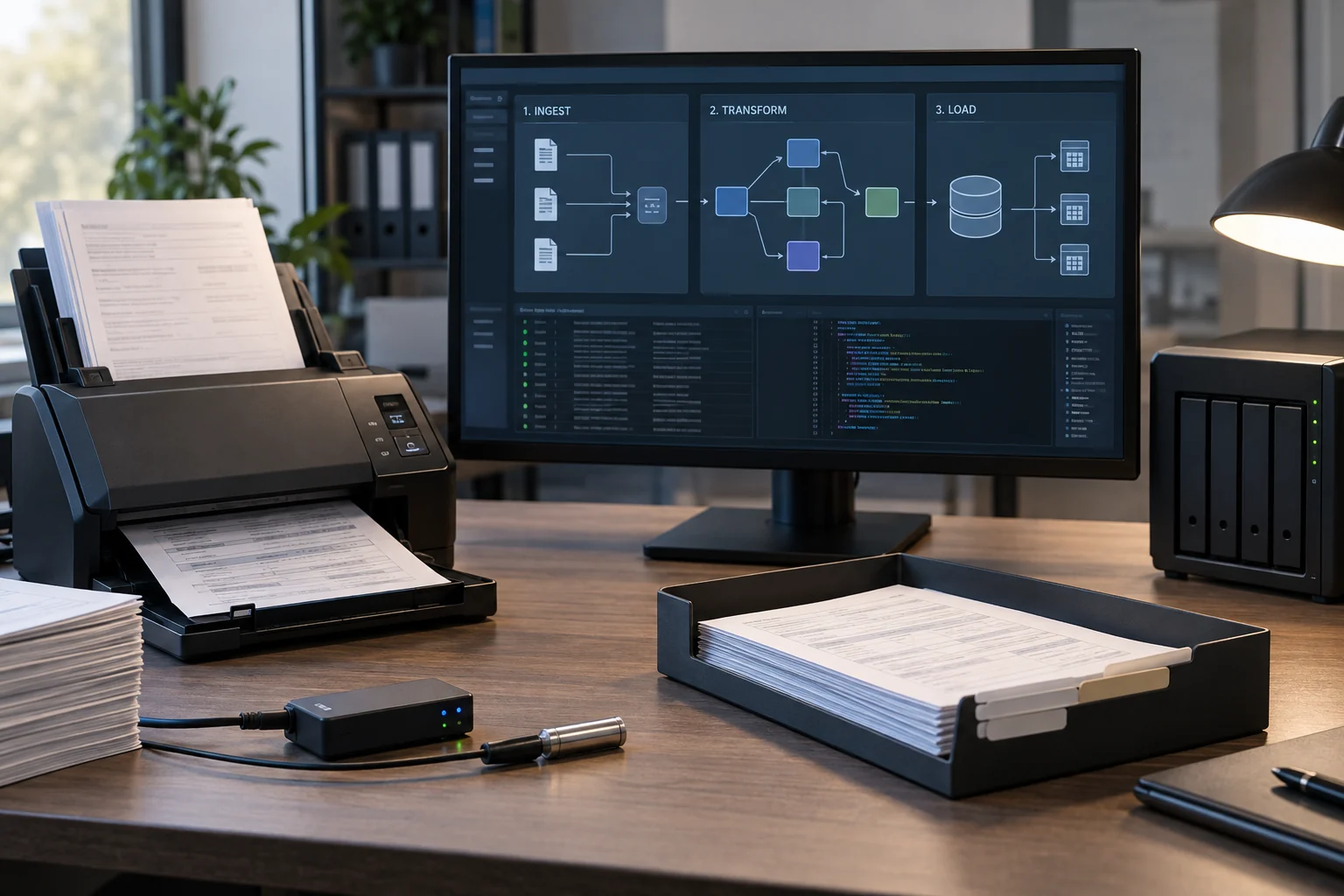
Overview: federal pipelines are a quality problem, not a scheduling problem
The single biggest lie in federal data modernization is that pipeline orchestration is about moving data on schedule. It is not. Cron can do that. The real problem is that every federal analytic output is an evidentiary artifact — a testimony binder, an OIG report, a performance measure under the Evidence Act, a budget justification. Every figure a dashboard renders is defended in front of people who cannot be told "the script runs every night." Those people want lineage, reproducibility, tests that prove the transformation logic is correct, and a replay story when last Tuesday's numbers were wrong.
Modern ELT tooling — dbt for transformation, Airflow / Dagster / Prefect for orchestration, Great Expectations for quality, OpenLineage for lineage — treats pipelines like software. Every transformation is in Git. Every metric has tests. Every run produces lineage. Every failure is a ticket, not a mystery. Precision Federal builds federal ELT stacks that meet this bar on day one, migrates legacy ETL into them, and operates them through continuous ATO.
Our technical stack

Transformation
dbt Core, dbt Cloud (Government tier), SQLMesh, Dataform.
Orchestration
Apache Airflow, Amazon MWAA (GovCloud, IL5), Google Cloud Composer (Assured Workloads), Astronomer Federal, Dagster, Dagster+ Enterprise, Prefect, Argo Workflows on OpenShift, Azure Data Factory (Azure Gov).
Ingestion & replication
Fivetran, Airbyte, Meltano, custom Python connectors, Debezium for CDC, AWS DMS, Azure Data Factory, Google Datastream.
Data quality
Great Expectations, Soda Core and Soda Cloud, dbt tests, Deequ (Spark), Monte Carlo patterns.
Lineage & metadata
OpenLineage, Marquez, DataHub, OpenMetadata, Atlan, Collibra, Alation.
Compute
Snowflake, Redshift, BigQuery, Synapse, Databricks, Spark on EMR/Kubernetes, Trino, DuckDB.
Secrets & config
AWS Secrets Manager, Azure Key Vault, HashiCorp Vault, SOPS, Doppler.
Observability
Prometheus, Grafana, Datadog Federal, ELK, OpenTelemetry. See observability.
Dev tooling
GitHub Enterprise Cloud for Government, GitLab Dedicated for Gov, Azure DevOps Gov, pre-commit hooks, dbt-bouncer, SQLFluff, ruff, mypy.
Federal use cases
A federal health agency behavioral health pipelines (founder's prior work)
ingest, transform, and land treatment and survey data for production analytic and ML workloads. dbt discipline, quality gates, and reproducibility all matured on this engagement.
Army logistics ELT (pursuing)
consolidate GCSS-Army, LIW, and maintenance system extracts into a unified dbt project in Snowflake or Databricks.
Navy fleet readiness ELT (pursuing)
ship-level sparing, depot throughput, and availability transformations feeding readiness dashboards.
Air Force personnel and training (pursuing)
unified personnel lifecycle pipelines across training, deployment, and career records.
FBI investigative data consolidation (pursuing)
cross-case pipelines with strict sensitivity handling and reproducibility for evidentiary use.
Treasury / OMB budget execution
obligations and disbursements transformations with reconciliation to authoritative Treasury systems.
HHS / CDC public health reporting
nightly and near-real-time reporting pipelines with freshness SLAs.
USDA program payment pipelines
beneficiary eligibility and payment transformations with improper-payment risk scoring.
DHS case processing
application, vetting, and adjudication pipelines with row-level CUI enforcement.
DOE research data
experiment metadata pipelines consolidating across national labs.
Reference architectures
Architecture 1: dbt + Airflow (MWAA) on AWS GovCloud
Amazon MWAA as the orchestration plane (FedRAMP High, IL5). Source extraction via Airbyte on EKS or AWS DMS into raw S3 GovCloud paths. Snowflake Government as the warehouse. dbt Cloud Government tier or dbt Core invoked via Airflow, with CI running against an ephemeral Snowflake account for every pull request. Great Expectations checks as Airflow tasks gating downstream models. OpenLineage producers on both Airflow and dbt shipping to DataHub. Secrets in AWS Secrets Manager. GitHub Actions on GitHub Enterprise Cloud for Government for CI. Audit logs to CloudTrail + agency SIEM. Fits AWS-standardized civilian agencies.
Architecture 2: Dagster + dbt on Azure Government with Databricks
Dagster+ or self-managed Dagster on Azure Kubernetes Service (Azure Gov). Source data landed to ADLS Gen2 via Azure Data Factory, Fivetran, or custom connectors. Databricks on Azure Gov as compute. dbt-databricks adapter for transformation. Soda Core for quality gates, Unity Catalog for lineage. Azure DevOps Gov for CI/CD. Entra ID Gov for authentication. Sentinel for audit. Fits DoD components and M365 GCC High agencies.
Architecture 3: Airflow + dbt air-gapped on OpenShift
Airflow Helm chart on Red Hat OpenShift in a classified enclave. PostgreSQL on OpenShift as metadata DB. Trino or Spark on the same OpenShift as compute. dbt-trino or dbt-spark adapter. MinIO S3-compatible storage as the landing zone with Iceberg tables. Apicurio for schema governance. HashiCorp Vault for secrets. Internal GitLab for source control and CI. Full pipeline stack with zero cloud dependency.
Delivery methodology
- Discovery: inventory existing pipelines, source systems, destination systems, data contracts, SLA targets, failure history, and lineage gaps.
- Design: orchestration tool selection, dbt project structure (staging / intermediate / marts), quality framework, CI/CD pipeline, environment topology (dev / stage / prod), secret management, monitoring plan.
- Build: dbt project scaffolding, orchestrator scaffolding, connector catalog, test suites, documentation. CI with SQLFluff, dbt-bouncer, dbt test, unit tests, and security scans. Infrastructure-as-code.
- Migration (when replacing legacy): catalog of every existing job, translation to dbt/Airflow, dual-run with automated reconciliation, phased decommission.
- Quality bring-up: Great Expectations or Soda coverage on every critical table, freshness checks on all sources, schema contract enforcement, alert routing to the on-call.
- Handover and operation: runbooks, training, on-call rotation if contracted, monthly health reviews.
Engagement models
SBIR Phase I
$150K-$250K, 6-9 months. Fits pipeline-modernization SBIR topics.
SBIR Phase II
$1M-$2M, 18-24 months.
Fixed-price modernization sprint
90 days, $100K-$400K.
T&M engagement
contracted directly with the agency, labor-category driven.
OTA prototype
via Tradewind or NSIN.
Direct BPA / IDIQ task order
once vehicle access allows.
Partner team
bringing the dbt/Airflow specialty alongside partner firms.
Maturity model
Level 1 — Pilot
one dbt project, one orchestrator, manual quality checks.
Level 2 — Program
CI, dbt tests, environment separation, basic lineage.
Level 3 — Enterprise
Great Expectations coverage, OpenLineage, freshness SLAs, quality gates blocking bad data.
Level 4 — Mission-integrated
data contracts, schema registries, asset-based orchestration, auto-healing reruns.
Level 5 — Continuously monitored
error budgets, SLO enforcement, automated ATO evidence from lineage, federated pipelines across partner agencies.
Deliverables catalog
- dbt project repository with staging, intermediate, and marts layers.
- Airflow / Dagster DAG repositories with unit tests.
- Connector catalog (Airbyte, Fivetran, Debezium, or custom).
- Great Expectations or Soda coverage mapped to data contracts.
- CI/CD pipeline with SQLFluff, dbt tests, integration tests, security scans.
- OpenLineage integration shipping to DataHub or similar.
- Infrastructure-as-code for orchestrator, ephemeral CI warehouses, secrets.
- Runbooks for every common failure (source schema change, DQ failure, orchestrator outage).
- NIST 800-53 control narratives for AC, AU, CM, SC, SI.
- Training materials for the agency's own engineers.
Tool comparison: Airflow vs Dagster vs Prefect
Airflow
mature, ubiquitous, huge operator ecosystem. Managed via MWAA or Composer. Task-first abstraction. Best when the agency already has Airflow or needs the widest ecosystem.
Dagster
asset-aware orchestration, strong typing, software-engineering-grade defaults. Dagster+ adds observability. Best for teams building modern data platforms from scratch.
Prefect
Python-native, lightweight, easy to adopt. Prefect Cloud has a federal path but smaller deployment footprint. Best for smaller teams without Kubernetes maturity.
Argo Workflows
Kubernetes-native, container-per-task. Good for heterogeneous workloads (mixing Spark, dbt, Python, shell).
Federal compliance mapping
AC-2, AC-3, AC-6
orchestrator RBAC, workspace separation, service principal least-privilege.
AU-2, AU-6, AU-12
DAG run logs, task logs, dbt artifacts shipped to SIEM; lineage as audit evidence.
CM-2, CM-6, CM-7
Git-based baseline, policy-as-code enforcement of dbt project structure, restricted execution roles.
IA-2, IA-5
federated identity to the orchestrator UI, service accounts with rotated credentials.
SC-8, SC-13
TLS 1.3 everywhere, FIPS modules for warehouse connections.
SC-28
encrypted metadata DB, encrypted secrets at rest.
SI-4, SI-7
DQ gates as integrity monitoring, freshness alerts as availability monitoring.
Sample technical approach: retiring a 14-year-old Informatica environment
A civilian agency runs ~450 Informatica PowerCenter workflows totaling 8,000+ mappings. Annual support and hardware refresh costs approach $1.8M. Most of the original team has retired; nobody can defend what half the mappings do. Our approach: auto-catalog all PowerCenter XML via a scraper. Cluster mappings by target table, downstream consumer, and complexity. Prioritize migration by business criticality and decommission risk. For each cluster, translate extraction to Airbyte or DMS, land raw to S3 or Snowflake, and rewrite transformation as dbt models with tests. Dual-run for 90 days per cluster, reconciling row counts, checksums, and key business metrics. Decommission on proven parity. Total migration runs 12-18 months at a small-team scale, with typical 60-70 percent first-year cost reduction net of the modern stack's cost.
Past performance
Precision Federal holds two federal contracts directly: FHWA purchase order 693JJ326P000024 ($141,370.26, September 2026 through September 2028) and CDC purchase order 75D30126P21398 ($296,250, signed September 18, 2026). The work below is Bo Peng's, from before he founded the firm.
Production data pipelines on behavioral health data
dbt-based transformation, governed ingestion, and quality gating on a federal health agency data. The pipeline discipline we ship to federal customers is the same discipline that took this work to production. Full past performance →
Related capabilities, agencies, and insights
Pipelines orchestrate the whole data platform — see data warehousing, data lakes, streaming data, data governance, business intelligence, ML. Agency pursuits: a federal health agency, Army, Navy, FBI, HHS. Vehicles: SBIR, OTA, GSA MAS. Insights: dbt for federal data teams, Airflow vs Dagster.