Why federal data warehousing is not commercial data warehousing
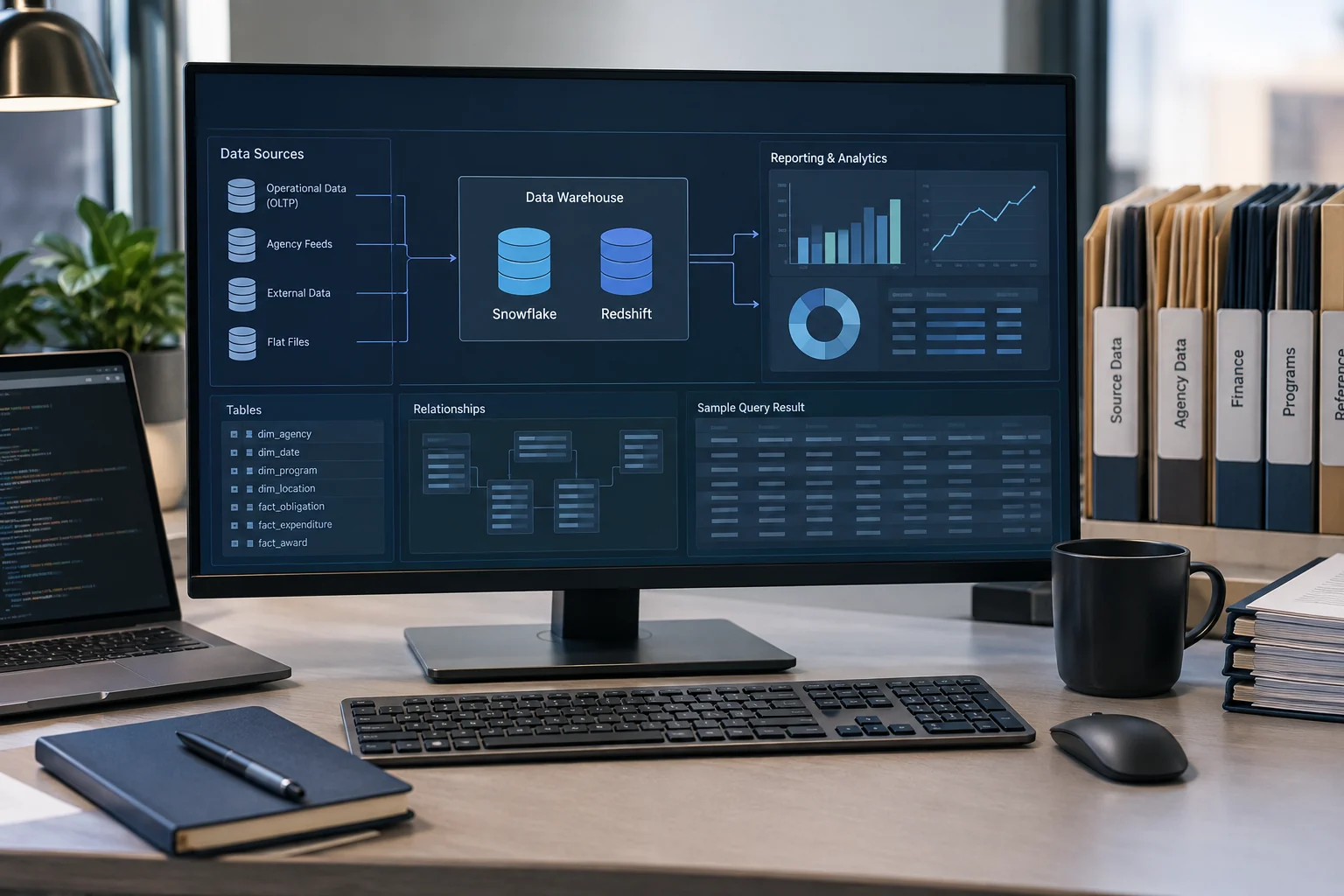
A commercial data warehouse has one job: serve queries fast and cheaply. A federal data warehouse has the same job plus five others — maintain an ATO, enforce Privacy Act boundaries, keep CUI inside its authorization, meet continuous monitoring obligations, and produce audit evidence on demand. The four major cloud data warehouses — Snowflake, Amazon Redshift, Google BigQuery, and Microsoft Azure Synapse — all have federal-eligible deployments, but the shape of the work differs from commercial builds in ways that matter.
Precision Federal designs warehouses where the authorization boundary, the cost profile, the modeling standard, and the governance posture are all decided in the same conversation. We do not drop a commercial pattern into GovCloud and hope. We build for the constraints agencies actually face.
The four federal-eligible cloud warehouses

Snowflake Government
Snowflake operates a FedRAMP High Authorized Government region on both AWS GovCloud and Azure Government, with DoD IL4 and IL5 coverage. It is the most-standardized choice across civilian agencies because of the separation of storage and compute, zero-copy cloning, time travel, and mature role-based access control. We build on Snowflake Government when the agency is already there, when cross-cloud portability matters, or when the workload has variable concurrency that benefits from elastic warehouses.
Amazon Redshift (GovCloud)
Redshift in AWS GovCloud (US-East and US-West) is FedRAMP High authorized and IL5-eligible. Redshift Serverless removes capacity planning; RA3 provisioned nodes give cost predictability for steady workloads. Redshift Spectrum queries directly against S3 GovCloud, giving a cheap path to pair structured warehouse tables with open-format lake data. We reach for Redshift when the agency is AWS-native, when S3 lake integration dominates the pattern, or when multi-year reserved pricing gives the CIO a budget story.
Google BigQuery (Assured Workloads)
BigQuery via Google Cloud Assured Workloads supports FedRAMP High and IL4. It has unique strengths: columnar storage with automatic partitioning, BigQuery ML for in-warehouse model training, and a serverless cost model that can be dramatically cheaper for bursty analytic workloads. We deploy BigQuery when an agency has committed to Google Cloud, when BigQuery ML simplifies the path from warehouse to model, or when the team wants zero operational burden.
Azure Synapse (Azure Government)
Synapse in Azure Government is FedRAMP High and IL5-authorized, and integrates natively with Microsoft Purview for governance, Power BI for BI, and Microsoft Fabric for the broader data estate. Synapse is our default choice when the agency is a Microsoft-standardized shop — DoD components, IC elements with M365 GCC High, and civilian agencies on Azure Gov. See our BI capability page for Power BI integration detail.
How we choose: a decision framework, not a preference
Cloud lock-in tolerance
high tolerance → BigQuery or Synapse. Low tolerance → Snowflake (multi-cloud) or Iceberg/Delta on object storage.
Workload pattern
steady, predictable → Redshift provisioned. Bursty analytic → BigQuery or Snowflake. Mixed batch + interactive → Snowflake or Databricks SQL.
Existing agency tooling
Power BI / M365 GCC → Synapse. Tableau heavy → Snowflake or Redshift. In-warehouse ML required → BigQuery ML or Snowflake Snowpark.
ATO inheritance
if the agency already has an ATO on a given warehouse, use it. Standing up a second warehouse for one workload is rarely worth the paperwork.
Cost sensitivity
predictable workload favors reserved compute; bursty favors serverless. We model this explicitly before committing.
Modeling federal data: the standard we use
A warehouse is only as good as its model. We default to a layered architecture that works across all four engines:
Raw layer
source-faithful, append-only, one-to-one with system-of-record fields. Preserves history for audit.
Staging layer
type casting, deduplication, PII tagging, lineage metadata. This is where data contracts are enforced.
Integration layer
Data Vault 2.0 hubs, links, and satellites for source-neutral history. Optional for smaller agencies; essential at Treasury, DoD, or cross-program shops.
Marts layer
Kimball conformed dimensions and fact tables tuned for downstream BI and ML. This is what analysts and dashboards query.
Semantic layer
dbt models, Cube definitions, or Looker LookML. Metric definitions versioned in Git with test coverage.
The model is expressed in dbt or SQLMesh, tested on every build, documented automatically, and lineage-captured via OpenLineage. See ETL / ELT and data governance.
Security posture
Encryption
FIPS 140-2/3 validated modules at rest and in transit. Customer-managed keys via KMS (GovCloud), Azure Key Vault, or Cloud KMS.
Network isolation
PrivateLink, Private Service Connect, or Private Endpoints. No public warehouse endpoints, ever.
Identity
agency SSO via SAML/OIDC to Okta, Azure AD / Entra ID Gov, or ICAM. MFA mandatory. Short-lived credentials for service accounts.
Access control
row-access policies, dynamic data masking, column-level security. CUI and PII tagged at ingest, enforced at query time.
Audit
every query logged to the warehouse native log plus shipped to the agency SIEM (Splunk, Sentinel, Chronicle) for 800-53 AU compliance.
Cost discipline
Warehouse costs are the fastest way to embarrass a federal IT director. We enforce cost hygiene from day one: resource monitors with hard caps, auto-suspend at 60 seconds of idle, query tagging by mission / workload / team, workload isolation so one bad analyst does not blow the monthly budget, materialized view evaluation, and quarterly slow-query reviews. Agencies typically see 30 to 50 percent first-year savings versus a naive deployment where developers provision their own clusters without governance.
Past performance and targeted pursuits
Precision Federal holds two federal contracts directly: FHWA purchase order 693JJ326P000024 ($141,370.26, September 2026 through September 2028) and CDC purchase order 75D30126P21398 ($296,250, signed September 18, 2026). The work below is Bo Peng's, from before he founded the firm.
Production Analytics on Behavioral Health Data
Shipped production ML and analytic workloads on a federal health agency data — behavioral health treatment, survey, and admissions datasets. Warehouse patterns, dbt modeling standards, and governance architecture from this engagement inform every federal warehouse build. Full past performance →
We are targeting warehouse modernization scopes at Army (sustainment data), Navy (fleet readiness), the FBI (investigative data consolidation), and civilian agencies pursuing Evidence Act data infrastructure. See our Army, Navy, and FBI agency pages for opportunity-specific context.
How an engagement runs
- Assessment — inventory current sources, downstream consumers, ATO posture, and cost baseline.
- Architecture — engine selection, network topology, security controls mapped to 800-53, capacity plan, cost model.
- Build — infrastructure-as-code (Terraform), dbt project scaffolding, raw/staging/marts layering, CI/CD pipeline with SCA, SAST, and SBOM.
- Migration — if replacing an existing warehouse, dual-run with reconciliation until parity is proven.
- Operate & optimize — monitoring, quarterly cost and query reviews, continuous ATO evidence generation.