Precision Federal is pursuing opportunities at the U.S. Army
Precision Federal is pursuing opportunities at the United States Army across SBIR, xTech prize competitions, OTAs, and direct awards. The Army is the DoD's largest service by personnel — approximately 452,000 active-duty soldiers and more than 1 million across components — and its modernization portfolios generate the deepest pool of AI/ML demand in the department. From the Army AI Integration Center (AI2C) at Carnegie Mellon to the Army Futures Command cross-functional teams, the service has been explicit that it wants non-traditional performers who can move fast and survive operational security review.
That is the profile Precision Delivery Federal LLC (UEI Y2JVCZXT9HP5, CAGE 1AYQ0, NAICS 541512) targets. We are a SAM-registered small business with production federal ML past performance at a federal health agency, led by a Kaggle Top 200 data scientist, and we are DSIP-active with 102 Army topics already in the proposal library when the April 13, 2026 reauthorization landed.
Army commands and innovation arms we target
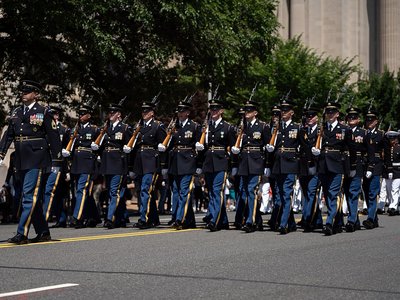
The Army's AI/ML demand is spread across operational commands, acquisition program executive offices (PEOs), research labs, and dedicated innovation arms. We track and pursue across all of them:
- Army Futures Command (AFC) — Austin, Texas. Owns Army modernization and houses the cross-functional teams (CFTs) for long-range precision fires, modern combat vehicle, future vertical lift, network, air-and-missile defense, soldier lethality, and synthetic training environment. AFC is the Army's clearest channel for contested-environment AI.
- Army AI Integration Center (AI2C) — co-located at Carnegie Mellon University in Pittsburgh. The Army's principal AI talent and integration hub. Works directly with performers on algorithm-to-edge pipelines and operational AI.
- ARCYBER (U.S. Army Cyber Command) — Fort Gordon, Georgia. Operates Army networks and conducts cyber operations. AI/ML demand centers on SIEM augmentation, anomaly detection, automated triage, threat intel synthesis, and cyber decision support.
- Army Research Laboratory (ARL) — corporate research lab. Funds basic and applied AI research through BAAs, CRADAs, and STTR awards with university partners.
- CECOM (Communications-Electronics Command) — Aberdeen Proving Ground. Sustainment of Army C4ISR systems. Predictive maintenance, obsolescence forecasting, software sustainment automation.
- PEO IEW&S (Intelligence, Electronic Warfare & Sensors), PEO C3T (Command, Control & Communications — Tactical), PEO Soldier, PEO Ground Combat Systems. The Army's acquisition machinery for ISR, tactical networks, and soldier systems.
- TRADOC (Training and Doctrine Command) — shapes requirements. Relevant for synthetic training environments, LLM-powered doctrine assistants, and simulation AI.
- xTech Program — the Army's prize competition umbrella. xTechPrime, xTechSearch, xTechSBIR, and topical xTech challenges. Non-dilutive cash prizes and direct-to-Phase-II SBIR pipelines.
Army mission areas mapped to our capability
Contested logistics and predictive maintenance
The Army runs tens of thousands of ground vehicles, thousands of helicopters, and a global sustainment network. Time-series ML on sensor telemetry, remaining-useful-life models, maintenance demand forecasting, and parts obsolescence prediction map directly to AFC, CECOM, and PEO Aviation scopes. Our Machine Learning practice is built for exactly this.
Soldier-worn sensing and edge AI
Soldier lethality and integrated visual augmentation demand edge-deployed ML — computer vision on body-worn optics, acoustic classification on worn sensors, health and fatigue inference from biometrics. Deployable as quantized open-weight models for disconnected operations.
Battlefield decision aids and agentic AI
Commanders drown in reports. Agentic LLM systems that triage intel, synthesize situation reports, draft COAs, and tag decision points belong to the AI2C and AFC decision-dominance theme. See Agentic AI.
ARCYBER anomaly detection and threat intel
Unsupervised and supervised ML on network telemetry, LLM-assisted threat intel summarization, SOAR-adjacent automation. Hardened against prompt injection, auditable by design.
Synthetic training environments
Generative AI for scenario authoring, agent behavior modeling, after-action review automation. TRADOC-relevant.
xTech — the prize-to-contract pipeline
The xTech Program is one of the Army's most distinctive innovation mechanisms. Unlike pure grant programs, xTech competitions pay cash prizes for successive rounds (white paper, pitch, prototype demo) and explicitly graduate winners into direct-to-Phase-II SBIR awards — bypassing the Phase I requirement for firms that already have credible prototypes. The program has awarded hundreds of companies over its history and has become a default on-ramp for AI, autonomy, and advanced materials non-traditionals.
We treat xTech as a priority channel for the Army. Our pattern: watch the quarterly topic releases, align scopes to our existing 102-topic proposal library, and submit white papers where there is a tight capability-to-topic fit. xTech winners who carry relevant past performance into Phase II frequently transition into OTAs, PEO task orders, or production-adjacent pilots with Army units.
The Army AI Integration Center (AI2C)
AI2C at Carnegie Mellon University is the Army's principal AI integration hub, created to close the gap between lab-grade models and operational deployments. Its work spans algorithmic warfare assistants, multi-domain sensing fusion, tactical edge AI, and trust/assurance tooling. AI2C regularly partners with non-traditionals and academia on applied AI prototypes that aim at specific Army CFT needs.
We position for AI2C-adjacent scope through SBIR topics that name AI2C as a sponsor and through STTR partnerships with university PIs. Our Data Engineering practice — lakehouse architectures, governed analytics, multi-classification handling — is typically the gap-filler that lets AI2C-adjacent prototypes survive the leap to unit-level deployment.
ARCYBER and Army cyber AI
ARCYBER runs the Army's networks and conducts offensive and defensive cyber operations for the service. The AI/ML opportunity surface is large and well-defined: anomaly detection on network telemetry, LLM-assisted threat intel synthesis, SIEM triage automation, vulnerability prioritization, and cyber COA recommendation.
We pursue ARCYBER-adjacent scope through SBIR topics sponsored by ARCYBER-adjacent PEOs. Our agentic AI practice — retrieval-augmented generation over threat intel corpora, tool-calling agents with human-in-the-loop gates, auditable output logs — maps directly. Prompt-injection hardening and NIST 800-53 control mapping are built into every deployment we architect.
SBIR 26.1 and Army positioning
The April 13, 2026 SBIR reauthorization (S. 3971) extends SBIR/STTR through September 30, 2031 and unlocked 115 new DoD open and pre-release topics on DSIP the same day. A significant block belongs to the Army. The compressed 30–45 day topic windows favor firms that were prepared and topic-mapped before the reauthorization landed. We were:
102 Army topics
in our current proposal draft library.
DSIP active
with firm certifications complete, approximately 97% profile completion.
Strategic Breakthrough Phase II
the new Phase II category for agencies spending over $100M on SBIR annually. DoD qualifies at a far higher threshold. Materially larger awards, narrower competition.
Per-firm submission caps
firms that relied on spray-and-pray will have to prioritize; firms with tight topic-to-capability fit like ours benefit.
Federal delivery record
Precision Federal is pursuing opportunities at the Army. Precision Federal's own federal contracts are FHWA purchase order 693JJ326P000024 ($141,370.26, September 2026 through September 2028) and CDC purchase order 75D30126P21398 ($296,250, signed September 18, 2026). Before founding the firm, Bo Peng delivered this federal work at prior employers:
- A federal health agency (HHS) — production machine learning system on federal health data. Full ATO. Real users. Shipped.
- Federal health IT data platform — lakehouse architecture, governance-first.
- Multi-agency cloud migration — delivered through federal contractor engagements.
Why this matters for the Army: the engineering discipline translates directly. ATO, NIST 800-53 control mapping, audit logging, governance, and shipping past security review are the hard parts of federal AI — and the part most startup competitors underestimate. For Army scope, we are targeting and pursuing through SBIR 26.1, xTech competitions, BAAs, and OTAs.
Vehicles, NAICS, and partners
- Primary NAICS 541512 — Computer Systems Design Services. SBA small business.
- Additional NAICS on SAM — 541511, 541519, 541715, 518210.
- Army vehicles we're positioned for — Army SBIR/STTR via DSIP, xTech prize competitions, ARL BAAs, and STTR with university PIs.
For Army scope, the cleanest engagement pattern is usually a focused AI/ML award that Precision Federal carries end to end, with partner firms and university PIs joining where the program needs them, and technical scope that passes security review. See How We Work, Partners and SBIR partnering for structure.
If you are an Army program office, xTech topic owner, AI2C collaborator, or a firm looking for an AI/ML partner, email contact@precisionfederal.com. Response within 24 hours with a fit assessment.