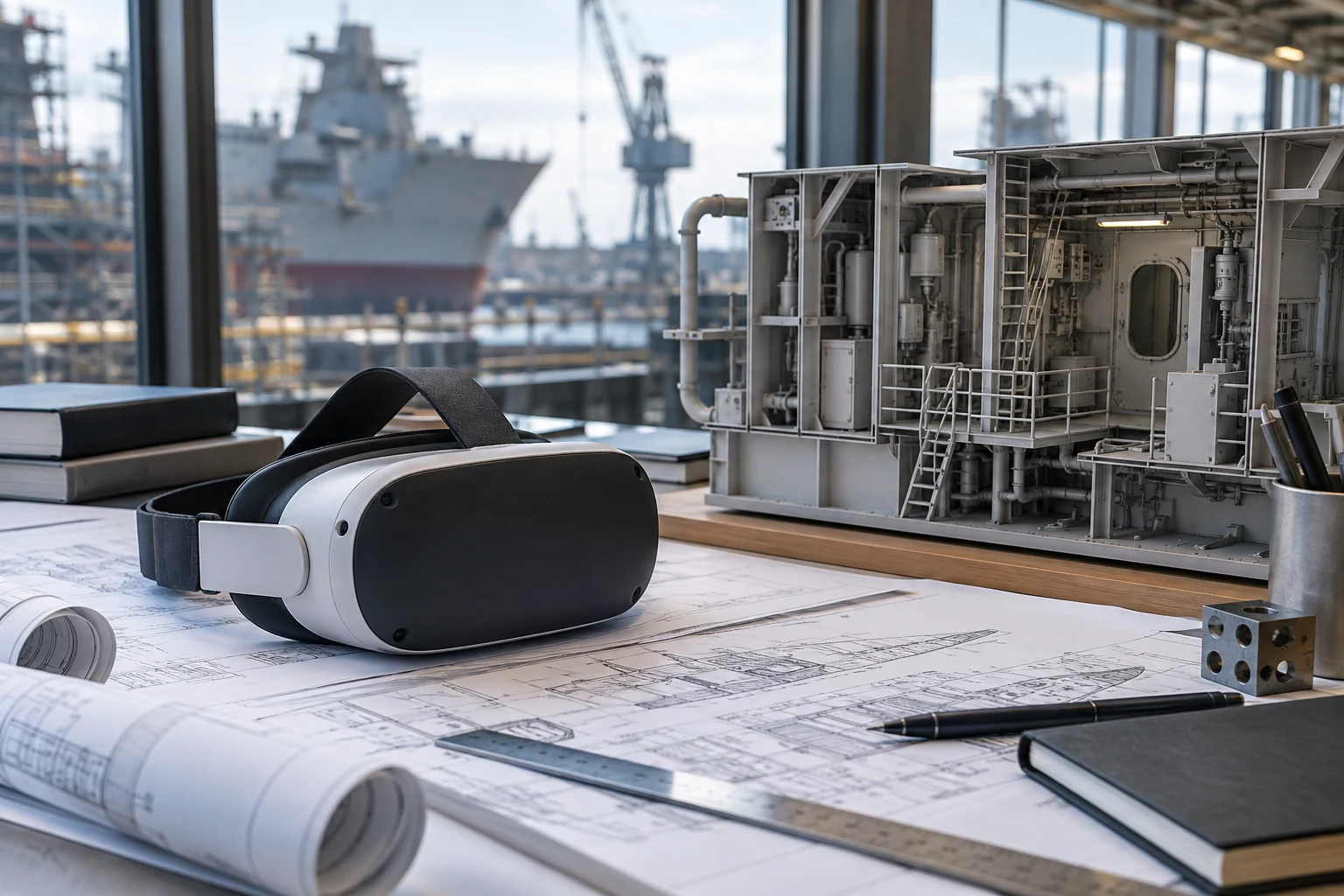
 AI-generated conceptual illustration
Higher score = stronger fit between the offeror's contribution and the engineering surface that survives review cycles.
The use case in public
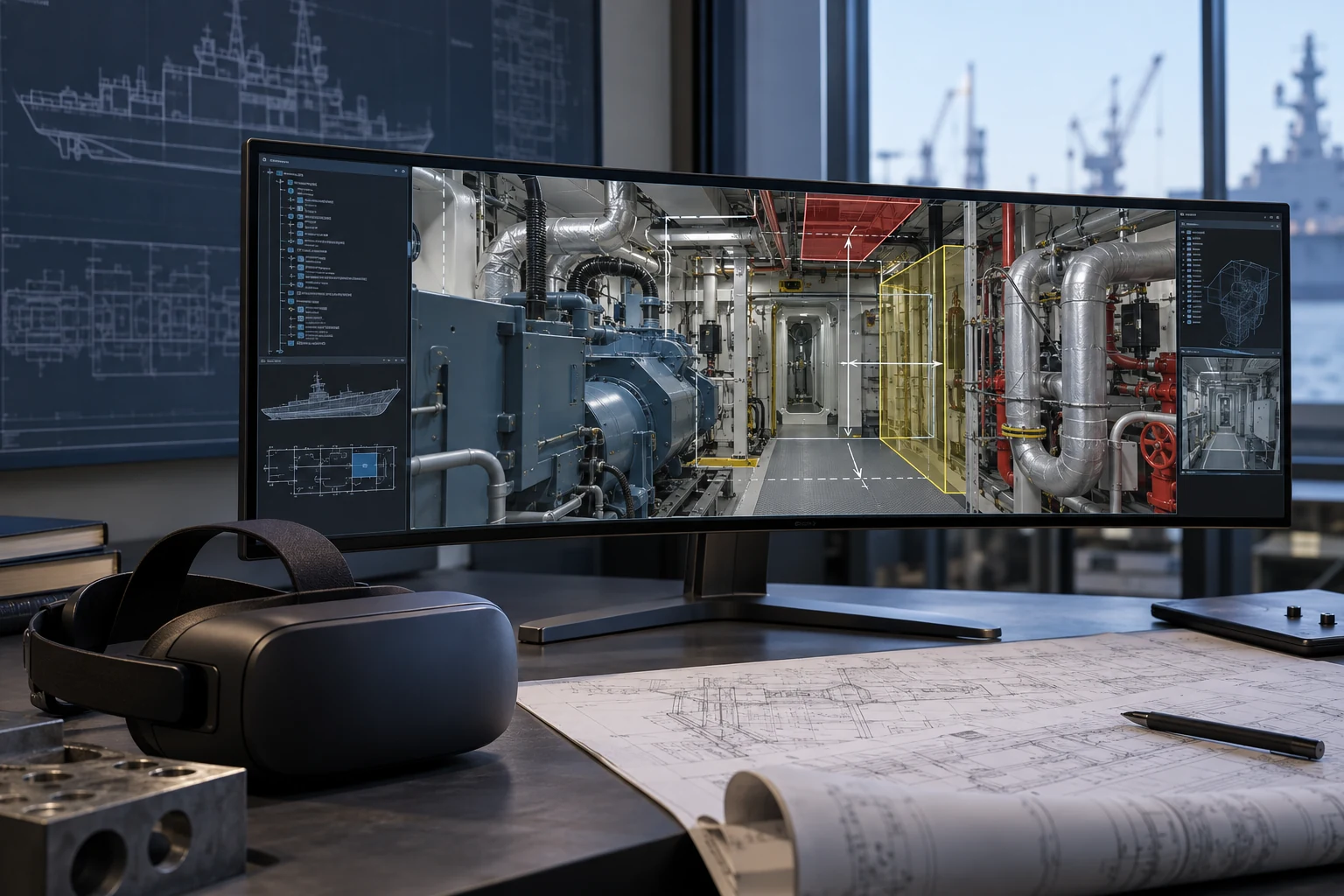
Naval platform design review involves walking through a virtual representation of the ship to evaluate ergonomics, maintenance access, system integration, and crew workflow before construction or modification. The publicly available MBSE and digital-engineering literature treats VR as one of several visualization modes for the underlying engineering model. The research question is less whether immersive review adds value in well-scoped use cases — the literature documents that it does — than how to integrate VR cleanly with the engineering source of truth so the visualization is always correct.
MBSE as the source of truth, CAD/PLM as the geometry source, and structured workflows for high-value review use cases. Lower-value scenarios produce less actionable output.
MBSE as the source of truth
Model-Based Systems Engineering, in the form of SysML 1.x and the SysML 2 successor under active OMG standardization, is the publicly endorsed methodology for naval platform design across multiple programs. The DoD Digital Engineering Strategy, the public Department of Defense Architecture Framework (DoDAF), and the academic INCOSE community have all converged on model-driven engineering as the substrate. A VR walkthrough that derives directly from the SysML model — through a pipeline that resolves CAD geometry, electrical and mechanical connectivity, and operational scenarios — is materially more useful than a VR walkthrough that is a one-time export.
The peer-reviewed research on automated MBSE-to-VR pipelines is growing. Work in IEEE Systems Engineering, Journal of Systems and Software, and the I/ITSEC and SIGGRAPH proceedings covers model-driven generation of immersive scenes, automated scenario instantiation from SysML activity diagrams, and synchronization of model changes back into the VR environment. The methodology that is converging treats the SysML model as the source, the CAD/PLM data as the geometry resolver, and the VR scene as a rendered view — not the other way around.
The discipline that survives operational use is to keep the VR environment derived rather than authoritative. Edits made in VR have to round-trip into the SysML and CAD source, or they have to be flagged and discarded. Tools that allow drift between the immersive view and the engineering source create defects that are hard to catch and harder to undo.
CAD/PLM integration
Engineering platforms have CAD and PLM systems that hold the authoritative geometry and component data. Public reference systems include Siemens NX and Teamcenter, Dassault CATIA and 3DEXPERIENCE, PTC Creo and Windchill, and the open STEP (ISO 10303) and JT (ISO 14306) interchange formats. A useful VR walkthrough has to honor these systems' update cycles, model history, configuration management, and access controls.
The open literature on CAD-to-VR conversion has well-known performance pitfalls — large assemblies are slow to load, level-of-detail control is hard at the assembly granularity practitioners need, metadata propagation is incomplete by default, and tessellation choices affect visual fidelity in ways that matter for review decisions. Recent work on neural mesh simplification, GPU-resident BVH builders for large assemblies, and Universal Scene Description (USD) as an interchange format has improved the toolkit, and NVIDIA's Omniverse has made USD-based pipelines more accessible to engineering teams.
Software-first firms that treat the CAD/PLM bridge as the engineering deliverable, not the VR rendering, build tools that survive review cycles. The integration code is what the customer cannot easily replace; the VR engine is a commodity. Phase I deliverables that demonstrate clean round-trip metadata propagation against a real CAD/PLM source are more credible than deliverables that emphasize the visual quality of the rendered scene.
What reviewers actually do in VR
The published human-factors research on VR design review has identified the high-value use cases: maintenance-access verification, sight-line and reach analysis, evacuation-route review, and crew-workflow walk-through. The peer-reviewed evidence — from Human Factors and Ergonomics Society proceedings, the IEEE VR conference, and applied-engineering journals — is consistent that these scenarios benefit measurably from 3D immersion versus 2D drawings.
Lower-value use cases — generic platform walk-through without a specific question — produce less actionable output. Tooling that supports the high-value scenarios with structured workflows (defined entry points, scripted reviewer actions, captured decisions, traceable annotations back to the engineering source) is more useful than tooling that emphasizes immersion or visual polish. The MBSE community's published work on review-by-scenario rather than review-by-walk-through gives offerors a vocabulary that program offices recognize.
The accessibility surface matters. VR sickness affects a meaningful fraction of reviewers, and the published guidance on minimizing it (frame-rate floor, locomotion modes, comfort options) is well-developed. Tools that ignore this lose adoption regardless of how good the integration is.
Test & evaluation of the tool itself
A VR design-review tool is itself a software system that needs T&E. The methodological discipline includes: ensuring the VR representation is geometrically correct (validated against the CAD source via automated geometric diffing), ensuring metadata propagation is correct (validated against the PLM source via automated metadata diffing), and ensuring the operator-facing workflow produces decisions the engineering team can act on (captured through structured reviewer studies). Public engineering T&E documentation describes related expectations.
Test instrumentation worth building in early includes geometric tolerance checks (mesh deviation against the source CAD), metadata audit trails (every visible attribute traced to its PLM source-of-record), interaction logs (every reviewer annotation traceable to a model element), and a regression harness that runs the integration pipeline against a known assembly on every change. The published software-testing literature on visual diff tools and on golden-image testing applies directly.
Where this fits
For software-first firms, the addressable surface is the integration software, not the VR engine itself. Commercial VR engines — Unity, Unreal, Omniverse, and the open-source alternatives — are mature; the integration with engineering data and engineering workflows is where Phase I research belongs. Phase II scales to additional platforms or design phases, and the strongest Phase II proposals show the Phase I integration already running against a second engineering source with a credible plan for a third.
Phase III typically transitions through program engineering accounts with measurable design-review-cycle savings, fewer design defects discovered during construction, and faster onboarding of reviewers to a given platform. The published case studies from commercial aerospace and shipbuilding (Boeing, Airbus, Northrop Grumman, the Korean and Japanese shipbuilders) give offerors comparable benchmarks to cite.
VR Design-Review Stack — Where the Engineering Lives
| Layer | Public substrate | Where Phase I research belongs |
|---|---|---|
| Source of truth | SysML 1.x / 2.0, DoDAF, INCOSE handbook | Model-driven scene generation; round-trip discipline |
| Geometry | STEP (ISO 10303), JT (ISO 14306), USD | Tessellation, LOD control, large-assembly performance |
| PLM bridge | Teamcenter, Windchill, 3DEXPERIENCE APIs | Metadata propagation; version and configuration tracking |
| Engine | Unity, Unreal, Omniverse (commodity) | Not the research deliverable |
| Reviewer surface | HFES VR research, IEEE VR proceedings | Structured-workflow scenarios; comfort options |
About this article
Precision Federal writes public technical commentary on problem classes adjacent to the programs our firm engages. The point is to demonstrate that the principal investigator has read the literature and respects the line between public technical thinking and proprietary or sensitive program content. We are a software-only SBIR firm, principal-investigator-led, and we ship under Phase I and Direct-to-Phase-II SOWs. If a public article like this one is useful to your work, we welcome the conversation.
Common questions on the public-record framing
Where do VR review tools earn their cost?
Maintenance-access verification, sight-line and reach analysis, evacuation-route review, and crew-workflow walkthroughs. Generic ship walk-throughs without a structured workflow produce less actionable output.
How does immersive review T&E itself work?
Geometric correctness validated against CAD source, metadata propagation validated against PLM source, and operator workflow validated against engineering team acceptance. Several public NAVSEA and NAVAIR documents describe the related expectations.
What does this article not cover?
Specific platform classes, specific shipbuilder integrations, or any Precision Federal VR review methodology.
Frequently asked questions
The published human-factors literature identifies the high-value scenarios consistently: maintenance-access verification, sight-line and reach analysis, evacuation-route review, and crew-workflow walk-through. These benefit measurably from 3D immersion. Generic walk-throughs without a specific reviewer question produce less actionable output.
Commercial VR engines are mature commodities. The hard, agency-specific work is keeping the VR representation honest with the authoritative engineering data — CAD, PLM, and the underlying systems-engineering model — across update cycles. Software-first firms that treat the integration as the deliverable build tools that survive review cycles.
Three layers: geometric correctness validated against the CAD source, metadata correctness validated against the PLM source, and operator-workflow validation that the decisions reviewers make in the tool are decisions the engineering team can act on. Tools that pass all three are the ones that get adopted.
Phase I demonstrates the integration methodology on a representative subsystem. Phase II scales to additional platforms or design phases with measurable design-review-cycle savings. Phase III typically transitions through program engineering accounts that already fund design-review tooling, with the SBIR-built integration replacing or supplementing legacy review processes.