
What moved in April 2026, and what stayed put
On April 20, 2026, the Justice Department moved the compliance dates in its web and mobile accessibility rule for state and local governments by one year. Public entities with a total population of 50,000 or more now have until April 26, 2027. Smaller entities and special district governments have until April 26, 2028. Counting from today, the first of those dates is 173 days away.
The requirements themselves are unchanged. The April 2024 final rule added subpart H to 28 CFR part 35 and adopted WCAG 2.1 Level AA, in its June 2018 version, as the technical standard for web content and mobile apps that a public entity provides directly or through contractual, licensing or other arrangements. The interim final rule (91 FR 20902) changed two dates in section 35.200(b), took effect the day it was published, and states that it does not alter any other provision of the 2024 rule.
| Public entity | Original date | Current date |
|---|---|---|
| Total population of 50,000 or more | April 24, 2026 | April 26, 2027 |
| Total population under 50,000 | April 26, 2027 | April 26, 2028 |
| Any special district government | April 26, 2027 | April 26, 2028 |
The sentence in the interim rule that matters most for planning has no date in it: "Regardless of the compliance dates, covered entities have an ongoing obligation to ensure that their services, programs, and activities offered using web content and mobile apps are accessible to individuals with disabilities in accordance with their existing obligations under title II of the ADA." The duties to provide effective communication and reasonable modifications long predate the 2024 rule. A resident who cannot finish an online application can ask for help now, and the entity has to provide it.
DOJ's reasons carry a planning lesson. It cited resource and staffing limits and wrote that generative AI "does not yet reliably automate the remediation of inaccessible content at scale." Budget for skilled people doing manual work, with tools in support.
Where the rule stands in November 2026
The comment period on the interim rule closed on June 22, 2026. A search of the Federal Register today shows no later DOJ action: no final rule answering the comments and no proposed rule on the substance. Two open items could still affect your plan.
A possible proposed rule. DOJ said it plans future rulemaking on the substance of the 2024 rule and will consider issuing a notice of proposed rulemaking during the extension. Its regulatory agenda, published August 14, 2026, describes reconsidering whether some provisions "could be made less burdensome" and lists the proposed rule's date as "To Be Determined." The interim rule also says that if no such proposal issues, and if circumstances suggesting further delay do not exist, DOJ "fully anticipates implementing the regulation at the new deadline."
A pending lawsuit. The National Federation of the Blind sued DOJ and the Department of Health and Human Services on May 21, 2026, in federal court in Maryland (No. 1:26-cv-02007). The suit asks the court to set aside both agencies' extensions and order the original deadlines enforced. The case remained open, with no relief granted, in the latest reports from late October. The original date for larger entities, April 24, 2026, has passed, so a ruling for the plaintiff could shorten the runway with little notice.
HHS funding carries its own dates
HHS made a parallel change to its Section 504 rule (91 FR 25496, effective May 7, 2026; 45 CFR 84.84). Recipients of HHS financial assistance with 15 or more employees now have until May 11, 2027, and smaller recipients until May 10, 2028, under the same WCAG 2.1 Level AA standard. This test counts employees rather than residents, so a county under 50,000 with an HHS-funded program and 15 or more staff can face a May 2027 date a year ahead of its Title II date. Ask counsel how it applies to your programs.
The uncertainty runs both ways: rulemaking might ease parts of the rule, and the lawsuit seeks earlier dates. Plan to April 26, 2027. Work that lets a resident finish a permit application with a screen reader counts under every outcome, because the ongoing Title II duty depends on none of them.
Who is covered and which date applies
Subpart H covers all state and local governments and their departments and agencies. That includes state agencies, cities, counties, towns, public school districts, public colleges and universities, courts, public transit agencies, commuter authorities and special purpose districts. Your date turns on the rule's definition of total population, which works differently for different entities.
- Governments with their own Census count use the most recent decennial Census, which today means 2020.
- Departments and other instrumentalities without their own count, such as a police department or a library, use the population of the government they belong to. A commuter authority or an instrumentality of several governments uses their combined population. A state university that is an instrumentality of the state takes the state's population, which places it in the April 2027 group.
- School districts vary. A city district uses the city's population, a county district uses the county's, and an independent school district uses the Census Bureau's most recent Small Area Income and Poverty Estimates.
- Special district governments take the April 26, 2028 date whatever their size. The rule defines them as limited-function governments authorized by state law, separate from a county, municipality, township or independent school district, whose population the Census Bureau does not calculate.
Public colleges and school districts should note one change from the 2023 proposal, which carried exceptions for password-protected course content. The final rule removed them. In DOJ's words, such content "will be treated like any other content," which puts course pages and files inside a learning management system in scope.
What the standard requires in practice
The rule requires the Level A and Level AA success criteria and conformance requirements of WCAG 2.1. Those criteria are testable: text contrast of at least 4.5:1, captions, labels on inputs, full keyboard operation, visible focus. Version 2.1 added 12 Level A and AA criteria to version 2.0, including Reflow (1.4.10), Orientation (1.3.4) and Non-text Contrast (1.4.11). WCAG 2.2 followed in October 2023, and content that meets it also meets 2.1, but the regulation names the June 2018 version of 2.1.
The rule reaches well past the website the communications office runs. DOJ's own example is a parking app: when a city has an arrangement that lets the public pay for parking through an app, the app is covered even if the city neither designed nor owns it. New social media posts count once the date arrives, and the entity is expected to use the platform's alt text and caption features. Live-streamed public meetings fall under Success Criterion 1.2.4, which requires captions for live audio in synchronized media.
Four provisions set the limits, and each is narrower than it first appears.
- Conforming alternate versions (section 35.202) are allowed only where technical or legal limitations make direct accessibility impossible. A separate "accessible version" is not a general option.
- Equivalent facilitation (section 35.203) permits other designs or methods if they deliver substantially equivalent or greater accessibility and usability.
- Fundamental alteration and undue burden (section 35.204) place the burden of proof on the entity. The head of the entity or a designee decides, after considering all resources available for the service, and gives a written statement of reasons. The entity must still do all it can short of that point.
- Minimal impact (section 35.205) applies in a "limited circumstance": people with disabilities must still get the same information, interactions and transactions with substantially equivalent timeliness, privacy, independence and ease of use.
The five exceptions, read closely
Section 35.201 lists five exceptions. Each is paired below with what it leaves in scope.
| Exception | Conditions in the rule | What stays covered |
|---|---|---|
| Archived web content | All four must hold: created before the compliance date (or reproduces older paper or physical media); kept only for reference, research or recordkeeping; not altered after archiving; stored in a dedicated area clearly identified as archived | Anything made after the date. DOJ's example is a PDF flyer posted after the date and later moved to an archive, which generally still must conform. Agendas and minutes for later meetings would likely not qualify. |
| Preexisting conventional electronic documents | PDF, word processor, presentation or spreadsheet files available before the compliance date, unless currently used to apply for, gain access to, or participate in a service, program or activity | Forms and instructions people still use. Old water quality reports qualify; the new report each year does not. The file format list is exhaustive, so web pages and video never qualify. |
| Content posted by a third party | Posted by a third party, unless the posting is due to contractual, licensing or other arrangements with the public entity | Calendars, scheduling tools, maps, reservation systems and payment systems the entity puts on its site, along with the authoring tools and embedded content that let the public post. |
| Individualized, secured documents | Conventional electronic documents about a specific individual, their property or their account, and password-protected or otherwise secured | The portal around the document. The exception reaches the PDF bill, while the login, the menus and any web pages must conform. A resident with a disability who needs that bill must still receive it in a usable form, in a timely manner. |
| Preexisting social media posts | Posted before the compliance date | Every post after the date. |
An exception releases content from the technical standard and leaves the older duties in place. DOJ states that effective communication, reasonable modifications and equal opportunity still apply. Have a fast, staffed process for requests.
Where public sites and apps usually fail
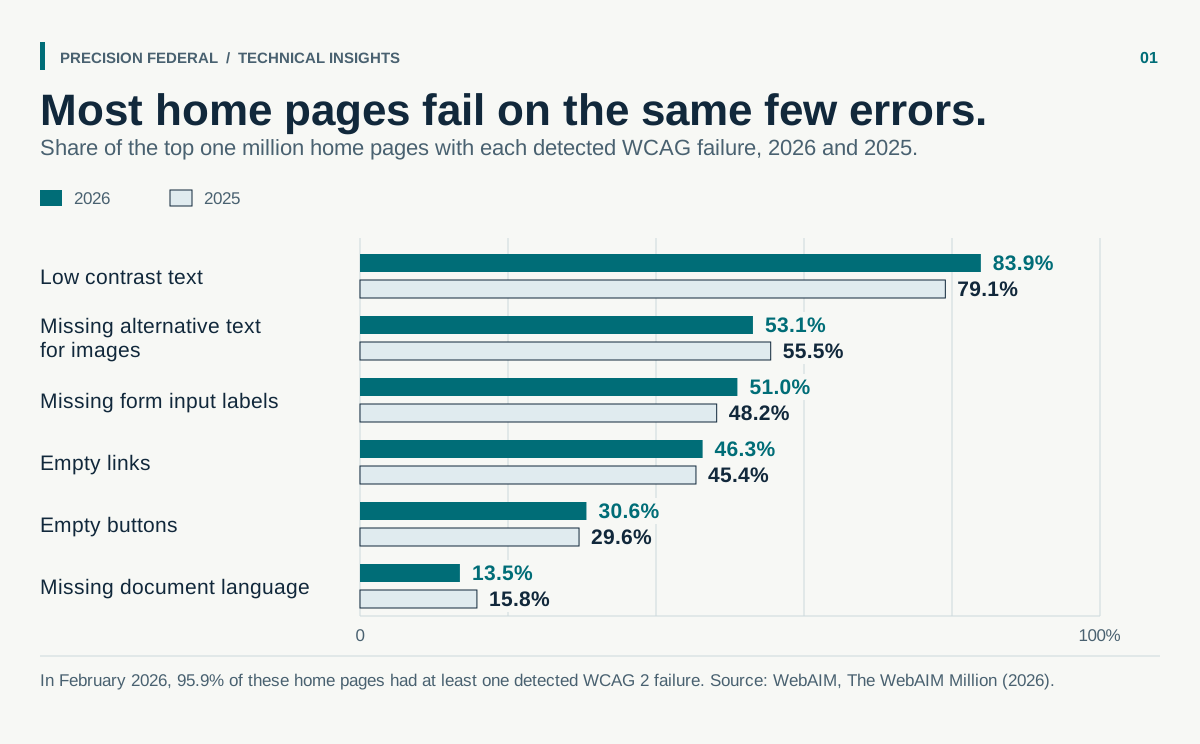
WebAIM's February 2026 scan of the top one million home pages found detectable WCAG failures on 95.9 percent of them. The most common were low-contrast text (83.9 percent), missing image alt text (53.1 percent) and missing form labels (51 percent). Those figures show only what a scanner can see. In government, the serious barriers sit deeper, where a resident has to complete a task.
| Where | What goes wrong | Criteria to test |
|---|---|---|
| PDFs and scanned forms | Image-only scans with no text, untagged files that lose headings and tables, unlabeled fillable fields. For a form in active use, a web form usually costs less over time than repeated PDF repair. | 1.1.1, 1.3.1, 3.3.2 |
| Agendas, minutes and packets | New files go up every week, so the backlog grows after the compliance date. Fix the template and the publishing tool. | 1.1.1, 1.3.1 |
| Payment and permit portals | Unlabeled fields, controls that work only with a mouse, errors shown without a text description, focus that jumps out of order. | 2.1.1, 2.4.3, 3.3.1, 4.1.2 |
| GIS and map viewers | A map with no text alternative and controls the keyboard cannot reach. Zoning and district lookups need an address search and text results on the same page. | 1.1.1, 1.4.11, 2.1.1 |
| Video | Auto-generated captions published without review, no audio description of visual content, streamed meetings with no live captions. | 1.2.2, 1.2.4, 1.2.5 |
| Third-party plug-ins | Chat widgets, calendars, embedded forms and consent banners that trap the keyboard or hide their names and roles from assistive technology. | 2.1.1, 4.1.2 |
| Mobile apps | Buttons with no spoken label in VoiceOver or TalkBack, screens locked to one orientation, text that breaks at larger sizes. | 1.3.4, 4.1.2 |
How to plan the work
DOJ's "First Steps" guidance runs from confirming your date through inventory, evaluation, prioritizing, vendor contracts and policies. Here is how that sequence works on a real public portfolio.
Inventory everything. The budget and schedule depend on this list. Crawl every domain, then add what a crawler misses: vendor-hosted services, apps, social accounts, video channels and course platforms. For each item record the owner, vendor, contract end date, monthly use, document count, and whether people use it to apply, pay or get a service.
Rank by consequence, then by traffic. Emergency information, benefits, permits, payments, court access, enrollment and voting information go first, even when their traffic is modest. After that, use analytics to find the highest-use pages and documents.
Assign every item one of four outcomes. Retire what nobody needs. Archive old material that meets all four conditions. Remediate what you own. Replace what a vendor will not fix, or get dated commitments in writing.
Test with tools and with people. Automated scans belong in the workflow, but the W3C says evaluation tools "can not determine accessibility, they can only assist in doing so." Add a keyboard-only pass, a screen reader pass on desktop and phone, and zoom and reflow checks. Test whole tasks, such as finishing an application and paying the fee, because a task can fail between pages that each pass alone. The rule does not mandate testing by people with disabilities, but DOJ recommends that entities "seek and incorporate" their feedback.

Budget for upkeep. DOJ's analysis of the 2024 rule estimated $16.9 billion in nationwide implementation costs over the first three years and about $2.0 billion a year in operating and maintenance costs after that. Expect the same shape locally: a project cost now and a recurring line after it.
Write accessibility into every purchase
DOJ was explicit that public entities are not relieved of their obligations when they act through third parties. A gap in a vendor's portal is the public entity's gap under the rule. Procurement officers belong on the team from the first meeting.
Set the standard in the solicitation. Require conformance to WCAG 2.1 Level AA for everything delivered, including updates, generated documents, notices and mobile apps.
Ask for the right report. An Accessibility Conformance Report (ACR) is a completed Voluntary Product Accessibility Template (VPAT) with documented results. Ask for the WCAG or INT edition. The 508 edition is built on the revised Section 508 standards, which incorporate WCAG 2.0, so it may say nothing about the criteria 2.1 added. Remember that an ACR is the vendor's own statement and carries no certification.
Read the report as an evaluator. Check the product version and the date. Ask what every "Partially Supports" line means for a resident's task. GSA's Section 508 guidance, written for federal buyers, travels well: it says "Not Evaluated" "does not provide any assurance of accessibility," recommends independent validation testing whenever possible, and suggests reserving the right to test offered products before award.
Put the rest in the contract. Treat accessibility defects like other defects, with severity levels and repair times. Require a dated roadmap for known gaps, notice before major releases, and retesting after them. Make a walkthrough of core tasks with assistive technology part of acceptance, before go-live and payment.
Reach back to existing contracts. Use renewals before your date as the lever. For multi-year agreements, ask for an amendment now, while there is time to replace the product if the answer is no.
Keeping it accessible after launch
Compliance decays with every upload and software release, and new files posted after the date generally must conform. Name an owner, usually the ADA coordinator and the CIO's digital lead together. Train authors by role and give them accessible templates. Run automated checks on a schedule and inside the release process, and repeat manual audits of core tasks at least yearly and after major releases. Publish a simple way to report a barrier and track each report to closure. Keep written records of the exceptions you rely on and any section 35.204 decisions.
The timeline from here
Regulatory dates are in bold. The other rows are planning targets for an entity with an April 2027 date. Entities with a 2028 date can follow the same order over a longer span.
| When | What happens | Type |
|---|---|---|
| By mid-December 2026 | Owner named, date confirmed, inventory complete, accessibility terms in all new solicitations | Planning target |
| By January 31, 2027 | Items ranked and sorted, vendor reports collected, top resident tasks tested end to end | Planning target |
| By March 31, 2027 | Priority forms converted, agenda and video workflows fixed, critical vendor fixes verified, replacements decided | Planning target |
| April 26, 2027 | Title II compliance date for public entities of 50,000 or more, other than special district governments | 28 CFR 35.200(b)(1) |
| May 11, 2027 | Section 504 compliance date for HHS recipients with 15 or more employees | 45 CFR 84.84(b)(1) |
| April 26, 2028 | Title II compliance date for entities under 50,000 and all special district governments | 28 CFR 35.200(b)(2) |
| May 10, 2028 | Section 504 compliance date for HHS recipients with fewer than 15 employees | 45 CFR 84.84(b)(2) |
What to do in the next 90 days
Ninety days from today is February 2, 2027, which leaves an entity with the April date 83 days to finish.
- Confirm your date under the population definition, and check whether the HHS dates apply
- Name one accountable executive and one working lead, and give procurement a seat
- Finish the inventory, including vendor-hosted services, apps and course platforms
- Test the ten resident tasks that matter most end to end, with a keyboard, a screen reader and people who use assistive technology
- Pull every related contract, record end dates and request current ACRs
- Add accessibility terms to every solicitation and renewal leaving your office from now on
- Convert the most-used PDF forms to web forms and fix the agenda template
- Caption your streamed public meetings and review captions on new video
- Publish a way to report barriers and train the staff who answer those reports
- Put the money in the next budget request: one line for remediation and a recurring line for upkeep
Frequently asked questions
Yes. The compliance date applies to the technical standard in subpart H. DOJ states that the ongoing Title II obligation applies regardless of those dates, and effective communication and reasonable modification duties apply now.
Generally not. Conventional electronic documents posted before your date are excepted unless they are currently used to apply for, gain access to, or participate in a service, program or activity. New documents generally must conform, and a person with a disability who needs an excepted document must still receive it in a usable form.
No. The obligation sits with the public entity, even when a vendor builds and hosts the service. Ask for a current ACR on the WCAG or INT edition, read every qualified line, test core tasks before acceptance, and put repair obligations in the contract.
Yes. The 2024 final rule removed the exceptions for password-protected course content proposed in 2023, so public educational institutions generally need that content to meet WCAG 2.1 Level AA by their compliance date.
Waiting is the riskier plan. DOJ's agenda lists a possible proposed rule with no date, a proposal changes nothing until a final rule issues, and a pending lawsuit seeks the original deadlines. The ongoing Title II duty applies whatever happens.