
A defense AI solicitation asks for models. The program office is buying something else. It is buying a capability that can be tested, authorized, integrated, sustained and defended in a review, delivered by a team that will still be there in year three. Proposals that answer the words on the page lose to proposals that answer what the office has to account for. The gap between those two readings is where capture on these programs is won, and it is almost always visible in the first two pages of a technical volume.
This is written for the capture director assembling a team for a defense AI or autonomy pursuit. The question is what the technical approach has to cover, which of those coverages your organization already holds, and where a specialist engineering partner adds score rather than headcount.
What the program office is accountable for
Start from the evaluator's obligations rather than from the solicitation's outline. A program office that fields an AI capability has to answer, on the record and often to people outside the program, a set of questions the solicitation may never phrase directly.
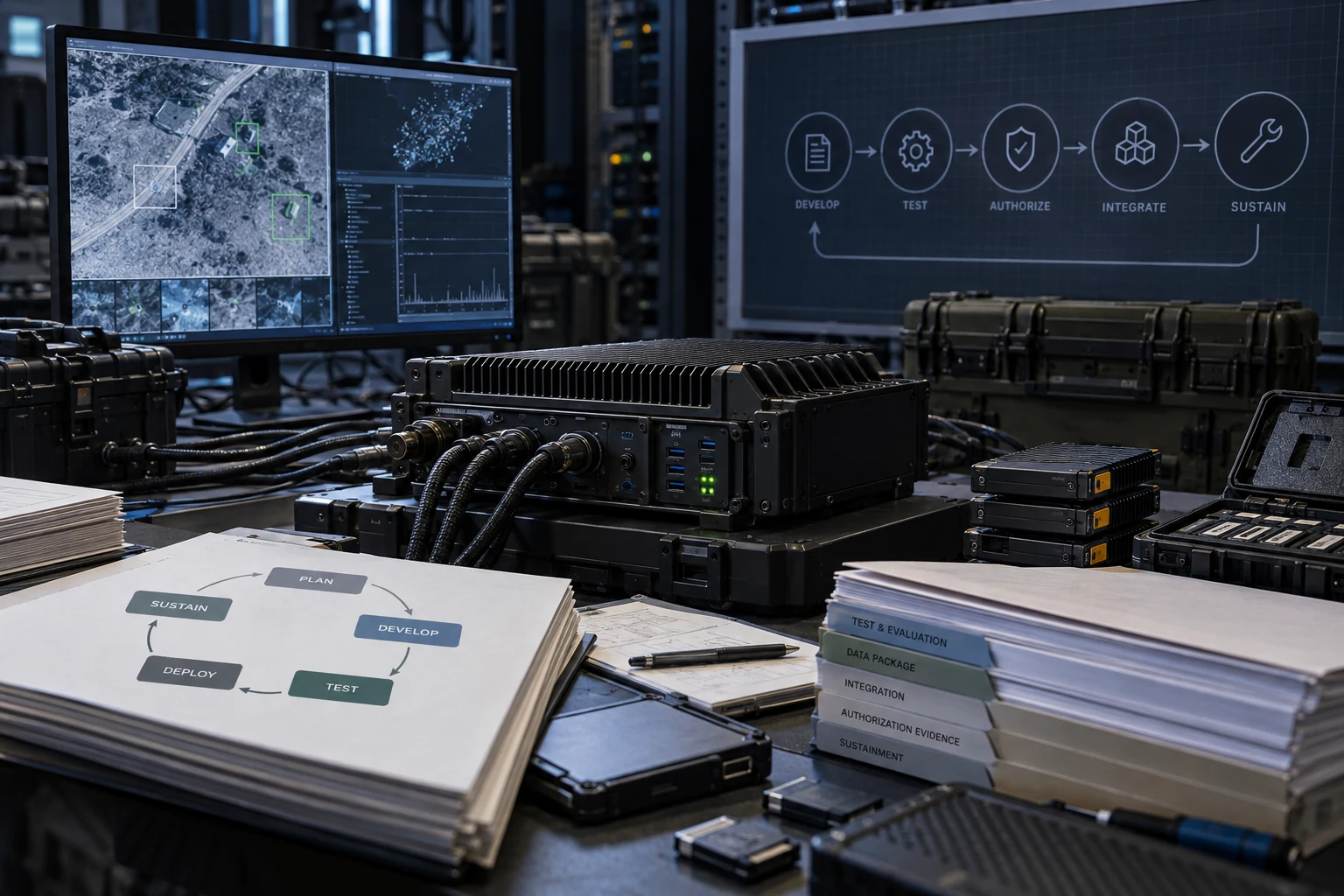
Does it work, and how do you know. Not a benchmark number. A test approach with a held-out evaluation set, a definition of the measures that matter operationally, performance reported by condition rather than as a single average, and a description of where the system fails. An office that cannot describe failure modes cannot defend the capability.
Where does the data come from, and can it keep coming. Training data provenance, rights to use it, labeling approach and quality, a pipeline that keeps producing it, and a plan for the day the sensor changes or the mission shifts. A model trained on a one-time extract is a demonstration with an expiry date.
What happens when it is wrong. The consequence of an error, who reviews what, what the degraded mode is, and how the system tells an operator that it is uncertain. This is the assurance question, and on defense programs it is usually the one with the most senior audience.
Can it be authorized and can it be integrated. Where it runs, what security baseline applies, what it inherits, what it talks to, and whose schedules those interfaces sit on.
Who keeps it running. The sustainment organization, the retraining cadence, the monitoring, and what the government owns so that it is not captive to one vendor for the life of the capability.
A technical approach that answers those five in order, with specifics, reads as a capability. One that describes model architectures and accuracy figures reads as a research proposal, and program offices have learned to be careful with research proposals.
What a defense AI technical approach is really being scored on
Editorial weighting, illustrative rather than measured. The last row is deliberately low: architecture novelty is the least defensible thing to sell a program office.
The five coverages a team has to hold
Read the pursuit as five bodies of work and ask, honestly, which ones your organization can staff at depth on this schedule. Most primes hold three of the five comfortably and one of the remaining two is where a specialist earns a seat.
Mission and domain. What the operator does today, what decision the capability supports, what the operational tempo is, and what the acceptable error looks like in that setting. Primes with program history in the domain hold this and it is very hard for anyone else to fake.
Data engineering. Collection, ingestion, schema management, labeling workflow and quality control, versioning, lineage, storage, access control and the pipeline that feeds both training and evaluation. This is the largest single work package on most defense AI programs and the one most often underestimated in the basis of estimate.
Model engineering and evaluation. Training, fine-tuning or retrieval design; the evaluation suite and its measures; error analysis by condition and subgroup; the regression set; the promotion gate; and the honest statement of limits. The evaluation work is usually larger than the modeling work and is what the program office reads most carefully.
Platform and deployment. Hosting, authorization, containerization, deployment automation, monitoring, drift detection, rollback and the integration adapters. This is ordinary production software engineering applied to a system that has a model inside it.
Program and assurance. Schedule, cost, the government relationship, risk management, the assurance narrative, the documentation set, and the sustainment organization. This is the prime's territory and it does not delegate well.
Writing the technical approach so it reads as a capability
Four structural choices separate a technical volume that scores from one that is merely compliant.
Lead with the deployment path, not the model. The first section after the summary should name where the capability runs, what security baseline applies, what it inherits from the hosting environment, and what it integrates with. A reader who sees a real deployment path in the first two pages reads the rest of the volume as a plan. A reader who has to reach page fourteen to find out where it runs reads the rest as a hypothesis.
Make the evaluation section concrete enough to argue with. Name the measures. Say how the held-out set is constructed and why it is representative. Describe how performance will be reported by condition rather than as an average. Commit to a regression set of previously failed cases. State what result would cause the team to change approach. A section that could be pasted into any AI proposal is a section that earns no score.
Put the data strategy where it can be read as a work package. Not a paragraph of intent. The sources, the rights position, the labeling approach and who does it, the quality control method, the volume estimate and its basis, the storage and access design, and the schedule. Data strategy that appears only as an assumption is the single most common reason a program office discounts an otherwise strong approach.
Write the assurance narrative as a design, not a policy statement. "We will comply with responsible AI principles" scores nothing. What scores is a description of the specific review step for consequential outputs, how uncertainty is surfaced to the operator, what the degraded mode is when the model is unavailable or out of distribution, how a bad model is rolled back, and who has authority to turn the capability off.
Where a specialist partner adds score
The useful question in team design is not "who can do AI" but "which coverage is thin and what would fix it in the eyes of the evaluator." Three shapes recur.
| Gap on the team | What the evaluator notices | What a specialist scope fixes | How to write it |
|---|---|---|---|
| Evaluation depth | Accuracy claims with no method behind them | An evaluation design with measures, conditions, regression set and thresholds | A named work package with its own deliverable and a key person |
| Data engineering | Data treated as an assumption rather than a work package | Pipeline design, labeling workflow, lineage and quality control | Its own section, with a basis of estimate that shows the volume |
| Production deployment | No stated hosting, authorization or integration path | Deployment architecture, inheritance position and interface register | Early in the volume, with the environment named |
| Sustainment engineering | No retraining cadence or monitoring described | Drift monitoring, retraining trigger, rollback, runbooks | In the management volume and the cost narrative, not just the technical |
| Nontraditional participation | An all-prime team on an agreement that rewards otherwise | A specialist with a real, scored technical scope | Named, with workshare percentage and the scope it covers |
The last row deserves a note. On other transaction pursuits, participation by a party that does not routinely carry full defense contract terms can matter to how the agreement is structured. The way to make that worth something in the evaluation is a real technical scope with a named deliverable, not a nominal percentage attached to a name. Evaluators read the two differently, and so do the people who administer the agreement later.
The evidence that makes a proposal believable
Program offices have read many AI proposals and have developed a set of tells. Five things move a reader from polite interest to belief.
- A worked example on data the team has actually seen. Not the customer's data, which you usually cannot have during a pursuit. A structurally similar public or synthetic set, run through the actual pipeline, with real numbers and a description of what went wrong. This converts a claim into a demonstration.
- Failure modes named before anyone asks. A section that says where this class of approach breaks and what the design does about it reads as experience. Its absence reads as inexperience, regardless of the credentials on the team.
- An interface register with owners and lead times. Naming the systems the capability must talk to, and being honest about which agreements exist and which do not, is the strongest schedule-credibility signal available in a proposal.
- A basis of estimate that shows data work. If the labeling and pipeline effort is not visible in the cost volume, an experienced evaluator concludes the team has not done this before. Showing it, even at an uncomfortable number, is more persuasive than hiding it.
- Key personnel who will actually be on the program. With allocations, and a substitution path stated. Evaluators have been given optimistic staffing before and price it accordingly.
How a program office weighs a defense AI team, by what it can verify
Editorial weighting, illustrative rather than measured. The last row is deliberately low: benchmark performance rarely predicts operational performance.
The engineering that the words "data strategy" hide
Depth is the difference between a section that scores and a section that fills a page, so it is worth spelling out what a real data work package contains on a defense AI program.
Ingestion with a schema contract. Every source gets a declared schema, validation on arrival, and a defined behavior when the upstream system changes without notice: reject, quarantine, or accept with a flag. Silent schema drift is the most common cause of a model that quietly degrades.
Labeling as a managed workflow. Written guidance, a qualification step for labelers, overlapping assignments on a sample to measure agreement, adjudication of disagreements, and a record of who labeled what and when. Label quality sets the ceiling on model quality, and a program that treats labeling as a commodity purchase discovers this after the first evaluation.
Versioning and lineage. Datasets are versioned artifacts. Every training run records the dataset version, the code version, the configuration and the resulting weights, so that any model in production resolves to a reproducible run. Without this, a model that misbehaves cannot be investigated, only replaced.
Splits that reflect the operational question. A random split is usually wrong. If the system will see new locations, new platforms or a later time period, the held-out set has to be split on that dimension, or the evaluation measures memorization rather than generalization. Getting this wrong is how a proposal's accuracy figure becomes an embarrassment in test.
Access control and handling. Who may see raw data, where it may rest, what may be copied to a development environment, what is de-identified and how, and what is destroyed when. Written before the first extract, not after a question from a records officer.
A synthetic path. A schema-faithful synthetic generator lets engineering proceed while access approvals move, and it leaves the program with a permanent test fixture that anyone can run end to end without touching sensitive data.
How we work inside a partner's pursuit and program
Precision Federal builds AI, data platforms, software and cloud systems and delivers them into production inside federal agencies. On a defense AI pursuit we come in as the specialist engineering partner.
During capture. We write the technical content for the sections that cover data, evaluation and deployment, in the proposal's voice and to its outline. We build the worked example on public or synthetic data through a real pipeline so the volume has numbers with a method behind them. We produce the interface register and the inheritance position for the deployment section. And we give our partner an honest read on which claims will survive an evaluator who has seen this before.
In the first weeks after award. A data pipeline against the real sources with schema contracts and validation. The evaluation suite with its measures, splits and thresholds, running on a schedule. The deployment path to the target environment, proven with a trivial service before real code depends on it. And a written gap list for anything the proposal assumed that turns out not to hold.
What our partner keeps. The customer relationship and every conversation our partner wants to own. The code, under a written assignment rather than a recital, with our pre-existing tooling named, carved out and licensed for use in the delivered system so no future maintainer is blocked. The models, the datasets and the evaluation artifacts. And the ability to have somebody else sustain the capability, which is what the documentation, the automation and the reproducible training runs exist to make true.
How it is priced. Fixed-price milestones where the scope is written, with acceptance stated as measurements rather than adjectives. A committed team at a named allocation where the backlog is negotiated with the program office. We do not price a defined outcome as hours and then discover the accountability question at acceptance.
How to start. One email with a one-page brief: the solicitation or the program, what the capability has to do, what data exists and who owns it, where it has to run, the date that matters, and who can approve a scope change. We come back with a scoped, priced statement of work, and if it is a pursuit, a view on which sections we should write.
Bottom line
Defense AI solicitations are written in the language of models and evaluated in the language of capability. The program office has to answer whether it works and how you know, where the data comes from and whether it keeps coming, what happens when the system is wrong, whether it can be authorized and integrated, and who keeps it running. Build the team by asking which of those five your organization can staff at depth and which one a specialist scope would fix in an evaluator's eyes. Then write the volume to lead with the deployment path, make the evaluation concrete enough to argue with, show the data work in both the technical and cost volumes, and describe assurance as a design rather than a policy. That is the proposal that reads as a program rather than a study.
Frequently asked questions
A deployable capability it can defend on the record. That means test evidence with named failure modes rather than a benchmark number, a data strategy covering provenance, rights, labeling and a pipeline that keeps producing, an assurance position describing what happens when the system is wrong and who reviews consequential outputs, an authorization and integration path, and a sustainment plan with a retraining cadence. A technical approach organized around those five reads as a capability. One organized around model architecture reads as research.
Read the pursuit as five coverages: mission and domain, data engineering, model engineering and evaluation, platform and deployment, and program and assurance. Most primes hold mission, platform and program comfortably. Data engineering and evaluation depth are where a specialist partner most often adds score, because those are the sections evaluators read most carefully and the ones most commonly written as intent rather than as a work package with a deliverable and a named person.
Five things. A worked example run through the team's own pipeline on structurally similar public or synthetic data, with real numbers and an account of what went wrong. Failure modes named before anyone asks. An interface register with owners and lead times, honest about which agreements exist. A cost volume where the data and labeling effort is visible rather than hidden. And key personnel with committed allocations and a stated substitution path.
Because the program office has to defend the capability, and defense requires method. Evaluation design decides whether the reported number means anything: how the held-out set is constructed, whether the split reflects the operational question such as new locations, new platforms or a later time period, whether performance is reported by condition rather than as an average, and whether a regression set of previously failed cases guards against silent loss. A random split on data that will be seen in new conditions measures memorization, not generalization.
Ingestion with a declared schema per source, validation on arrival, and a defined behavior on upstream change. Labeling run as a managed workflow with written guidance, labeler qualification, overlapping assignments to measure agreement, adjudication and a record of who labeled what. Versioned datasets, with every training run recording dataset version, code version, configuration and resulting weights so any production model resolves to a reproducible run. Splits chosen to match the operational question. Written access and handling rules before the first extract. And a schema-faithful synthetic path so engineering proceeds while approvals move.