
The moment this article is about
Somewhere in a state agency, a program manager has decided they want you. They saw the demo, they called the reference, and they do not want to spend four months running a competition to arrive back where they already are. So they ask procurement for a sole source, procurement asks them for a justification, and the justification lands in your inbox with a note that says can you help me with this. Everything that follows is governed by law you did not write, and the most useful thing you can do for that buyer is understand it better than they do.
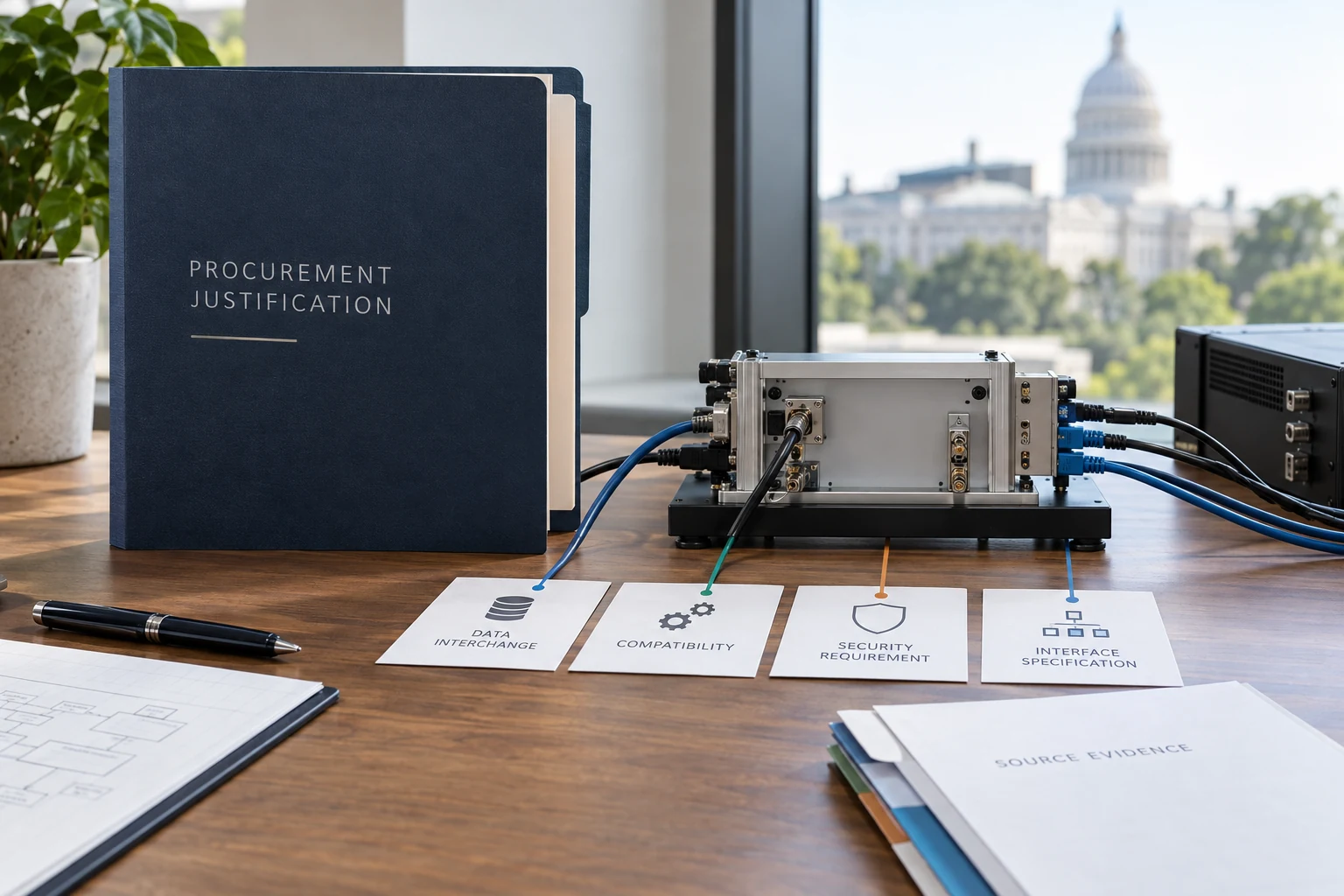
What follows is drawn from state procurement statutes and regulations, the federal uniform grant rules that ride along whenever federal money is in the contract, and the notices states publish when they make these awards. Every citation is public and checkable.
The document is a claim about the market, not a claim about you
The most common vendor mistake is treating the justification as a capability pitch. It is not. It is a negative finding about everyone else, and the statutes are blunt about it.
Maryland's regulation opens with the rule and then adds the tiebreaker: sole source procurement "is not permissible unless a requirement is available from only a single vendor," and "when doubt exists, competition should be solicited." Virginia's Public Procurement Act permits an award without competitive sealed bidding or competitive negotiation only when "there is only one source practicably available for that which is to be procured," and the public body "shall document the basis for this determination." New York State Finance Law § 163 defines sole source as "a procurement in which only one offerer is capable of supplying the required commodities or services."
Read the grammar. None of those sentences say the chosen vendor is the best one. They say the field is empty. That distinction decides what evidence is useful. A page of your differentiators does nothing for the file. What helps is material that makes the negative claim checkable: the requirement in functional terms, the reason it is legitimate, and the record of what the buyer found when searching the market against it.

Sole source and single source are different words with different consequences
New York's statute is the cleanest place to see the split, because it defines both in one section. Sole source is the empty-field claim. Single source is something else: "a procurement in which although two or more offerers can supply the required commodities or services, the commissioner or state agency, upon written findings setting forth the material and substantial reasons therefor, may award a contract or non-technical amendment to a contract to one offerer over the other." The same statute tells agencies they "shall minimize the use of single source procurements and shall use single source procurements only when a formal competitive process is not feasible."
The difference matters. If other firms can do the work and the agency wants you anyway, the honest filing is a single source, and the finding is about whether competition is feasible rather than whether the market has anyone else in it. That is a harder argument in most places, and in several states the category does not exist. Where it does not, the buyer either makes the stronger empty-field claim, which may not be true, or uses a different vehicle.
Ask your buyer which one they are filing. If they cannot answer, the file will be weak, and you have learned that early enough to do something about it.
The bases that actually hold up
Oregon's statute enumerates the findings that support a sole source determination rather than leaving the test abstract. Under ORS 279B.075 the agency must determine in writing that the goods or services "are available from only one source," and the supporting findings may include that "the efficient utilization of existing goods requires acquiring compatible goods or services," that "the goods or services required to exchange software or data with other public or private agencies are available from only one source," and that "the goods or services are for use in a pilot or an experimental project." Maryland lists a parallel set of examples: unique sources, equipment compatibility needs, trial use, resale items, and exclusive utility services.
Three of those describe software and data work directly, which is why the route comes up so often in technology procurement and why procurement offices read it skeptically.
Compatibility. The agency already owns something, and the new work has to fit it. This is the strongest available basis for most software engagements and the most abused, because "it integrates with our system" is a preference, not a finding. What turns it into a finding is naming the interface: a specific message schema, a proprietary data format the agency is already committed to, a vendor-controlled API with no published specification, a support agreement that voids if a third party touches the code.
Interchange. The agency has to exchange data with somebody else, and that somebody else has fixed the format. This is common in health, transportation, education and justice data, where a federal reporting system or a multi-state exchange dictates the payload. When the mandate is external and documented, the finding writes itself.
Pilot or experiment. Several states allow a limited trial without competition on the theory that the agency is buying knowledge rather than a production system. It is real and self-limiting: the pilot ends, and the production award almost always has to be competed. Treat it as a door into the building, not as the contract.
How durable each basis is once a reviewer reads it
Editorial ranking of how intact each basis tends to survive a procurement or audit review, read off how the statutes phrase the test and what posted determinations rely on. A ranking of durability, not a measured approval rate.
The bottom two rows are where most requests start and where most of them die. Familiarity and satisfaction are reasons a buyer wants you. They are not reasons the market is empty, and a reviewer who has read a hundred of these files says so in one line.
The reasons that collapse under review
Federal acquisition law states the two disqualifying rationales more plainly than most state codes, and state reviewers reason the same way. FAR 6.301(c) says contracting without full and open competition "shall not be justified on the basis of" either "a lack of advance planning by the requiring activity" or "concerns related to the amount of funds available (e.g., funds will expire)."
Those two sentences describe the origin of a large share of sole source requests. The grant period closes in nine weeks. The incumbent contract expires at the end of the quarter. Nobody started the solicitation in March. None of that is a defect in the market, and writing it into the file is writing your own denial.
A second trap catches technically strong vendors specifically. Under the federal uniform grant rules at 2 CFR 200.319, "specifying only a 'brand name' product instead of allowing 'an equal' product to be offered" is listed among the situations considered restrictive of competition. Brand-name-or-equivalent language is permitted, but only "when it is impractical or uneconomical to clearly and accurately describe the technical requirements." A requirement written tightly enough that only one product qualifies is itself a compliance problem, not a solution to one.
The same section closes the loop: "contractors that develop or draft specifications, requirements, statements of work, or invitations for bids must be excluded from competing on those procurements." A vendor who helpfully drafts the requirements document so that only that vendor can meet it has not built a justification. It has built a disqualification, and handed a competitor the argument.
What each state exposes, and when
The mechanics vary more than the legal test does. What changes state to state is who signs, how much of the file becomes public, and whether disclosure comes before the award or after it. That timing is the most consequential difference for a vendor.
| State | The written test | Who signs or approves | What becomes public, and when |
|---|---|---|---|
| Virginia Code § 2.2-4303(E) | "Only one source practicably available for that which is to be procured." | The public body documents the basis. | Notice identifying the procurement, contractor and award date, posted on the Department of General Services central procurement website. Required for state bodies, encouraged for local ones. |
| Florida Fla. Stat. § 287.057(3)(c) | Commodities or contractual services "available only from a single source." | Agency written determination after reviewing vendor information. | A description of what is sought, posted electronically at least 15 business days before award, requesting that prospective vendors state whether they can supply it. Reported to the department quarterly. |
| Washington RCW 39.26.140 | Written justification meeting the sole source criteria, plus evidence the opportunity was posted on the state vendor notification system. | The Department of Enterprise Services must approve before the contract binds or any work is performed. | The contract is filed and open to public inspection not fewer than 15 working days before the proposed start date. |
| New York State Finance Law § 163 | Sole source: "only one offerer is capable." Single source: written findings setting out "material and substantial reasons." | Documented in the procurement record, subject to review by the State Comptroller. | For single source awards, a summary of the circumstances and reasons competition was not feasible, posted on the agency website within 30 days after award. |
| Oregon ORS 279B.075 | Written determination that the goods or services "are available from only one source," supported by enumerated findings. | The Director of the Department of Administrative Services, a local contract review board, or the State CIO for certain information technology. | The determination is an agency record, and the agency must negotiate advantageous terms, so price sits inside the file. |
| Maryland COMAR 21.05.05 | "Available from only a single vendor," with the instruction that "when doubt exists, competition should be solicited." | The procurement officer, with agency head approval. | A written determination stating the basis, its scope, and how long it remains effective. |
Local governments run variations on the same structure under their own charter or code, often with a council or board vote replacing the state-level approver above a stated dollar figure. Read the county or city purchasing ordinance rather than assuming the state rule applies downstream.
The posted notice is a challenge window, and vendors misread it
Florida shows most clearly what the public posting is really for. Before proceeding, the agency posts a description of the commodities or services sought "for at least 15 business days," and the posting must include "a request that prospective vendors provide information regarding their ability to supply" them. That is not a formality. It is an open invitation to your competitors to break the sole source, published by the agency, at the agency's expense.
Washington's fifteen working days of public inspection before the proposed start date does similar work, with the added weight that the Department of Enterprise Services must approve the contract before it binds and before anyone performs. New York's disclosure comes within thirty days after award, which shifts the risk from losing the award to explaining it afterward. Virginia posts the award with the contractor named.
Two things follow for the vendor. First, the posted description has to survive a competitor reading it with hostile intent. Narrow enough that only you qualify, and a competitor can argue the specification is restrictive. Broad, and someone raises a hand. No drafting trick escapes that squeeze. The only stable position is a requirement statement that is functional, tied to something the agency actually owns or is actually obligated to, and true.
Second, when a competitor responds claiming it can supply, the agency has to take that seriously. Sometimes the response is thin and the agency documents why it misses the requirement. Sometimes it is real, and the procurement converts to a competition on the original schedule, with you as the presumptive but no longer exclusive bidder. Plan for that before the notice posts.
Price is the second gate, and it is a separate one
Competition is what normally proves a price is reasonable. Remove it and somebody has to prove reasonableness another way, so most regimes attach a pricing obligation to the noncompetitive award.
Under 2 CFR 200.324, a cost or price analysis is required "for every procurement transaction, including contract modifications, in excess of the simplified acquisition threshold," and the recipient "must make independent estimates before receiving bids or proposals." The same section prohibits the "cost plus a percentage of cost" method outright. California Public Contract Code § 10348 directs the department to prescribe "the methods and criteria which shall be used in determining the reasonableness of contract costs when a contract is awarded without competition." Oregon requires that "to the extent reasonably practical, the contracting agency shall negotiate with the sole source to obtain contract terms that are advantageous to the contracting agency."
In practice the buyer will ask for material supporting a written reasonableness finding: a rate build-up by labor category, a published price list if you maintain one, comparable contracts, and a statement of what is inside the price and what is not. The most persuasive comparable is a rate you charged another public body for similar work.
One caution. In several states the negotiated price lands in a file open to public inspection. Quote a number you would be comfortable seeing read by your next customer.
Federal money changes who has to say yes
A large share of state technology spending is federal pass-through, which pulls a second rulebook into the file. Under 2 CFR 200.320(c), noncompetitive procurement is permitted only when the amount does not exceed the micro-purchase threshold; when "the procurement transaction can only be fulfilled by a single source"; when "the public exigency or emergency for the requirement will not permit a delay resulting from providing public notice"; when "the recipient or subrecipient requests in writing to use a noncompetitive procurement method, and the Federal agency or pass-through entity provides written approval"; or when, "after soliciting several sources, competition is determined inadequate."
The fourth condition is different in kind. It is not a fact about the market at all. It is a permission, and getting it adds a federal reviewer and a calendar the state cannot control. When a buyer says the funder has to bless it, that is the clause they mean.
Two structural details are worth knowing. First, 2 CFR 200.317 lets a state follow "the same policies and procedures it uses for procurements with non-Federal funds," which is why the state code stays in charge, while four sections still apply regardless: §§ 200.321, 200.322, 200.323 and 200.327. Every other recipient and subrecipient, including a local government spending state pass-through, follows §§ 200.318 through 200.327 directly. Second, the dollar thresholds are defined by cross-reference. 2 CFR 200.1 points to the Federal Acquisition Regulation, and FAR 2.101 currently states that "simplified acquisition threshold means $350,000" and "micro-purchase threshold means $15,000," with lower figures for certain construction and service categories. These numbers have moved and will move again, so read the current FAR text rather than a figure copied into somebody's desk procedure.
The record-keeping obligation at 2 CFR 200.318 outlives everybody involved. Recipients "must maintain records sufficient to detail the history of each procurement transaction," including "the rationale for the procurement method, contract type selection, contractor selection or rejection, and the basis for the contract price." A single audit three years later reads that record, not the relationship that produced it.
What a vendor should actually hand the buyer
Give your buyer a package they can lift into their own template without editing your marketing voice out of it, written in the agency's terms rather than yours.
- A functional requirement statement the agency could publish: what the system must do and interoperate with, no product names in it.
- The technical fact that closes the market — schema, license, protocol, certification or data-exchange mandate — with a document reference the buyer can attach.
- A short market scan naming the firms that plausibly compete and, for each, the concrete reason it misses the stated requirement.
- Pricing support: rate build-up by labor category, published rates if you have them, and comparable public-sector engagements with the rates charged.
- A period of performance with a defined end, because open-ended noncompetitive awards attract review that bounded ones avoid.
- A written path back to competition: what the agency owns at the end, and what a future competitor would need to bid the follow-on.
- A clean conflict record of what you did and did not write in the requirements documents, since 2 CFR 200.319 excludes contractors who drafted them.
The path back to competition is not defensive housekeeping. Reviewers approve files that show the agency is not painting itself into a corner, so a justification that names the exit survives more often than one that does not, and it costs you nothing you were going to keep.
From "they want you" to a signed contract
When to stop and use a different door
Sometimes the best advice a vendor can give is that the sole source is not the fastest route. Four alternatives are usually faster and always safer.
A cooperative or existing contract. If the requirement can be bought off a contract already competed, the justification problem disappears. Under 40 U.S.C. 502(c), state, local, regional and tribal governments, including local educational agencies and institutions of higher education, may buy information technology from the federal supply schedules covering "automated data processing equipment (including firmware), software, supplies, support equipment, and services." Participation in those sales is voluntary for the vendor. State term contracts and multi-state cooperative agreements work on the same logic.
A below-threshold direct purchase. Every state sets a dollar figure under which informal quotes or a purchase order suffice. Scoping the first engagement under that figure turns a legal argument into a paperwork exercise, and a delivered first engagement is worth more to the relationship than a larger contract that spent five months in review.
A prequalified pool or qualified vendor list. Where the agency runs one, competition was done in advance and task orders move quickly among the qualified firms.
A subcontract to the incumbent. If the reason only one firm can do the work is that one firm holds the platform contract, the honest structure may be that the platform holder primes and you deliver the scope beneath it.
Emergency authority is a fifth route, and it deserves a caution rather than a recommendation. Virginia allows an emergency award without competitive sealed bidding or competitive negotiation, but the public body must still obtain "such competition as is practicable under the circumstances," and the file must document "the basis for the emergency and for the selection of the particular contractor." That second clause catches people. An emergency explains the speed. It never explains the choice of vendor, and the choice is a separate finding.
Bottom line
A sole source justification is a public official's written statement that the market cannot supply the requirement from anyone else. It is not a statement that you are the right choice, and the evidence proving you are the right choice does almost nothing for the file. What helps is a functional requirement the agency can defend, one technical fact that closes the field, a market scan naming competitors and why each falls short, pricing that stands without a competition behind it, and an end date with a path back to open competition. When the honest reading is that two firms could do this work, say so early and help your buyer find the faster legal door. Vendors who do that get called back. Vendors who help build a file that collapses in review do not.
Frequently asked questions
The determination is the agency's, signed by an agency official, and cannot be outsourced. What a vendor can supply is the underlying material: a functional requirement statement, the technical fact that closes the market, a market scan, and pricing support, written in the agency's language for the buyer to place in their own template. Be careful about drafting the specification itself, since 2 CFR 200.319 excludes contractors who develop or draft specifications, requirements, statements of work or invitations for bids from competing on those procurements.
New York State Finance Law § 163 draws the line explicitly. Sole source means only one offerer is capable of supplying the requirement. Single source means two or more can supply it but the agency awards to one anyway on written findings of material and substantial reasons. Not every state recognizes the second category, and where it exists the statute typically directs agencies to minimize its use.
Usually, and often before the award rather than after. Florida requires a description of what is sought to be posted electronically for at least 15 business days, with an invitation for other vendors to say whether they can supply it. Washington requires the contract to be filed and open to public inspection not fewer than 15 working days before the proposed start date. Virginia requires a posted notice naming the contractor, and New York a posted summary within 30 days after a single source award.
No, and stating it in the file is harmful. FAR 6.301(c) says other than full and open competition cannot be justified on the basis of a lack of advance planning by the requiring activity or concerns about funds expiring. State reviewers apply the same reasoning even where their code does not spell it out, because a scheduling failure is not a fact about the market.
It adds a second rulebook. 2 CFR 200.320(c) permits noncompetitive procurement only in five defined circumstances, one of which requires written approval from the federal agency or pass-through entity. A cost or price analysis is required above the simplified acquisition threshold under 2 CFR 200.324, and 2 CFR 200.318 requires records detailing the rationale for the method and the basis for the price. States keep their own policies under 2 CFR 200.317; subrecipients follow the federal standards directly.