
Anyone underwriting real estate at volume has the same experience: a hundred properties, a hundred rent rolls, no two formatted alike, and a modeling process that begins with a person retyping numbers into a template. It looks like a document understanding problem. It is mostly a normalization problem.
The concepts are stable; the labels are not
Across formats the underlying concepts barely vary — unit, tenant, area, base rent, term dates, escalations, recoveries, concessions. What varies is naming, units of measure, whether rent is monthly or annual, whether area is rentable or usable, and what gets folded into a single column.
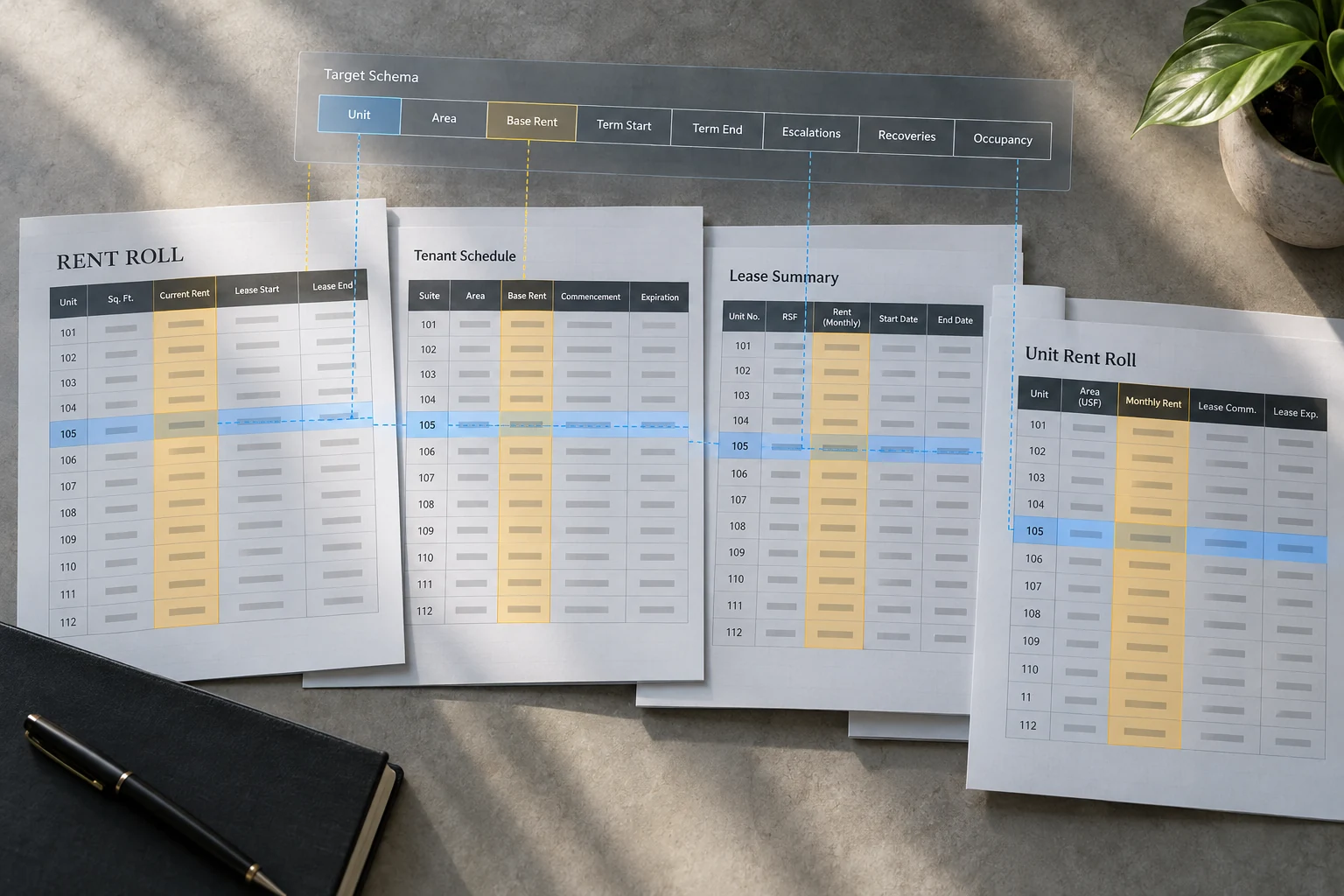
A model asked to summarize a rent roll will produce a competent-sounding paragraph. A model asked to map columns to a defined schema, with the mapping shown, produces something an analyst can check in thirty seconds and correct in ten.
Ask for a summary and you get prose. Ask for a mapping and you get something checkable.
The specific traps
- Monthly versus annual rent stated identically, distinguishable only by magnitude
- Rentable versus usable area, where the difference is a load factor nobody wrote down
- Total rows embedded mid-sheet, which silently double a portfolio
- Vacant units represented as blank, as zero, or as absent entirely
- Escalations expressed as a percentage, a fixed step, or a reference to a lease clause not in the file
The last one is where the document genuinely does matter. Escalations and recoveries frequently cannot be resolved from the rent roll at all and require the lease, which means the honest system reports the field as unresolved rather than inferring it.
Why inference here is worse than a blank
An analyst who receives a blank fills it. An analyst who receives an inferred escalation that looks reasonable will carry it into a model, and the error compounds through the hold period. The cost of a wrong value is much higher than the cost of a missing one, which should drive the design.
So the rule is strict: the extracted value or nothing, with a span link to the cell or clause it came from, and an explicit unresolved state that the interface makes visible rather than hiding as an empty field.
Where rent-roll extraction goes wrong
Relative weighting from delivery practice, not a measured statistic — shown to rank where attention belongs.
What good output looks like
A normalized table where every populated cell can be clicked back to its origin, every unit conversion is recorded as a transformation rather than applied invisibly, every unresolved field is flagged, and the sheet-level reconciliation — unit count, occupied count, total rent — is checked against any totals stated in the source.
That last check catches most extraction failures cheaply. If the extracted units do not sum to the stated total, something is wrong, and the system should say so rather than deliver a clean-looking table that is quietly short three units.
The target schema is the actual design decision
Everything downstream depends on defining what the normalized output is, and this decision is usually made implicitly by whoever builds the first template.
| Field | Definition that must be fixed | Common failure |
|---|---|---|
| Area | Rentable or usable, and the measurement standard | Mixing both across a portfolio, silently |
| Base rent | Monthly or annual; per unit or per area | Annual figures read as monthly, off by twelve |
| Term dates | Commencement, rent commencement, expiration — distinct | Collapsing them, which breaks free-rent modeling |
| Occupancy | Leased, occupied, and physically occupied are different | One number reported as though it answered all three |
| Recoveries | Structure and base year, not just a rate | Reduced to a percentage that loses the structure |
| Escalations | Type, rate, frequency, and next date | Extracted as a rate with no schedule |
Fixing these definitions before extraction begins is what prevents a portfolio where each property is internally consistent and the aggregate is meaningless.
The mapping, and why it should be visible
The productive interaction is not "summarize this rent roll." It is a proposed mapping from source columns to target fields, with a sample value for each, that an analyst confirms in one screen.
This inverts the review burden usefully. Instead of checking hundreds of extracted values, the analyst checks a dozen mapping decisions — and a wrong mapping caught once fixes every row at that property. It also makes the system's uncertainty legible: a column the system could not map is a visible gap rather than a quietly empty field.
Mappings should be remembered per source. Most operators submit the same format every period, so a confirmed mapping applies to the next twelve exports with a diff check for changed columns. The second period costs almost nothing, which is where the operating leverage actually comes from.
Validation that catches most errors cheaply
A small set of arithmetic checks catches the majority of extraction failures without any understanding of the document.
- Row sums against stated totals — the single highest-yield check available
- Unit count against the property record — catches embedded subtotals and dropped rows
- Occupied plus vacant equals total — catches blank-versus-zero confusion
- Rent per area within a plausible band for the market — catches unit and annualization errors
- Term dates ordered correctly and within plausible ranges — catches column misalignment
- Period-over-period delta on aggregate rent — catches a format change the mapping missed
These are ordinary data quality checks and their absence is the most common reason a clean-looking normalized table is wrong. They also fail loudly, which is exactly what is wanted.
When the rent roll is not enough
A rent roll is a summary produced by an accounting system. It is not the lease, and several fields that matter economically cannot be recovered from it at any level of extraction quality.
Recovery structures, renewal and termination options, co-tenancy provisions, exclusive use restrictions, and the actual escalation mechanics frequently live only in the lease document. A system that infers them from the rent roll produces values that look complete and are guesses.
The honest design reports them as unresolved and, where lease documents are available, extracts them separately with clause-level spans. Abstracting a lease is a larger task than reading a rent roll and it is the task that produces the fields that drive value. Conflating the two — treating a rent roll extraction as a lease abstraction — is a common and expensive category error.
What this is worth
The obvious return is analyst time, and it is real: the retyping stage largely disappears and review shifts to adjudicating flagged items.
The larger return is portfolio-level comparability. When every property is normalized to one schema with provenance, questions that previously required a special project become queries — exposure by expiration year across the portfolio, weighted average lease term by market, concentration by tenant across entities. Those questions were always answerable and the cost of answering them was high enough that they were asked rarely.
That shift, from "we could find out" to "we know," is usually worth more than the hours saved on any single deal.
Portfolio rollup is where the value concentrates
Normalizing one rent roll saves an analyst an afternoon. Normalizing a portfolio to a single schema changes what the organization can ask.
Expiration exposure by year across every asset, weighted average lease term by market, tenant concentration across entities that were never compared, the effect of a single tenant's credit on the whole book — these questions were always answerable and the cost of answering them meant they were asked at transaction time and rarely otherwise.
Making them queryable moves them from due diligence into asset management, which is where they actually influence decisions. That shift is worth more than the hours saved on any individual deal, and it is invisible in a business case built on extraction time alone.
Rent roll and lease abstraction are different products
| Rent roll extraction | Lease abstraction | |
|---|---|---|
| Input | An accounting export | The executed lease and amendments |
| Answers | Who is in which unit, at what rent, until when | Options, recoveries, restrictions, remedies |
| Effort | Hours per property once mapped | Hours per lease, every lease |
| Failure mode | Silent unit or annualization errors | A missed option or exclusive-use clause |
Treating the first as though it delivers the second is the common and expensive category error. A rent roll cannot tell you whether a tenant holds a right of first refusal on the adjacent space, and a system that infers an answer has manufactured one.
Period-over-period is the cheapest quality control available
Because rent rolls arrive on a cycle, each new export can be compared against the last. That comparison catches things no single-document validation can.
A unit that vanished. A rent that moved by an implausible multiple, which is almost always a unit-of-measure change rather than a real increase. A column that was renamed, silently breaking a mapping. A tenant name that changed, which may be an assignment worth knowing about.
None of this requires understanding the document. It requires only keeping the prior version and diffing, which most workflows do not do because the prior version was retyped into a model and discarded.
Frequently asked questions
The schema differs — multifamily, industrial, and retail carry different concepts — but the approach does not. Define the target schema, map to it with provenance, and refuse to infer.
Meaningfully less, but not zero, and the goal should not be zero. The realistic target is that review time moves from retyping everything to adjudicating the flagged minority.