
The change with the highest blast radius and the lowest ceremony
In most companies shipping a language-model feature, a schema migration needs review, a staged rollout and a rollback plan, while a sentence added to a system prompt reaches every user in the time it takes to save a file. The second change can alter the tone, the length, the refusal behavior, the format and the accuracy of every response the product produces. The asymmetry is not a matter of discipline. It is that a prompt does not look like code, so none of the machinery that guards code was ever pointed at it.
The symptom shows up as a conversation nobody can finish. Support reports that answers got worse sometime last week. Engineering checks the deploy log and finds nothing relevant. The model provider says the endpoint is unchanged. Someone eventually remembers editing an example in a prompt on Thursday, and nobody can say for certain which responses were produced by which text, because no response ever recorded the version that made it.
The version is a bundle, not a string
This is the mistake underneath most of the others. Teams version the system prompt in a table or a file, roll it back when something breaks, and find the behavior unchanged — because the thing that changed was one of the other seven inputs that decide what the model does.
The versioned artifact has to include all of it:
| In the bundle | Why it belongs there |
|---|---|
| System and instruction text | The obvious one, and typically the only one that gets versioned |
| Tool definitions and their descriptions | A tool description is a prompt. Rewording it for clarity changes when the tool gets called |
| Output schema and format instructions | Changes what downstream code receives, often in ways only a consumer notices |
| Few-shot examples, in order | Both the content and the ordering affect behavior |
| Retrieval configuration | Passage count, chunk size, reranker settings and the index version all change the context |
| Model identifier and snapshot | The same prompt on a different snapshot is a different system |
| Decoding parameters | Temperature, top-p, max tokens, stop sequences |
| Post-processing rules | Parsers, repair passes and validators shape what the user actually sees |
Hash the whole bundle. That hash is the version. Anything less and your rollback restores a subset of the state and you spend the incident wondering why the numbers did not recover.
You are probably here because
- Output quality changed and nobody can say what changed with it
- A rollback did not restore the previous behavior
- Prompts live in three places and you are not sure which one production reads
- A non-engineer can edit a prompt and it reaches customers immediately
The bundle section addresses the first two, the storage section the third, and the rollout section the fourth.
Where the prompts live
Two options, both defensible, and one common arrangement that is worse than either.
In the repository gets you review, diff, blame, branch, and an atomic tie between a prompt and the code that consumes it. The prompt ships with the deploy that expects it. The cost is that changing a word requires a deploy, and non-engineers cannot edit anything.
In a database or a prompt-management service gets you edits without a deploy, non-engineer authorship, and instant rollout. The cost is that you have taken a production behavior change out of the release pipeline entirely, and the coupling between prompt and code is now an assumption rather than a guarantee — a prompt that expects a new tool can be published before the tool exists.
The arrangement that fails is the accidental third one: some prompts in the repo, some in a service, some inlined in a function three call frames down, and a genuine uncertainty about which the running system reads. We find it often, and finding it is usually the first hour of the engagement.
What we recommend: keep the repository as the source of truth and let the runtime resolve a bundle by identifier with a pinned default, so an unreachable configuration service degrades to the last known-good bundle rather than an outage. If a management tool is used for authoring, export every published change back to the repo automatically, so the git history remains the record even when the edit did not originate there.
The registry entry
Whatever the storage, one row per bundle version, and it should carry: the identifier and content hash; the model snapshot it was validated against; the identifier of the evaluation run that gated it; who authored and who approved it; a one-line changelog written by a human; the traffic it is currently allowed; and the status, which is one of draft, shadow, canary, live, superseded or rolled back.
That last field is what makes an incident answerable in minutes. "Which bundles are live right now, and what changed most recently" should be one query, not an investigation. The discipline is the same one applied to model artifacts in a model registry that earns its keep, and a prompt bundle deserves it for the same reason: it decides behavior in production.
Every response records the hash
This is the cheapest high-value change in the whole article and the one most often missing. Write the bundle hash, the model snapshot, and the retrieval index version onto every response record you keep, alongside the request identifier.
With it, "output got worse last Tuesday" becomes a query: group the quality signal by bundle hash and look at the boundary. Without it, the same question is a memory exercise involving three people and a chat history. It costs a few bytes per row and it is the difference between a twenty-minute diagnosis and a two-day one.
Return the hash to API consumers too, if you have them. A customer reporting a behavior change who can quote the version identifier has done most of your triage for you.
The gate: a paired evaluation that can fail the release
A prompt change ships behind an eval set the same way a code change ships behind tests. The composition that works, in descending order of value:
- A regression set built from real past failures — every bug becomes a permanent case. This is the highest-value set you will own
- A stratified sample of real traffic, refreshed quarterly, covering the shapes of input you actually receive
- Adversarial and edge cases: empty input, wrong language, contradictory instructions, prompt injection attempts, the longest document a user has ever sent
- Cost and latency checks, because a prompt that adds four hundred tokens to every request is a budget change nobody approved
Run it paired: the same inputs through the old bundle and the new one, comparing outcomes case by case. This matters more than it sounds. Comparing two independent accuracy numbers wastes most of your statistical power, because the variance between cases swamps the difference you are looking for. Comparing per case — how many cases got better, how many got worse, how many were unchanged — is far more sensitive, and it hands you the list of regressions directly instead of a number that moved.
Be honest about resolution. A paired set of two or three hundred real cases will reliably surface a change of several points and a clear list of newly broken cases. It will not settle a one-point difference, and pretending otherwise leads to teams shipping noise as an improvement. If a change matters at that resolution, either gather far more cases or accept that the eval cannot decide it and the canary must.
What we find in place when we are handed a language-model codebase
Impressions from review work rather than a survey. The bottom three are where nearly every incident we investigate begins.
Rollout: shadow, canary, live
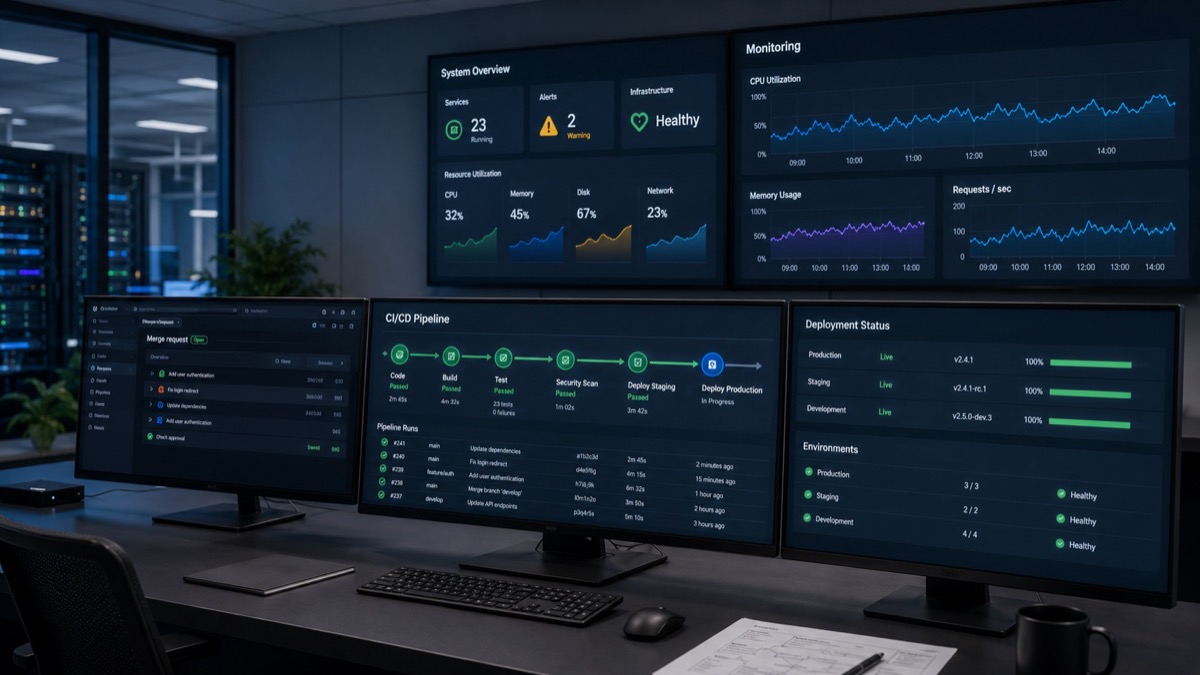
Shadow runs the new bundle alongside the old on real traffic, serves only the old output, and logs both. It is the safest signal available and it costs double tokens on the shadowed share, so shadow ten percent rather than everything.
Canary serves the new bundle to a slice. Two rules make it trustworthy. Assign deterministically by hashing a stable key — account, or conversation — so the same user does not flip between versions. And keep the assignment sticky for the whole conversation, because a session that switches system prompts mid-thread produces exactly the incoherence that makes users lose confidence, and it also poisons your comparison.
Live is full traffic with the previous bundle retained and one action away.
Watch the right signals during a canary, and note that the interesting ones are mostly not accuracy. Refusal rate and average output length are the two that move first and are cheap to compute on every response. Then: schema validation failure rate, tool-call rate, retry rate, thumbs-down rate, escalation-to-human rate, and cost per request. A prompt change that quietly doubles output length has changed your latency budget and your bill without changing a single quality metric.
Thin traffic changes the method, not the standard
Below a few thousand relevant requests a day, a percentage canary will take weeks to say anything, and teams respond by skipping the canary. Better options exist: cohort by customer rather than by percentage and pick friendly accounts; run the paired offline eval on a larger sample instead; or ship to internal users first and read the outputs yourself. Reading fifty real outputs carefully is a legitimate release gate and it is more informative than a statistically meaningless dashboard. A/B testing when your traffic is thin covers the general case.
Tell us how a prompt change reaches your users today.
Where the prompts live, who can edit them, what gates a change, and what happens when one goes wrong. Email contact@precisionfederal.com. You get back the three gaps we would close first and what each one costs to build, in writing, in one business day. No charge and no meeting.
contact@precisionfederal.comRollback has to be one action, and most of them are not
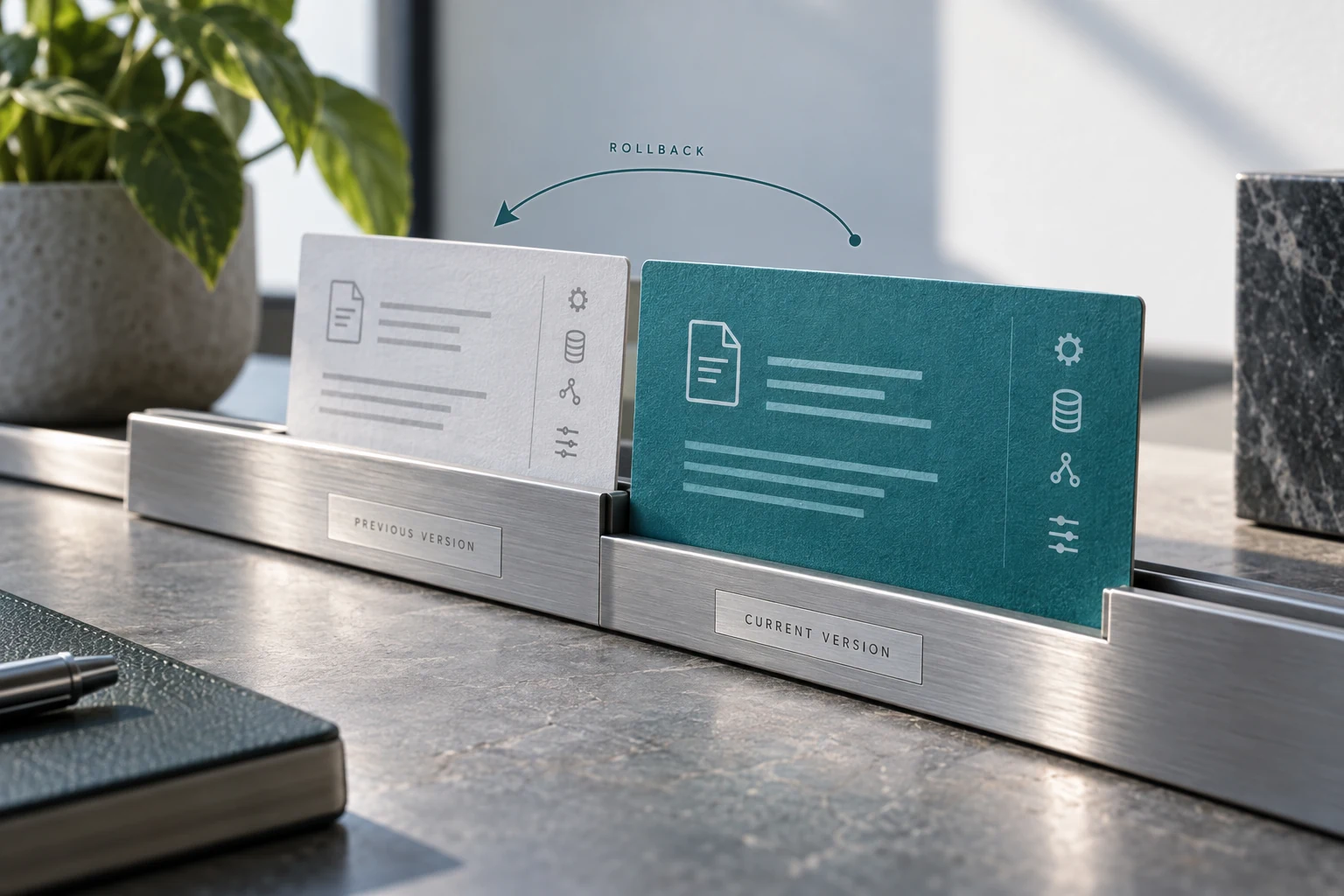
The target is a single operation that repoints traffic to a previous bundle, executable by whoever is on call, without a build, and rehearsed at least once outside an incident. If nobody has performed a rollback while nothing was wrong, you do not have one; you have a plan.
Four things break it in practice, and all four are worth checking before you need them:
Caches. If cached responses are not keyed by the bundle hash, rolling back leaves the new behavior being served from the cache for the whole time-to-live, and rolling forward again has the same problem in reverse. Putting the hash in the key makes both instant. This is covered from the cache side in caching for LLM applications.
Written data. If the new bundle produced output in a new shape and you stored it, a rollback restores the generator and not the records. Now you have two formats in one table and a reader that must handle both.
Downstream consumers. If an API customer or an internal service adapted to the new format, rolling back breaks them. This is what makes a schema change forward-only regardless of what your prompt tooling claims.
The model snapshot. If the change was made because a provider retired the old snapshot, there is nothing to roll back to. Track provider deprecation dates as scheduled work with an owner, because that is an outage with a date printed on it months in advance.
Name the changes that are forward-only
Some changes cannot be undone, and the honest thing is to label them at authoring time rather than discovering it at two in the morning. A change is forward-only if it alters a stored data shape, if a consumer has adapted to its output, if it was forced by a provider deprecation, or if it produced data used to train or tune something else.
Forward-only changes need a different process: a migration plan, a compatibility window, and an explicit decision, not a canary and a rollback plan that will not work. Keeping the forward-only list short is a design goal in itself — if every second prompt change is unrollbackable, the coupling between your prompts and your storage is too tight, and that is the thing to fix.
Per-customer prompts and the fork problem
Selling to enterprises produces requests for customer-specific behavior, and the easy answer — copy the prompt and edit it — creates a maintenance surface that grows linearly with customers and never shrinks. A year later a security fix has to be applied to forty divergent prompts, and nobody can say which forty.
Represent overrides as a small structured diff on a shared base: a tone directive, a glossary, a set of disallowed topics, a few extra examples. Cap what can be overridden, so the base can still evolve. Version base and override independently, and record both hashes on the response. When a customer asks for something the override structure cannot express, that is a product decision requiring a real conversation, not a new fork.
The five-minute incident drill
Rehearse this before you need it. Someone says quality dropped. In order: query the response records for the last twenty-four hours grouped by bundle hash and find the boundary; check whether the model snapshot changed underneath you, which is the case an unpinned alias makes possible; check the retrieval index version, since a reindex changes behavior with no prompt change at all; run the paired eval on the two candidate bundles; roll back if the picture is clear, or pin to a snapshot if the provider moved. Every step in that list is a query that exists only if you did the recording work above. That is the entire argument for doing it.
A two-week hardening pass
Prompt Release Hardening
Step one is longer than anyone estimates. In a codebase of any age the prompts are in a config file, a database table, three inline string literals, a tool description in a decorator, and a fallback path that was written during an incident and never revisited. You cannot version what you have not found, and the inventory alone usually explains a couple of standing mysteries.
Common objections
Is this not too heavy for a team of six?
Most of the value is in three cheap things: pin the model snapshot, hash the bundle, and record the hash on every response. That is a couple of days and it converts the worst class of incident from an investigation into a query. The eval gate and the canary can come later, in that order, when the cost of a bad release justifies them.
Our prompt tool already does versioning. Is that enough?
Check what it versions. Most tools version the prompt text and not the tool definitions, the retrieval configuration, the decoding parameters or the model snapshot, which means a rollback in the tool restores part of the state. Also check what happens when the tool is unreachable: if the runtime cannot fetch a prompt and has no pinned local default, an outage in a configuration service is an outage in your product.
Should non-engineers be able to edit prompts?
Often yes, and it is one of the genuine advantages of the medium — the person who understands the domain can express it directly. Put the same gate on their change as on an engineer's: eval, canary, rollback. The problem is never who wrote the words. It is a behavior change reaching production with no gate at all.
How do we handle a provider deprecating a snapshot we depend on?
Treat it as scheduled work with a named owner from the day it is announced. Run the paired eval against the replacement snapshot early, budget time to re-tune the prompt because a bundle fitted to one snapshot rarely transfers unchanged, and ship it as a normal canary rather than a deadline scramble. The failure mode is discovering the dependency in the final week.
The mistakes we are called in to fix
- A moving model alias in production, so behavior changes with no deploy and no notice
- No version recorded on responses, making every quality question a memory exercise
- Tool descriptions edited freely, since they read as documentation rather than as prompt
- Rollback that restores the prompt text only, leaving retrieval settings and decoding parameters at the new values
- Canary assignment by request, flipping users mid-conversation and ruining the comparison
- An eval set of synthetic cases that has never contained a real reported failure
- Caches keyed without the bundle hash, so a rollback takes hours to take effect
- Forty forked customer prompts with no shared base and no way to apply a fix once
Before a prompt change reaches customers
- The bundle is defined, hashed, and includes tools, schema, retrieval and decoding settings
- Every model reference is a pinned snapshot, not a moving alias
- The bundle hash, snapshot and index version are recorded on every response
- A paired eval ran on the same inputs and the regressions were reviewed by a person
- Refusal rate, output length and cost per request were checked, not only accuracy
- The canary is sticky per conversation and assigned deterministically
- Rollback is one action, rehearsed, and does not require a build
- Caches are keyed by the bundle hash so a rollback takes effect immediately
- If the change is forward-only, it says so and has a migration plan instead
- The registry says who approved it, what it changed, and how much traffic it holds
Bottom line
Treat the prompt as what it is: a deployable artifact that determines production behavior. Version the whole bundle rather than the text, pin the model snapshot, and record the hash on every response — those three make incidents answerable and cost a couple of days. Gate changes on a paired eval built from your own past failures, roll out sticky per conversation, and rehearse the rollback while nothing is wrong. The teams that do this ship prompt changes more often, not less, because the cost of being wrong drops to a single reversible action and the argument about whether to risk it disappears.
Frequently asked questions
The system text, tool definitions and their descriptions, the output schema, few-shot examples and their order, retrieval configuration including the index version, the model snapshot, decoding parameters, and any post-processing. Hash all of it together. Versioning only the prompt string produces a rollback that restores one input out of eight, which is why so many rollbacks appear not to work.
The repository as the source of truth, with the runtime resolving a bundle by identifier and holding a pinned local default so a configuration outage is not a product outage. If a management tool is used for authoring by non-engineers, export every published change back to the repository automatically so the history stays in one place.
Run it paired on identical inputs and a few hundred real cases will surface changes of several points along with the specific regressions. It will not resolve a one-point difference, and treating noise as an improvement is a common failure. Prioritize cases drawn from real reported failures; fifty of those are worth more than a thousand synthetic ones.
Usually one of four reasons: a cache keyed without the version kept serving new-bundle answers, the retrieval index or configuration also changed, the model snapshot moved underneath an unpinned alias, or only the prompt text was reverted while decoding parameters and tool definitions stayed at their new values.
Refusal rate and average output length move first and are computable on every response. Then schema validation failures, tool-call rate, retry rate, negative feedback rate, escalation to a human, and cost per request. A change that doubles output length has altered latency and spend without touching any accuracy metric, and that is a common way a canary passes and the month's bill does not.