
An engineer paged at two in the morning faces a wall of alerts, a timeline, and several thousand log lines. Summarizing that is an obviously good use of a language model, and it is also a setting where a wrong summary is unusually expensive, because it sends a tired person down a path.
The cost asymmetry during an incident
Outside an incident, a mediocre summary wastes a little time. During one, a summary that names the wrong subsystem redirects the entire response, and the correction does not come until someone re-derives the picture from raw data — which is what the summary was supposed to prevent.
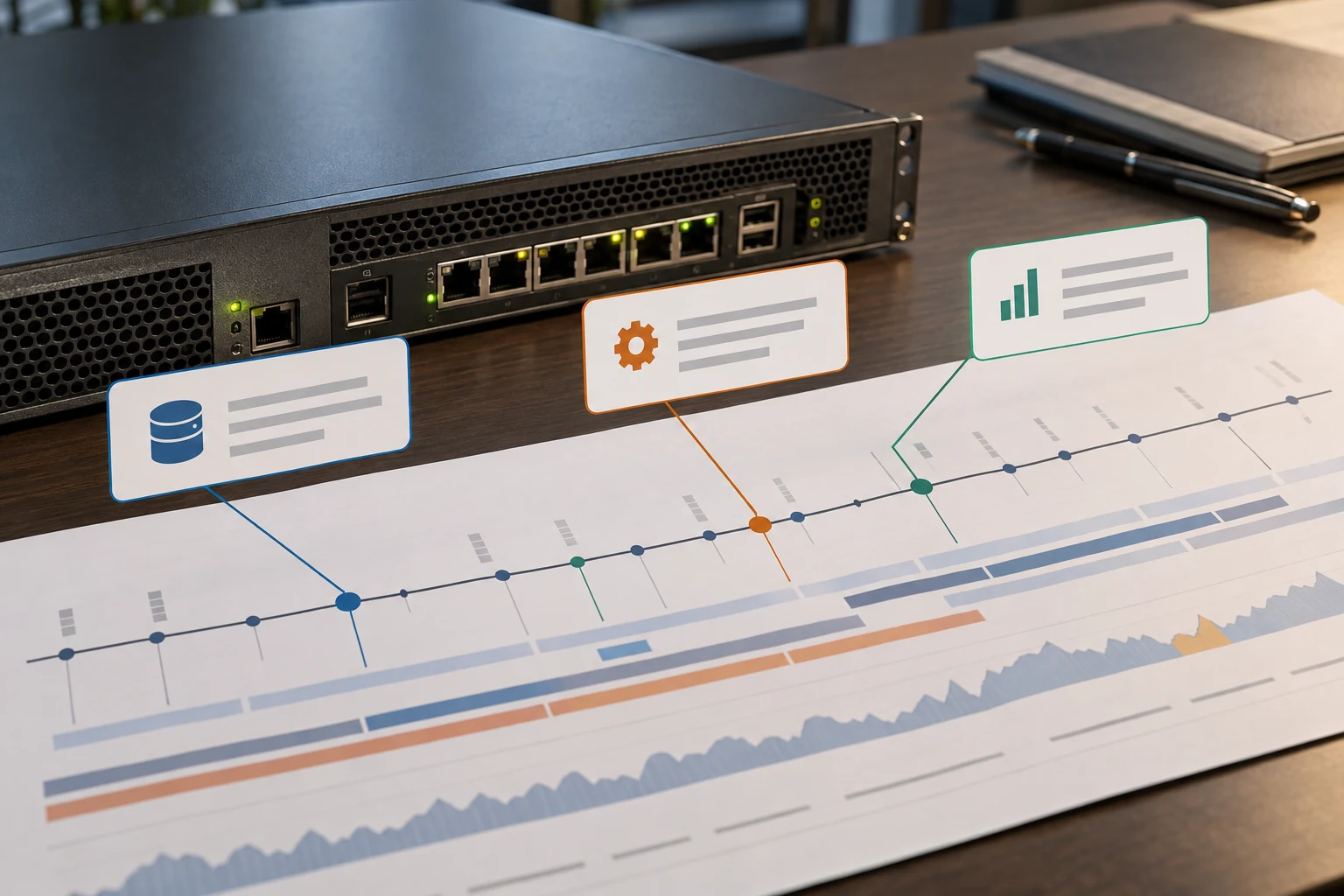
This means the bar for incident summarization is higher than for most summarization tasks, not lower, even though the demand for speed pushes the other way.
The summary competes with reading the logs. If it cannot be trusted, it has added a step.
What makes a summary actionable
Engineers do not want a narrative. They want a small set of grounded observations they can verify at a glance and then stop verifying.
- First deviation, with the exact timestamp and the metric or log line that carries it
- What changed in the window before it — deploys, config pushes, topology events — as facts, not inference
- Blast radius stated as the specific services and regions with observed errors
- Explicit separation of observed from inferred, visually, not in a caveat sentence
- Every claim linked to the query that produced it, so it can be re-run live
That last point does most of the work. A summary whose claims are re-runnable queries is not really a summary; it is a pre-built investigation the engineer can extend. That is a far more useful object than a paragraph.
The correlation trap
The strongest pull on a language model in this setting is toward causal language. A deploy happened, errors rose, and the fluent sentence is that the deploy caused the errors. Sometimes true, often not, and stated causally it stops the search.
Systems that hold up state the temporal fact and leave the causal claim to the engineer. A deploy completed four minutes before the first error, stated as such, gives the responder the same lead without foreclosing the alternatives.
What a responder needs, in the order they need it
Relative weighting from delivery practice, not a measured statistic — shown to rank where attention belongs.
Where the real leverage sits
Not in the live summary, which is the visible feature, but in the write-up afterward. Post-incident review is universally valuable, universally deferred, and consists largely of assembling a timeline from sources everyone is tired of looking at.
Generating that timeline from the event record, with links, and letting the humans supply the analysis is a clean division of labor. It also produces the corpus that makes future incidents easier to reason about, which compounds in a way the live summary does not.
What responders actually need, in order
Incident tooling tends to present everything at once. Responders work in a sequence, and matching it makes the output far more useful.
| Stage | The question | What helps |
|---|---|---|
| Orient | What is broken and for whom | Blast radius as specific services, regions, and customer impact |
| Time-anchor | When did it start | First deviation with the exact signal that carries it |
| Correlate | What changed before that | Change events in the preceding window, stated as facts |
| Hypothesize | What could produce this pattern | Prior incidents with a similar signature |
| Act | What do we do | Runbook entries and known mitigations, linked |
A summary that opens with a hypothesis has skipped three stages and anchored the responder before they have oriented. That anchoring is the specific harm — not that the hypothesis is wrong, but that it arrives before the responder has formed their own.
Separating observation from inference, structurally
The single highest-value design choice is to make the boundary between what was measured and what was inferred visually unmistakable, rather than expressing it through hedging language.
Hedged prose fails under stress. "It appears that the deploy may have contributed" reads, to someone at two in the morning, as "the deploy did it." Sentence-level qualification is not a reliable signal when the reader is skimming.
Structural separation works. Observations in one block, each with its query link. Inferences in a separate, visually distinct block, each labeled with what would confirm or refute it. The responder can consume the first block as fact and treat the second as a starting point, which is the correct relationship to each.
Re-runnable claims change what a summary is
A claim linked to the query that produced it stops being a static assertion. The responder clicks it, sees the live result, and extends the query — narrowing to a region, widening the window, adding a dimension.
This converts the summary from a document into an investigation starting point, which is a materially different artifact. It also removes the trust problem at its root: the responder does not have to decide whether to believe the claim, because verifying it costs one click.
- Every quantitative claim carries the query, not a description of it
- Queries are parameterized so the window and scope can be adjusted inline
- Results render in place rather than opening a separate tool
- Claims that cannot be expressed as a query are marked as inference, not stated as fact
- The query set is retained with the incident record for the post-incident review
The post-incident write-up is the larger opportunity
Live summarization is the visible feature and the harder problem. The write-up afterward is the easier problem and probably worth more.
Post-incident reviews are universally valuable and chronically deferred, and the deferred part is almost entirely assembly: reconstructing the timeline from alerts, chat, deploy history, and metrics that everyone is tired of looking at. The analysis — why it happened, what we change — is the part humans are needed for and the part that gets rushed because assembly consumed the time.
Generating the timeline from the event record, with links, and leaving the analysis to the team is a clean split. It also produces the corpus that makes the next incident easier, because a well-structured history of prior incidents is what makes signature matching possible at all.
Evaluation on replayed incidents
This is one of the rare settings with excellent evaluation data sitting unused: every past incident, with a known conclusion and a complete event record.
Replay them. For each, capture what the system would have said at the five-minute mark and at the twenty-minute mark, and score two things. Did the first named subsystem match the eventual finding? And how often did it name a subsystem that was investigated and ruled out?
The second number predicts adoption better than the first. A system that is right half the time and never sends responders down a dead end is valuable. A system that is right more often but occasionally produces a confident wrong direction will be switched off after the first outage it lengthened, and it will deserve to be.
Alert fatigue is the precondition, not a side effect
Summarization is usually proposed for teams already drowning, and it is worth being clear that a summary layer over a noisy alerting estate mostly produces well-written noise.
The ordering that works is unglamorous. Reduce the alerts that should never have paged anyone. Then correlate what remains into incidents rather than individual signals. Only then does summarization have a coherent object to describe, because a summary of forty uncorrelated alerts is a list, and the responder still has to do the correlation the tool was meant to save them.
Teams that invert this get a visible feature that does not reduce time to resolution, and they generally conclude the technology does not work rather than that it was applied to the wrong layer.
Runbook maturity determines what can be automated
- No runbooks — the system can orient and time-anchor; suggesting action would be invention
- Prose runbooks — it can retrieve and link the relevant one; the human executes
- Structured runbooks with preconditions — it can propose the specific entry and show why it matched
- Executable runbooks — it can offer a gated action with a clear blast radius
Most organizations are at the second rung and buy for the fourth. Naming the rung honestly at the start sets expectations that survive the first incident, and it identifies runbook structuring as the actual prerequisite — which is work the team can do without any tooling decision at all.
The correlation trap, restated as a rule
Because it is the single most consequential design choice here, it is worth reducing to something a reviewer can check: the system may state what happened and when; it may not state why.
A deploy completed four minutes before the first error is a fact. That the deploy caused the errors is a hypothesis, and stated as fact at two in the morning it ends the search. Every incident tool that has lengthened an outage did so by making a confident causal claim that a tired responder had no reason to doubt.
Holding the line costs almost nothing in usefulness. The responder gets the same lead from the temporal fact and keeps the alternatives open, which is exactly what good incident response requires.
Frequently asked questions
Only if it can point to a runbook entry or a prior incident with the same signature. Generated remediation advice during an outage is a category of risk most teams should decline.
Replay historical incidents and measure whether the summary's first named subsystem matched the eventual finding, and how often it named one that was ruled out. The second number is the one that predicts whether engineers will keep using it.