
Edge ISRT fusion — methodological signals
Higher score = stronger public-literature anchoring for an edge ISR&T fusion claim.
The framing
Edge-deployed multimodal ISR&T systems combine inputs from multiple sensor modalities — RF, EO/IR, radar, acoustic, and others — to produce timely, actionable intelligence within tight compute and bandwidth envelopes. The publicly available sensor-fusion literature treats this as a layered architecture problem: which fusion happens at which layer, with which dependencies, and at which latency.
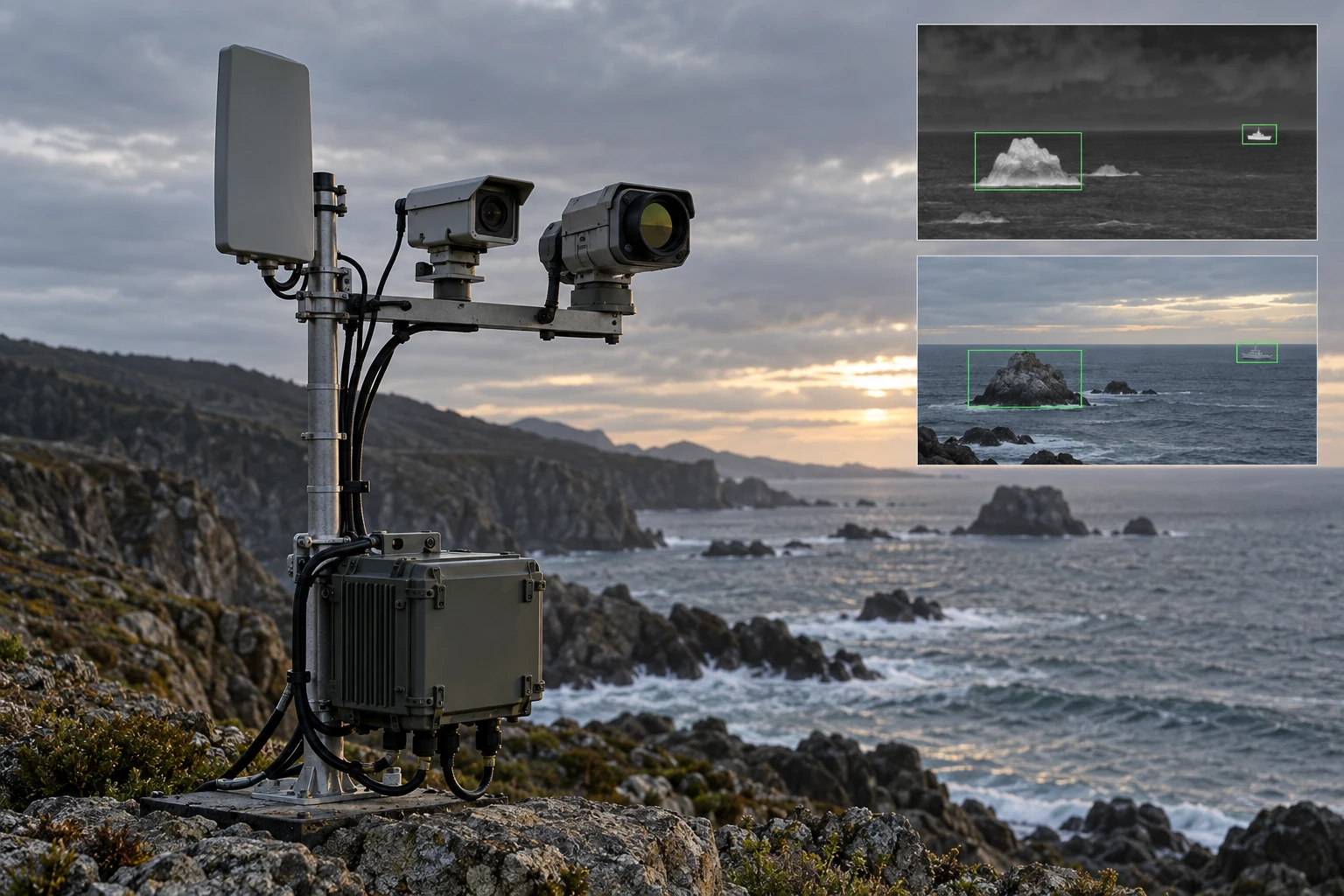
JDL fusion taxonomy as the foundation; latency budgets decomposed across capture, encoding, fusion, decision, action. SWaP-C and DDIL-comms constraints are the binding architectural drivers.
Fusion levels in the open literature
The classical taxonomy from the JDL (Joint Directors of Laboratories) data-fusion model and its later revisions distinguishes data-level fusion (raw or low-feature), feature-level fusion (learned representations), and decision-level fusion (independent decisions combined). Each level has trade-offs. Data-level fusion produces the richest joint representation but requires synchronized, calibrated inputs to the millisecond and to the pixel. Feature-level fusion is most common in modern ML systems, with learned encoders feeding a cross-attention or concatenation-based fusion head — the architectural pattern Vaswani et al. popularized in transformers, which has been adapted by recent multimodal foundation work such as Meta AI's ImageBind, Google's PaLI series, and the broader CLIP-style contrastive alignment literature. Decision-level fusion is most robust to single-modality failure.
The trade-off is not purely about accuracy. Each fusion level imposes different demands on data engineering, training compute, and runtime memory. Survey papers in IEEE TPAMI and the Information Fusion journal consistently report that hybrid architectures — feature-level fusion for the dominant modality pairs combined with decision-level reconciliation across the remainder — outperform single-level designs on operationally realistic benchmarks. The 2015 Proceedings of the IEEE survey by Lahat, Adali, and Jutten on multimodal data fusion remains a frequently cited reference for the taxonomy, and AFRL's published work on multi-INT fusion echoes the same layered framing.
For ISR&T specifically, the public DoD doctrine signals an interest in robustness as much as accuracy. A fusion system that produces a slightly worse joint estimate but that degrades gracefully when one sensor is jammed, occluded, or simply offline is preferable to a system that maximizes benchmark score but collapses under realistic sensor loss. This is why decision-level fallbacks appear in most fielded designs even when the primary path is feature-level.
| Fusion level | Joint representation richness | Synchronization sensitivity | Single-modality failure tolerance |
|---|---|---|---|
| Data-level | Highest | Highest — requires tight temporal and geometric calibration | Lowest — joint representation breaks if any modality is missing |
| Feature-level | High — learned encoders share a common embedding space | Moderate — encoders absorb some calibration drift | Moderate — masking and dropout training help, do not eliminate |
| Decision-level | Lowest — only the per-modality outputs are shared | Lowest — each modality runs its own pipeline | Highest — surviving modalities continue to contribute |
| Hybrid | High in the chosen pair, lower for outliers | Moderate | High — typically the operational choice |
Latency budgets at the edge
An ISR&T system with a five-second latency budget cannot afford the same architecture as one with a fifty-millisecond budget. The published latency analyses of multimodal pipelines decompose the budget across capture, preprocessing, encoding, fusion, decision, and downstream action. NVIDIA's Jetson benchmark documentation, the MLPerf Tiny and MLPerf Mobile suites, and AFRL-funded edge benchmarks all stress that benchmark numbers in isolation are not budget numbers — what matters is the worst-case latency across the full chain under realistic input load and thermal conditions, not the median latency of a single component on a cool device.
Practitioners who handle this well decompose the budget formally. A typical published decomposition assigns ten-to-fifteen percent to capture and DMA, fifteen-to-twenty percent to preprocessing and color/format conversion, thirty-to-forty percent to per-modality encoding, fifteen-to-twenty percent to fusion and decision, and the remainder to downstream action and queueing. The proportions shift by modality mix and by hardware, but the discipline of writing the budget down — and then measuring against it under load — is what separates a research demo from a system that survives field testing.
The published research on streaming and event-driven fusion architectures further suggests that a single end-to-end forward pass is rarely the right design. Asynchronous per-modality encoders feeding a small fusion head — with backpressure handling and frame-skip logic — generalize better across input rates and hardware variation than monolithic pipelines. ARL's work on tactical edge architectures and Lincoln Laboratory's published streaming-fusion experiments make the same point.
Calibration across modalities
A learned fusion head is only as good as the calibration of its inputs. RGB cameras, thermal sensors, and radars have different temporal sampling, different geometric properties, and different noise characteristics. The published calibration literature offers solutions for many sensor pairs — Zhang's checkerboard calibration for camera intrinsics, Lidar-to-camera extrinsic calibration via mutual information or learned matching networks, radar-to-camera calibration by corner reflector correspondence — but is thinner on three-or-more-modality calibration where joint observability is the limiting factor.
Temporal calibration is often the first failure mode. EO cameras may run at thirty frames per second, thermal sensors at sixty, radar at variable rates, and acoustic sensors at much higher sample rates with different epoch handling. The published methods for cross-modal time alignment — hardware sync via PTP and IEEE 1588, software alignment via cross-correlation of common events, learned alignment via attention over a shared time embedding — each have known failure modes. Practitioners who document the residual temporal error, not just the median, produce more reliable fusion outputs.
Geometric calibration drift over operational use is the second failure mode. Vibration, thermal cycling, and field maintenance all cause extrinsic calibration to drift on the order of milliradians per hour. The published online-calibration methods — joint visual-inertial calibration, target-of-opportunity calibration against known geometric features, learned residual correction — are needed to keep accuracy from degrading silently. The methodological discipline is to monitor calibration residuals continuously and to alert when they exceed mission-defined bounds.
Data-level fusion. Operates on raw or low-feature inputs and produces the richest joint representation, at the cost of strict synchronization and calibration requirements.
Feature-level fusion. Combines learned representations from per-modality encoders, typically through cross-attention or concatenation, and is the most common choice in modern multimodal ML systems.
Decision-level fusion. Combines independent per-modality decisions and is the most robust to single-modality failure, at the cost of late information sharing.
Hybrid fusion. Uses feature-level fusion for the dominant modality pair and decision-level reconciliation for the remainder; the operational default in most published fielded systems.
Confidence and uncertainty
An ISR&T fusion output that is a single class label is not operationally useful. Operators need confidence, uncertainty, and explanations. The published research on uncertainty quantification in multimodal ML has matured to the point that any new system can pick from validated approaches. Bayesian neural networks via Monte Carlo dropout (Gal & Ghahramani, 2016), deep ensembles (Lakshminarayanan et al., 2017), and conformal prediction (Vovk, Shafer, Romano, and the ICML 2022 tutorials) each produce calibrated uncertainty under specific assumptions. The methodological choice depends on compute budget, calibration-data availability, and the operational tolerance for distribution shift.
Aleatoric versus epistemic uncertainty separation is the next layer of discipline. Aleatoric uncertainty — irreducible noise in the sensor — is what an operator needs to know to set decision thresholds. Epistemic uncertainty — model uncertainty due to limited training data — is what a developer needs to know to direct further data collection. Systems that report only a single uncertainty number conflate the two and lose the operational signal. NIST's AI Risk Management Framework explicitly calls out the need for uncertainty disaggregation in safety-critical AI.
Multimodal systems get an additional uncertainty axis: per-modality reliability. When one sensor's input quality degrades — fog on the EO, jamming on the radar, ambient acoustic clutter — the fused output's uncertainty should reflect that. The published methods for modality-aware uncertainty include learned reliability gating, mixture-of-experts ensembles with modality-specific experts, and conformal-prediction adaptations that respect per-modality distribution. Systems that report calibrated, modality-aware uncertainty are easier to integrate into operator workflows than systems that don't.
Edge deployment realities
Edge deployment of multimodal ISR&T runs into the same constraints as any edge AI: SWaP-C, thermal management, software supportability, and the absence of hyperscaler infrastructure. The published methods for model compression — quantization-aware training to int8 and int4, structured pruning that yields actual latency improvements on real hardware, and knowledge distillation from larger teachers — apply to multimodal systems as well. The complication is that modality-specific encoders compress at different rates. A vision encoder may tolerate aggressive int4 quantization with under one percent accuracy loss; an audio encoder built on a transformer may degrade sharply at the same precision.
Joint compression is therefore its own engineering discipline. The published patterns include modality-specific precision (vision int4, audio int8, fusion head fp16), per-encoder distillation against modality-specific teachers, and sensitivity analysis to identify which encoders dominate end-to-end accuracy under compression. Hardware vendors' own toolchains — NVIDIA TensorRT, Qualcomm AIMET, Intel OpenVINO — each implement subsets of these patterns, and matching toolchain capability to architecture is a non-trivial decision early in the engineering plan.
The supportability story is the part that most often gets neglected. An edge fusion stack that works in the lab but cannot be re-trained, re-quantized, and redeployed on operationally realistic intervals is a liability. The published DevSecOps patterns for federal edge AI — reproducible build pipelines, signed model artifacts, on-target validation harnesses, and audit-ready logging — are not optional infrastructure; they are part of the deliverable. The recent CDAO and DoD CIO software-acquisition-pathway guidance reinforces this point.
Common questions on the public-record framing
What public fusion-level taxonomy is foundational?
JDL fusion model, Hall & Llinas handbook of multisensor data fusion, and the data/feature/decision-level distinction. Each fusion level has trade-offs in latency, robustness, and joint-representation richness.
How are latency budgets decomposed in operational fusion?
Capture, preprocessing, encoding, fusion, decision, downstream action. MLPerf Tiny/Mobile and ARL/Lincoln Lab streaming-fusion publications show the decomposition methodology.
What is calibration across heterogeneous modalities?
RGB cameras, thermal sensors, and radars have different temporal sampling, geometric properties, and noise characteristics. Calibration literature has solutions for many sensor pairs but is thinner on three-or-more-modality calibration.
What does this article not cover?
Specific platform integrations, specific named surveillance scenarios, or any Precision Federal fusion architectural approach.
Frequently asked questions
Fusion level refers to where in the pipeline information from different sensor modalities is combined. Data-level fusion combines raw or low-feature inputs, feature-level fusion combines learned representations, and decision-level fusion combines independent per-modality decisions. Each level has different requirements for synchronization, calibration, and robustness.
Edge ISR&T systems operate under tight time constraints set by the operational concept. The total budget has to be allocated across capture, preprocessing, per-modality encoding, fusion, decision, and downstream action. Pipelines built without an explicit budget tend to miss real-world deadlines under load even when individual components benchmark fine in isolation.
An operator using a fusion output to inform a high-stakes decision needs more than a class label. Calibrated confidence and uncertainty estimates — produced through Bayesian methods, conformal prediction, or related approaches — make multimodal systems easier to integrate into operational workflows and to defend during accreditation.
SWaP-C — size, weight, power, and cost — bounds what edge hardware is available. Multimodal models must be compressed (via quantization, pruning, or distillation), and modality-specific encoders may compress at different rates. Joint compression of the full pipeline is its own discipline distinct from compressing any single encoder.
How we use this site
We write articles like this to make our reading visible — what we think the open literature says, what we think the open gaps are, and where careful work might land. We do not use these pages to preview proposed approaches in active program spaces. Precision Federal is a software-only SBIR firm. If your office is funding work in this area and would value a software-first partner with a documented public-reading habit, we welcome the introduction.