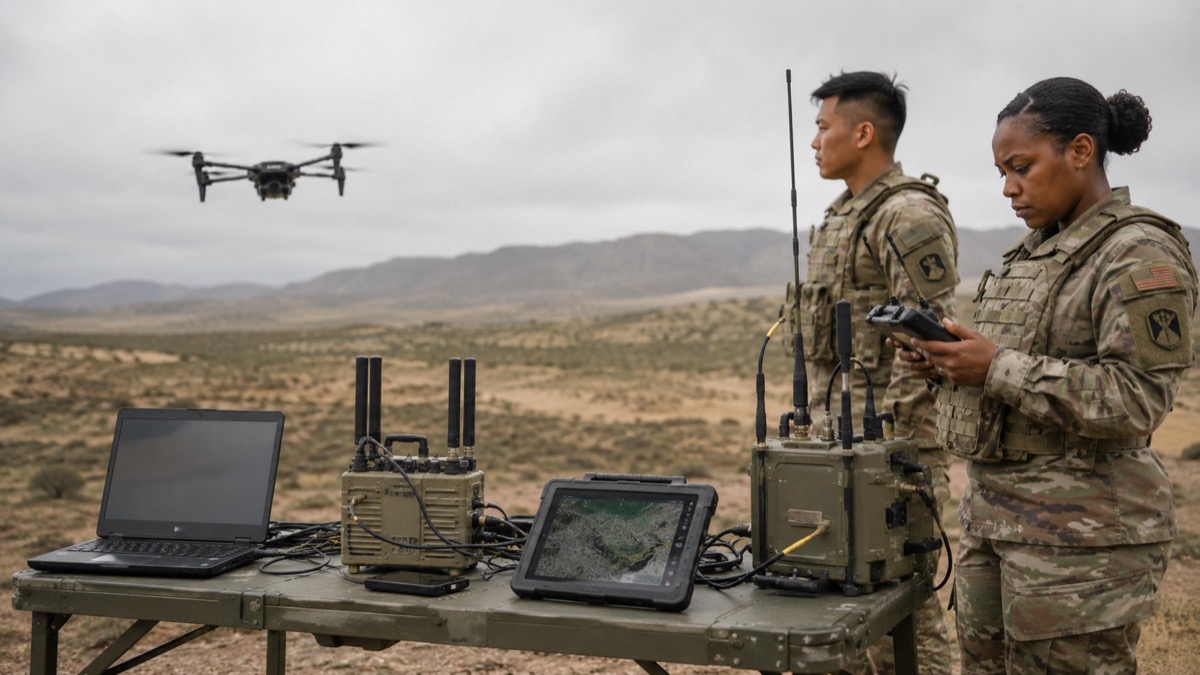
Editorial weighting from public sources and practitioner reading — illustrative, not a measured statistic.
Higher score = the sub-problem is more deeply covered in the open literature.
The counter-UAS detection problem
The publicly stated problem in counter-UAS detection is that small, low-flying, often plastic airframes are difficult to detect with any single sensor modality, and the consequence of missing one is high. The open literature has converged on multi-sensor architectures that fuse RF, electro-optical/infrared, radar, and sometimes acoustic inputs. The engineering trade-off is that multi-sensor systems are heavier, more expensive, and produce more false alarms than single-sensor systems unless the fusion is done carefully.
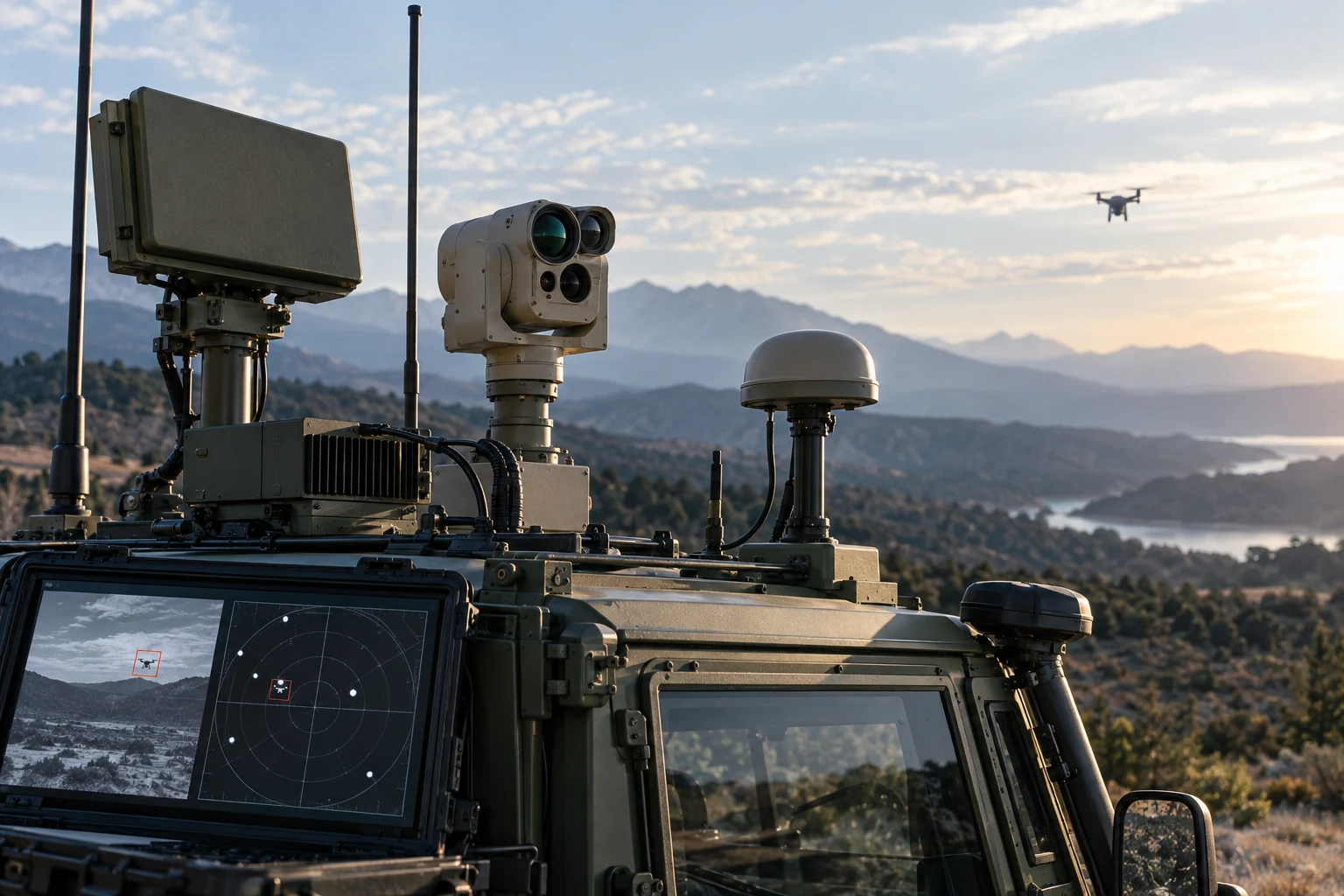
RF, EO/IR, radar, and acoustic modalities each have distinct strengths and failure modes. The published fusion architectures favor feature-level fusion with calibrated confidence outputs for operator workflows.
Sensor modalities in public research
RF detection — passive monitoring of control signals and video downlinks — has the longest public track record and the deepest set of open datasets. The methodological pattern is signal classification on demodulated waveforms, often with CNNs or transformer encoders applied to spectrograms or in-phase/quadrature (I/Q) sample windows. The open community has converged on architectures inspired by O'Shea and West's work on radio-modulation classification, with later refinements that handle the specific waveforms (OcuSync, Lightbridge, FHSS variants) used by commercial UAS. The DroneRF and DroneDetect public datasets, published by university research groups, are the dominant academic baselines.
EO/IR detection works at shorter range but provides identification confidence that RF cannot, and the open computer-vision literature offers a deep set of detector architectures. The COCO-style detector lineage — single-stage detectors in the YOLO family, transformer-based detectors in the DETR family — has been adapted to the small-target regime that counter-UAS demands, where the target may occupy fewer than 32 pixels in a frame. Specialized small-object detection benchmarks (VisDrone, Anti-UAV, USC Drone) have driven architectural choices that prioritize feature-pyramid resolution and high-recall configurations.
Radar detection is harder against small, low-RCS UAS but improves with newer phased arrays and with micro-Doppler classifiers that exploit the rotor-blade signature. AFRL and ARL have published unclassified work on micro-Doppler signature analysis using time-frequency representations and deep classifiers. Acoustic detection is range-limited but harder to jam in many operational acoustic environments; the published ML pipelines on acoustic detection use mel-spectrogram features and convolutional encoders, with reported performance heavily dependent on background-noise statistics.
Fusion architectures
The published fusion literature distinguishes early fusion (raw signal level), feature fusion (learned representation level), and late fusion (decision level). For counter-UAS, the prevalent published architectures are feature-level — each modality has its own feature extractor, and a learned fusion head combines them. This trades complexity for robustness: a single-modality dropout doesn't disable the system. Recent transformer-based fusion approaches use cross-attention between modality embeddings, drawing on the broader sensor-fusion literature in autonomous driving.
The harder problem is calibration: the fusion head's confidence outputs need to be meaningful for downstream operator decisions. Guo et al.'s work on temperature scaling and the broader literature on calibrated deep classifiers (expected calibration error, reliability diagrams) is directly relevant. Without calibration, a multi-modal system that nominally improves detection rate may degrade overall mission performance because operators cannot tell which alarms to trust.
The other under-discussed problem is missing-modality robustness. In real operations, sensors fail, get occluded, or get jammed. Published methods that train fusion heads with stochastic modality dropout (analogous to dropout regularization at the modality level) produce systems that degrade gracefully when a sensor is unavailable. Methods that assume all modalities are always present do not field well.
Public sensor-modality strengths and gaps
- RF detection — Long-running open corpus; defeated by autonomous UAS under emissions control.
- EO/IR identification — Shorter-range, higher-confidence; weather-degraded.
- Radar — Improving against small/low-RCS UAS with newer phased arrays.
- Acoustic — Range-limited but harder to jam in many environments.
- Online adaptation — Self-supervised background-model updates as the platform moves.
Mobile and vehicle-mounted contexts
Static counter-UAS systems are easier than mobile ones. A vehicle-mounted system moves through different RF backgrounds, different visual scenes, and different radar clutter at every kilometer. The open literature on mobile counter-UAS is thin compared to the static-installation literature, but recent work on self-supervised online adaptation — letting the system update its background model as it moves — is promising. The broader unsupervised-domain-adaptation literature (Tzeng et al., Ganin and Lempitsky) provides the methodological foundation, even if the counter-UAS-specific applications are still a research frontier.
The methodological discipline is to handle the case where the system has not yet adapted to the current environment without producing false alarms during the transient. One published pattern is uncertainty-aware gating: during the adaptation transient, the system increases its confidence threshold for declaration, accepting lower recall in exchange for false-alarm suppression. Another is ensemble of background models, with a meta-classifier choosing which model is currently in-distribution based on observable scene statistics.
Vehicle-platform constraints add a second layer of engineering. SWAP-C envelopes for mobile counter-UAS are tighter than for fixed installations, which forces the model-compression discipline (quantization, structured pruning, knowledge distillation) covered in the wider edge-AI literature. The open NVIDIA Jetson and Xilinx Versal communities have published reference implementations of the dominant detector architectures at int8 precision with documented latency and power numbers.
Operator interaction and workload
The most overlooked variable in public counter-UAS performance is operator workload. A system that produces frequent false alarms will be ignored regardless of its detection rate on a benchmark. The published human-factors literature on counter-UAS interfaces emphasizes confidence calibration, anomaly explanation, and clear separation between detection and engagement decisions. AFRL's 711th Human Performance Wing has published unclassified work on operator trust and trust calibration in automated detection systems.
The wider human-AI teaming literature — including DARPA's XAI program and follow-on academic work on calibrated explanation — gives counter-UAS designers a vocabulary for what an operator-facing detection display should do. Local explanations of why this detection (which features triggered the classifier, in which modality, with what confidence) are more useful than global model-behavior summaries. Several published studies show operator performance improves more from better confidence presentation than from incremental gains in raw model accuracy.
Software-first firms that take this seriously — by treating operator-facing UI as a primary engineering deliverable, with measured time-to-decision and false-alarm-fatigue metrics — outperform firms that treat the model as the product. Program offices funding mobile counter-UAS work increasingly ask for operator-in-the-loop evaluation as part of the published evaluation criteria.
Test & evaluation
Open T&E methodology for counter-UAS detection is improving but not standardized. Several university and FFRDC efforts have published benchmark datasets — Anti-UAV, DroneRF, DroneDetect, USC Drone, and a growing list of synthetic-augmented sets — but they tend to be modality-specific and rarely capture the mobile-platform regime. NIST's evaluation methodology lineage from face-recognition and biometrics testing offers a useful template: report per-class detection rates, false-alarm rates at fixed operating points, and confidence intervals from documented test populations.
The right T&E posture for a software-first SBIR offeror is to construct a defensible internal benchmark, document the construction methodology, and report performance honestly across the modalities the program office cares about. Reviewers experienced with detection systems will look for ROC and detection-error-tradeoff (DET) curves, operating-point selection rationale, and explicit treatment of class imbalance — not single-number accuracy claims.
Self-reported leaderboard results are not credible without methodology disclosure. The right framing is the analogous lesson from the face-recognition community: the headline single-number accuracy numbers from the early benchmarks turned out to be unreliable when the test populations were investigated, and the field stabilized only after evaluation methodology became as carefully documented as the model architecture.
Concept terms in this problem class
Multi-modal fusion. Combining inputs from sensors with different physics (RF, optical, radar, acoustic) so that detection survives the failure of any one channel.
Domain shift. The change in input distribution as a mobile platform moves through new environments — a primary cause of degradation in fielded counter-UAS detectors.
Operator workload. The cognitive load that a detection system imposes on the human in the loop, often dominated by false-alarm rate rather than headline detection accuracy.
Common questions on the public-record framing
What public counter-UAS benchmarks exist?
DroneRF, DroneDetect, Anti-UAV, and VisDrone are the most cited. Each is modality-specific. AFRL and ARL micro-Doppler datasets appear in the radar-classification literature.
How do calibration and confidence affect operator workload?
A system that produces frequent false alarms gets ignored regardless of detection rate. Calibrated confidence (Guo et al. ECE / reliability diagrams) and modality-aware uncertainty propagation are the published baseline.
Why is mobile counter-UAS harder than static?
Static systems learn one background; mobile systems traverse different RF environments, visual scenes, and radar clutter at every kilometer. Self-supervised online adaptation is the published frontier.
What does this article not cover?
Specific platform integrations, specific named system architectures, or any Precision Federal multi-modal fusion methodology.
Frequently asked questions
No single modality covers all UAS classes and operating modes. RF misses emissions-controlled platforms; EO/IR is range-limited; radar struggles against low-RCS targets; acoustic is range-limited. Fusion produces resilience against single-modality failure.
Domain shift. A vehicle-mounted system moves through different RF, visual, and radar-clutter backgrounds at every kilometer, and the public literature on online adaptation under those conditions is still maturing.
Build a defensible internal benchmark, document the construction methodology, and report performance honestly across the modalities the program office actually cares about. Self-reported leaderboard numbers without methodology disclosure are not credible.
Operators ignore systems that cry wolf. False-alarm rate, confidence calibration, and clear UI separation between detection and engagement decisions are first-order performance variables, not finishing touches.
How we use this site
We write articles like this to make our reading visible — what we think the open literature says, what we think the open gaps are, and where careful work might land. We do not use these pages to preview proposed approaches in active program spaces. Precision Federal is a software-only SBIR firm. If your office is funding work in this area and would value a software-first partner with a documented public-reading habit, we welcome the introduction.