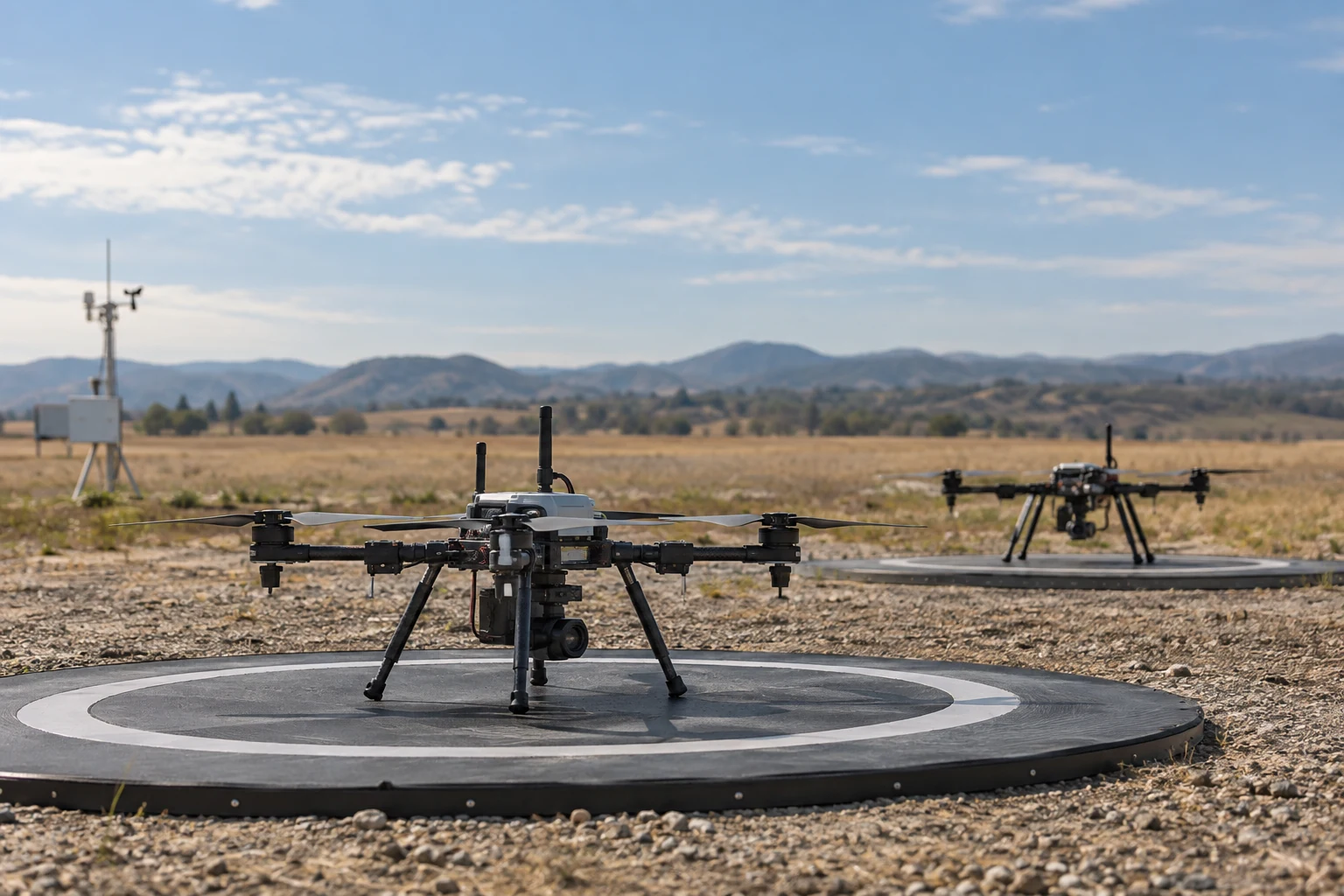
 AI-generated conceptual illustration
Public-Research Maturity Across Formation-Control Sub-Problems
Editorial weighting from public sources and practitioner reading — illustrative, not a measured statistic.
Higher score = more public-literature consensus and demonstrated maturity.
The control problem in public
Leader-follower formation control is one of the oldest problems in multi-agent robotics. The public literature spans four decades, and the basic version — keep follower agents at specified relative positions to a leader — is solved for many configurations. The harder versions — heterogeneous platforms, intermittent communication, contested environments, dynamic re-formation under task constraints — are active research.

Classical control methods set the baseline. Learning-based methods evaluate mostly in simulation; real-world transfer is the binding constraint. Heterogeneous formations are an active research gap.
Classical methods
The classical control literature offers several mature solutions: virtual structure approaches treat the formation as a rigid body and have a long lineage in the AIAA Guidance, Navigation, and Control proceedings; behavioral approaches blend goal-seeking, formation-keeping, and collision-avoidance behaviors and trace back to the foundational work of Reynolds (boids) and Arkin's behavior-based robotics; consensus algorithms use graph-theoretic communication protocols to converge on shared state, with the dominant reference being Olfati-Saber, Fax, and Murray's published treatment of consensus on graphs.
Each family has well-characterized stability properties under specified communication assumptions. Virtual-structure controllers can be analyzed with rigid-body dynamics; behavioral controllers admit Lyapunov analyses for the simpler combinations; consensus algorithms admit explicit convergence-rate results that depend on the algebraic connectivity of the communication graph. The published Lyapunov-based stability proofs are not academic ornament; they are the kind of analysis program offices expect to see when an offeror is proposing fielded autonomy.
The mature classical methods remain the right baseline for any new system; published learning-based methods that claim to outperform them are properly compared under matched assumptions. Recent surveys (Oh, Park, Ahn) have documented the remaining open problems even in the classical regime: heterogeneous-graph stability, formation reconfiguration under hard constraints, and certified safe behavior under partial communication failure.
Learning-based methods
The reinforcement-learning and imitation-learning approaches to formation control have grown rapidly in the last five years. Cooperative multi-agent RL has demonstrated the ability to learn formations that adapt to unseen environments in simulation; the published methods cover the standard centralized-training-decentralized-execution paradigm, value-decomposition approaches, and policy-gradient frameworks adapted to the cooperative setting. Survey papers from the multi-agent learning community document the trade-offs between sample efficiency, scalability in agent count, and transferability.
Imitation learning from expert pilot trajectories has been used to bootstrap policies that are then refined with RL. The behavioral-cloning starting point reduces the sample-complexity burden but inherits any limitations of the demonstration distribution. More recent work uses inverse reinforcement learning and adversarial imitation methods to recover a reward signal from demonstrations rather than directly cloning actions, which generalizes better outside the demonstrated regime.
The published evaluation is mostly in simulation; real-world transfer remains the binding constraint. Several academic groups have built open simulation environments for multi-agent UAS — using physics engines like Gazebo, AirSim, and Isaac Sim — but no published benchmark yet has the status that ImageNet had for vision or that MuJoCo had for single-agent RL. The lack of standardized cooperative-flight benchmarks is itself a research gap that program offices have noticed.
Communication assumptions
The single most important assumption in any formation-control method is communication. Published methods range from "fully connected and instantaneous" (mathematically clean, operationally unrealistic) to "intermittent peer-to-peer with bounded delay" (more realistic, harder to analyze). The graph-theoretic literature on consensus under switching topology — published across the IEEE Transactions on Automatic Control over more than two decades — gives the analytical scaffolding for the harder cases.
For DoD-relevant scenarios, the right assumption set is intermittent, low-bandwidth, peer-to-peer, with the possibility of full loss to subsets of agents. The published methods most likely to survive contact with operations are event-triggered controllers (each agent communicates only when its local state has changed by more than a threshold), gossip-style averaging (agents exchange with a randomly chosen neighbor at each step), and methods that explicitly bound the information rate they assume.
Methods that assume continuous high-bandwidth communication will not transition. The published guidance that DARPA, AFRL, and ONR program managers have given in unclassified venues consistently emphasizes that communication-budget realism is a first-order evaluation criterion for autonomy proposals, not a finishing detail.
Heterogeneous formations
Most published formation-control work assumes homogeneous agents — same airframe, same dynamics, same sensor stack. Heterogeneous formations — mixing platform types with different speeds, sensor footprints, and ranges — are more operationally relevant and harder to control. Published work on leader-follower configurations with dynamically dissimilar agents (a fixed-wing leader with rotary-wing followers, or a manned leader with unmanned followers) is growing but remains thin compared to the homogeneous case.
The control-theoretic complications include heterogeneous dynamics that prevent the use of identical-agent simplifications, asymmetric sensing that breaks the standard relative-position assumptions, and asymmetric communication links where the leader's downlink to followers may have different bandwidth than peer-to-peer follower links. Published work on output-regulation-based heterogeneous synchronization (Wieland, Sepulchre, Allgöwer and the broader output-regulation literature) provides one analytical entry point.
This is a research gap that program offices have publicly acknowledged. Manned-unmanned teaming concepts described in unclassified Air Force and Army documents repeatedly emphasize that the formations of interest will be heterogeneous; the autonomy that supports them has to handle that case explicitly rather than assuming it away.
Test & evaluation patterns
The honest T&E pattern for fielded formation control is incremental: simulation, then captive carry, then constrained outdoor flight, then mission-representative flight. Each stage tests different assumptions. Simulation tests the algorithm and the high-level architecture; captive carry tests the integration with real sensor stacks; constrained outdoor flight introduces real wind, GPS multipath, and real radio behavior; mission-representative flight closes the loop on operational realism.
The dominant published simulators (Gazebo with PX4 SITL, AirSim, Isaac Sim, Flightmare) cover the first stage well. The captive-carry and constrained-flight stages depend on facility access; ranges run by DoD Test Resource Management Center sites and university test ranges (e.g., Penn State, Georgia Tech) appear in the public record as host facilities for academic and SBIR flight-test campaigns. Software-first offerors who can describe in advance which range they intend to use, and what envelope of permissions they have, are taken more seriously than offerors with vague flight-test plans.
Software-first SBIR offerors who take the simulation-to-real transfer seriously — including building or using a credible simulator before claiming flight-test results — are taken more seriously by program offices than offerors who skip stages. The honest reporting pattern is to document the simulation distribution, the real-world distribution, and the gap between them as a methodology number that the offeror commits to closing.
Concept terms in this problem class
Virtual structure. A classical method that treats the entire formation as if it were one rigid body, with each follower computing its trajectory from the body's pose.
Consensus. A graph-theoretic family of algorithms in which agents exchange local information and converge on a shared state estimate, the foundation for many distributed formation methods.
Sim-to-real. The discipline of transferring policies trained in simulation to real platforms; the binding constraint on most learning-based formation-control results today.
Common questions on the public-record framing
Where does the simulation-to-real transfer gap matter most?
Most published learning-based methods evaluate in simulation (Gazebo, AirSim, Isaac Sim, Flightmare). Real-world transfer is the binding constraint, especially under realistic communication assumptions.
Why are heterogeneous formations harder than homogeneous?
Heterogeneous formations mix airframe types with different speeds, sensor footprints, and ranges. Wieland/Sepulchre/Allgöwer output regulation is the closest analytical lineage.
What does this article not cover?
Specific vehicle integrations, specific named comms protocols, or any Precision Federal formation-control selection.
Frequently asked questions
The basic homogeneous case under generous communication assumptions is well solved by classical methods. Heterogeneous platforms, intermittent communication, and contested-environment operation are still active research.
Use whichever fits the program, but compare to the right baseline. Learning-based methods that claim to outperform classical control should match the classical method's assumptions on communication and platform homogeneity, or the comparison is not informative.
Because operational scenarios feature intermittent, low-bandwidth, peer-to-peer links with potential full loss to subsets of agents. Methods that assume continuous high-bandwidth comms do not survive transition.
Incremental: simulation, then captive carry, then constrained outdoor flight, then mission-representative flight. Each stage tests different assumptions, and skipping stages is read as inexperience.
About this article
Precision Federal writes public technical commentary on problem classes adjacent to the programs our firm engages. The point is to demonstrate that the principal investigator has read the literature and respects the line between public technical thinking and proprietary or sensitive program content. We are a software-only SBIR firm, principal-investigator-led, and we ship under Phase I and Direct-to-Phase-II SOWs. If a public article like this one is useful to your work, we welcome the conversation.