
Where things stand on November 4, 2026
On January 1, 2027, 43 states and the District of Columbia must make Medicaid eligibility for most expansion adults depend on 80 hours a month of work or other qualifying activity. On the same date those adults move from annual to six-month renewals. And on October 29, 2026, a federal court struck part of the medical frailty test that state design teams had begun to build. If you run an integrated eligibility system, that ruling reaches your release plan, with go-live 58 days from this writing.
The requirement comes from section 71119 of Public Law 119-21, signed July 4, 2025, which added section 1902(xx) to the Social Security Act. CMS issued its interim final rule, CMS-2454-IFC, on June 1, 2026, and published it on June 3 at 91 FR 33348. The rule took effect July 31, 2026, the same day comments closed, and adds 42 CFR 435.550 through 435.563. The six-month renewal change is section 71107, explained in State Medicaid Director letter 26-001 of March 6, 2026.
Massachusetts v. Oz, D. Mass., No. 26-12962
Judge Stearns vacated the rule's requirement that a condition significantly impair a person's ability to comply, and entered a permanent injunction. The 12-month claims limit and the self-attestation limit survived. The plaintiffs, 25 states and D.C., received a six-month stay of enforcement on frailty determinations. The court said plainly that the January 1, 2027 date does not move. As of KFF's November 2 analysis, HHS had not said whether it would appeal.
Who is subject, and what counts
An "applicable individual" is a non-pregnant adult aged 19 through 64, not entitled to or enrolled in Medicare, who is eligible for or enrolled in the Medicaid adult group, or in certain section 1115 demonstrations that provide minimum essential coverage to adults. U.S. territories are outside the law.
A person meets the requirement for a month through any one of these paths:
- 80 hours of work, community service or a work program, or any combination of them, which can include educational hours for someone enrolled less than half-time.
- Enrollment in an educational program at least half-time.
- Monthly income of at least 80 times the federal minimum wage, which is $580 a month in 2026, calculated from MAGI-based income.
- For a seasonal worker, average monthly income at that level over the preceding six months.
Your rules engine needs an income path as well as an hours path. Quarterly wage data carry earnings, and the rule permits income as a proxy for hours, including an option to estimate hours where income falls short of $580 and hours are unknown. How you use that option shapes how much you can verify automatically.
The three kinds of exemption your rules engine must carry
The regulation has three structures, and they behave differently in the system.
| Category | Who it covers | System behavior |
|---|---|---|
| Specified excluded individuals (435.554) | Former foster youth; American Indians and Alaska Natives; parents, guardians, caretaker relatives and family caregivers of a child 13 or under or a disabled individual; veterans rated 100 percent; the medically frail; people complying with TANF work rules; members of a SNAP household who are not exempt from SNAP work rules; people in drug or alcohol treatment programs; inmates; pregnant and postpartum individuals | Outside the requirement entirely. Must be applied whenever the state has enough information, even if the person also meets the 80 hours. |
| Mandatory exceptions (435.553) | For the month, under 19, on Medicare, or in a mandatory coverage group; or an inmate at any point in the prior three months | Deemed compliant month by month. Evaluate each month in the look-back. |
| Optional short-term hardship (435.555) | Inpatient or similar care; a county under a declared emergency or disaster; a county with unemployment at or above the lesser of 8 percent or 1.5 times the national rate; extended travel for serious medical care | State election. County-based hardships apply automatically once in effect, with no request to the person. The unemployment exception needs CMS approval. The system needs a county-level rules table. |
Read the SNAP line closely. SNAP receipt alone does not exclude anyone. The person must belong to a household receiving SNAP and also not be exempt from a SNAP work requirement. CMS says states must have a process to get this status from the SNAP and TANF agencies, so an eligibility system that stores only "SNAP: yes" will not answer the question. Stand-alone Medicaid systems may need a new data exchange, and the agreement behind it.
CMS also urges plain language screening questions, particularly for family caregivers, who often do not see themselves in that role. Those questions change the application, the renewal form and the data model.
Medical frailty after October 29
The rule as published required two showings: a condition within one of five statutory categories, and proof that the condition significantly impaired the person's ability to comply. The court removed the second showing. It noted that Congress's own functional limit remains in one category, a physical, intellectual or developmental disability that significantly impairs one or more activities of daily living. KFF reads the decision as applying nationwide, and HFMA reports the same for the vacatur, while the six-month stay covers the plaintiff states.
What stands today:
- Five categories: blind or disabled; substance use disorder, excluding people in stable recovery of five or more years; disabling mental disorder; the disability category above; serious or complex medical condition.
- A condition list: the state must keep a list of diseases, diagnoses and conditions that is auditable, justifiable and regularly revised, with a process for people whose condition is not on it.
- Twelve months of data: adjudicated claims (paid, pended or denied) and encounters from the preceding 12 months. The court upheld this limit. CMS also says a lack of claims may not be used to find someone ineligible for the exclusion.
- Self-attestation: before January 1, 2028, a state may accept a statement under penalty of perjury each time it verifies frailty. From that date, only once per continuous period of enrollment, and the next regular renewal must verify through data or documents.
- Reverification: at least every 12 months once status has been verified through data or documentation.
Treat the impairment test as an effective-dated rule parameter, switched off now and retained in version history, rather than deleting it from the code. KFF notes states may be cautious about abandoning that work until the decision is settled, and CMS can still appeal. Record which version of the rule decided each case, because fair hearing staff will need it.
Look-back, renewals and the first evidence month
At application, the state sets a look-back of one to three consecutive months immediately before the month of application. At renewal, the state requires one or more months, consecutive or not, since the last determination. In a KFF and Georgetown survey fielded early in 2026, 36 states planned one month at application and two, Idaho and Indiana, planned three. Indiana and New Hampshire planned quarterly checks between renewals.
A January 2027 application in a one-month state tests December 2026 activity, so the first evidence month is weeks away. And people enrolled on your implementation date are checked at their first renewal initiated on or after that date, so the renewal calendar, not January 1 itself, sets your first compliance volumes.
SMD 26-001 gives states two ways to move current enrollees to six-month cycles. Option 1 reschedules already-set renewal dates, no earlier than January 1, 2027. Option 2 keeps the existing 12-month period and starts the six-month cycle at the next scheduled renewal. Model both before you commit. Three edge rules belong in the logic:
- Certain American Indians and Alaska Natives in the adult group stay on 12-month renewals.
- Other MAGI groups must stay on 12 months. The law gives states no option to shorten them.
- States attest to the six-month change through a state plan amendment in MACPro, due no later than March 31, 2027.
For applications made on or after January 1, 2027, section 71112 limits adult group retroactive coverage to one month before the month of application.
Ex parte first: what you can verify from data you hold
A state must check all reliable information available to it, for all relevant months, before asking the person for anything. It may not limit that check to certain activities or statuses, and it must keep checking until it verifies compliance, deemed compliance or exclusion. Your verification plan under 435.945(j) must name the electronic sources you use.
| Source | What it can establish | Limit to design around |
|---|---|---|
| State quarterly wage records | Earnings against the $580 income path; free to states | Lag of up to three months; no gig or other non-traditional work |
| The Work Number, through the Federal Data Services Hub | More current employment and income | States pay per use; population coverage varies by state |
| SNAP and TANF agency data | SNAP household and work rule status; TANF work rule compliance | Needs status fields, not participation flags |
| Claims and encounters | Medical frailty, pregnancy, inpatient stays, treatment participation | 12-month limit; claims lag; federal privacy rules, including 42 CFR Part 2 |
| Eligibility system and case record | Age, Medicare, tribal status, former foster care, children in the home | May be dated in older cases |
| State-held payroll | Paid caregiver and state employee earnings | Usually held by another office |
| New federal sources | CMS names the National Student Clearinghouse and the VA as examples; it is also building the Emmy tool | Connect within 12 months of a source's first availability through the Hub |
CMS's own estimate shows what the ex parte rate is worth. Of about 20 million adults subject to the requirement and due for renewal, it expects 56 percent to be verified from information available to the state and the other 44 percent, 8.8 million people, to send information to the state, every six months in most states. It also expects 3.75 million new applicants to submit information. Each point of ex parte verification a state adds is paperwork a member does not have to send and a caseworker does not have to review.
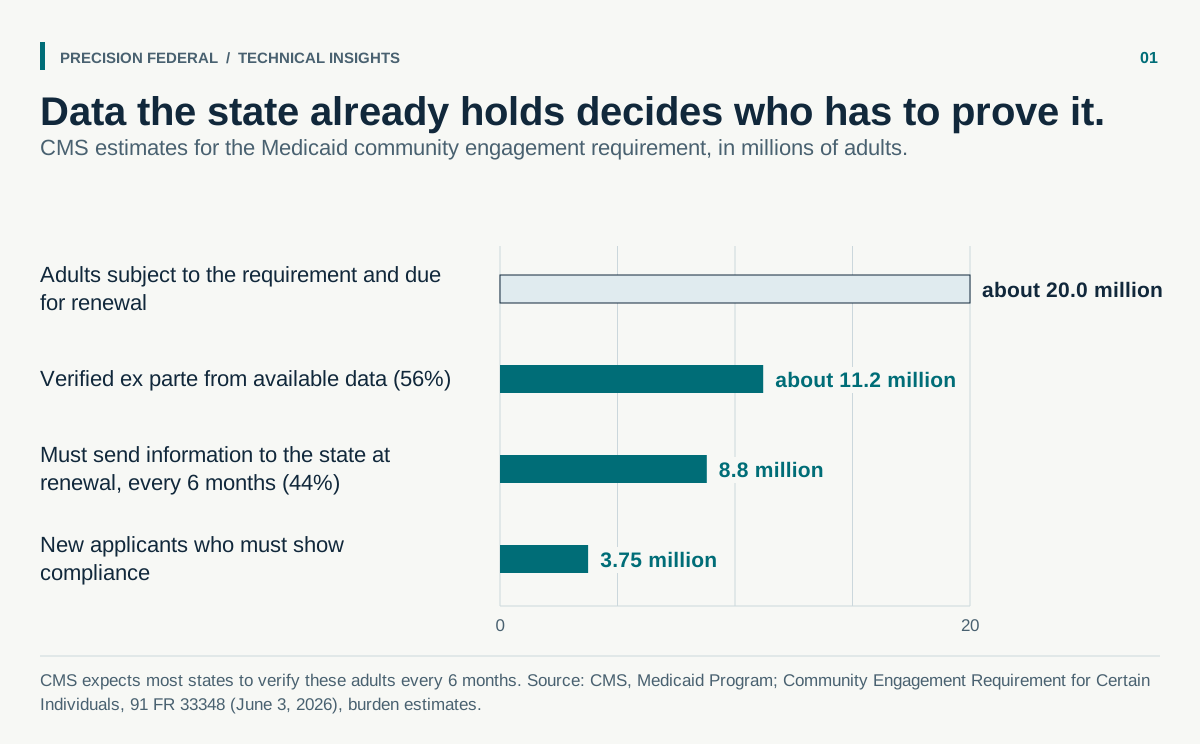
Nebraska offers an early signal of where the volume sits. Of 7,280 renewals subject to the requirement, 57 percent qualified through an exclusion and 34 percent through qualifying activities. The data do not show how each was verified, but they suggest exclusion matching deserves at least the engineering attention that wage matching gets. Where data run out, member reporting takes over. From January 1, 2028, the state must require documentation whenever it is reasonably available, though it may never deny coverage solely because documents do not exist.
What the system work actually is
CMS expects multiple interrelated changes across Medicaid Enterprise Systems, and continued automation after go-live. MACPAC advises states to define a minimum viable product for their implementation date, so rank the backlog by the requirements a state cannot lawfully run without.
- Rules engine. Month-level determination across all paths, look-back and renewal windows, and effective-dated policy versions.
- Data matches. SNAP and TANF exchanges, wage and Hub calls, claims queries against the frailty list, and audit logging.
- Member reporting. Portal and mobile upload, plus phone, mail and in-person routes. The rule requires every application modality under 435.907(a).
- Notices. Plain language outreach, noncompliance and adverse action notices naming the months assessed, the deadline and how to respond.
- Caseworker tools. A view of each source checked and each month's result, so staff can explain and correct a decision.
- Reporting. The data elements in 435.562: enrollment, timeliness, outcomes and compliance by manner of compliance.

The noncompliance sequence deserves its own test suite. When the state cannot verify, it sends a notice and gives 30 calendar days from receipt, with receipt presumed five days after the notice date. Coverage continues for enrollees during that period. The state must then consider all other bases of eligibility, give advance notice and fair hearing rights, and disenroll no later than the end of the following month. Reapplication cannot be restricted, and MAGI enrollees keep the reconsideration period. A person found noncompliant also cannot get premium tax credits, so account transfer logic to the Marketplace needs review.
Review your contracts now as well. States may not use managed care plans, or contractors with direct or indirect financial ties to those plans, to determine compliance. Plans may still help deliver outreach, so check your vendor list against that line.
Paying for it
Section 71119(e) provides $200 million for fiscal year 2026 for all 50 states and D.C., half split equally and half by each state's share of people subject to the requirement. Eligible system costs can also draw 90 percent federal match for design, development and installation and 75 percent for ongoing operations, each through an Advance Planning Document (APD). CMS estimates a one-time cost of $15 million per state, and $1.52 billion in total through 2036, of which $1.289 billion is federal. It cautions that the data are limited. MACPAC notes CMS has published a list of vendors offering no-cost and discounted products.
Keep an updated APD ready. New data connections and enhancements can trigger periodic system review, and CMS says it will follow project status, milestones and functional demonstrations to judge readiness.
What earlier state experience showed
The record is short, but the operational lessons are consistent.
- Arkansas, 2018: more than 18,000 people were disenrolled by December, according to MACPAC's summary of state data. MACPAC cites weak awareness and trouble using the online portal. A New England Journal of Medicine study led by Benjamin Sommers found coverage losses with no change in employment in the first six months. State officials disputed those findings.
- Georgia, from 2023: GAO found $54.2 million in administrative spending against $26.1 million in health care spending from fiscal 2021 through the second quarter of fiscal 2025. MACPAC reports $50.8 million of that administrative total went to IT. Georgia later reduced how often enrollees had to report. Its demonstration ends December 31, 2026.
- Nebraska, 2026: the first state under the new law began May 1. KFF's review of state data shows 93 percent of renewals kept coverage and 7 percent, or 533 people, lost it. Of those 533, 92 percent did not respond to verification requests. Of 4,089 applications needing a determination, 14 percent were denied, 84 percent of those for non-response. Renewal figures cover July through mid-August, so these are early numbers.
Montana started July 1 under a state plan amendment, and Iowa has set December 1. Arkansas planned a July soft launch with no disenrollments until January 2027.
Non-response is the failure to plan for, because a state cannot tell from silence whether a person is ineligible or never saw the letter. The practical responses are higher ex parte rates, current contact data, a second channel for every notice, and a caseworker queue for people who go quiet.
Forecast the workload, then watch procedural terminations
Six-month renewals mean roughly two renewal events a year per expansion adult where there was one. Build a monthly model by renewal cohort: share resolved ex parte, forms sent and returned, noncompliance notices, calls and uploads per notice, staff minutes per case, and terminations. CMS's own impact analysis assumes 7 percent of people who meet the requirement or qualify for an exception would still lose coverage for administrative or procedural reasons, a useful reference alongside your own renewal history. County-administered states need county detail, because the staffing decision sits there.
Federal monitoring adds to this. Under 435.562, states report enrollment, timeliness, outcomes and manner of compliance. Late or poor data, or outcomes that suggest a need for more outreach, can bring corrective action or added notices. Run your own weekly view first: ex parte rate by path, notice response rate, and terminations for non-response against those after a finding, each by county, age and language. Sample terminated cases each month and check whether a data match should have cleared them. That review catches match defects early, while they can still be fixed for the next cohort.
If January 1 is out of reach: the good-faith exemption
Under 435.560, CMS may exempt a state temporarily, and no exemption can run past December 31, 2028. Initial approvals are limited to six months, with possible extensions. A request must address actions taken, significant barriers (funding, design, development, procurement or installation), a detailed plan with milestones, and any exigent circumstances such as a cybersecurity incident or disaster. CMS says approvals will be limited to states showing meaningful effort and extraordinary, severe or unexpected issues. It estimated about 10 requests and about two approvals. Exempted states report quarterly, and CMS can end an exemption early.
Keep the evidence regardless of your plans: dated project status, procurement actions, test results and a risk log. CMS wants to see diligent progress throughout 2026.
The dates that matter
Medicaid community engagement milestones
What to do in the next 90 days
This list runs to early February 2027. The dates are planning targets.
- This week: convene policy, legal and systems leads on the frailty ruling. Decide how the impairment test will be switched off, how pending cases are handled, and which notices and screens change.
- By November 20: walk one synthetic case through each exclusion, exception and income path end to end, and log every gap.
- By November 20: confirm that SNAP and TANF exchanges return work rule status, and that the data sharing agreements are signed.
- By December 1: finish the verification plan, check contracts against the managed care conflict rule, and update the APD.
- By December 1: choose Option 1 or Option 2 for renewal transition, using the workload model.
- By December 15: test the full noncompliance sequence, including date calculations, notices, hearing rights and Marketplace transfer.
- By December 15: train county and call center staff using real scenarios, and script the frailty and SNAP questions.
- By December 15: decide with CMS whether a good-faith request is needed.
- January 2027: run a daily command center for the first renewal and application cohorts, with a defect triage owner.
- By early February: publish the first internal monitoring view, sample terminated cases, and file the state plan amendment if it is still open.
Frequently asked questions
No. The court vacated one part of the medical frailty definition and said the January 1, 2027 date set by Congress is unaffected. The six-month stay for the plaintiff states concerns enforcement of frailty determinations only. The 12-month claims limit and the self-attestation limit remain in place.
Only in part. The exclusion covers a member of a household receiving SNAP who is not exempt from a SNAP work requirement. Separately, people who comply with TANF work requirements are excluded. States must have a process for getting this status from both agencies.
At their first renewal initiated on or after the state's implementation date. Applicants are checked at application against one to three months immediately before the month of application, as the state plan specifies.
Possibly. CMS may grant a temporary good-faith exemption, expiring no later than December 31, 2028, with initial approvals of up to six months. CMS decides case by case and expects few approvals.