 AI-generated conceptual illustration
Public-Lineage Maturity Across Debrief Sub-Problems
Editorial weighting from public sources and practitioner reading — illustrative, not a measured statistic.
Higher score = more public-lineage maturity in the human-autonomy debrief subproblem.
The named program and its public lineage

After-action review for human-autonomy teams has emerged as a recognized discipline in DoD-funded research, with a public lineage running through several Air Force, Army, and academic programs over the last decade: when humans and autonomous systems operate together, the after-action review has to make sense to both. The public lineage runs through DARPA's XAI program and a growing academic literature on human-AI teaming.
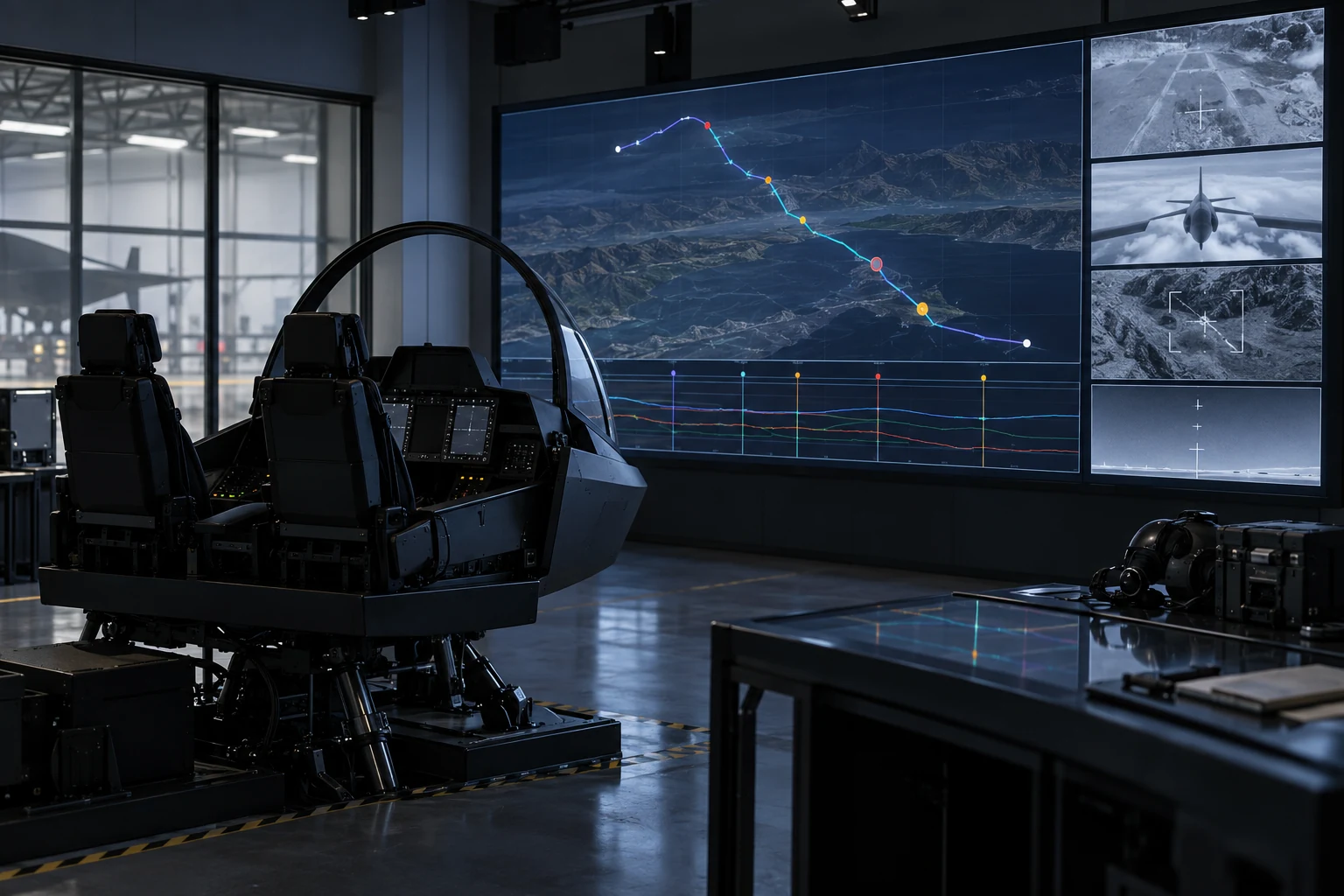
After-action review for autonomy-included teams requires reconstruction, replay, explanation, and operationally meaningful framing. The XAI literature is large; the operator-facing subset is smaller and harder.
What an AAR has to do
A military after-action review has well-defined functions described in unclassified Army and joint doctrine: reconstruct what happened, identify what worked and what did not, distinguish individual error from systemic gap, and inform the next iteration of training, doctrine, or tactics. The doctrinal literature on AAR (TRADOC publications, the joint training community of practice) is decades deep and operationally specific.
When one of the participants is autonomous, all four functions get harder. Reconstruction now requires fusing operator log data, autonomy telemetry, and environmental data into a coherent timeline. Distinguishing error from systemic gap requires interpretability of the autonomy's decisions: was this a one-off mistake under unusual inputs, or a systematic blind spot in the policy? The published research on operator-facing autonomy explanation is still maturing, and the gap between research-grade explanation methods and field-grade operator briefings is the part of the problem that survives most academic work.
The doctrinal AAR has another property that the autonomy literature sometimes ignores: it is collective, not individual. Crews, squadrons, and command teams use AAR to learn, not just individual operators. A debrief system for human-autonomy teams therefore has to support multi-perspective reconstruction — what each human knew, what each autonomous component decided, and how those views diverge — rather than producing a single canonical narrative.
Replay and counterfactual analysis
The open literature on replay-based AAR has converged on the importance of counterfactual exploration: not just "what happened" but "what would have happened if." For autonomous components, counterfactual replay requires either deterministic replay of the same conditions with a modified policy, or surrogate models that approximate the policy's response under different inputs. The published methods on counterfactual policy evaluation in reinforcement learning (the off-policy evaluation lineage from Precup, Sutton, and many follow-ups; doubly-robust estimators; importance-weighted methods) provide one analytical foundation.
Both approaches are documented in academic work and both have known limitations. Deterministic replay requires careful logging of all sources of nondeterminism (random seeds, sensor noise, network timing); surrogate-model approaches inherit any approximation error of the surrogate. The published practitioner advice converges on a hybrid: use deterministic replay when feasible, fall back to surrogate when not, and report which mode produced any given counterfactual analysis.
Practitioners who treat replay as a software engineering problem — version-controlled logs, deterministic seeds, audit-grade telemetry, immutable-storage policies — produce more useful AAR systems than practitioners who treat it as a visualization problem. The data-engineering literature on event sourcing, CQRS, and time-series databases provides the substrate; the operationally specific work is in adapting those patterns to the bandwidth, security, and exercise-tempo constraints of the field.
Public methodological references
- DARPA XAI — Explainable AI program (2017-2021) — foundational lineage.
- Counterfactual replay — Precup off-policy evaluation, doubly-robust estimators.
- Local explanations — LIME, SHAP, integrated gradients for local decision rationale.
- Audit-grade telemetry — Synchronized clocks (PTP/IEEE 1588), event-sourcing patterns.
- AAR doctrine — Army TRADOC published lineage for after-action review.
Explainability that operators trust
The XAI literature is large and the operator-facing subset is small. DARPA's XAI program and its published final reports established the methodological vocabulary for the field; the academic follow-ups have published a wide set of methods (LIME, SHAP, integrated gradients, attention-based explanations, prototype-based methods) and characterized their fidelity-vs-interpretability trade-offs.
The methodological convergence is that local explanations (why this decision in this moment) are more useful operationally than global explanations (what does the model do in general), and that explanations have to be correct — a plausible-but-wrong explanation is worse than no explanation. The faithfulness-versus-plausibility distinction, formalized in published evaluation methodologies, is what separates research-grade explanation work from operator-grade explanation work.
Several academic groups have published on calibrated, faithful explanation methods for the policy classes most likely to appear in fielded autonomy: tree-structured policies, neural policies with attention bottlenecks, and policies with verified constraint satisfiers. AFRL's 711th Human Performance Wing has published unclassified work on operator trust calibration, which complements the algorithmic XAI work by characterizing how operators actually consume explanations under workload.
The data-engineering substrate
The unsexy half of any debrief system is the data plumbing: synchronized clocks across heterogeneous platforms (PTP/IEEE-1588 for sub-microsecond synchronization where required), schema evolution as the autonomy stack changes, lossless logging under bandwidth constraints, and storage with the right access controls. None of this is research; all of it determines whether the research-grade debrief tools work in the field.
The published software-engineering literature on observability — distributed tracing standards (OpenTelemetry), structured logging conventions, and time-series storage patterns — is the right starting point. The specific adaptations for human-autonomy debrief are in the schema (operator state, autonomy state, environmental state, and their cross-references), the bandwidth model (lossless capture during the exercise, deferred export afterwards), and the access control (role-based separation between debrief-team access and operator-feedback access).
Software-first SBIR firms that lead with data-engineering rigor tend to pass the field-test bar that lab demos do not. The published Phase II case studies that the AFWERX and Army Software Factory communities have shared in unclassified venues show a consistent pattern: the firms that invested in the substrate during Phase I had functional exercise tools by Phase II, and the firms that did not, did not.
Where this connects to procurement
AFWERX, the Army Software Factory ecosystem, and several Navy programs have publicly funded debrief-adjacent capabilities under unclassified solicitations across several recent SBIR cycles. The transition pattern is consistent: a successful Phase II is one where a specific operator community has used the tool in a real exercise — squadron-level training events, joint exercises at the combat training centers, or program-specific operational tests.
The published transition statistics from Air Force SBIR reporting and the broader DoD SBIR Annual Reports show that operator-validated tools transition at materially higher rates than tools that exited Phase II as lab demos. Program offices know this; offerors who plan for the exercise from Phase I day one have higher transition rates than offerors who treat the operator validation as a Phase II concern.
The honest framing for software-first offerors in this space is that the debrief problem is a long-run discipline, not a single-program opportunity. Programs that have funded debrief-adjacent capabilities have generally re-funded them across several solicitations as the operator community's needs have evolved.
Concept terms in this problem class
After-action review (AAR). A doctrinal practice — reconstruct, identify, distinguish, inform — that gets harder when an autonomous teammate is one of the participants whose decisions need to be explained.
Counterfactual replay. The ability to ask "what would have happened if" — either by deterministic replay with a modified policy or by querying a surrogate model.
Local explanation. A justification of a single decision in a single moment, more operationally useful than a global account of what a model "tends to do."
Common questions on the public-record framing
What public XAI lineage anchors operator-facing explanation?
DARPA XAI program (2017-2021), academic work from Berkeley, MIT, CMU, and AFRL 711th HPW. Trust calibration is the active subfield.
Why does replay matter beyond simple logging?
Counterfactual replay (Precup off-policy evaluation, doubly-robust estimators) is what supports systematic AAR. Event sourcing and CQRS are the engineering substrate.
How is the data-engineering substrate underestimated?
Synchronized clocks across heterogeneous platforms (PTP/IEEE 1588), schema evolution, lossless logging under bandwidth constraints, and audit-grade storage all determine whether AAR works in the field.
What does this article not cover?
Specific operator workflows, specific named program offices' debrief preferences, or any Precision Federal AAR architectural approach.
Frequently asked questions
The same four functions as a traditional AAR — reconstruct, identify what worked, distinguish individual error from systemic gap, inform the next iteration — but applied to a team that includes one or more autonomous components whose decisions also need to be reconstructed and explained.
Because synchronized clocks, lossless logging, schema evolution, and access-controlled storage determine whether any of the research-grade analytical tools actually function on real exercise data. Without that substrate, the research tools do not survive the field test.
Local — the justification of a specific decision in a specific moment — is generally more useful to operators than a global characterization of the model. Faithfulness and calibration matter more than expressiveness.
One where a specific operator community has used the tool in a real exercise. Offerors who plan from day one for the operator-in-the-loop exercise have measurably higher transition rates.
About this article
Precision Federal writes public technical commentary on problem classes adjacent to the programs our firm engages. The point is to demonstrate that the principal investigator has read the literature and respects the line between public technical thinking and proprietary or sensitive program content. We are a software-only SBIR firm, principal-investigator-led, and we ship under Phase I and Direct-to-Phase-II SOWs. If a public article like this one is useful to your work, we welcome the conversation.