
Why federal compliance is a fit for agentic AI
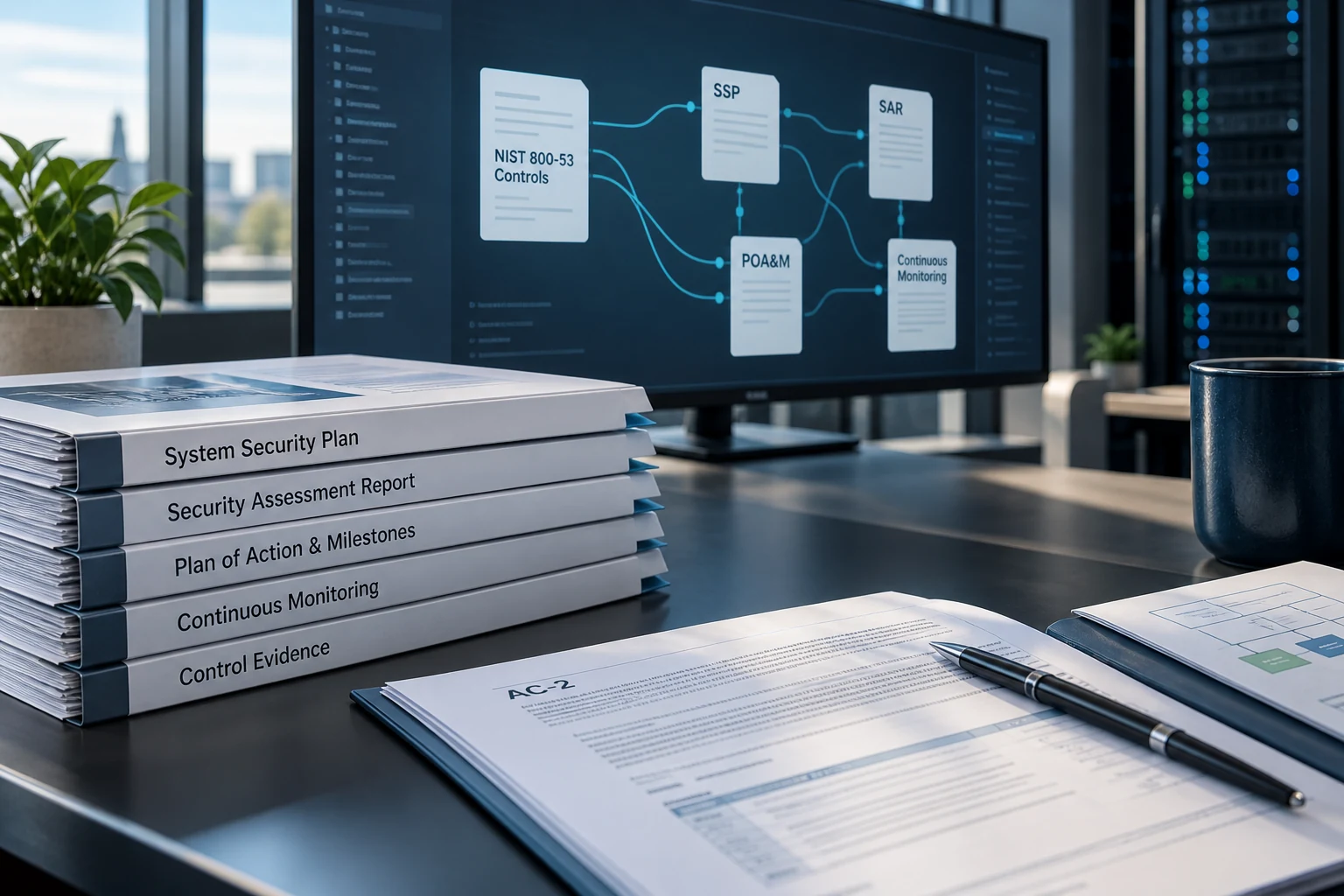
Federal compliance work has three features that make it unusually well-suited to agentic automation. The work is highly structured — the NIST 800-53 control catalog is a known finite set of controls, each with a defined structure. The work is highly repetitive — the same control narrative shape appears across every system an organization authorizes. And the work involves heavy cross-document reasoning — an SSP cross-references a security assessment report, which cross-references a POA&M, which cross-references continuous monitoring evidence. Agents are good at structured, repetitive, cross-document work.
Automated evidence collection, policy gap analysis, and audit-ready artifact generation — not a chatbot that answers questions about NIST 800-53. The agent must write to eMASS, not explain controls.
The usual LLM failure modes — hallucination, inconsistency — are manageable here because every claim an agent makes can be checked against a concrete artifact: a configuration file, an IAM role definition, a network ACL, a scan result. The agent is not asked to invent; it is asked to extract, summarize, and draft against verifiable ground truth.
The ATO workload, by phase

To see where agents help, walk through a standard ATO workload. For a FedRAMP Moderate system, the work is roughly:
- Categorization (FIPS 199 / 200) — determine the system impact level. Low human work, mostly a decision.
- Control selection — baseline 800-53 controls plus overlays. Largely mechanical.
- SSP drafting — hundreds of control narratives, system descriptions, data flow diagrams, inventories. The heaviest writing work in the whole process.
- Control implementation — the engineering to make controls real. Not automatable by LLMs; that is actual infrastructure work.
- Security Assessment Report (SAR) — third-party assessor testing and documentation. Partly automatable on the evidence-collection side.
- POA&M — tracking open findings and mitigation plans. Highly automatable on tracking and aging; remediation is engineering.
- Continuous monitoring — ongoing evidence collection, vulnerability management, configuration drift detection. A major agentic AI opportunity.
- Authorization package assembly — packaging everything for the Authorizing Official. Largely mechanical document assembly.
The two heaviest items by time — SSP drafting and continuous monitoring — are also the two most agent-friendly. That is not coincidence. Compliance work concentrates time where structured writing and evidence gathering dominate, and those are LLM strengths.
What an agent can do today: concrete examples
SSP section drafting
Given a system architecture diagram, configuration inventory, and a list of inherited controls from the underlying FedRAMP-authorized platform, an agent can draft:
- The system description (executive summary, system environment, boundary).
- Information types and categorization justification.
- Control narratives for the majority of 800-53 control families, grounded in the configuration inventory.
- User roles and privilege descriptions extracted from the IAM configuration.
- Data flow descriptions tied to actual network configuration.
Realistic time savings: 50-70 percent on first draft. The human still reviews every narrative for accuracy, completeness, and agency-specific language preferences. The gain is on the blank-page problem, which is where SSP projects usually stall.
Control narrative generation from configuration
The shape is always the same: the control statement says what the system must do, the narrative describes how this specific system does it. An agent fed the AU-2 control statement plus the actual audit logging configuration (CloudTrail, CloudWatch Logs, log retention policies, encryption keys) can produce a narrative that names the specific services, the specific log categories, the specific retention period, and the specific encryption mechanism. That narrative is typically more accurate than a human-written one because the human often paraphrases from memory while the agent reads the configuration directly.
Cross-reference checking
An SSP must be internally consistent — if the boundary diagram includes a bastion host, the SSP section on remote access must describe that bastion host. If the POA&M lists a finding on MFA, the IA control narrative must describe MFA. Agents are excellent at spotting these inconsistencies at scale, far better and faster than human reviewers.
POA&M management
Agents can ingest vulnerability scans and audit findings, generate candidate POA&M entries with CVE references and suggested remediations, track aging against CVSS-based due dates, escalate overdue items, and draft status updates for monthly continuous monitoring reports. The human makes remediation decisions; the agent handles everything around them.
Evidence collection
The agent queries configured systems — cloud APIs, CMDBs, ticketing systems, vulnerability scanners — to pull evidence of control implementation and effectiveness on demand. For continuous monitoring, the agent assembles monthly evidence packages automatically. Assessors love this because evidence is current and uniformly structured.
Deviation detection
An agent that knows the baseline configuration (from the SSP) can monitor the live configuration and alert on drift. "The S3 bucket policy documented in AC-3 specifies these three principals. The current bucket policy includes a fourth. A human should review."
What agents should not automate
The line is clear. Agents draft; humans decide. Specifically, an agentic compliance system should not:
Close POA&M items autonomously
Closure is an accountability event.
Alter control implementations
Configuration changes go through the same change management as any other engineering change.
Sign documents
Authorization decisions require human accountability. The ISSO, ISSM, AO, and authorizing official all exist for reasons that automation does not change.
Negotiate with the AO
Risk acceptance discussions are human.
Decide risk tolerance
Agents describe risk, they do not set it.
This boundary is both a safety boundary and a compliance boundary. SP 800-53 requires human accountability at specific control points. Automating around those controls is itself a finding.
Reference architecture
A practical federal compliance-automation system in 2026 looks something like this:
flowchart LR
    subgraph Sources["Evidence Sources"]
        E1[AWS Config\nAzure Policy]
        E2[Vuln Scanners\nNessus, Prisma]
        E3[IdAM Systems\nOkta, AD]
        E4[Ticketing\nJira, ServiceNow]
    end
    subgraph Core["Orchestration Core (GovCloud)"]
        EI[Evidence Ingestion\nConnectors]
        DS[OSCAL Document Store\nSSP, SAR, POA&M, overlays]
        OL[Orchestration Layer\nPrompt build, tool calls, logging]
        LLM[LLM Endpoint\nClaude on Bedrock GovCloud]
        AL[Audit Log\nFull prompt + response]
    end
    subgraph Output["Human-in-the-Loop"]
        RQ[Reviewer Queue\nApprove / Edit / Reject]
        FD[Finalized Docs\nOSCAL output]
    end
    E1 & E2 & E3 & E4 --> EI
    EI --> DS
    DS --> OL
    OL <--> LLM
    OL --> AL
    OL --> RQ
    RQ --> FD
    style LLM fill:#3b82f6,color:#fff,stroke:#3b82f6
    style RQ fill:#d97706,color:#fff,stroke:#d97706
    style FD fill:#0d9488,color:#fff,stroke:#0d9488
Authorized cloud region
the whole system inside AWS GovCloud, Azure Government, or Google Assured Workloads at the appropriate impact level.
Document store
classification-aware RAG store holding the control catalog, overlays, SSP templates, prior SSPs, agency-specific guidance, and system documentation.
Evidence ingestion
connectors to cloud APIs (AWS Config, Azure Policy), vulnerability scanners, identity systems, and ticketing. Continuous, not on-demand.
Orchestration layer
handles prompt construction, input filtering, tool calls, output validation, and full logging.
LLM endpoint
Claude on Bedrock GovCloud or GPT-4 on Azure OpenAI, version-pinned. See our model-choice guide.
Human-in-the-loop UI
every draft generated goes to a reviewer queue with inline approval, edit, and reject actions. Nothing auto-commits to a finalized document.
Audit log
every prompt, response, tool call, and RAG source logged per the control requirements (our FedRAMP logging guidance).
OSCAL and the machine-readable future
NIST's OSCAL (Open Security Controls Assessment Language) is the emerging standard for expressing SSPs, SARs, and POA&Ms as structured XML/JSON/YAML. OSCAL is agentic-AI's best friend. A well-structured OSCAL SSP is essentially a programmatic description of the entire control implementation, which agents can read, validate, update, and generate with dramatically more precision than prose-only SSPs allow.
Adoption in 2026 is uneven. FedRAMP has adopted OSCAL for several artifacts. Agency-specific adoption lags. But the direction is clear: within five years, machine-readable compliance artifacts will be the default, and the agents that exist today will become dramatically more useful when they have OSCAL to work with instead of Word documents.
Continuous ATO (cATO) and the real payoff
Continuous ATO shifts compliance from point-in-time assessment (every three years) to ongoing assessment with real-time evidence. The workload changes shape: less "write an SSP once" and more "maintain an SSP forever." Periodic bursts become continuous flows.
That flow shape is exactly what agents are good at. An agent that runs daily against your live configuration, updates narratives when configuration drifts, refreshes evidence packages, and opens POA&Ms on new findings is performing cATO at far lower cost than a human team could sustain. The agents do not replace the humans; they make a three-person compliance team effective at the scale of what used to require a twelve-person team.
This is also, quietly, where the federal dollar volume is going. Agencies are moving off three-year cycles onto cATO for cloud-native systems. The tooling market is young and the agentic AI category will dominate within five years. Firms building in this space in 2026 are early enough to matter.
Mistakes we see
Trying to automate the human accountability points
Agents draft, humans sign. Confuse the two and you fail the next audit.
Commercial-endpoint prototyping with real SSP content
SSP content often contains CUI or sensitive architectural details. Develop in the authorized region from day one.
Skipping the RAG classification layer
Feeding the agent the entire control catalog and the entire prior-SSP archive with no classification filtering produces leakage across systems.
No evaluation harness
You need to be able to measure whether the agent's narratives are getting better or worse over time. A small curated evaluation set of control narratives with known good answers, run on every model change, is sufficient.
Treating the agent as a product instead of a workflow
The winning systems are deeply integrated with the compliance team's existing tools (GRC platforms, ticketing, scanners), not standalone chat UIs.
Time savings we actually see
Rough numbers from founder delivery at prior firms and programs observed in 2025-2026:
- First-draft SSP for a new FedRAMP Moderate system: 40-50% faster with agent-assisted drafting.
- SSP refresh for an existing system with configuration drift: 60-70% faster.
- Monthly continuous monitoring evidence packaging: 70-80% faster with automated evidence collection.
- POA&M aging and escalation: near-100% on the mechanical tracking, with humans only on remediation decisions.
- Cross-reference checking between SSP, SAR, and POA&M: findings an agent catches in minutes that humans miss over weeks.
These numbers are not model-benchmark speculation. They are what teams that have actually deployed this pattern report, consistently, across different agencies and system types.
Bottom line
Agentic AI for federal compliance is one of the few AI use cases where the technology is genuinely mature, the ROI is easy to measure, and the compliance boundaries are clear. Agents draft, humans decide. Classification-aware retrieval, strict logging, and human-in-the-loop review are the non-negotiables. Teams that build this discipline in now will have a decisive cost advantage as cATO becomes the norm.
Frequently asked questions
It can draft most of one given the architecture, configuration inventory, and inherited controls. Humans still review and sign. The realistic gain is 50-70% time reduction on drafting.
A control narrative is prose describing how a specific 800-53 control is implemented in a system. Highly templated, highly repetitive — ideal automation target. Agents draft from configuration; humans verify.
Yes. The PMO rejects inaccurate, incomplete, or inconsistent SSPs — not AI-drafted ones. A reviewed and corrected AI draft is indistinguishable from any other SSP in review.
Closing POA&Ms, altering controls, signing documents, setting risk tolerance, negotiating with the AO. The human accountability points remain human.
cATO shifts compliance from periodic to continuous — exactly the workload shape agents handle well. cATO plus agentic tooling is the strongest near-term use case in federal compliance AI.
Not yet. FedRAMP uses OSCAL for several artifacts; agency adoption varies. Agents work against prose SSPs today, but OSCAL dramatically improves their accuracy when available. Plan for OSCAL-native workflows.