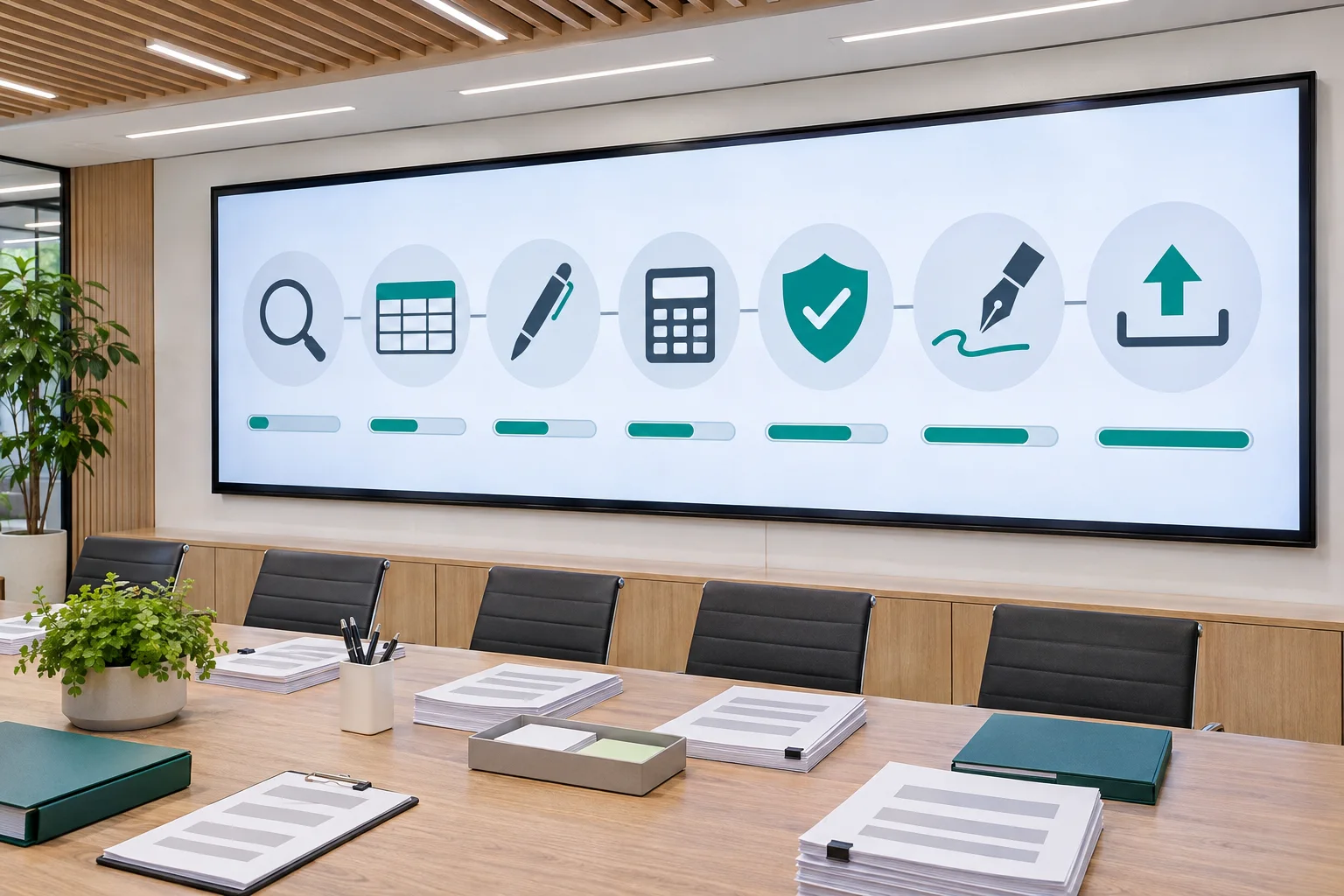
A week is enough if the order is right
A week is short for a federal proposal, and long enough to win one if each day has one job. The schedule below is how a working proposal team moves a bid from a posted solicitation to a filed package with a receipt. Precision Federal files its own bids this way every week.
The rule underneath it is simple: the things that cannot be undone come first. Reading the solicitation and deciding whether to bid comes before writing. Writing comes before pricing, because the method drives the cost. Review comes before forms, because forms are the last thing that can change the number of pages.
What follows takes each day in turn, and ends with what the contractor must supply so the team is never waiting.
The week at a glance
| Day | The team does | The contractor gives |
|---|---|---|
| 1 | Read everything, decide, build the matrix and the data call | The go or no-go, and one point of contact |
| 2 to 4 | Write the volumes against the matrix | Project list, resumes, licenses, site and method answers |
| 5 | Build the price and tie it to the technical volume | Labor rates, supplier and trade quotes, bonding and insurance figures |
| 6 | Adversarial review against the evaluation factors | Decisions on what the review finds |
| 7 | Forms, signatures, filing and receipt | Signatures, final price approval, notary if required |
Day one: read everything and decide
Read the whole solicitation, every attachment and every amendment already issued. Read the evaluation section first, because it tells you what is being bought in the buyer's own terms. Then the instructions, then the scope, then the clauses. Note every date, page limit and required form as you go. If the solicitation is large, split the reading between two people, but have both read the evaluation section and the instructions. Reading is the cheapest work of the week and the most expensive to shortcut.
By the afternoon, make the bid decision. A week leaves no room for a decision that drifts to day three. If it is a no, you have spent one day. If it is a yes, the owner names one person with authority to answer questions all week, and the week starts.
Day one, continued: the matrix and the data call
Before anyone writes a sentence, build the compliance matrix: every instruction and every evaluation factor in one list, with its source paragraph, the volume and page where it will be answered, and an owner. Then send the contractor one data call, a single list of everything the writers will need. One list beats twenty separate requests, and a request sent on day one gets answered by day two.
Send any questions for the buyer the same day, if the question period is still open. Answers that arrive on day four can still change the approach. Answers that arrive on day seven cannot.
- Check SAM. FAR provision 52.204-7 requires an active registration when you submit an offer and at award, and it can take time to fix
- Confirm the portal. Log in, check your account role, and read the upload rules
- List the forms. Identify every required standard form, certification and attachment on day one
- Lock the calendar. Set an internal filing time at least one working day before the real one
Days two to four: write the volumes
Writers work in parallel, one owner per volume, each against the matrix. Write the technical approach so that each scored sentence in the solicitation has an answer a reader can find. Make it specific to this site and this work, with real names, real durations and a real method. Write past performance from the actual project records, and collect the reference names and contract numbers at the same time.
Build the graphics and tables as you write, because a schedule graphic or a staffing table is harder to produce than a paragraph and easy to lose at the end. Keep a running list of claims that need proof, and collect the proof as you go: a project number, a certificate, a letter. A claim with no proof behind it is the first thing the reviewer strikes on day six.
Check in once a day for fifteen minutes. The only agenda is what is blocked and who unblocks it. If a question stands open more than half a day, the point of contact answers it or the writer takes the safest reading and flags it for day six.
Write to the page limit from the start. A proposal that runs long on day four will be cut in a hurry on day seven, and cuts made in a hurry lose content that scores.
Day five: build the price from the technical volume
Pricing happens after the approach exists, so the estimator is pricing the actual method and staffing. Pull quantities and durations straight from the technical draft. Bring in supplier and subcontractor quotes, and confirm your labor burden and insurance rates. On service contracts, price from the wage determination in the solicitation. On construction, get bonding figures from your surety now.
By the end of the day, compare price and approach directly. Do the hours match the staffing plan? Does the schedule match the general conditions? Fix any difference that day, while the writers are still available.
Set the final price on the owner's authority, with the market in mind. A price is a business decision that the estimator's worksheet feeds, and on a price-decided award it needs to be made as early as the data allows.
Day six: review it the way an evaluator will
On day six, someone who did not write the proposal reads it as an evaluator, with the evaluation factors in hand, and tries to take points away. This is the day that decides whether the proposal competes, because the writers cannot see what they left out.
Read it the way an evaluator will, with the evaluation factors in hand, and try to take points away.
Read it the way an evaluator will, with the evaluation factors in hand, and try to take points away. For each factor, the reviewer answers three questions: where is the answer, how strong is it, and what would make a competitor's answer better. Findings go into a list with an owner and a fix. Then the writers spend the afternoon making those fixes, in priority order. Protect time for this, because a week-long bid that skips review is a first draft.
Day seven: forms, signatures and filing with a receipt
Forms come last because they depend on the final price, but they should never be a surprise, since you listed them on day one. On federal construction above the simplified acquisition threshold, the solicitation will use Standard Form 1442, and other buys use forms such as the SF 1449. Fill each amendment acknowledgment, confirm the representations in SAM, and make sure the signer has authority to bind the company.
- Final read of the whole package against the matrix and the latest amendment
- Page counts, file names, file sizes and formats checked against the instructions
- Signatures and any notarization completed
- Upload or delivery done early, with every portal step finished
- Confirmation of receipt saved to the file
Aim to have everything uploaded before lunch. That leaves the rest of the day for a portal that misbehaves, a signature that arrives late or a file the system rejects.
Save the receipt. Federal rules treat a proposal received after the exact time specified as late, and the Government Accountability Office has said plainly that delivery is the offeror's responsibility. An upload that finished is the only one that counts, and a receipt is how you prove it.
What the contractor needs to have ready
Most schedule slips happen because the contractor's information arrives in pieces. Have these on hand before the week starts, and most of the data call answers itself.
- A list of recent projects with contract numbers, values, dates, scope and a reference who will pick up the phone
- Current resumes for the people you would actually put on the job
- Licenses, certifications and your bonding letter
- Current insurance certificates, and your experience rating and OSHA summaries for construction work
- Your labor rates and overhead figures, or someone who can provide them
When seven days will not work
Some bids need more than a week: a major design-build with a large technical volume, a bid requiring new teaming arrangements, or a requirement for a certification you do not yet hold. Others are short enough that seven days is more than enough. The plan compresses easily for a simple quote, and it does not stretch far for a large one, so make that call honestly on day one. If the buyer extends the due date, put the extra days into review before you put them into more writing.
Ways seven days turn into ten
- Starting to write before reading the evaluation section
- Waiting on a decision nobody was named to make
- Pricing before the technical approach is settled
- Skipping the adversarial review to save a day
- Leaving the portal account and registration check until the final afternoon
Frequently asked questions
Yes, if the solicitation is reasonably sized and the firm's information is ready. The constraint is usually the contractor's own data and decisions, far more than the writing.
Plan on the owner being available for the decision on day one, the pricing decisions on day five, the review findings on day six and the signature on day seven. One other person should handle day-to-day answers.
Decide quickly whether a weak bid is better than no bid. Compress the plan, but keep the reading, the matrix and a final review, because a package that fails compliance has no chance at any price.
Keep the final package, the receipt, the matrix and your notes on the decision. Those files make the next bid faster and give you material to compare against a debriefing.