
Why synthetic media became a mission problem
Synthetic media stopped being a novelty the moment it became cheap, fast, and convincing enough to change an outcome. For a federal agency the stakes are concrete: a cloned voice authorizing a payment, a fabricated video seeding an influence operation, a manipulated recording offered as evidence, a generated face defeating a remote identity check. Detection is not an academic exercise in that setting. It gates money, trust, legal process, and access.

Four mission surfaces make this concrete. Fraud: synthetic-identity onboarding and voice-clone social engineering target benefits systems, contact centers, and financial controls. Influence operations: fabricated video and audio move opinion inside a decision window. Evidence integrity: investigators and courts need to know whether a recording is what it claims to be, so chain of custody now accounts for authenticity. Identity proofing: remote enrollment and biometric checks face presentation and injection attacks built from generated faces and liveness spoofs.
Evaluation Priorities For A Media-Forensics Capability
Editorial weighting from public sources and practitioner reading — illustrative, not a measured statistic.
The generation families a detector must face
A detector does not face one thing called a deepfake. It faces several distinct generation families, and a system tuned for one can be blind to another.
Face swap composites a synthesized face onto a target head; the blend seam and the warp around the jaw are the classic tells. Reenactment, or puppetry, keeps the real identity but drives expression, head pose, and lip motion from a source actor, which is what puts words in a real official's mouth. Full synthesis generates an entire image or video from no real source, using a GAN or diffusion model to produce faces of people who do not exist. Voice cloning reproduces a speaker from a few seconds of audio, often the highest-yield attack because a phone call carries no visual channel to cross-check.
Artifact-based detection and its half-life
The first detectors keyed on visible mistakes: blending boundaries where a face was composited, warping around the hairline, inconsistent blinking, mismatched teeth and specular highlights, corneal reflections that disagree between the eyes, and lighting that does not match the scene. These worked because early generators were sloppy.
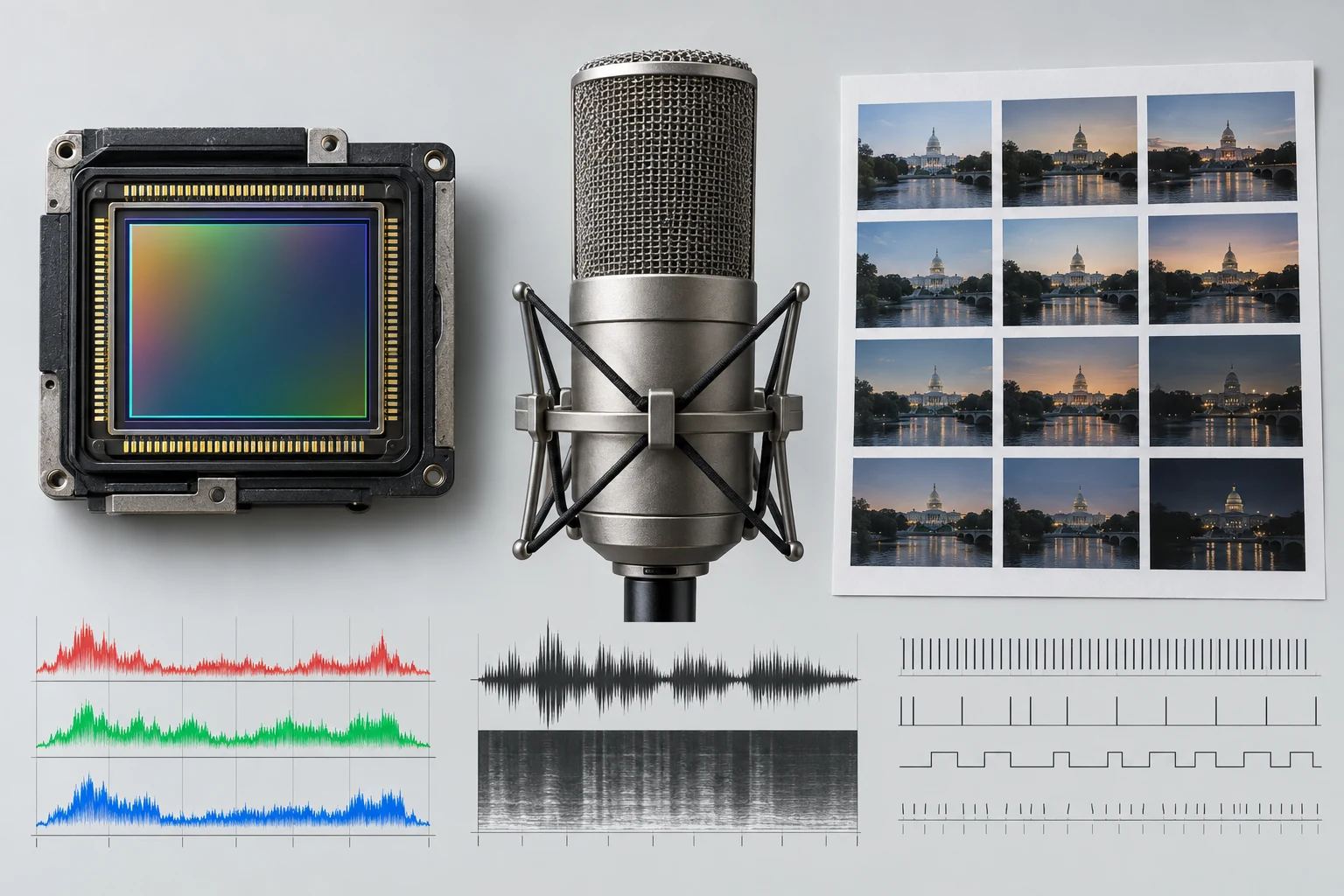
The problem is structural. Every artifact a detector learns is a bug the next generation of models fixes, so these features have a half-life. A detector trained on last year's face swaps degrades quietly as this year's models close the seams, and the decline is invisible until you test on fresh material. Artifact detection is worth building, but it is perishable and needs constant re-validation.
Frequency-domain and statistical fingerprints
A more durable line moves from pixels to spectra. Upsampling layers in many generators leave periodic patterns in the frequency domain, spectral peaks a Fourier or DCT view exposes when the eye sees nothing wrong. GAN architectures left recognizable fingerprints; diffusion models leave different, subtler traces, and statistical tests on noise residuals can localize a generated region inside a real frame.
The caveat is the same, only slower. Frequency cues outlast surface artifacts but are fragile to laundering. Compression, resizing, and re-encoding, which is what happens when media crosses a social platform or a messaging app, attenuate the high-frequency evidence these methods rely on. A detector that shines on pristine files can collapse on the same clip after it has been screenshotted and transcoded twice.
Biological-signal cues, and where they break
A third approach reads physiology the generator never modeled. Remote photoplethysmography estimates a pulse from tiny color changes in facial skin across video frames; a real face carries a coherent heartbeat across skin regions, and many fakes do not. Gaze consistency and blink dynamics are related signals. They are hard to spoof by accident, but they need resolution and frame rate, they degrade under compression, and newer generators are learning to reproduce plausible physiological signals. The right role is one vote inside an ensemble, not a standalone verdict.
Comparing the four detection approaches
Laid side by side, the four families trade the same currency. Each buys a period of reliable performance, and each decays along a different axis, so a serious capability blends them and plans for the decay rather than betting on one.
| Approach | What it reads | Where it decays |
|---|---|---|
| Artifact-based | Blend seams, warps, blink and lighting errors visible in the frame | Fastest decay; each generation fixes the tell, and cues wash out under compression |
| Frequency-domain | Spectral peaks and upsampling fingerprints below visual perception | More durable, but attenuated by re-encoding, resizing, and platform laundering |
| Biological-signal | Pulse, gaze, and blink coherence a real face carries | Needs resolution and frame rate; increasingly reproduced by newer generators |
| Provenance / watermark | A signed capture-and-edit history or an embedded machine mark | Only works when the mark exists and survives; absent on adversary media |
Provenance approaches: C2PA, watermarking, and camera attestation
The strongest long-run answer inverts the problem: instead of proving media is fake, prove genuine media is genuine. C2PA, the standard from the Coalition for Content Provenance and Authenticity whose consumer label is Content Credentials, defines a cryptographically signed manifest that travels with a file and records how it was captured and edited. The specification matured through its 2.x versions across 2025 and 2026, adding coverage for live video and for marking generative-model outputs. Cameras from major vendors now sign at capture, large platforms have begun labeling AI content, CISA issued 2025 guidance recommending provenance for government and critical-infrastructure media, and the EU AI Act moves machine-readable marking of AI content toward mandatory status in 2026.
Watermarking sits alongside provenance: a generator embeds a signal in its own output so downstream tools can flag it as machine-made. Camera attestation binds a hardware signature at capture, the closest thing to a birth certificate for a pixel. Both establish trust at the source instead of reconstructing it later.
The adoption gap is the whole story. Provenance protects the honest path and is silent on the adversary's: a hostile actor will not sign or watermark anything, will strip metadata, and will re-encode to destroy a fragile mark. It raises the floor for trusted sources, which is real value, but it does not detect a determined fake. It is the other half of a strategy whose first half is still detection.
The generalization problem
This is the honest center of the subject. Detectors overfit to the generators they were trained on. A media-forensics model that scores near-perfect on the fakes it was trained on can fall toward a coin flip against a generator it has never seen, and the research literature is blunt about the size of that drop. It is not a tuning defect that better engineering removes; it is the shape of the problem, because the adversary's generator is by definition one the detector never trained on.
The consequence for a buyer is direct. A single accuracy number means little without naming the generators and conditions behind it. The honest way to describe a detector is a matrix, not a headline: which families, which generators, which compression levels, and whether the hard cases were held out of training or quietly included.
Public benchmarks and why their scores flatter the field
Public datasets made this field measurable, and the same datasets make it easy to overstate readiness. Each benchmark freezes a set of generators in time, and models can learn the benchmark rather than the problem.
- FaceForensics++ — 1,000 real videos manipulated by four methods across compression levels; the standard training benchmark, now studied enough that strong models overfit to it.
- DeepFake Detection Challenge (DFDC) — a large, deliberately messy set with real-world perturbations; harder than most, still bounded by the generators it used.
- Celeb-DF (v2) — higher-quality fakes that exposed how far cross-dataset performance drops on unfamiliar synthesis.
- WildDeepfake and in-the-wild sets — scraped from real platforms to close the lab-to-field gap, yet still a snapshot of the generators available when built.
- The structural limit — every benchmark is frozen while generation keeps moving, so a leaderboard score is an upper bound on real-world performance, not an estimate of it.
A benchmark answers how well a model does on these fakes. It never answers how well it will do on the fake someone builds next month, so a headline accuracy read as a field number is protection against yesterday's adversary.
Human-in-the-loop triage as the realistic operating model
The deployable system is not an oracle that stamps real or fake. It is triage. Automated tools rank and route incoming media, provenance is checked first because it is cheap and decisive when present, and trained analysts adjudicate the hard cases. The tool focuses scarce attention, surfaces the cues that drove a score, and keeps a defensible record, because an analyst and later a court both need to know why a clip was flagged.
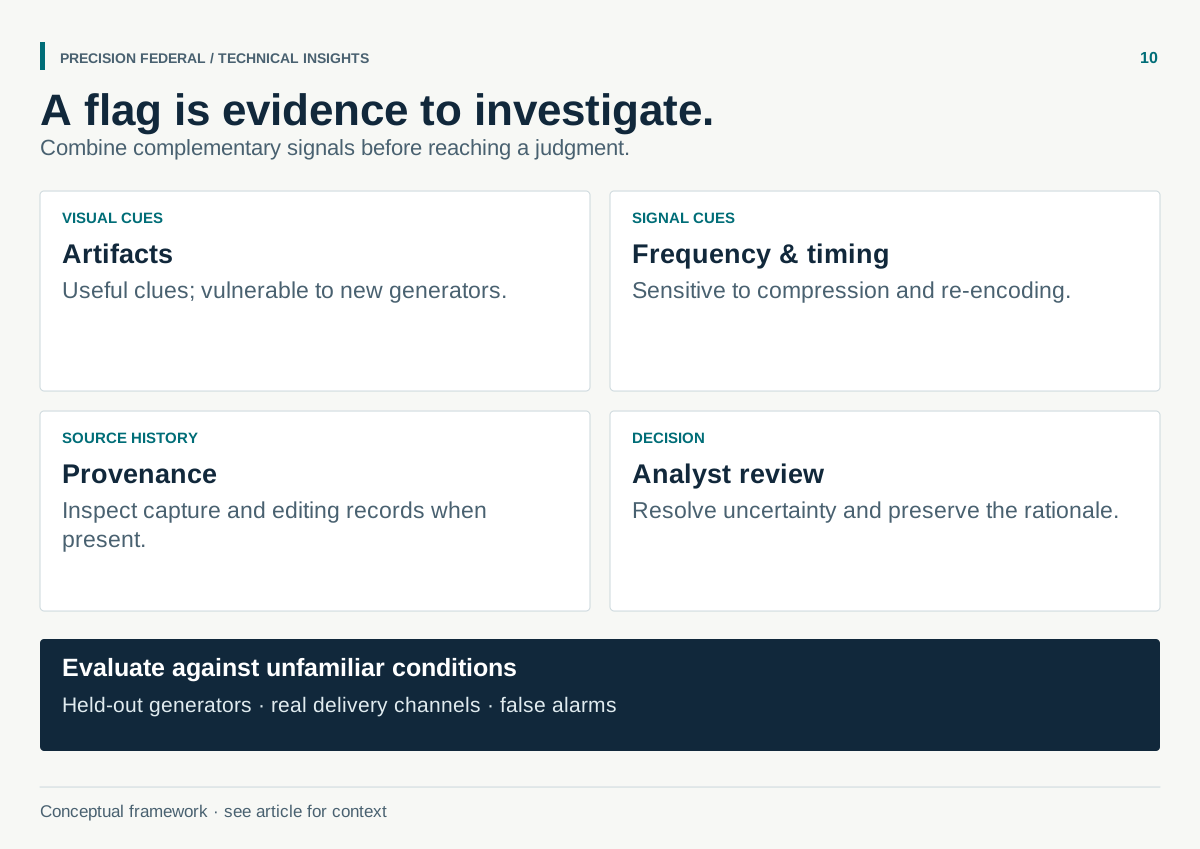
This posture also fixes an incentive problem. A detector sold as fully automatic invites over-trust, and over-trust on a probabilistic screen is how a false positive ruins a real person or a false negative passes a fake into an evidence chain. The mature product is assistive, tuned to the cost of each error in the mission it serves.
Evaluation discipline for an acquisition
If you are buying or funding a media-forensics capability, the evaluation is the product. Three tests separate real capability from a benchmark score, and any offeror should welcome all three.
Held-out generators. Score the system on synthesis methods it never trained on. In-distribution numbers are marketing; out-of-distribution numbers are the truth about how it meets a novel adversary.
Adversarial robustness. Measure performance after compression, resizing, re-encoding, and the laundering a real delivery channel imposes. A detector that only works on pristine files does not work where media arrives.
Base-rate awareness. At realistic prevalence, where genuine media vastly outnumbers fakes, a detector with a fine-sounding error rate can still produce mostly false alarms. Ask for precision at the operating base rate, calibrated confidence, and a defined human review path, not a single headline accuracy.
Where federal programs fund media-forensics work
Media forensics has a long federal research lineage and an active acquisition front. DARPA's Media Forensics and later Semantic Forensics programs built much of the modern detection and attribution methodology, and their influence runs through current work. Agencies with fraud, identity-proofing, and information-integrity missions, from benefits administration to homeland security and the intelligence community, fund detection, provenance tooling, and analyst-assist systems.
For a small firm the winnable solicitations are rarely a claim to detect all deepfakes. They are a specific modality, a specific mission context, a specific robustness or provenance gap, and a deliverable an analyst could use in the field. A proposal that names the family it detects, the channel it survives, and the generators it was held out against starts well ahead of one promising a universal answer.
Bottom line
Synthetic media detection is a moving-target discipline, not a solved classifier. Artifact, frequency, and biological cues each buy time and each decay; provenance raises the floor for honest sources and is silent on the adversary; benchmarks measure the generators of the past. The organizations that get real value treat detection as probabilistic triage with a human in the loop, buy on held-out and adversarial evaluation instead of headline accuracy, and pair detection with provenance rather than choosing one. The firms still useful in two years are the ones building for the generator they have not seen yet.
Common questions on scope and limits
Is there a detector that just works?
No. Every technique decays as generators improve, and cross-generator generalization is still the open problem. Plan for triage and continuous retraining, not a one-time purchase that stays accurate on its own.
Does C2PA solve this?
It helps for cooperating sources and honest capture, and it is being adopted in cameras, platforms, and government guidance. It says nothing about media an adversary generates without signing and then re-encodes, so it complements detection rather than replacing it.
Why not trust the benchmark leaderboard?
A leaderboard measures performance on a fixed set of generators. Field performance against novel synthesis is almost always lower, so read a leaderboard score as an upper bound, not a forecast.
What about audio and voice?
Voice cloning is often the highest-yield attack because a phone channel offers no visual cross-check. Audio forensics is a distinct competence and should be evaluated on its own terms, not assumed to arrive bundled with a video detector.
Frequently asked questions
Synthetic or manipulated media, whether a face swap, reenactment, full synthesis, or cloned voice, used to commit fraud, run an influence operation, corrupt evidence, or defeat identity proofing. The risk is an outcome changed by a fabrication, not the novelty of the technology.
Because they depend on which generators and conditions were tested. High within-dataset scores routinely collapse on unseen generators and laundered media, so an accuracy figure reported without its test conditions is not informative.
No. Provenance authenticates cooperating, honest capture and editing and raises the floor for trusted sources. It cannot flag media an adversary generated without signing and then re-encoded, so it belongs in the stack alongside detection.
Human-in-the-loop triage. Automated tools rank and explain, provenance is checked when present, and trained analysts adjudicate. Fully automatic real-or-fake verdicts invite over-trust on a probabilistic screen.
On held-out generators, on robustness to compression and re-encoding, and on precision at the real operating base rate with calibrated confidence, rather than on a headline benchmark accuracy.