
The clauses are not missing by accident
The Federal Acquisition Regulation applies to procurement contracts. An other transaction is not a procurement contract, which is the entire point of it, and so the clause set that would have allocated patent rights, technical data rights, and software rights is not in the document. Nothing replaces it by operation of law. What the parties write is the whole of the arrangement, and the opening draft is usually the government's.
This is no longer a small corner of federal spending. GAO reported in September 2025 that Department of Defense obligations through other transaction agreements grew from $1.8 billion in fiscal year 2016 to over $18 billion in fiscal year 2024, with prototype agreements accounting for more than $16 billion of the fiscal 2024 total. Executive Order 14265, signed April 9, 2025, directed the department toward "a first preference for commercial solutions and a general preference for Other Transactions Authority." More agreements are being written every quarter, and each one settles its intellectual property questions from scratch.
The firms that come out of this well are not the ones with the best lawyers. They are the ones who arrive at the negotiation already knowing which of their assets predate the project, which the government actually needs, and what the difference costs.
What the regulation would have supplied
It helps to be precise about what is being given up, because the FAR and DFARS defaults are frequently described as hostile when the real problem is different. The defaults are not especially generous. They are settled. Both sides know the answer before the conversation starts.
On a Defense contract, DFARS 252.227-7013, "Rights in Technical Data—Other Than Commercial Products and Commercial Services," grants the government unlimited rights, government purpose rights, or limited rights in technical data depending on who paid for the development. Its companion, DFARS 252.227-7014, does the same for other than commercial computer software and its documentation, with restricted rights standing in for limited rights. Government purpose rights run for a nominal five-year period that starts when the instrument requiring the development is executed, and the period is negotiable; when it expires, the government has unlimited rights.
DFARS 252.227-7017 makes an offeror identify and attach its asserted restrictions with the offer, which forces the inventory conversation before award rather than after. DFARS 252.227-7018 carries the SBIR and STTR protection period. On the civilian side, FAR 52.227-14 defines "data" to include both technical data and computer software and gives the government unlimited rights in data first produced in performance of the contract.
None of that attaches to an other transaction. The statutory scaffolding behind those clauses is written for contracts as well: 10 U.S.C. §§ 3771 through 3775 govern rights in technical data in Defense contracts, and the validation subchapter at §§ 3781 through 3785 applies to Defense contracts that call for delivery of technical data.
Patents run on a defined list, and an other transaction is not on it
Bayh-Dole, at 35 U.S.C. §§ 200 through 212, operates through "funding agreements." The statute defines a funding agreement as any contract, grant, or cooperative agreement between a federal agency and a contractor for experimental, developmental, or research work funded in whole or in part by the government. An other transaction is deliberately none of those three.
So the standard patent rights clause does not attach on its own, and everything that rides on it goes with it in both directions. The contractor has no automatic statutory right to elect title to a subject invention. The government has no automatic nonexclusive, irrevocable, paid-up license, and no march-in authority under 35 U.S.C. § 203. The U.S. manufacturing preference at § 204 does not arrive by itself either.
In practice most agreements end up with a patent article that reads like Bayh-Dole, because the program office wants the government license and the company wants title, and that is the deal both sides would have made anyway. The difference is that it has to be said out loud. An agreement silent on inventions is not an agreement where Bayh-Dole quietly fills the gap.
Borrow the vocabulary, then define it
Draft agreements routinely use the phrase "government purpose rights" with no definition attached. Everyone in the room believes they know what it means. They are picturing DFARS 252.227-7013, where government purpose rights are the rights to use, modify, reproduce, release, perform, display, or disclose technical data within the government without restriction, and to release it outside the government for United States government purposes.
Picturing a clause is not incorporating it. If the agreement uses the term, it should either reproduce the definition or cite the DFARS clause by number and date. The same goes for duration. The five-year period is a feature of the clause, not of the phrase; an undefined grant of government purpose rights has no expiry at all unless the agreement gives it one.
The background schedule decides most of the outcome
Every serious other transaction has, or should have, an attachment listing the intellectual property each party brings to the project. Components, libraries, models, datasets, pipelines, internal tooling. Anything not on that list is exposed to the argument that it was developed under the agreement, and that argument is much harder to win a year later than it is to prevent in week one.
The list is only half of it. The other half is engineering discipline, and it is the half that gets skipped. If the background model and the project-funded integration layer live in one repository, share a build, and ship in one container, the schedule describes a separation that the delivered artifact does not have. Segregation has to be real at the file, module, and package level before it means anything on paper.
Data is not software, and the clause vocabulary already knows it
This is where the borrowed DFARS language starts to strain, and it matters more for AI work than for anything else in the agreement. DFARS 252.227-7014 defines "computer software" as computer programs, source code, source code listings, object code listings, design details, algorithms, processes, flow charts, formulae, and related material that would let the software be reproduced, recreated, or recompiled. It separately defines a "computer database" as a collection of recorded data in a form capable of being processed by a computer, and says the term does not include computer software. Two different definitions, two different things.
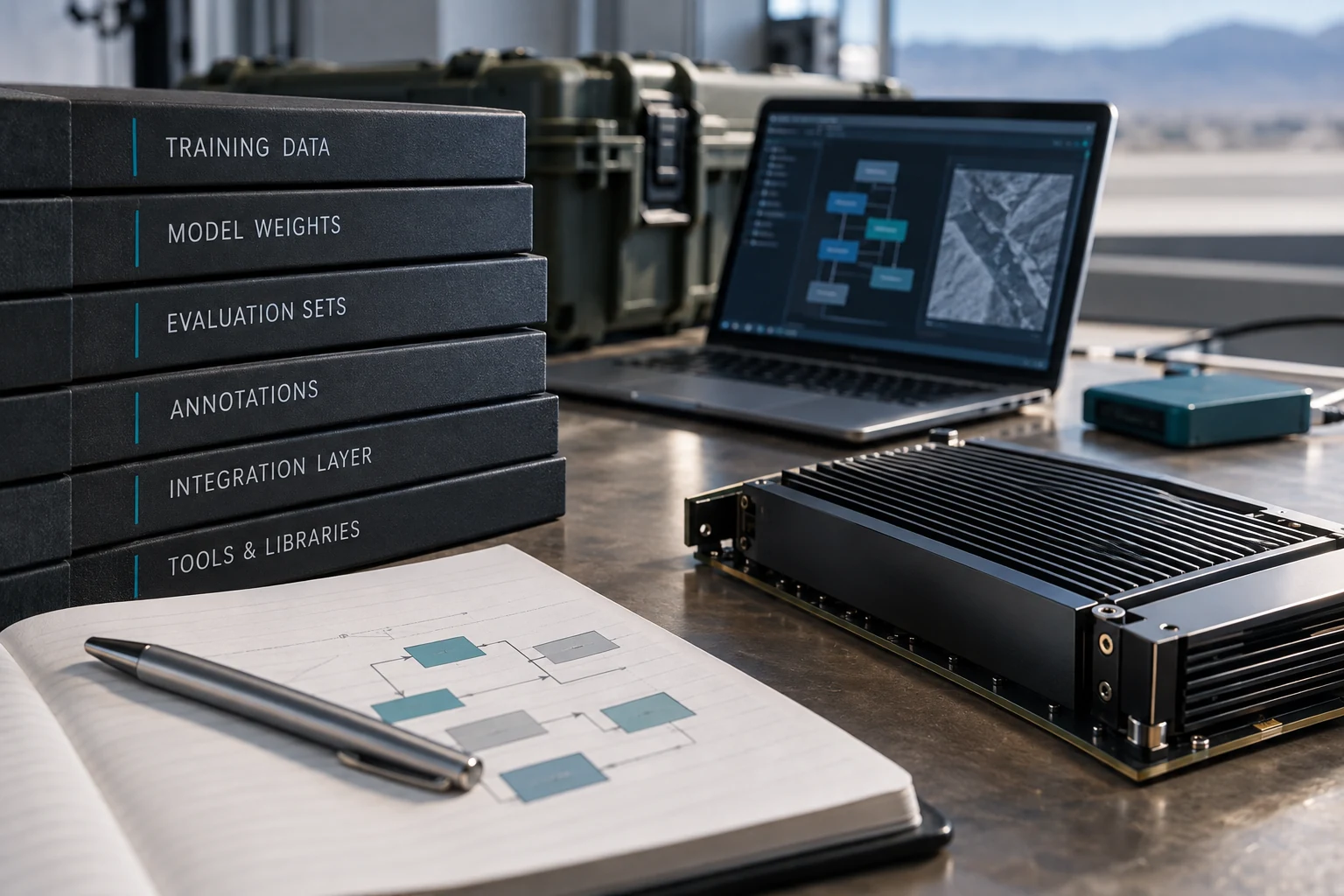
A modern machine learning delivery is neither one cleanly. A training corpus is closer to a database. Labels and annotation guidelines are their own asset. A held-out evaluation set is arguably the most valuable artifact in the whole project and is rarely mentioned. Trained weights are not source code, are not documentation, and are not obviously a database. Fine-tuning adapters, prompt libraries, retrieval indexes, and production telemetry each sit somewhere different again.
A license grant written over "software and technical data" leaves all of that to be sorted out by whoever is holding the agreement when the question comes up. The fix is unglamorous and takes an afternoon: enumerate the artifacts by name in an attachment, and give each one its own line stating who owns it, what license the government receives, for how long, and whether it can be released outside the government.
Weight we place on each term when reading a draft agreement
Editorial ranking of review priority, drawn from statute, DoD guidance, and the clause set the agreement is displacing. Relative emphasis, not measurement.
Marking is a condition, not a formality
The consequence of a missed marking is the harshest rule in this whole area, and SBIR firms meet it first. SBA's own guidance is blunt: failure to mark, or marking inappropriately, gives the government unlimited rights in the data, which means it can put the material in solicitations, compete it, and disclose it to the firm's competitors. The rule is not a technicality with a cure period.
Under a contract, DFARS 252.227-7017 makes the offeror assemble the assertion list before award, so the discipline is imposed from outside. An other transaction imposes nothing. If the agreement is going to condition protection on markings, and it usually is, then the agreement should also say exactly what the legend reads, where it goes, and what happens when an artifact ships without it.
Then make it survive the build. Legends applied by hand to a design document do not carry into a compiled binary, a container image, a model checkpoint, a Parquet file, or a notebook exported to HTML. Marking is a pipeline problem, and treating it as a document-formatting problem is how good positions get lost.
SBIR technology delivered under an other transaction
This is the question most often asked and least often answered cleanly, so it is worth stating the tension plainly rather than resolving it artificially.
The SBIR statute at 15 U.S.C. § 638(e)(3) defines a funding agreement as any contract, grant, or cooperative agreement between a federal agency and a small business. That list does not include other transactions. At the same time, SBA's published data rights guidance states that the SBIR marking requirement "applies to all types of funding agreements — grants, contracts, cooperative agreements, Other Transaction Agreements, task orders of any type, and any other Government funding agreement, no matter what the Government calls it."
Both statements are accurate quotations of their sources, and they point in different directions on whether SBIR protection attaches to an other transaction by force of the program's own rules. We are not aware of a definitive published resolution, and treating one as settled would be a mistake. The practical answer does not depend on resolving it: write the protection into the agreement expressly. Name the protection period, name the license the government receives during it, name what happens when it ends, and attach the legend.
For reference, the terms worth mirroring are the ones in DFARS 252.227-7018, which a final rule published in December 2024 aligned with the policy directive: a protection period of 20 years running from the date of award, during which the government has limited rights in the technical data and restricted rights in the software, converting to perpetual government purpose rights when the period expires. A firm carrying technology from an earlier phase into a prototype agreement should be able to point at each artifact and say which award it came from and which clock it is on.
Export control, CUI, and ethics follow the data, not the paperwork
An other transaction is an exception to the FAR, not to everything else. Export control and classification obligations attach to the technology and the people who touch it. Controlled unclassified information handling requirements travel with the information, and program offices commonly write NIST SP 800-171 style terms directly into the agreement because the clause that would have done it is absent. Procurement ethics apply by statute: 10 U.S.C. § 4022(h) provides that an agreement under that section is treated as a federal agency procurement for the purposes of the procurement integrity rules in chapter 21 of title 41.
The enforcement machinery is missing too
Rights are only as good as the process for defending them, and this is the part firms discover late.
On a Defense contract, a company that marks data restrictively gets a defined fight. The government may challenge the assertion, but the validation subchapter at 10 U.S.C. §§ 3781 through 3785 sets boundaries: review of an asserted restriction happens within three years of the later of final payment or delivery, and a challenge generally may not be brought after six years measured the same way, unless the assertion is found not to have been substantially justified. For technical data under a contract for commercial products, the contracting officer must presume the restriction is justified as developed exclusively at private expense, and the challenge succeeds only if the department produces information showing otherwise. DFARS 252.227-7019 and 252.227-7037 supply the procedure.
None of that exists in an other transaction unless the agreement builds it. Nor does the ordinary disputes path. The Contract Disputes Act runs on procurement contracts, so there is no contracting officer's final decision to appeal by default and no automatic route to a board or the Court of Federal Claims. Boards of contract appeals can hear matters outside that act where an agency agreement or charter gives them jurisdiction, which is precisely why the forum belongs in the agreement rather than in anyone's assumptions.
Four sentences cover most of it: who may challenge a restriction, what evidence settles it, how long the window stays open, and where an unresolved dispute goes.
Follow-on production is a data-rights question wearing a contracts costume
Under 10 U.S.C. § 4022(f), a follow-on production contract or transaction may be awarded to a prototype participant without further competition when competitive procedures were used to select the participants and the prototype was successfully completed. That provision is the strategic reason to be in a prototype agreement at all.
Here is the part that surprises people. GAO's September 2025 review found that among 18 weapon systems in its sample that used prototype other transactions, ten planned to switch to standard contracts for production, with officials citing cost oversight as the reason. A production award made as a FAR contract carries the DFARS clause set. The carefully negotiated license articles in the prototype agreement do not follow the technology into that contract on their own.
So the prototype agreement should say what the production instrument will carry. At minimum: that rights granted for the prototype do not expand automatically on transition, that the licenses granted in the prototype survive it on their stated terms, and that assertions made and accepted during the prototype are recognized in the follow-on. And define "successfully completed" against measurable acceptance criteria, because that phrase is the trigger for the whole non-competitive pathway.
Side by side on the terms that decide
| Question | FAR / DFARS contract | Prototype other transaction | SBIR-funded contract |
|---|---|---|---|
| Patent rights | Bayh-Dole patent rights clause; contractor elects title, government receives a license, march-in available | No clause attaches; title, license, and march-in exist only if the agreement says so | Bayh-Dole applies as on any funding agreement |
| Technical data and software | DFARS 252.227-7013 and -7014, or FAR 52.227-14 at civilian agencies | Negotiated article; borrowed terms need their definitions and durations written in | DFARS 252.227-7018 SBIR and STTR rights on qualifying data |
| Assertion of restrictions | DFARS 252.227-7017 assertion list attached to the offer before award | No required list; build one and attach it as a schedule | Same as any contract, plus the SBIR legend |
| Protection period | Government purpose rights nominally 5 years, then unlimited rights | Perpetual unless the agreement sets an end date | 20 years from date of award, then perpetual government purpose rights |
| Challenging a restriction | Statutory validation procedure with 3-year review and 6-year challenge windows | Only what the agreement provides | Same statutory procedure as any Defense contract |
| Disputes forum | Contracting officer's decision, then board or Court of Federal Claims | Whatever the agreement names; nothing by default | Same as any FAR contract |
Consortium base agreements set the floor before you arrive
Most Defense prototype dollars move through consortia. The government signs a base other transaction agreement with a consortium manager, firms such as Advanced Technology International and NSTXL among them, and members compete for individual project agreements underneath it. Both organizations are actively managing consortia in 2026.
The base agreement usually contains a standing intellectual property article. Sometimes the project agreement can vary it, sometimes it cannot, and the answer is rarely printed on the request that reaches the membership. Read the base document before pricing the work. A term fixed at the base level is not a negotiation you are going to have.
One statutory term is worth knowing because it shows up in the base agreement rather than the project agreement. Under 10 U.S.C. § 4022(b), a prototype agreement providing for payments over $5,000,000 must include a clause giving the Comptroller General discretion to examine the records of any party. The requirement does not apply to a party that has not entered into any other agreement providing audit access by a government entity in the year before the agreement, the records reachable are limited to the same types the government could already examine under that party's prior agreements, and the examination window closes three years after final payment.
Where the flexibility is genuinely worth having
All of the above reads as caution, so be clear that the freedom cuts the other way too. This is why capable firms keep choosing these agreements.
An other transaction can license a hosted capability rather than deliver source code, an arrangement the DFARS clause set does not naturally produce. It can grant government purpose rights in an integration layer while holding restricted rights in a core model, deliverable by deliverable. It can put a defined end date on a license, a field-of-use limit, or a term that steps up rights only if the government funds a follow-on. It can adopt ordinary commercial license terms for a commercial component. Under a Part 15 contract most of those outcomes require an exception. Here they are just drafting.
The policy wind is behind the instrument as well. Beyond the April 2025 executive order preference, Congress amended the commercial solutions opening authority at 10 U.S.C. § 3458 in December 2025 to cover commercial products, commercial services, or nondevelopmental items, and to authorize follow-on production awards, including sole-source contracts and follow-on transactions as defined in § 4022. The pathway is widening, which means more agreements and more first drafts.
Terms to settle before signature
- A background intellectual property schedule that matches the actual repository structure
- A license grant per deliverable, with datasets, trained weights, and evaluation sets named separately
- Definitions and durations for every borrowed term, or a citation to the clause by number and date
- Third-party and open-source components identified with their licenses, including anything copyleft in a delivered image
- Marking requirements stated exactly, and enforced in the build pipeline rather than by hand
- A challenge procedure with a burden of proof, a time limit, and a named forum
- Express treatment of any SBIR or STTR technology carried into the project, with its clock identified
- Language on what rights the production instrument carries if a follow-on is awarded
Bottom line
An other transaction gives a firm the ability to write its own intellectual property terms, and it removes the safety net that would have caught the firm that did not read them. Those are the same fact. The regulation the agreement displaces was doing two jobs: setting the default allocation, and supplying the procedure for arguing about it later. Replacing the first and forgetting the second is the most common failure, because the loss shows up years afterward when there is no forum and no time limit and no presumption to stand on.
Do the inventory before the negotiation. Say what each artifact is, who paid for it, and what the government gets. Make the code match the schedule. That work is worth more than any clause you could win at the table, and it is the only part of the process entirely within your control.
Common objections, answered plainly
Doesn't an other transaction mean we keep all our intellectual property?
It means nothing is decided until the agreement decides it. Government templates often open with broad rights language, because the program office is protecting its ability to compete production later and has to write that in by hand. A firm that arrives with a background schedule and per-deliverable grants usually gets them. A firm that signs the opening draft can hand over rights in work that predates the project by years.
Can we just cite the DFARS clauses and be done?
You can, and for some agreements it is the cleanest option, because the DFARS framework is well understood and both parties know how it behaves. Cite the clause by number and date so it is unambiguous. But recognize what comes along: the government purpose rights conversion to unlimited rights, and a framework built for delivering technical data packages rather than models and datasets.
Our software is commercial. Doesn't that solve it?
Commercial status is a strong position and it is worth asserting clearly, with the commercial license terms attached. Under an other transaction, though, the presumptions and validation procedures that back a commercial assertion in a Defense contract are not present unless the agreement adopts them. Assert the status and write in the procedure that protects it.
Frequently asked questions
Not on their own. Those clauses attach when a contracting officer puts them in a procurement contract. An other transaction is not one, so the clauses appear only if the agreement adopts them by reference or reproduces their terms. Referencing them by clause number and date is a legitimate and common drafting choice.
Bayh-Dole runs through "funding agreements," which the statute defines as contracts, grants, and cooperative agreements. An other transaction is none of those, so the standard patent rights clause does not attach automatically, and neither the contractor's right to elect title nor the government's license and march-in authority arrive by default. Most agreements negotiate a patent article that reaches a similar result, but it has to be written.
The SBIR statute defines a funding agreement as a contract, grant, or cooperative agreement, while SBA's data rights guidance states that the marking requirement applies to other transaction agreements as well. Rather than rely on either reading, write the protection expressly into the agreement: the protection period, the license during it, what happens at expiration, and the legend. Mark every artifact, since unmarked material can be treated as carrying unlimited rights.
Name them individually in an attachment rather than folding them into "software and technical data." The clause vocabulary treats computer software and computer databases as separate categories, and trained weights fit neither well. Give each artifact its own line covering ownership, the license granted, the duration, and whether release outside the government is permitted. Evaluation sets deserve particular attention because they are often the most valuable item and the least discussed.
Not automatically, and this is a live risk rather than a theoretical one. GAO found that ten of eighteen sampled weapon systems using prototype other transactions planned to move to standard contracts for production, which brings the DFARS clause set with them. The prototype agreement should state that licenses granted survive on their terms and that accepted assertions are recognized in any follow-on instrument.