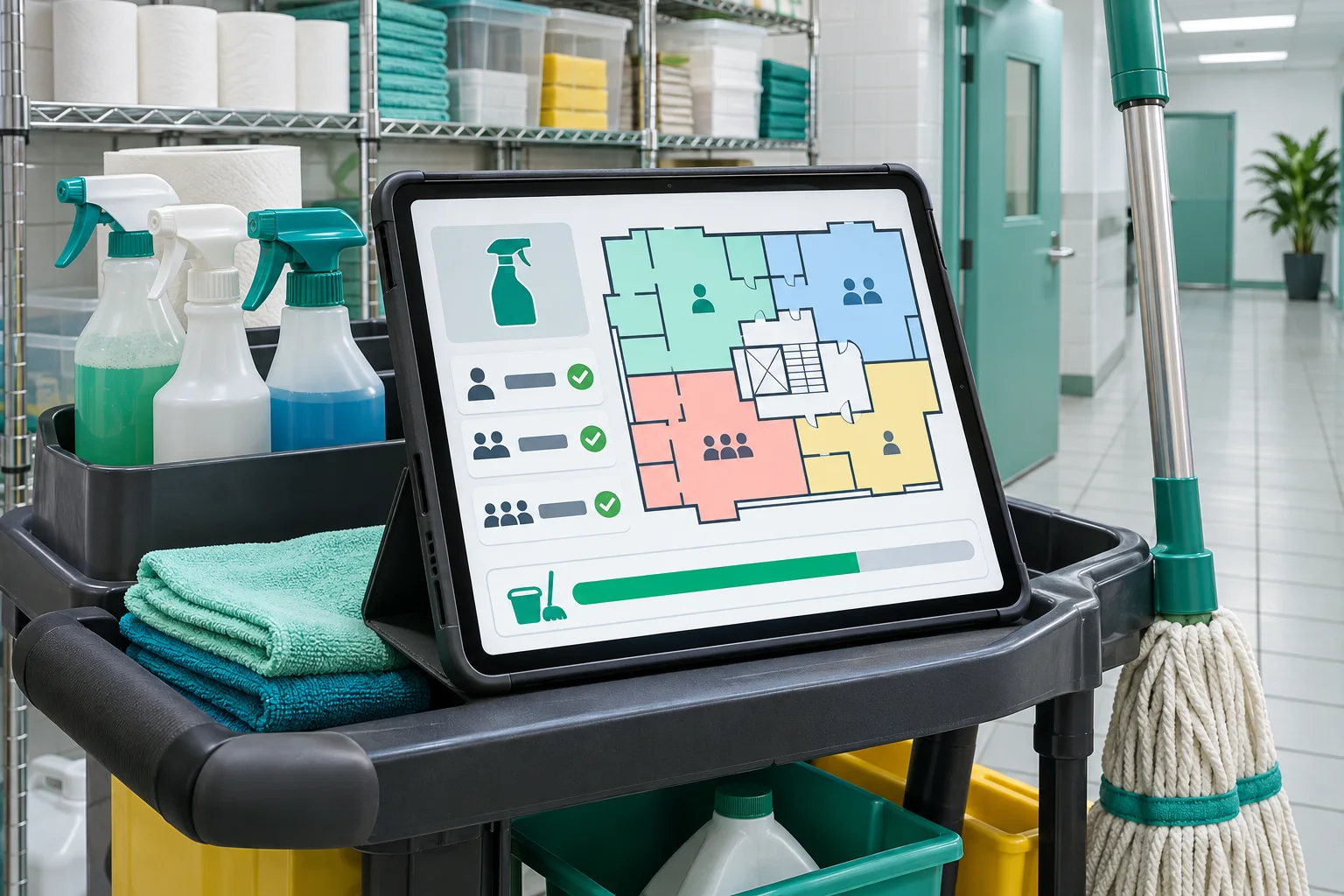
Staffing is the proposal
In a custodial bid, the staffing plan decides almost everything else. It sets your price, because labor is most of the contract. It sets your quality, because a crew that is too thin will miss tasks. And it is the first thing an experienced evaluator tests, because a bidder who cannot show the arithmetic behind the hours is guessing.
A credible plan starts from the buildings and works up to people, one calculation at a time. This guide shows how to turn a building list into a staffing plan an evaluator can follow, and how the Service Contract Labor Standards statute sits underneath it.
Start from the buildings
Federal custodial work is usually written as a performance work statement. The current FAR Overhaul text says a performance work statement must describe the outcome required, not how to achieve it or the estimated level of effort, and must include meaningful and measurable performance standards to the maximum extent practicable. So the government has told you what clean must look like, and the labor to get there is yours to work out. Agencies have been putting the Overhaul text in place through class deviations, so read the solicitation you have.
Build a space inventory from the drawings and the site visit, using cleanable square footage rather than gross. Break every building into space types, because a carpeted office and a tiled restroom are different work.
- Offices and conference rooms, by floor type
- Corridors, lobbies and stairs
- Restrooms, counted by fixture as well as area
- Break rooms and kitchens
- Specialty areas: clinics, labs, secure rooms, shops
- Access limits: escort requirements, hours of entry, badging delays
Walk the site if a visit is offered. Plans and square footage miss what actually eats time: the long haul from the supply closet, the elevator that is out half the day, the secure suite that opens for only one hour.
Frequencies come from the work statement
Pull every task and frequency from the performance work statement into one table: empty trash daily, vacuum three times a week, strip and refinish floors twice a year. Separate daily, weekly, monthly and periodic work, because each one is staffed differently. Daily work sets the base crew. Periodic work usually goes to a floor crew or is scheduled into slack hours.
Convert every task to an annual count so it can be priced consistently, and note the holidays, closures and government-directed shutdowns that reduce the count. If the statement is silent on a frequency that you know will matter, ask the contracting officer during the question period.
Productivity rates need a named source
The single most important credibility test is where your production rates came from. There are two good answers, and they work best together.
The first is the published industry reference. ISSA's Official Cleaning Times is described by ISSA as the industry's tasks, tools and workloading resource. ISSA explains that cleaning time is calculated as the square footage to be cleaned, divided by the production rate per hour, multiplied by 60, with fixture work calculated as the number of fixtures multiplied by minutes per fixture. ISSA also says its times are meant to be used as a benchmark and to act as a guide for bidding and estimating cleaning work.
The second is your own measured rates. ISSA notes that organizations have demonstrated more efficient results through individual studies. If you have timed your own crews on similar buildings, say so, describe how you measured, and show how your rate compares with the published one.
If you use a rate that is faster than the benchmark, explain why, such as equipment, floor type or a route design. An evaluator can accept a faster rate with a reason. An unexplained one reads as a price made up to win.
Do the arithmetic where the evaluator can see it
Show the calculation, by space type, in a form that can be checked. The table below works the method with example numbers. Every input in it stands in for your own measured or sourced rate and your own count.
| Task (example) | Quantity | Rate | Frequency | Hours per week |
|---|---|---|---|---|
| Vacuum carpeted offices | 40,000 sq ft | 4,000 sq ft per hour | 3 per week | 30.0 |
| Damp mop corridors | 20,000 sq ft | 5,000 sq ft per hour | 5 per week | 20.0 |
| Clean restroom fixtures | 60 fixtures | 3 minutes per fixture | 5 per week | 15.0 |
| Trash and high-touch surfaces | 30,000 sq ft | 6,000 sq ft per hour | 5 per week | 25.0 |
| Weekly total | 90.0 |
Then convert hours to people. Start with the hours one full-time cleaner can actually spend cleaning in a week, after breaks, setup and travel between buildings. Add a coverage allowance for vacation, holidays and sick leave, and be explicit about how you got it. If 90 hours of cleaning divides across cleaners who each deliver 32 productive hours a week, you need 2.8 full-time equivalents before any coverage, which rounds up to a schedule of real people on real shifts.
State the resulting shift schedule. A staffing plan that ends in a decimal is unfinished. Show who works which hours, in which building, and how the weekly numbers hold together.
A staffing plan that ends in a decimal is unfinished.
Cross-check against appearance levels
The second lens is the outcome. APPA, the educational facilities association, publishes custodial staffing guidelines built around five appearance levels: Orderly Spotlessness, Ordinary Tidiness, Casual Inattention, Moderate Dinginess and Unkempt Neglect. APPA's own figures show how sharply productivity changes with the level of clean you are expected to reach.
These are cleanable square feet per custodian for carpeted offices, from an example APPA published in its Facilities Manager magazine in early 2013. APPA's classroom example with hard floors ran from 7,200 square feet at Level 1 to 24,500 at Level 5. Use figures like these as a sanity check, and remember they come from guidelines written for educational facilities.
If your plan implies each cleaner covers an area that a published reference associates with a far lower level of clean than the work statement demands, an evaluator is entitled to doubt it. Better you find that gap first.
Supervision and coverage
Explain who supervises, how many people each supervisor oversees, and on which shifts. There is no universal ratio, so state yours and connect it to the geography of the job. A single building with one night shift needs less supervision than twelve buildings spread across a base. Name the on-site lead, describe the person's authority to fix a problem without calling the office, and state who covers when that person is out.
Address absences directly. Say how many floaters or standby employees you carry, how a call-out gets filled before the first building opens, and what you do when the government closes a facility. Coverage is often where a thin plan shows up first.
The Service Contract Labor Standards floor
Custodial work on federal contracts falls under the Service Contract Labor Standards statute, 41 U.S.C. chapter 67, formerly called the Service Contract Act. Service contracts over $2,500 must contain provisions on minimum wages and fringe benefits, and the contracting officer must obtain wage determinations for each new solicitation and contract above that amount. The wage determination for your place of performance sets the floor for each classification, so read it before you price the first hour.
- Pricing a rate below the wage determination for the janitor classification
- Using last year's wage determination when an amendment attached a new one
- Forgetting that fringe benefits in the determination have to be funded on top of wages
- Ignoring a predecessor contractor's collective bargaining agreement
- Quoting a schedule that assumes staff you have not recruited
Where a contract succeeds an earlier one for substantially the same services, the statute generally bars paying service employees less than the wages and fringe benefits, including prospective increases, provided for in the predecessor's collective bargaining agreement. Look for that agreement in the solicitation attachments, and price it. Multiple-year and option contracts commonly carry a price adjustment clause, and you should read how it treats wage determination changes before you set your out-year prices.
Quality control and phase-in
The staffing plan and your quality control plan have to agree. If your plan says a supervisor inspects every building weekly, the hours for that inspection have to exist somewhere in the schedule. The contract will commonly require an inspection system with complete records, so plan on the time it takes.
Treat phase-in as a staffing problem as well. Name the transition lead, the recruiting plan, the interview schedule for incumbent employees, and what is ready on the first day. When a job is being taken over at a federal facility, the incumbent is required to give the contracting officer a certified list of service employees and anniversary dates no later than 10 days before contract completion, and the contracting officer gives a copy to the successor. Where the continuity of services clause applies, contractors agree to furnish phase-in training and to cooperate in an orderly transition.
Frequently asked questions
Use a named source and say what it is: your own measured rates, a published reference such as ISSA's cleaning times, or both. Explain anything faster than the benchmark, since unsupported speed is what evaluators distrust.
Yes. The statute is now called Service Contract Labor Standards, at 41 U.S.C. chapter 67, and it covers contracts whose principal purpose is to furnish services in the United States through service employees. Its wage and fringe provisions reach contracts over $2,500.
Yes, within the page limits. A summary table by space type with hours, rates and frequencies shows the evaluator that the staffing was derived. Keep the full workbook available in case discussions or pricing questions come up.
State your assumption and its source, and ask about it during the question period. Evaluators accept stated assumptions far more readily than hours with no explanation.