
Two different things answer to the name CSO
Before a single page gets written, settle which authority the announcement is running under, because two unrelated legal frameworks both go by commercial solutions opening and they produce different documents, different awards, and different rights. The first is the Defense CSO: a general solicitation under 10 U.S.C. 3458, implemented at DFARS subpart 212.70, which ends in a FAR-based contract that must be fixed-price. The second is a CSO used as the competitive method for awarding a prototype other transaction under 10 U.S.C. 4022, which ends in a negotiated agreement that the FAR does not govern.
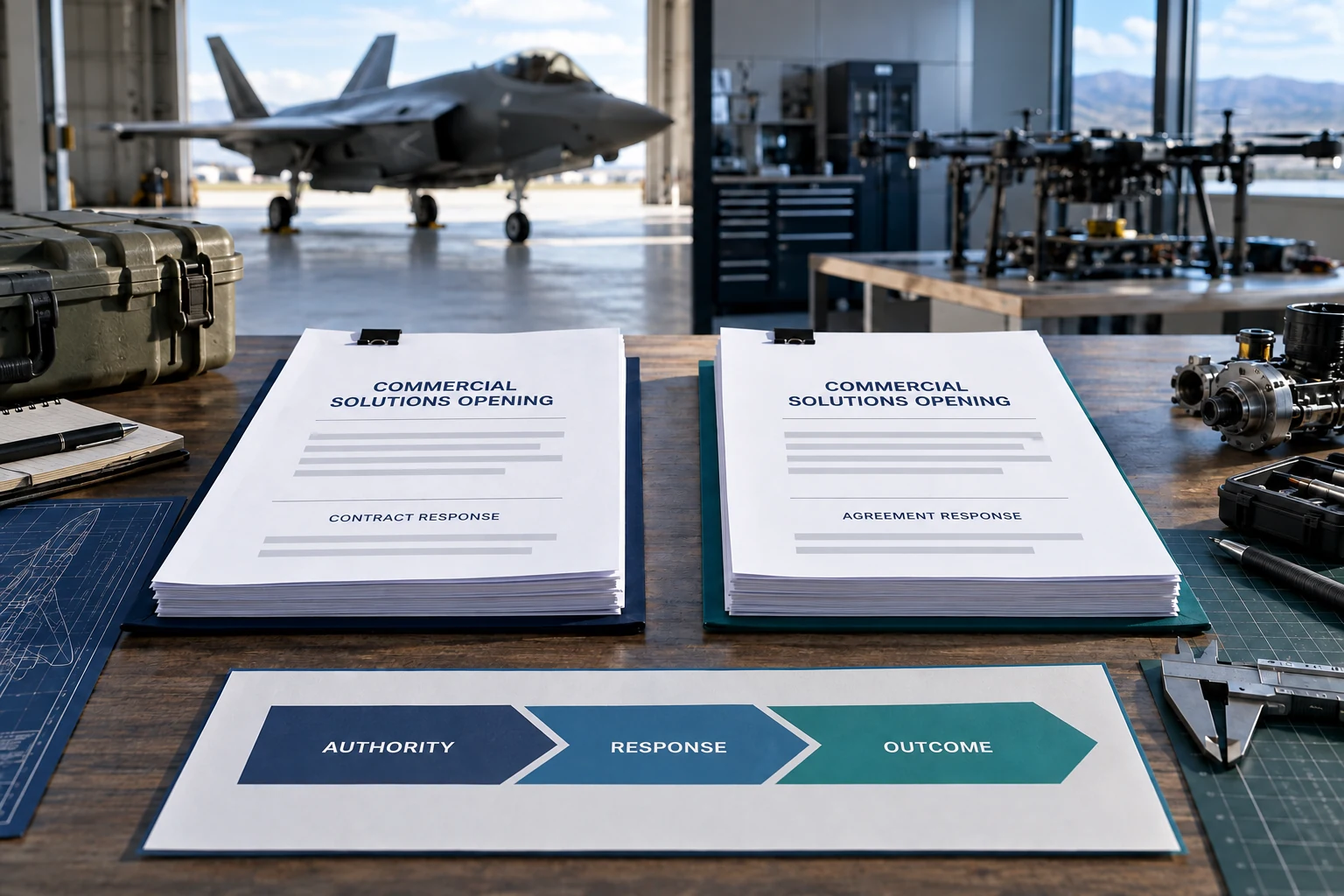
The Defense Innovation Unit says this plainly in its 2026 CSO guidebook. DIU built its process on 10 U.S.C. 4022 to satisfy that statute's requirement to use competitive procedures to the maximum extent practicable, and the guidebook warns readers not to confuse it with the Defense CSO authorized by Section 803 of the FY2022 National Defense Authorization Act. Same three letters, different machine.
The consequence for a first-time responder is large. Under DFARS 212.70 the government is buying a commercial product or service and the contract type is constrained by regulation. Under 10 U.S.C. 4022 it is funding a prototype project, your eligibility depends on a statutory test with no analogue in a FAR contract, and nearly every term including intellectual property is negotiable. Find the authority paragraph. It is usually on the first page, and it decides most of what follows.
What DFARS subpart 212.70 tells the writer
The subpart is six short sections and it repays a careful reading, because the parts that read like internal procedure are in fact instructions about how your document will be handled.
212.7002, policy. A CSO may be used to obtain innovative solutions or potential capabilities that fulfill requirements, to close capability gaps or provide technological advancements, and only when meaningful proposals with varying technical or scientific approaches can be reasonably anticipated. Notwithstanding FAR 12.207, the contracting officer must use fixed-price contract types, including fixed-price incentive. What is bought is treated as a commercial product or commercial service. And when a CSO is used to acquire research and development, it runs alongside FAR part 35 and DFARS part 235 but is not subject to the budget-activity limitation at DFARS 235.016, which is why a program office holding development money and a research-shaped problem reaches for a CSO instead of a broad agency announcement.
212.7004, procedures. This is the section to read twice. The announcement must state the agency's interest, either for one program requirement or for broadly defined areas of interest. It must specify the technical data the department needs, with a pointer to the commercial data rights framework at DFARS 227.7102 and 227.7202. It must state the evaluation factors, and the regulation names them: technical merit and importance to agency programs are the primary factors, and price is evaluated to the extent appropriate but at minimum to establish that it is fair and reasonable.
Then comes the sentence that changes how the document should be written. Proposals are evaluated through a scientific, technological, or other subject-matter expert peer review. Written evaluation reports on individual proposals are required, but proposals need not be evaluated against each other, since they are not submitted in response to a common performance work statement or statement of work. There is no competitive range. There is no ranking you can climb by being marginally better than the firm next to you.
212.7004(d) and (b), publication. Individual contract actions arising from a CSO are not separately synopsized; the announcement itself satisfies that requirement, and it is republished through the governmentwide point of entry at least annually. That is why CSOs sit open for years and why calls or areas of interest appear underneath them with short windows. Waiting for a discrete solicitation to drop means missing the window that matters.
212.7003 and 212.7005, the ceilings. Senior procurement executive approval is required to award a CSO contract in excess of $100 million, and congressional notification requirements apply above the same figure. Both point to guidance in the DFARS procedures, guidance and information. Neither is your problem at first submission, but both tell you where the friction sits if the work scales.
What December 2025 changed, and what has not caught up
Public Law 119-60, the FY2026 National Defense Authorization Act, was enacted on December 18, 2025. Section 1823 rewrote 10 U.S.C. 3458. The word innovative came out: the authority now reaches commercial products, commercial services, and nondevelopmental items rather than only innovative ones. Selection may follow a peer, technical, or operational review, as appropriate. Follow-on production is written into the statute, including on a sole-source basis after a competitive CSO selection. The prior written determination above $100 million was removed, while notification to the congressional defense committees within 45 days of an award exceeding $100,000,000 survives.
The regulation has not caught up. As of this writing DFARS 212.7001 still defines the work as innovative and DFARS 212.7003 still calls for senior procurement executive approval above $100 million. That lag is ordinary after an authorization act, and it is happening while the broader FAR rewrite moves through its own rulemaking. When the two texts disagree the statute governs, but the document you are answering was written by a particular contracting office operating under a particular class deviation. Ask which one. A question submitted through the announcement's inquiry channel costs nothing and the answer often reshapes the response.
Where the response parts company with a FAR proposal
Someone who has written a Part 15 technical volume arrives with habits that do not transfer. Four of them are worth naming.
There is no statement of work to comply with. A Part 15 proposal is a compliance artifact: Section L tells you what to submit, Section M tells you how it will be scored, and the cross-reference matrix is half the work. A CSO announcement gives you a problem and a set of criteria. Nobody has decided what the solution looks like. Writing to a requirement that was never issued is the most common way a strong company produces a weak brief.
Discriminator language does not land. Because submissions need not be evaluated against each other, the paragraph that explains why your approach beats the alternatives is doing nothing. Replace it with evidence that the thing works: measured performance, deployment history, named users who can describe the pain it removes.
You may never be told what was wrong. In a Part 15 negotiated acquisition, if the contracting officer conducts discussions, FAR 15.306(d)(3) requires that each offeror still in contention be told about deficiencies, significant weaknesses, and adverse past performance it has not had a chance to answer. That obligation does not attach here. In PavCon, LLC, B-420640 (July 5, 2022), GAO reviewed an Air Force CSO evaluation and held the agency was not required to hold discussions under CSO procedures; the exchanges that had occurred, including a pitch and written questions, were clarifications aimed at determining acceptability rather than an invitation to revise. GAO added that agencies have substantial discretion in deciding which CSO proposals to fund. Write the submission as though it is the only one you will get, because it may be.
The debriefing machinery is different. FAR 15.506 entitles a debriefed offeror to the government's evaluation of significant weaknesses, the evaluated price and technical rating of the winner, the ranking, and the rationale for award. A CSO response outside that framework gets what the announcement promises, which is usually a notification. On the civilian pilot the window is unusually tight: GSA's guide gives unsuccessful offerors three business days from notice of non-selection to request technical feedback. Diary that date before you submit.
| Dimension | Defense CSO response (DFARS 212.70) | FAR Part 15 proposal | Prototype OT white paper (10 U.S.C. 4022) |
|---|---|---|---|
| What you answer | A problem statement or area of interest; no statement of work exists | A statement of work with Section L instructions and Section M criteria | A problem statement, plus a statutory prototype definition the agreements officer must satisfy |
| How it is judged | Subject-matter expert peer review; proposals need not be compared to each other | Evaluated against stated factors, competitive range, tradeoff or lowest-price technically acceptable | Merit against the stated criteria; typically pass or cut at each phase |
| Price at first pass | Assessed at minimum for fair and reasonable; fixed-price contract type is mandatory | Full cost or price volume, often with certified or other-than-certified data | Rough order of magnitude at the pitch; reasonableness anchored to commercial pricing |
| Chance to fix a flaw | None guaranteed; exchanges may be clarifications only | If discussions are held, deficiencies and significant weaknesses must be raised | None guaranteed at the brief stage; negotiation happens only after selection |
| Eligibility test | Ordinary responsibility; SBA certificate of competency applies to small firms | Ordinary responsibility and representations | One of the 4022(d) conditions must be met, including a nontraditional participant or one-third cost share |
| Data rights posture | Commercial framework attaches through DFARS 227.7102 and 227.7202 | Standard technical data and computer software clauses, with assertions | Nothing attaches by default; every term is written into the agreement |
| What follows a win | Fixed-price commercial contract; statutory follow-on production since December 2025 | The contract as awarded, with options and recompete | Prototype agreement, then follow-on production under 4022(f) if the prototype is completed successfully |
Where it parts company with an other-transaction white paper
The two documents look similar from the outside. Both are short, both are read by a mixed technical and business panel, and both feed a pitch. The differences are in what the reader has to prove downstream.
An agreements officer awarding a prototype other transaction has to write a determination that the project meets the statutory prototype definition and that one of the conditions at 10 U.S.C. 4022(d) is satisfied: a nontraditional defense contractor or nonprofit research institution participating to a significant extent, or every significant non-federal participant being a small business or nontraditional contractor, or at least one-third of total project cost coming from non-federal sources, or a senior procurement executive determination that exceptional circumstances justify it. A white paper that leaves the reader guessing which prong applies has handed the government homework. State it in a sentence, name the participants, and be right about your own status.
A Defense CSO response carries no such test. What it carries instead is a contract-type constraint the OT route does not have. Fixed-price is mandatory under DFARS 212.7002(b), so an underspecified scope is dangerous to you rather than to the government. If the announcement is a Defense CSO and the work still has real technical unknowns, the honest move is to propose a smaller, harder-edged scope you can price, not a large one you hope to renegotiate.
Data rights run opposite directions too. Under a CSO ending in a commercial contract, the government's rights follow the commercial framework the regulation points at. Under an other transaction nothing attaches by default, which is an advantage only for the party that arrives with drafted terms.
What actually goes in the solution brief
Where a CSO runs a phased down-select, phase one is a short written brief and it is a filter, not a proposal. DIU's published guidance recommends no more than five written pages in 12-point type, or fifteen briefing slides, with a title page that does not count against the limit. That shape has become the norm across defense CSO announcements, and it is worth treating the limit as real even where the announcement calls it a recommendation.
The content sections DIU asks for are unglamorous and specific. A title page naming the company, the point of contact, and the exact announcement being answered. An executive summary of about a page. A technology concept section describing the unique aspects of the technology and the proposed work as they relate to the stated problem, saying clearly whether this is a pilot of existing commercial technology or development of something new, with a maturation path if development is proposed, and identifying anything proprietary. A company viability section: company history, headcount, entity identifiers, funding raised or top-line revenue, commercialization history, and go-to-market strategy.
That last section surprises people. In a Part 15 technical volume, your funding round is noise. Here it is a scored input, because the government is deciding whether the company will still be shipping when the prototype needs to scale.
- The announcement's authority paragraph, so you know whether you are writing toward a fixed-price commercial contract or a negotiated agreement.
- One quantified mission-impact claim you can defend with data, placed in the first paragraph rather than the conclusion.
- Evidence the technology already runs: pilot data, deployment counts, logs, throughput, uptime, a customer who will speak to it.
- An honest maturity statement separating what exists today from what the effort would build.
- Your intellectual property boundary, written as a clean separation between the commercial core and anything the government would receive.
- Company financial facts: entity identifiers, active registration, funding stage or revenue, and runway.
- A rough order of magnitude and a notional schedule you can hold, ready for the pitch even if the brief does not ask for it.
- A named delivery team, including whoever will answer a hostile technical question live.
Three filters, applied in order
DIU's guidebook describes phase one as a binary review on three criteria, applied in sequence: relevance to the stated problem, innovation and uniqueness, then technical merit and feasibility. Each is a yes or no. A brief that fails the first is not rescued by excelling at the third, which is why the sequence matters more than the list.
The guidebook is unusually direct about what kills a submission at each gate. On relevance: generic technology searching for a problem, an unclear or speculative user, or a solution to a different problem than the one asked. On innovation: a cosmetic change to legacy technology, a single-digit improvement, buzzwords without proof. On technical merit: theory slides with no demonstration or data, ignored integration hurdles, timelines that cannot meet a rapid fielding pace. It also asks each brief to stand entirely on its own, with no cross-references and no assumed context.
Where a first CSO response most often ends, by editorial confidence
Editorial confidence that each item is the deciding factor when a first submission fails, read from published CSO criteria and government guidance. Judgement, not measurement.
The pitch is an evaluation, not a briefing
If the brief clears, phase two is live. DIU runs a strictly timed 60-minute session: roughly 20 minutes of presentation and 40 minutes of rapid questioning, evaluated through what the guidebook calls a mission lens and a commercial lens. The panel is not one person. It typically includes the program manager driving the session, a portfolio team probing technical merit and market fit, commercial engagement staff checking solvency and margins, business intelligence screening ownership and capital, the mission partner confirming field relevance, and the agreements officer guarding process.
The guidebook's own examples of strong and weak answers are the best preparation material published anywhere. Strong answers are specific and evidenced: a named threat, a named feature, a pilot with a real customer, event volumes, an engineer degrading a link on the spot and narrating what fails over. Weak answers are conditional: our platform is flexible, we have not simulated that, we would sort out code ownership during negotiation. Bring the person who can answer the hostile question, and bring the logs.
A phased CSO, as DIU publishes it
Durations as published in DIU's 2026 CSO guidebook. Other offices run their own tempo; treat this as shape, not schedule.
Price, and what fixed-price does to the response
Price enters late and it enters differently than a cost volume. At the pitch stage what is wanted is a rough order of magnitude and a notional schedule. At the agreement stage, DIU's guidance tells its agreements officers to request only the data needed to determine price reasonableness and to substantiate the offeror's standard commercial pricing, checking two things: does the price match the work, and does it align with what the company charges commercially. Price reasonableness comes from commercial norms rather than a government cost model.
That cuts both ways. No forced templates and no certified cost data at this stage. Also no cover if your price sits well above your published commercial rates. Reconcile the two before you are asked.
The milestone structure matters more than the total. Prototype agreements are commonly built as fixed-price payments tied to demonstrable outcomes, with the government obligated only to the current milestone and later ones contingent. Every milestone is deliberately an off-ramp. Structure yours so each one is independently valuable to the customer and independently survivable for you.
Say something about data rights before anyone asks
Data rights assertions are an evaluated factor at the pitch, not a post-award formality. The answer that works is a boundary, not a promise to negotiate: this integration layer goes to the government, the core engine stays in our commercial stack, here is the line between them and here is why it holds when scope shifts.
Under a Defense CSO the commercial framework at DFARS 227.7102 and 227.7202 governs, and 212.7004(a)(2) requires the announcement to specify the technical data the department needs. Read that paragraph early; it tells you how much of your stack is in play. Under an other transaction the terms are negotiated, and government guidance is explicit that commercial license terms can be proposed while a standing article supersedes anything in a license that conflicts with federal law. Bring a schedule of background intellectual property covering every component, model, library, and dataset that predates the effort, and treat training data, model weights, evaluation sets, and prompt libraries as separate assets. A clause drafted for technical data often does not say which of them it reaches.
Protest posture, and the civilian pilot
Remedies here are thinner than in a negotiated source selection, which is exactly the trade the pathway makes. A CSO award that produces a procurement contract can be protested, and GAO has decided such cases, but PavCon shows the standard: substantial agency discretion, review limited to whether the agency acted in bad faith or violated a regulation, and disagreement with a judgement is not enough. Where the award is an other transaction, GAO generally does not review the award itself; it will hear a timely argument that the agency is improperly using other transaction authority to buy something it should be buying under a contract, the holding companies cite from MorphoTrust USA, LLC, B-412711 (May 16, 2016).
Outside the department, CSO authority is a pilot rather than a permanent power. Section 880 of the FY2017 NDAA created it for civilian use; Section 7227 of the FY2023 NDAA amended it, set a $25 million total award limitation, and carried it to a sunset of September 30, 2027. GSA implements it at GSAM part 571, keeping the older and tighter definition limited to innovative commercial products and services, running evaluation through a peer review advisory group chaired by the contracting officer, stating a preference for the company retaining core intellectual property where appropriate, and sending unsuccessful offerors to agency-level protest procedures under GSAM 533.103 rather than an external forum. Until something changes it, the 2027 sunset is the planning assumption.
Bottom line
A commercial solutions opening response is a short, evidenced argument that a working thing solves a stated problem, written for a reviewer who will make a binary call without comparing it to anyone else's and without owing you an explanation. Identify the authority first. Answer the problem as written rather than the one you wish had been asked. Lead with measured results instead of claimed capability. Price something you can actually deliver at a fixed price. Draw the intellectual property line yourself before the panel draws it for you. The format is small on purpose, and the discipline it demands is the discipline of saying only what you can prove.
Frequently asked questions
Either, depending on the authority the announcement runs under. A Defense CSO under 10 U.S.C. 3458 and DFARS subpart 212.70 produces a FAR-based contract that must be fixed-price. A CSO used as the competitive method under 10 U.S.C. 4022 produces a prototype other transaction, which the FAR does not govern. DIU's 2026 guidebook explicitly distinguishes its 4022-based process from the Defense CSO. Read the authority paragraph in the announcement.
DIU's published guidance recommends no more than five written pages in 12-point type, or fifteen briefing slides, with a title page that does not count against the limit. Other offices set their own limits in the announcement. Treat the recommended limit as a hard one; reviewers running a ten-day sprint through a large stack of briefs are not rewarding volume.
Not necessarily. FAR 15.306(d)(3) requires deficiencies and significant weaknesses to be raised when discussions are held in a negotiated acquisition, and that obligation does not carry over. In PavCon, LLC, B-420640 (July 5, 2022), GAO held that an agency was not required to conduct discussions under CSO procedures and that exchanges aimed at determining acceptability were clarifications. GSA's civilian pilot allows a request for technical feedback within three business days of non-selection.
Under DFARS 212.7002(b), yes for a Defense CSO: notwithstanding FAR 12.207, the contracting officer must use fixed-price types, including fixed-price incentive. Prototype other transactions are not bound by that regulation, but in practice they are commonly built as fixed-price milestone payments tied to demonstrable outcomes, with the government obligated only to the current milestone.
Public Law 119-60, enacted December 18, 2025, amended 10 U.S.C. 3458 through Section 1823. The authority no longer requires that the product or service be innovative and now reaches commercial products, commercial services, and nondevelopmental items. Selection may follow peer, technical, or operational review. Follow-on production is written into the statute, including sole source. Congressional notification within 45 days of an award exceeding $100,000,000 remains. The DFARS text has not yet been updated to match.