
Ambient documentation is the most convincing AI demo in healthcare and the one with the least forgiving failure mode. The note is not a summary that someone reads once. It is a durable clinical record that follows the patient, informs the next clinician, and is read under time pressure by people who were not in the room.
The specific danger is plausible completion
Language models complete patterns. A visit transcript that discusses a symptom set the model has seen ten thousand times will attract the details that usually accompany it — a denial of a symptom that was never asked about, a negative finding on an exam that was not performed, a family history nobody mentioned.
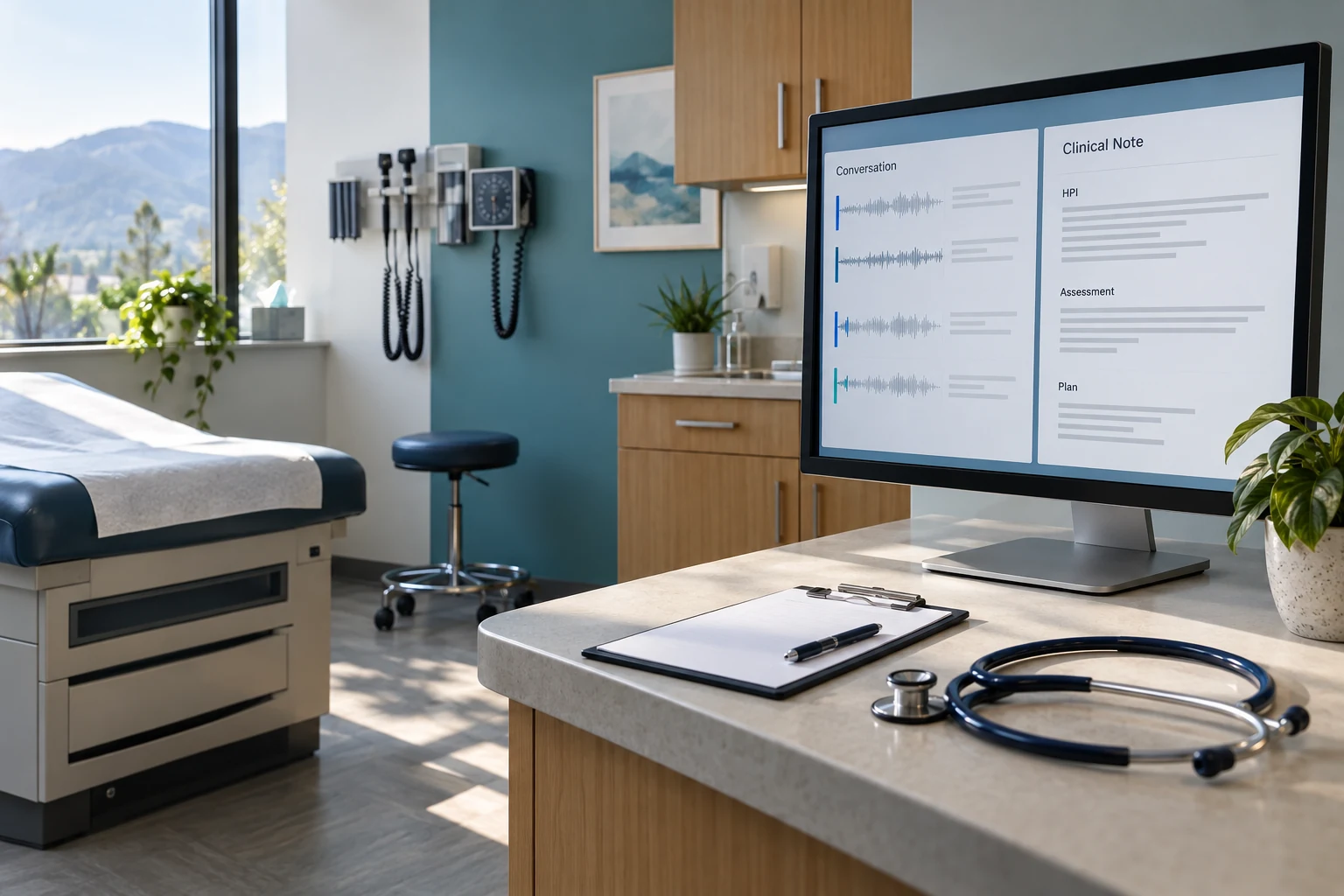
None of these look like errors. They look like a thorough note. That is precisely the problem: the fabricated content is indistinguishable from good documentation, and it is now in the chart.
The dangerous output is not the one that reads wrong. It is the one that reads more complete than the encounter was.
What provenance means here
It means every clinical assertion in the generated note maps to a specific span of the transcript, a specific device reading, or a specific existing record field — and that a clinician reviewing the note can see that mapping without leaving the review screen.
- Each assertion carries the transcript timestamp or record field it derives from
- Assertions with no source are flagged rather than silently included
- Negatives are only stated if a negative was actually elicited
- Anything imported from prior notes is labeled as carried forward, not restated as current
- The clinician's edits are captured as signal, not just corrections
The carried-forward rule deserves emphasis. Copy-forward was a documentation integrity problem long before AI, and a model that pulls context from prior notes will reproduce it at scale unless the boundary is explicit.
Why the review step cannot be treated as the safety net
Every deployment assumes clinician review catches errors, and it does catch many. But review quality degrades exactly where the risk is highest: at the end of a long clinic, on a note that reads fluently, when the alternative is rewriting it. Fluency suppresses scrutiny. That is a known human factor, not a training issue.
Which is why the flagging has to be structural. A note that visually separates sourced assertions from unsourced ones directs attention where it is needed. A note that renders uniformly relies on the reviewer to find the one sentence that was invented.
Where unsupported clinical assertions come from
Relative weighting from delivery practice, not a measured statistic — shown to rank where attention belongs.
Measuring the thing that matters
The headline metric in this category is usually time saved, which is real and worth having. The metric that determines safety is the rate of unsupported clinical assertions per note, measured against transcripts by a reviewer who was not the author.
That number is expensive to produce and almost never published. Asking a vendor for it — and for the definition they used — separates the products that have measured it from the products that have not.
A taxonomy of what actually goes wrong
Documentation failures get discussed as "hallucination," which flattens several distinct problems with different fixes. Separating them is the first step toward measuring them.
| Failure | What it looks like | Why it is dangerous |
|---|---|---|
| Invented negative | "Denies chest pain" when it was never asked | Reads as a completed review of systems; forecloses later inquiry |
| Invented exam finding | A normal finding on an exam not performed | Documents an action that did not occur |
| Specificity inflation | "Three days" when the patient said "a few days" | Precision that was never stated becomes fact downstream |
| Attribution error | A family member's symptom recorded as the patient's | Common in multi-speaker encounters; enters the problem list |
| Stale carry-forward | A resolved prior condition restated as current | Propagates indefinitely once in the record |
| Certainty upgrade | A hedged clinical impression written as a diagnosis | Changes the clinical meaning of the note entirely |
Only the first two are what most people mean by hallucination. The other four are subtler, more frequent, and less likely to be caught on review because none of them look wrong.
The review interface is the actual safety control
Every deployment relies on clinician review, and the design of the review surface determines whether that reliance is reasonable.
A note rendered as uniform prose asks the reviewer to detect the one unsupported sentence among forty, at the end of a clinic day, under time pressure, when the note reads well. That is a request the human factors literature says will not be reliably met, and treating it as the control is a documented way to be surprised later.
A note that visually distinguishes sourced from unsourced content inverts the task. The reviewer's attention goes to the small set of flagged assertions rather than being spread evenly across content that mostly does not need it. Hovering an assertion shows the transcript span. Unsourced content is not silently included — it is either omitted or surfaced as a suggestion requiring an affirmative click.
- Sourced assertions rendered plainly; unsourced ones visually distinct
- Span playback available inline, without leaving the note
- Carried-forward content labeled as such, with its origin date
- Negatives shown only where a negative was elicited, with the eliciting question available
- Edits captured as structured signal, not just as a diff
That last item compounds. Clinician edits are the highest-quality error signal any deployment will ever get, and most programs discard them by storing only the final note.
How to measure it, specifically
The protocol is not complicated and it is rarely run. Take a sample of encounters with both audio and generated note. Have a reviewer who did not author the note read each assertion in the note and classify it against the transcript: supported, unsupported, or contradicted.
Report the rate of unsupported clinical assertions per note, broken out by the taxonomy above. Report it separately for encounters with multiple speakers, for encounters with accented speech, and for encounters over a certain length, because performance is not uniform across those and the aggregate hides it.
A hundred encounters produces a usable estimate. It costs a reviewer perhaps two days. It is the only number that describes the safety of the deployment, and the fact that it is almost never published is itself worth weighing when evaluating a product.
What the record does with the note afterward
A generated note does not stay a note. Content flows into the problem list, the medication reconciliation, coded diagnoses, and quality reporting. An invented finding does not sit quietly in a paragraph — it may become a coded condition that follows the patient across institutions.
Which argues for a boundary that many deployments do not draw: generated narrative may enter the note, and structured elements should be promoted to coded fields only through explicit clinician action, never automatically. The convenience loss is real and small. The alternative is a pathway from a fluent sentence to a permanent coded diagnosis with no human decision in between.
It is also worth recording, in the record's metadata, that a note was machine-drafted and clinician-reviewed. Later, when a discrepancy is investigated, the difference between a note dictated by a clinician and a note drafted and approved is material to understanding how it arose.
What clinicians should be told
Adoption programs tend to emphasize time savings, which is honest but incomplete. Clinicians reviewing generated notes should be told plainly which failure modes to expect, because knowing that the system tends to invent plausible negatives changes where a reader looks.
This is a small intervention with disproportionate effect. A reviewer told "check the numbers" reads differently than a reviewer told "this system will occasionally document a review of systems more completely than you performed it." The second is specific enough to act on.
Performance is not uniform across the clinic
Aggregate accuracy figures conceal variation that matters clinically, and the variation is predictable enough to test for directly.
- Multi-speaker encounters — a parent, an adult child, an interpreter — drive attribution errors sharply
- Accented speech and code-switching degrade transcription before the note is ever generated
- Long or complex visits increase omission and compression errors
- Specialties with dense negative findings attract more invented negatives
- Encounters with interruptions produce fragmented context the model smooths over
Reporting a single number across all of these is not wrong so much as uninformative. A product that performs well on straightforward adult primary-care visits and poorly on pediatric visits with two caregivers is a product with a deployment scope, and knowing the scope is what makes it safe to deploy.
Questions worth asking a vendor
Most procurement conversations in this category center on time saved and EHR integration. Neither predicts safety. Five questions do.
What is the rate of unsupported clinical assertions per note, and how was it defined and measured? Broken out by which encounter characteristics? How does the interface distinguish sourced from unsourced content for the reviewing clinician? What happens to content that cannot be tied to a transcript span — omitted, flagged, or included? And are clinician edits captured as structured signal, and can we see the aggregate?
A vendor that has measured this will answer specifically. A vendor that has not will redirect to accuracy of transcription, which is a different and much easier problem.
The pilot design that surfaces the truth
A standard pilot measures satisfaction and time saved, both of which will look good, because a fluent draft genuinely does save time and clinicians genuinely do prefer it to typing.
The pilot that tells you something runs a parallel audit: a sample of encounters where a reviewer who did not author the note compares every assertion against the recording. It is more work than a standard pilot by a meaningful margin, and it is the only design that produces the number the safety case rests on.
It also produces something politically useful. When the audit finds a modest rate of unsupported assertions — as it generally will — the organization can decide knowingly whether the interface controls are sufficient, rather than deploying on an assumption and revisiting it after an incident.
Frequently asked questions
It helps with vocabulary and format. It does not remove the completion behavior, because that behavior is what generative models do. The constraint has to be architectural.
For coded fields it is strictly safer and should be preferred. Narrative is required for the parts of the record that are genuinely narrative, and those are the parts that need the span mapping.