
Direct versus channel is not one decision
Most software firms treat the question as binary. Sell direct and keep the margin, or sign a channel partner and buy reach. That framing produces bad agreements. What a government buyer needs separates cleanly into three parts: a contract instrument the money can legally travel on, someone to administer the order and the invoicing, and a company that shows up when the thing breaks. A channel partner can supply the first two. Almost nobody supplies the third on your behalf, because the program office knows who wrote the software.
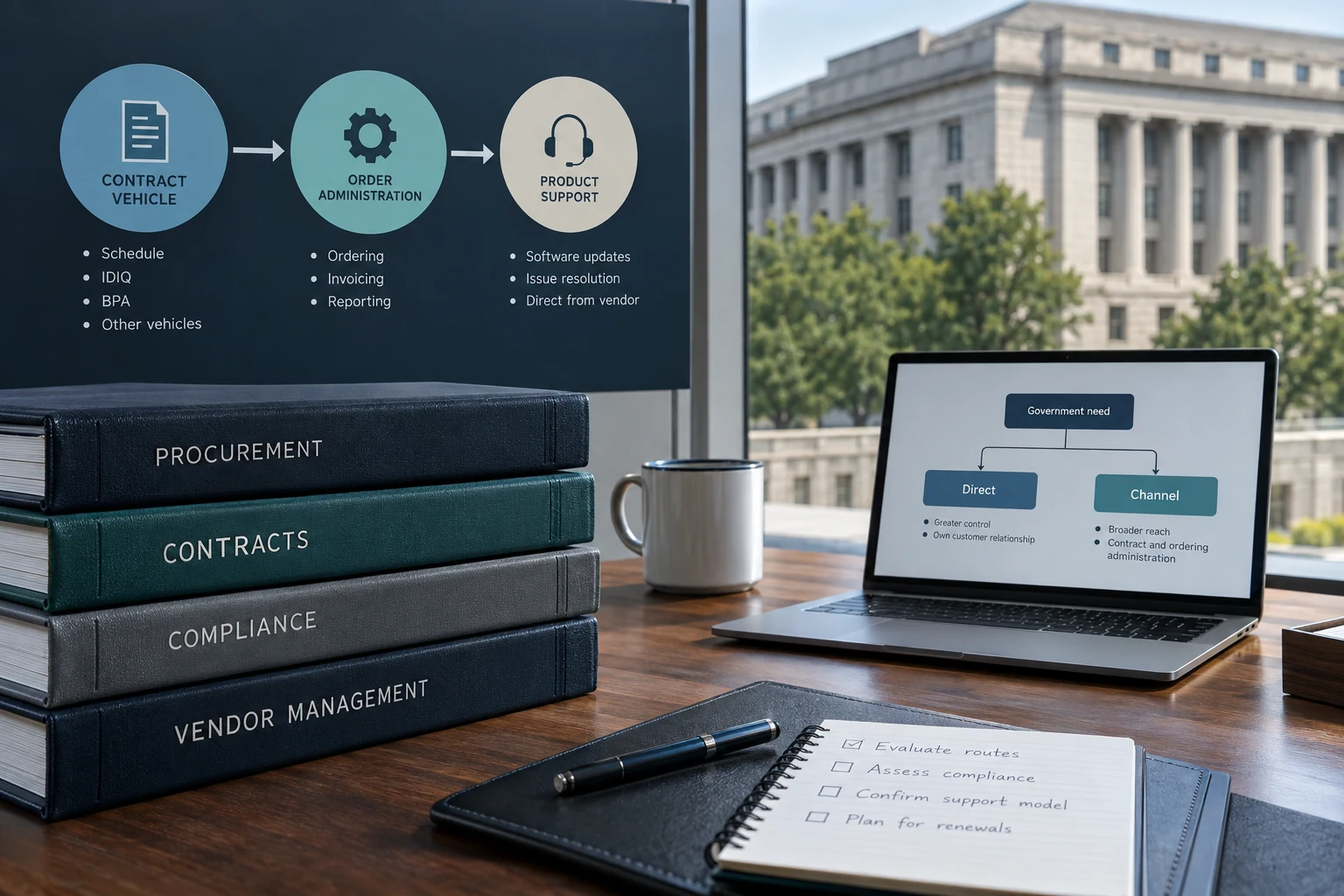
Once the three are separated, the decision stops being philosophical. A partner holding a contract vehicle you cannot reach this fiscal year is selling access to money that is already appropriated. A partner offering to open doors at an agency is selling something much softer at the same price. Both conversations sound identical in the first call. The paperwork tells you which one you are in.

The weighting below is our editorial judgement about what decides the routing question for a software firm selling to federal, state, and local buyers. The bars say which factors deserve the most argument in a partner negotiation. They are not a measured statistic and not the probability of anything.
Editorial weighting: what decides the routing question
Editorial weighting from public sources and practitioner reading. Illustrative, not a measured statistic.
Five routes, and they are not variations of one thing
Reseller, distributor, partner, and teammate get used interchangeably in first meetings. In contracting they describe structures with different owners of risk, different reporting duties, and different answers to who the government calls. Have this map in front of you before a term sheet arrives.
| Route | Who holds the government contract | What you give up | Where it breaks |
|---|---|---|---|
| Direct on your own GSA Schedule | You. You invoice, report sales, pay the Industrial Funding Fee | Time to award, catalog upkeep, permanent price disclosure | The minimum sales requirement, if the pipeline does not appear |
| Authorized dealer under a Schedule holder | The holder. GSA requires the dealer to be approved by the contracting officer and written into the contract | Margin, plus operating inside another firm's contract terms | Every term the holder agreed to applies to you |
| Contractor Team Arrangement on GSA MAS | Each member, for its own portion. All must hold Schedules | Little, if you hold a Schedule. Coordination if you do not | Closed to a firm without its own Schedule |
| Behind a distributor or aggregator | The distributor, on its vehicle. You supply the product | Distributor margin and visibility into the end buyer | Renewal and usage data sit with the distributor by default |
| Subcontract to a systems integrator | The integrator, as prime | Price transparency and the integrator's flow-down clauses | Your product becomes a line in someone else's architecture |
The GSA rules that decide which routes exist
Two of those routes are governed by specific GSA policy, and reading it early saves a month.
Contractor Team Arrangements on the Multiple Award Schedule. GSA's rule is that two or more MAS contractors may team to meet a single requirement, and that FAR subpart 9.6 does not apply to MAS CTA agreements. The arrangement creates no separate legal entity. Each member is responsible for its portion of the work under its own Schedule contract, and each tracks and reports its own sales and pays its own Industrial Funding Fee. GSA's guidance treats the team lead as the party that typically handles invoicing, and asks ordering activities to name every member in the award documentation. The consequence is blunt: a CTA is a partnership of Schedule holders, so a firm without a Schedule cannot enter one.
Authorized dealers. A Schedule holder may allow another legal entity to sell under its contract. GSA is specific that an authorized dealer must be approved by the procurement contracting officer and incorporated into the contract, that all contract terms and conditions applying to the holder also apply to the dealer, and that the holder's sales tracking system has to recognize, track, and report eligible sales for every participating dealer. GSA also draws the line that matters for vocabulary: an authorized dealer is not the same thing as a reseller, which holds its own MAS contract. When someone offers to put you on their Schedule, ask which of the two they mean, and whether the contracting officer has approved it.
One more piece of plumbing catches firms selling packaged products. GSA requires a letter of supply for products offered under the Information Technology large category, signed by both vendor and supplier and dated within twelve months of submission, unless the manufacturer or its authorized partner participates in GSA's Verified Products Portal. If you are the publisher and your partner is the offeror, you are the one signing it.
The bill for holding your own paper
Going direct is not free, and the recurring costs are the ones firms forget when they model the decision. A GSA Schedule carries the Industrial Funding Fee, currently 0.75 percent of reported sales, remitted with sales data through the FAS Sales Reporting Portal. It carries a minimum sales requirement of $100,000 over the first five years and $125,000 for each five-year period after that, with the contract subject to cancellation if those are missed. It carries catalog maintenance, with contract data updated within thirty days of a modification that changes catalog contents, and price reductions reported to the contracting officer within fifteen days.
None of that is heavy for a firm with real federal volume. All of it is heavy for a firm with one champion at one agency and no second buyer in sight. The sales minimum is a quiet forcing function: a Schedule you cannot feed becomes an administrative liability that eventually goes away on GSA's terms rather than yours. That is the strongest honest argument for routing an early deal through a partner who already holds the paper.
Fee stacking, and the number that actually matters
Both sides underestimate how many small percentages sit between the appropriation and the publisher. The published ones are modest. The Industrial Funding Fee is 0.75 percent. On the state and local side, NASPO ValuePoint describes its own administrative fee as between zero and one quarter of one percent, though individual participating addenda add a state fee on top, and executed addenda in the public record show state fees at one percent and higher. Those are the fees you can look up.
The fee you cannot look up is the channel margin, and it dwarfs every published percentage combined. It is negotiated deal by deal, it varies by whether the partner carries the paper, the invoicing, the demand generation, or all three, and no public source will tell you what is normal for your category. Anyone quoting an industry-standard number without reference to what they will actually perform is describing a preference. Price the functions instead: vehicle access, order administration, credit and collections, first-line support, marketing. Each has a cost you can estimate. A percentage attached to none of them is a rent.
What the government is doing on the other side of the table
The routing question does not sit still, because the buyer is actively restructuring how it buys software. GSA launched its OneGov strategy in April 2025 and describes the approach as working directly with original equipment manufacturers to eliminate markup and put accountability for support and performance in one place. By GSA's end-of-year update in December 2025, nineteen agreements had been executed with technology companies including Adobe, AWS, Anthropic, Box, Docusign, Elastic, Google, Microsoft, OpenAI, Oracle, Perplexity, Slack, and ServiceNow. Agencies can opt into those offers through September 2026, with discounted pricing available for up to thirty-six months on certain products. The AWS agreement alone is structured as up to $1 billion in incentive credits aggregated across federal civilian agencies through December 31, 2028.
Read that as a signal about direction rather than an opening most firms can enter. Those agreements went to publishers with enormous installed bases. What it tells you is that the government's own procurement leadership has stated a preference for buying closer to the manufacturer, so a partner whose entire value proposition is sitting between an agency and a publisher is standing in a current running the other way. Price any long exclusivity term with that in mind.
Compliance travels with the product, not with the seller
This is the section that turns a good channel agreement into a bad one when it is skipped. A partner can hold the contract. The obligations that attach to what is inside the box still land on the firm that built it.
Trade Agreements Act. GSA states that MAS offerings are subject to the TAA, so a contractor may offer only U.S.-made or designated-country end products and services, certifying country of origin for each product. The World Trade Organization Government Procurement Agreement threshold effective for calendar years 2026 and 2027 is $174,000 for the central government entities in U.S. Annex 1, with higher thresholds for sub-central and other listed entities. For software delivered as a service the origin analysis is less obvious than for a boxed product. Resolve it in writing before a partner lists you.
Section 889. FAR 52.204-24 and 52.204-26 carry the representations, and 52.204-25 carries the prohibition on providing any equipment, system, or service that uses covered telecommunications equipment or services as a substantial or essential component, plus a continuing duty to report if the contractor becomes aware of covered equipment during performance. That obligation follows the thing being delivered. A reseller in the middle does not absorb it.
CMMC. Under the program rule at 32 CFR part 170, requirements apply to DoD solicitations and contracts for commercial items above the micro-purchase threshold, except those exclusively for commercially available off-the-shelf items. DFARS 252.204-7021 makes the contractor responsible for flowing CMMC requirements down, triggered where the subcontract requires processing, storing, or transmitting federal contract information or controlled unclassified information on a contractor system. The test is not whether you are the prime. It is whether your system touches that data.
FedRAMP. For a cloud service, the authorization question belongs to the provider. FedRAMP is mid-transition: the Consolidated Rules for 2026 carry the requirements for FedRAMP 20x, which initially supports Class A (pilot), Class B (low), and Class C (moderate) certifications, and providers must obtain an initial implementation phase Marketplace listing before applying for certification. Timelines here have moved more than once, so confirm the current state on fedramp.gov rather than on a partner's summary of it.
Three things to re-verify before signing a multi-year channel agreement
The FAR itself is being rewritten. The FAR Council issued proposed rules in June 2026 to streamline the regulation under Executive Order 14275, comments closed in July 2026, final rules are still pending, and agencies have been working against model deviation text meanwhile. FedRAMP's 2026 consolidated rules are still being stood up. GSA's OneGov opt-in window runs through September 2026. Section numbers in a partner's template may point at superseded text, so cite the substance and check the deviation your buyer's contracting activity is using.
Why "just add it to my partner's Schedule" often fails
A frequent proposal from an eager partner is to attach your product to a Schedule order as an open market item. FAR 8.402(f) permits an ordering activity contracting officer to add items not on the Schedule to a Schedule order or blanket purchase agreement for administrative convenience, but only if the acquisition regulations applicable to those items have been followed, including publicizing, competition, commercial acquisition procedures, contracting methods, and small business programs. The contracting officer must determine the open market price fair and reasonable, clearly identify the items as not on the Schedule, include all clauses applicable to them, and establish a new line item. GSA's guidance adds that open market items are meant to support the Schedule order rather than be its primary purpose.
The open market route is a convenience mechanism for incidental items, not a side door for a software license that is the point of the purchase. A partner who calls it routine is either working at small dollar values or about to hand a contracting officer a problem. Ask which.
Set-asides change the answer for products, not for subscriptions
If the order is a small business set-aside and your partner is the offeror, the nonmanufacturer rule enters. Under 13 CFR 121.406 a small business offering a supply item it did not manufacture must meet the nonmanufacturer rule conditions, and SBA may grant waivers where domestic small manufacturers are unavailable. The rule does not apply to small business set-asides at or below the simplified acquisition threshold, but it does apply to 8(a), HUBZone, service-disabled veteran-owned, and women-owned small business set-asides.
Here is the part software firms consistently miss, and it works in their favor. SBA treats subscription services and remote hosting of software, data, or other applications on servers or networks that are not the government's as services rather than the procurement of a supply item, and for that reason will not grant nonmanufacturer rule waivers for them. A hosted subscription is bought as a service, which puts the analysis under the limitations on subcontracting at 13 CFR 125.6 instead. That distinction changes which partner structures are legal on a set-aside. Confirm it against the specific solicitation, because the classification follows how the requirement is written.
Referral fees, and the sentence that keeps them clean
Many channel conversations start as something simpler: pay us a percentage when a deal closes. Federal contracting has an old and specific rule here. FAR subpart 3.4 defines a contingent fee as any commission, percentage, brokerage, or other fee contingent on success in securing a government contract, and the clause at FAR 52.203-5 requires a warranty that no person or agency was retained to solicit or obtain the contract on a contingent fee understanding, except a bona fide employee or bona fide agency. A bona fide agency is an established commercial or selling agency maintained for securing business that neither exerts nor proposes to exert improper influence and does not hold itself out as able to obtain contracts through improper influence. Breach lets the government annul the contract or recover the full fee.
The clause is prescribed above the simplified acquisition threshold other than for commercial products or commercial services, so a commercial software buy will frequently not carry it. That is a reason to read the specific contract, not a reason to relax. Write the agreement around defined, performed services with deliverables a third party could verify, rather than a bare percentage for an introduction. A fee that pays for work is easy to explain to a contracting officer or an auditor. A fee that pays for access is not.
The diligence a distributor runs before it will carry you
Channel partners run their own version of the check a prime runs on a teammate, because listing your product puts their contract at risk. Being fast and complete on this list is the cheapest credibility available to a new software firm.
- SAM.gov registration active, with the Unique Entity ID and CAGE code ready for an onboarding form.
- Country of origin, stated to support a Trade Agreements Act certification, including where the software is developed and where a hosted service runs.
- Section 889 representation under FAR 52.204-24 and 52.204-26, plus a statement about the components inside the product.
- Cyber posture: a NIST SP 800-171 self-assessment score in SPRS and a stated CMMC level for DoD work; current FedRAMP status for cloud.
- Support model in writing: response times, escalation path, and who answers at two in the morning during an incident.
- Price list and discount schedule that survives a price reasonableness review, plus your position on price reductions if the partner holds a Schedule.
- License terms compatible with federal buyers, including automatic renewal, indemnity, choice of law, and audit rights that agencies routinely refuse.
- Data rights position, especially if any part of the product was developed under a federal research award.
- Accessibility conformance documentation for any user interface, plus insurance certificates and a W-9.
Who owns the customer after renewal one
Everything above is mechanics. This is the part that decides whether the agreement is an asset in year three or a wall between you and your own market.
Deal registration has to name what is protected and for how long. A registration that protects an opportunity forever with no performance requirement gives a partner a claim on revenue it did not produce. One that expires unless the partner has advanced the deal to a defined stage is fair to both sides.
Usage and renewal data belong in the agreement. If the partner invoices the agency, the partner sees consumption, seat counts, and the renewal calendar. Ask for that reporting explicitly, on a stated cadence. A publisher who learns about a lost renewal afterward has been paying margin for blindness.
Reference rights are separate from resale rights. The right to describe the work publicly, subject to the customer's approval, funds your next five deals. Do not let it be assigned away inside an exclusivity clause.
Research-funded technology carries its own rules. If the software came out of an SBIR or STTR award, SBA's policy directive sets a uniform twenty-year data rights protection period running from the date of award, and a Phase III award must derive from, extend, or complete the prior effort, be funded with non-SBIR funds, and carry SBIR data rights. Agencies may award Phase III work sole source on that basis. Those rights attach to the small business that performed the work. A partner who does not know this exists should not be drafting your agreement.
When direct wins, and when the channel wins
Channel wins when the money is already on a vehicle and the fiscal year is short. An agency with expiring funds and an existing distributor contract can transact in weeks. Standing up your own instrument cannot compete on calendar time, and margin surrendered on a deal you would not otherwise have closed is not a loss.
Channel wins when order volume is high and unit value is low. Many small orders across many agencies is an administrative business. Someone has to quote, invoice, chase payment, and reconcile. If that describes your product, paying a partner to run it beats hiring for it.
Direct wins when the sale is technical and the buyer needs your engineers in the room. When the evaluation turns on architecture, data handling, or integration into a system of record, a reseller adds a translation layer at the exact point where precision closes the deal.
Direct wins when the relationship is the product. Long-lived programs with a named technical point of contact reward vendors the customer can call. If your growth depends on hearing about the next requirement early, an intermediary who owns the account works against that.
A hybrid is normal and should be written down. Most durable arrangements split by account, agency, or order size, with a named list and a process for adding to it. The failure mode is not the hybrid. It is the hybrid that lives in an email thread and gets litigated the first time both parties call the same program office.
Bottom line
Route the deal on the contract that already has the buyer's money on it, and pay for functions rather than introductions. A partner who holds a vehicle you cannot reach this year, administers orders you would otherwise staff for, and reports renewal data back to you has earned real margin. A partner who wants a permanent percentage, exclusivity with no performance floor, and the customer relationship on top has proposed something else. The obligations inside the product stay with the firm that built it whatever name is on the order. Write the agreement so the compliance you own and the customer you keep are both in it, and the rest is arithmetic.
Frequently asked questions
Sometimes, but the structure matters. A GSA Contractor Team Arrangement requires every member to hold its own Schedule contract, so it is not available to a firm without one. An authorized dealer arrangement can let another entity sell under a Schedule holder's contract, but GSA requires the dealer to be approved by the procurement contracting officer and incorporated into the contract, and all of the holder's contract terms then apply to the dealer. The third route is simply to be the supplier behind a distributor that holds its own vehicle.
No. CMMC requirements follow whether a system processes, stores, or transmits federal contract information or controlled unclassified information, and DFARS 252.204-7021 pushes them down the supply chain on that basis rather than on business model. FedRAMP authorization belongs to the cloud service provider. A channel partner can hold the contract and handle the order, but it cannot substitute its posture for the posture of the system your customer will actually use.
It depends on the contract and on what the fee is paying for. FAR subpart 3.4 treats a fee contingent on securing a government contract as a contingent fee, and the clause at FAR 52.203-5 requires a warranty that no one was retained on that basis except a bona fide employee or bona fide agency. The clause is prescribed above the simplified acquisition threshold other than for commercial products or commercial services, so many commercial software buys will not carry it. The durable practice either way is to pay for defined, performed services rather than for an introduction.
It applies to supply items. SBA treats subscription services and remote hosting of software or data on non-government servers as services rather than supplies, and for that reason will not grant nonmanufacturer rule waivers for them, which puts a hosted subscription under the limitations on subcontracting at 13 CFR 125.6 instead. Packaged software delivered as a supply item is a different analysis under 13 CFR 121.406. Confirm against how the specific solicitation writes the requirement.
The rights attach to the firm that performed the work. SBA's policy directive sets a uniform twenty-year data rights protection period from the date of award, and a Phase III award must derive from, extend, or complete the prior effort, be funded with non-SBIR funds, and carry SBIR data rights, with agencies permitted to award it sole source. A channel agreement can sit alongside that position, but it should say so explicitly rather than leaving the question to a boilerplate assignment clause.