The phrase "government edition" hides a decision that will shape your engineering for years. Most product teams hear it and picture a feature flag. What a federal buyer is actually asking for is a different deployment model, a different security posture, a different accessibility standard, a different audit surface and a different support model, all of which have to run on the codebase you already have without splitting it. Companies that treat this as a branch end up maintaining two products with one team. Companies that treat it as a set of configuration seams end up with a second revenue line and a better commercial product, because almost everything the government asks for is something a large enterprise customer will ask for eighteen months later.
This is written for the chief product officer or chief technology officer who has to decide what gets built, in what order, and by whom. The pressure is usually a specific deal: an agency or a system integrator has said they would buy the product if it ran in the right place and cleared the right reviews, and someone now has to say what that costs and how long it takes.
What a government edition really consists of
Strip the marketing off and there are five distinct requirements, each with its own engineering. They are not equally hard, and they are not usually discovered at the same time, which is why the estimate drifts.
A deployment model the buyer will accept. Usually a dedicated instance in a government cloud region, sometimes an instance inside the customer's own cloud account, occasionally a fully disconnected installation. Each of those is a different product. Multi-tenant shared with commercial customers is rarely acceptable for anything holding sensitive federal data.
A security posture that can be assessed. Not a security page on your website. A described boundary, implemented controls, evidence that they operate, and someone independent testing a sample. Even when a full authorization is not required for a particular deal, the buyer's security review will ask the same questions in a shorter form.
Accessibility conformance. Section 508 obligations apply to what agencies buy, and they are evaluated by procurement people who read the documentation you supply. For a product with a data-heavy interface, keyboard navigation, focus management, screen reader semantics on custom components, color contrast and accessible charts are real engineering, not a plugin.
An audit trail with retention. Who saw what, who changed what, who exported what, retained for a defined period, protected from the administrators, and searchable by someone who was not there at the time. Most commercial products log for debugging and have to build this from scratch.
A support model with cleared boundaries. Who may access the system, from where, on what device, under what background screening, and what happens when your normal support engineer cannot see the data. This one surprises product leaders most, because it is an operations change rather than a code change.
Where a government edition typically diverges from the commercial product
Editorial weighting, illustrative rather than measured. The last row is deliberately low: the product itself should barely change.
The rule that prevents a fork
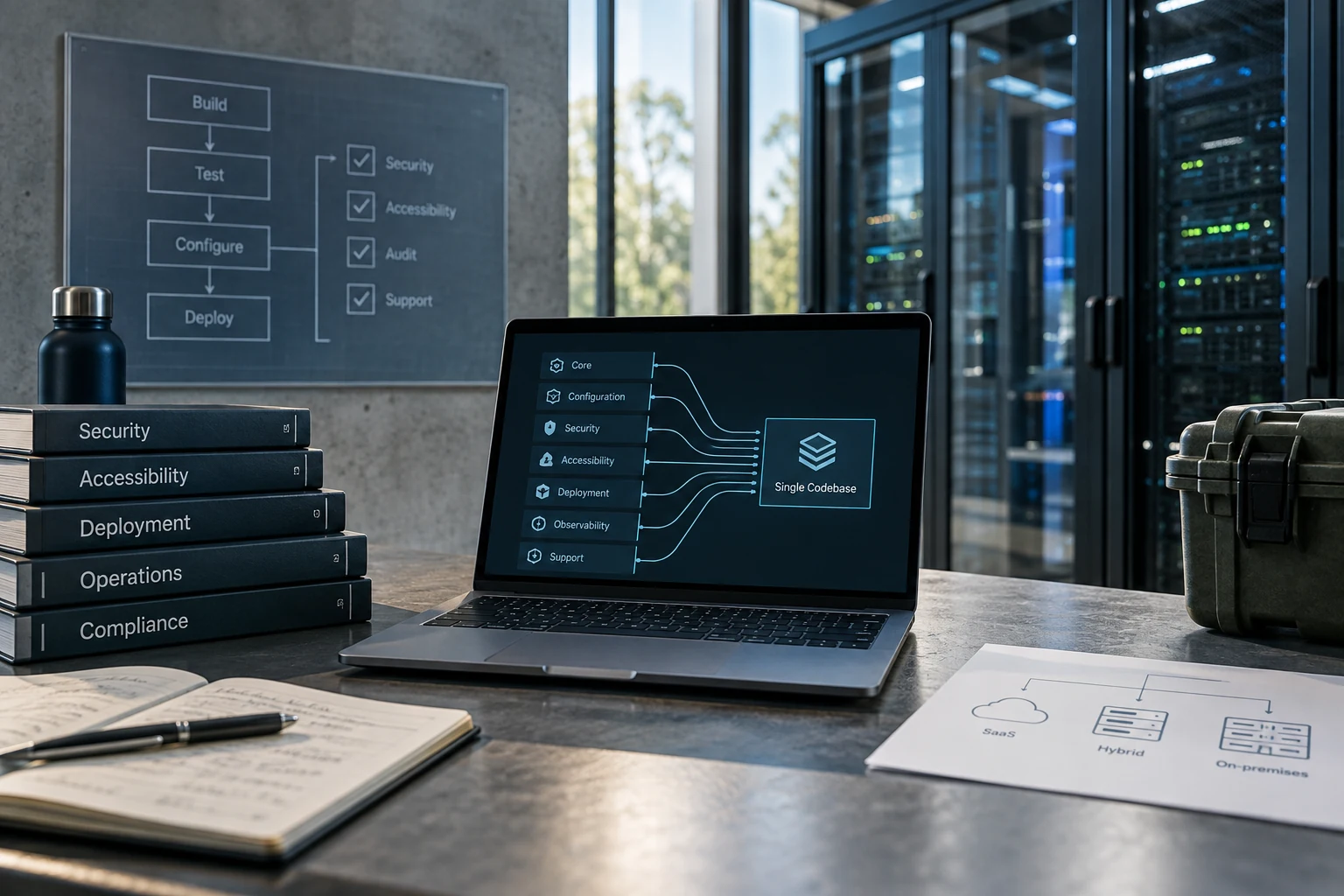
One rule governs everything below, and it is worth stating plainly before the detail: differences between editions live in configuration and in swappable adapters, never in branched code. The moment a government-only change is made by editing a shared file on a separate branch, you have signed up to build every future feature twice, and the second build will always be late because it is done by whoever is free rather than by whoever wrote the first one.
In practice that means the government edition is the same artifact built from the same commit, with different configuration and different implementations bound behind interfaces you control. If a capability cannot exist in the government deployment, it is turned off by a capability flag evaluated at runtime, and the code path is still compiled, still tested, and still present.
The seams to build, one by one
Here is the concrete work. These are the interfaces that, once they exist, absorb almost every government requirement without touching product code.
A storage adapter with a region and key policy. Object storage, database and cache access go through an interface whose implementation is chosen by configuration. The government implementation targets the government region, uses customer-managed keys held in a service in that region, and refuses cross-region reads at the client level rather than trusting a bucket policy alone.
An identity adapter. Authentication and authorization are the most common source of accidental forking, because the government deployment needs a different provider, different session lifetimes, phishing-resistant factors for administrators, and often certificate-based authentication. Push all of it behind an interface that returns a subject with attributes, and let the edition decide how the subject was proven.
An outbound call registry. Every third-party call your product makes, and every dependency that phones home, has to be enumerable. Analytics, error reporting, feature flag services, geolocation, mapping tiles, font content delivery networks, email providers, embedded model providers. In a government deployment most of these are either forbidden or must be replaced with an in-boundary equivalent. Building a registry that fails the build when a new outbound host appears is a two-week task that saves a security review.
A model and inference adapter, if the product uses machine learning. Which model, running where, with what data retention, and whether inputs may leave the boundary. Federal buyers ask this early and precisely. If your product calls a commercial model endpoint, the government edition needs either an in-boundary hosted model or an equivalent service in the government region, and the abstraction has to permit swapping without changing prompts, evaluation suites or output handling.
An audit event bus. A single interface for security-relevant events, separate from application logging, with a schema: actor, subject, action, resource, timestamp, source address, outcome, and a correlation identifier. The commercial edition can write it to your normal store. The government edition writes it to an append-only destination outside the reach of platform administrators, with retention configured by policy. Doing this as one event bus rather than sprinkling audit calls through controllers is the difference between a week of work and a quarter.
A capability flag system evaluated server-side. Not a client feature flag. A server-evaluated capability set derived from the edition configuration, so that a disabled capability is unavailable at the API layer, not merely hidden in the interface.
A data classification and export path. If the product exports data, the government edition usually needs export to be recorded, sometimes approved, and occasionally restricted by classification of the record. Building a single export chokepoint is far cheaper than retrofitting one after three teams have shipped their own download button.
Accessibility, treated as engineering rather than as a document
Accessibility is where the most confident product teams get caught, because their product looks fine and passes an automated scan. Automated tools find a fraction of real barriers. The problems that stop a federal buyer are the ones automation cannot see: a custom data grid that traps keyboard focus, a modal that does not return focus on close, a chart with no text equivalent, a drag-and-drop builder with no keyboard alternative, status messages that never reach a screen reader, and error text conveyed only by color.
The engineering is specific. Custom interactive components need correct roles, states and keyboard interaction. Every visualization needs a data table or text summary that carries the same information. Focus order has to follow visual order. Dynamic regions need live region semantics that announce once, not on every keystroke. And the whole thing has to be tested with an actual screen reader by someone who knows how to use one, on the browsers the buyer uses.
The deliverable that accompanies this is a conformance report describing how each applicable criterion is met, partially met or not met, with explanations. Buyers read it. An honest report with a small number of documented exceptions and a remediation plan is far better received than a report claiming full conformance that falls apart when their own accessibility office tests the product.
Three deployment models compared
Choosing among these is the single decision with the largest cost consequence, and it should be made against the buyers you actually intend to serve rather than against the most demanding one you can imagine.
| Dimension | Dedicated instance, government region | Deployed into the customer's account | Disconnected installation |
|---|---|---|---|
| Who operates it | You, under your own operations model | Shared: you supply and they run it | The customer, with your installation package |
| Engineering to reach it | Region, identity, logging and key seams | All of that, plus a packaged installer and upgrade path | All of that, plus offline dependencies and licence handling |
| Release cadence | Yours, subject to change notification | Theirs, so you support several versions at once | Theirs, on a slow cycle you cannot influence |
| Support and diagnostics | Normal, with access controls and logging | Limited: you often cannot see production | Very limited: diagnostics travel by file |
| Best fit | Most agency buyers of a hosted product | Buyers with their own accredited environment | Isolated networks and specialized mission systems |
| Typical failure | Commercial features quietly depend on unavailable services | Version sprawl consumes the support team | Upgrade path never built, so version one runs forever |
The documentation set that ships with the product
A government edition is not finished when the code runs. A defined set of documents ships with it, and their absence stops deals that engineering believes are won. The set is stable across buyers.
- An architecture and data flow description showing components, trust boundaries, where data rests and how it moves, at a level someone outside your company can follow.
- A security control description mapping your implementation to the control set the buyer uses, with a customer responsibility matrix saying what they must do.
- An accessibility conformance report against the applicable criteria, with exceptions and remediation dates stated plainly.
- A privacy and data handling statement: what is collected, where it is stored, retention, deletion, and whether anything is used to train a model. The answer to the last one should be no, in writing.
- An installation, configuration and upgrade guide that a customer engineer can execute without calling you.
- An incident response and notification commitment with a defined timeline, and the contact path that will actually be answered.
- A software bill of materials generated from the build, not compiled by hand, plus your process for handling a vulnerability in a dependency.
- Support terms for the edition: hours, escalation, who may touch the system, and what diagnostics you can obtain.
Which parts of the work also improve the commercial product
Editorial weighting, illustrative rather than measured. The last row is deliberately low: offline packaging rarely helps a hosted commercial product.
Staging the build so the roadmap survives
The failure pattern is a product team pulled off the roadmap for two quarters to build an edition for one deal that has not closed. The sequencing below avoids that by putting the seams first, because the seams are useful regardless of which deal lands, and by keeping the deal-specific work small and late.
A staging that keeps the commercial roadmap moving
Step three carries a rule worth repeating: migrate the commercial edition onto the new seams first. If the seams are only exercised by the government build, they rot, and you find out during a security review. If both editions run on them, every commercial deployment is a test of the government path.
How an engineering partner works inside your team
We build product engineering for companies in exactly this position, and we build and deploy systems inside federal agencies, which is why we know what the buyer's security office will ask before they ask it.
In the first two weeks we deliver a requirement inventory drawn from your actual buyers and their reviews, a seam plan naming every interface to be built and the files that change, an estimate in hours per seam, and a dependency order. That document is usable on its own: it is what your board or your executive team should see before the program is funded.
Then we build the seams alongside your engineers, in your repositories, through your review process, on your branching model. We do the adapter work, the audit event bus, the dependency registry, the accessibility remediation and the deployment automation. We write the documentation set from the system rather than from a template. We sit in the buyer's security review with your team and answer the engineering questions directly.
Your product engineers stay on the roadmap. That is the point of the arrangement: the edition gets built without the commercial product stopping, and when we leave your team owns seams they helped design and reviewed line by line.
What you keep. Everything. The code is yours in your repositories under a written present assignment of intellectual property. The documentation is yours. The buyer relationship is yours; we do not sell your product and we do not stand between you and your customer. The handover is a rehearsal in which your team deploys and operates the edition while we watch.
How it is priced. Fixed-price milestones where scope is definable, which fits the requirement inventory, the seam plan, the documentation set and the accessibility work. A committed team at a monthly rate where the work is a continuous build, which fits the adapter and deployment construction. Most programs use both.
How it starts. One email with a one-page brief: what the product is, what stack it runs on, which buyers are asking, what deployment model they want, and the date that matters. We return a scoped, priced statement of work with the assumptions written down.
Failure modes worth naming
The branch. A government-only branch created "temporarily" for one deal. It never merges. Two years later the editions differ in ways nobody can enumerate and the government edition is three releases behind.
Building for the hardest imaginable buyer. A team designs for a disconnected classified installation because someone mentioned it once, and spends two quarters on packaging that no current buyer needs. Build for the buyers in your pipeline.
Accessibility deferred to the end. Retrofitting keyboard interaction and screen reader semantics into a mature custom interface costs several times what building it correctly costs, and it lands at exactly the moment the deal is waiting.
Outbound calls discovered in the security review. An analytics beacon, a font host, a crash reporter. Each one is a small fix and a large delay, because the review restarts.
Support model undefined. The edition ships, an incident occurs, and nobody has decided who is permitted to look at production. Decide it in the design phase and write it into the support terms.
The audit trail written as application logs. Debugging logs cannot answer "who exported this record and when," and every buyer eventually asks.
Bottom line
A government edition is a configuration of your product, not a second product, and the difference between those two outcomes is decided in the first month by whether you build seams or a branch. Put the interfaces in place first, migrate the commercial edition onto them so they are exercised every day, then add the government deployment as a configuration of the same artifact from the same commit. Do accessibility as engineering rather than as a document, define the support model before the first incident, and produce the documentation set from the running system. Almost everything on this list makes the commercial product better as well, which is the argument that gets it funded.
Frequently asked questions
It is the same product delivered under a different deployment model, security posture, accessibility standard, audit surface and support model. Typically that means a dedicated instance in a government cloud region or inside the customer's own account, an identity path with stronger authentication for administrators, an audit trail with defined retention, an accessibility conformance report, and support terms saying who may access the system. The application logic itself should barely change, and if it is changing a lot, the edition is being built as a fork rather than as a configuration.
No, and forking is the outcome to design against. Keep one codebase, build the government artifact from the same commit, and express every difference as configuration or as an implementation bound behind an interface you control. Capabilities that cannot exist in the government deployment are turned off by a server-evaluated flag, with the code path still compiled and tested. Once differences live in branched code, every future feature is built twice and the second build is always late.
It depends mostly on how much of the product already deploys from source into an empty account and how much of identity, storage and logging is already behind interfaces. A product with those seams already in place can reach a government deployment in a few months. A product where identity, storage and outbound calls are wired directly into application code needs those seams built first, which is the larger part of the work. Building the seams is worth doing regardless, because the commercial edition benefits from them too.
In practice, that the product a federal agency buys can be used by people with disabilities, and that you supply documentation describing how each applicable criterion is met. Automated scanning finds only a fraction of real barriers. The issues that stop deals are custom components that trap keyboard focus, charts with no text equivalent, drag-and-drop with no keyboard alternative, and status messages a screen reader never announces. Plan for manual testing with a screen reader, and publish an honest conformance report with exceptions and remediation dates.
An architecture and data flow description, a security control description with a customer responsibility matrix, an accessibility conformance report, a privacy and data handling statement covering retention, deletion and whether anything trains a model, an installation and upgrade guide a customer engineer can execute alone, an incident notification commitment with a timeline, a software bill of materials generated from the build, and support terms for the edition. Missing documents stop deals that engineering believes are already won.