
A partnership is a structure, not a mood
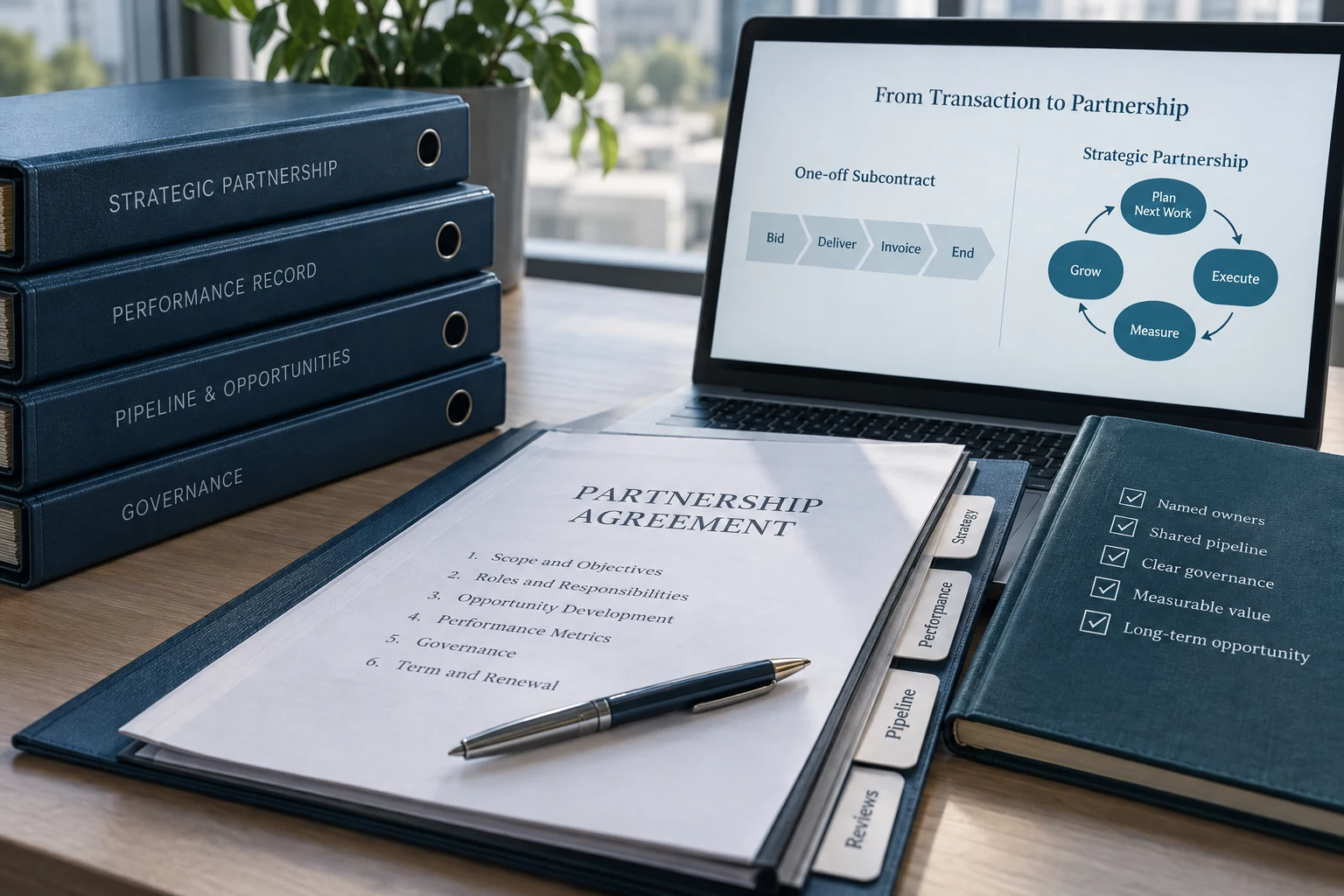
A founder who has delivered three clean scopes for the same prime and gets re-qualified from zero on the fourth has not failed at relationship building. The relationship is usually fine. What is missing is structure. A one-off subcontract is a sale that ends when the invoice clears. A partnership is a standing arrangement carrying a written performance record, a named owner on each side, an agreed way of finding the next work, and a scoreboard both parties can read. Delivery inside a container built to expire produces exactly what it was built to produce.
The research is old, unflattering, and still accurate. Jonathan Hughes and Jeff Weiss reported in Harvard Business Review in November 2007 that the failure rate for alliances hovers between 60 and 70 percent, even as alliances grew about 25 percent a year and came to account for up to a third of revenues and value at many companies. Their diagnosis travels well: most partnerships are over-specified on the business case and badly under-specified on how the two organizations will work together day to day.
So the practical question is narrow. What has to exist, in writing and on somebody's calendar, before a partner stops re-deciding the relationship every time work appears? The list is short, and almost none is social.
What decides whether a partner reuses a technical firm or re-shops the scope
Editorial weighting from public program rules and practitioner reading. Illustrative, not a measured statistic.
Why one-off subcontracts do not compound
Three mechanics keep a good subcontract from becoming a second one. All are fixable.
Each award is re-qualified from zero. The compliance staff who cleared a firm eighteen months ago run the same check again, because nothing in their file says it was already done and stayed true: registration, size representation, insurance, cyber posture, reps and certs. That work is free after the first time, but only if somebody on the partner's side owns a file that persists.
The relationship lives inside one person's head. A capture lead brought the firm in, vouched for it, and carries the memory of how the work went. When that person changes programs, the memory goes with them, and the firm starts over.
Nothing survives closeout. The scope finishes and the only artifact is a paid invoice. Six months later the partner's proposal team needs a data engineering teammate and searches its memory rather than its records, because there are none. Every completed scope should leave behind something a stranger can read. A delivery that leaves no artifact behind is a delivery your partner will have forgotten within a quarter.
| Dimension | One-off subcontract | Managed partnership |
|---|---|---|
| What triggers the next work | The partner remembers you when a gap appears | A joint plan naming pursuits, owners and dates |
| Where the relationship lives | In one manager's head | Named counterparts on both sides, plus an escalation path |
| Legal cycle per deal | Fresh NDA, teaming agreement and subcontract each time | One master agreement, then task orders |
| What survives closeout | A paid invoice | A rated performance record and named references |
| How performance is judged | Informally, and only when something goes wrong | Against agreed metrics on a fixed cadence |
| How it ends | Silently, by not being called | Deliberately, after a review that says why |
The performance record almost no subcontractor claims
The most underused instrument in federal subcontract work is an entitlement, not a favor.
Sections 8(d)(17) and 15(e)(5) of the Small Business Act, implemented at 13 CFR 125.11, let a small business that performed as a first-tier subcontractor on a contract that included a subcontracting plan request a rating of its subcontractor past performance from the prime contractor. The prime shall provide that rating within 15 calendar days of the request. It uses the same five-scale system that governs CPARS at FAR 42.1503 (Exceptional, Very Good, Satisfactory, Marginal, Unsatisfactory) and must cover at minimum technical quality of the product or service, cost control (not applicable on firm-fixed-price arrangements), schedule and timeliness, management or business relations, and other factors as applicable. Agencies must then consider that record when the firm competes as a prime, treated similarly to prime-contract past performance.
Read that again as an owner. A subcontract that produced no prime past performance can still produce a rated, factor-by-factor record, at the firm's own request, in about two weeks. The rule covers small business members of joint ventures too.
Method matters. Ask in writing within days of closeout, while the people who watched the work are still assigned. Address the person who approved the invoices and copy the prime's small business liaison officer, who knows which contracts carry a subcontracting plan. Include a short factual summary so the rater is not writing from memory, then file the result and use it in the next past performance volume.
Standing structures on the federal side
Federal teaming has a home in the regulation and it is deliberately thin. FAR 9.601 recognizes two forms of contractor team arrangement: a partnership or joint venture acting as a potential prime, or a potential prime agreeing that other companies will act as its subcontractors on a specified contract or program. FAR 9.604 sets the boundary: the government is not a party and will not enforce a work-share promise. Durability is a private-paper problem.
A master subcontract agreement. Terms, flow-downs, labor categories and rates negotiated once, with work released by task order. A full legal cycle costs a partner's contracts team more than a small scope is worth, and that friction is what keeps a good subcontractor from getting the next one. Ask whether the process you already survived can become standing paper.
A standing teaming agreement. One agreement covering a named program, customer or technical scope, with pursuits added by short addendum instead of a fresh document per solicitation. Attach the intended statement of work and priced labor categories as an exhibit and set a definitization deadline, so the subcontract is a fill-in. Work-share language left to future negotiation has repeatedly failed to bind in court, so the exhibit does the real work.
The mentor-protégé programs. Under 13 CFR 125.9, any for-profit concern that demonstrates a commitment and the ability to assist small business concerns may act as an SBA mentor. A mentor generally cannot have more than three protégés at once, and an agreement may not exceed six years. Permitted assistance is broad: technical and management help, financial assistance including equity and loans, subcontracts in either direction, trade education, and joint ventures on prime contracts. The Defense Department runs its own program, made permanent by section 856 of the FY2023 National Defense Authorization Act (Public Law 117-263) and implemented by a DFARS final rule effective March 26, 2024 that dropped "Pilot" from the name and cut mentor eligibility to $25 million in DoD contracts and subcontracts during the previous fiscal year, a quarter of the prior threshold. One date rewards reading rather than assuming: the September 30, 2026 cutoff on crediting developmental assistance costs applies to agreements entered into before December 23, 2022, not after.
The joint venture. Most upside, most rules. Under 13 CFR 125.8, a joint venture bidding a small business set-aside must name a small business as the managing venturer responsible for day-to-day management and administration of contract performance; that small business must own at least 51 percent of the entity, perform at least 40 percent of the work done by the joint venture, do work more than administrative or ministerial, and receive profits commensurate with the work performed. SBA must approve the mentor-protégé agreement before the firms submit an offer as a joint venture, or the exclusion from affiliation does not apply. Approval first, offer second: that ordering is a common way firms lose an award after winning it.
A GSA Schedule team arrangement is a different animal. Two or more Multiple Award Schedule contractors team to deliver a total solution, each holding its own MAS contract and each responsible for its portion under its own terms. It creates no separate legal entity, and FAR Subpart 9.6 does not apply to Schedules teaming. GSA expects the CTA document to state delegations of responsibility, duration, how orders are invoiced, and how a departing member gets replaced. That last one is the durability clause, and most CTA documents write it badly.
The subcontracting-plan math that decides how much a prime needs you
A partner's motive changes how a firm asks for things. Under FAR 19.702, an other-than-small prime must submit a subcontracting plan on an award expected to exceed the threshold when subcontracting opportunities exist. The 2025 inflation adjustment, a final rule issued August 27, 2025 and effective October 1, 2025, raised that figure from $750,000 to $900,000, with construction moving from $1.5 million to $2 million. FAR 19.704 requires separate percentage goals by socioeconomic category and a named individual administering the program, and those goals get reported and defended.
The scale is real. SBA's FY25 scorecard reported nearly 28 percent of prime federal contract dollars going to small businesses, about $179 billion against a 23 percent statutory goal, and nearly $273 billion once subcontracts are counted. A prime carrying goals it must report against has a structural reason to keep a performing teammate rather than re-shop the work.
The inverse matters just as much. A small business prime need not submit a plan, so when a small prime brings in another small firm it is buying capability and nothing else. Cleaner in one sense, more fragile in another: no goal credit holds it together once the technical need passes.
One administrative detail decides how expensive you are to add. Under FAR Subpart 44.2, where a prime has an approved purchasing system, consent to subcontract is required only for subcontracts the contracting officer specifically identifies, and section 824 of the FY2019 National Defense Authorization Act bars withholding that consent without the program manager's written approval. Such a partner can add and expand a teammate with far less friction, which is worth knowing before reading slowness as disinterest.
Commercial partner programs are a published scoreboard
The commercial side has what federal teaming lacks: written criteria for advancement that anybody can read and go earn. For a firm that is genuinely good and genuinely unknown, this is the fastest conversion from capability to visible status.
Amazon Web Services runs partner relationships through AWS Partner Central, with co-sell pipeline managed in ACE, the APN Customer Engagements system, where partners share opportunities, receive AWS-originated referrals, and track deals. AWS publishes the sequence: register in Partner Central, sell through AWS Marketplace, share opportunities to become ACE-eligible, engage the aligned programs, then use the co-sell features. Named programs include ISV Accelerate, the ISV Workload Migration Program, AWS Specializations, and Marketplace private-offer promotions. Resale runs on a selling authorization: an ISV authorizes a channel partner, who extends a Channel Partner Private Offer to the buyer.
Microsoft retired Silver and gold membership and now runs the Microsoft AI Cloud Partner Program on Solutions Partner designations. Six pathways (Data and AI, Digital and App Innovation and Infrastructure on Azure, plus Security, Business Applications and Modern Work) roll up into three visible badges: Solutions Partner for Cloud and AI Platforms, for Security, and for AI Business Solutions. Qualification runs on a partner capability score of Performance, Skilling and Customer success, and a designation is a prerequisite for Specializations.
Google Cloud replaced Partner Advantage with the Google Cloud Partner Network on January 15, 2026, moving from two tiers to three: Select, Premier and Diamond, with Diamond described as intentionally selective. Specializations gave way to Competencies, earned at Basic or Advanced levels and measured on capacity (certifications and sales credentials) and capability (contribution to validated closed-won opportunities).
Across all three, status is earned through evidenced customer outcomes rather than headcount or spend, which favors a firm whose advantage is that the work is good.
| Structure | What it establishes | What it does not do |
|---|---|---|
| Master subcontract agreement | Terms, flow-downs and rates set once; work released by task order | Obligate anyone to issue a task order |
| Standing teaming agreement | A pre-award relationship across a program, priced scope attached | Bind a work share left to later negotiation |
| SBA mentor-protégé agreement | Technical, management and financial assistance, up to six years | Confer the joint venture affiliation exclusion on its own |
| Small business joint venture | A vehicle to bid above your own capacity, 40 percent of the work yours | Survive sloppy paper on ownership, control or profit split |
| GSA MAS team arrangement | A combined Schedule solution under each member's own contract | Create a legal entity; FAR Subpart 9.6 does not apply |
| Cloud partner tier and co-sell | Published criteria, visible status, referral and marketplace flow | Generate demand; tiers decay without evidenced outcomes |
Deal registration and the rules of engagement
Commercial partnering has one convention federal teaming lacks, and misreading it burns goodwill in a first quarter. Deal registration lets a partner register an opportunity with the vendor before actively pursuing it. Once approved, the partner gets priority for a period the program defines, which keeps another partner or the vendor's own sales team from arriving in the same account. That manages channel conflict, which shows up three ways: partner against partner, partner against the vendor's direct sales force, and partner against inside sales.
Every mature program publishes rules of engagement stating which accounts each party may pursue independently, which require coordination, and how conflicts get adjudicated. Read them before the first joint customer call, not after the collision. Two habits protect a new partnership: register early and honestly, and never register an account you cannot actually influence.
Governance is most of the job
The structures above are containers. What fills them is a rhythm, skipped because it feels like overhead against billable work.
One named owner on each side. Inside a small firm this is the founder, and the point is holding the role explicitly rather than by default. Alliance management is a real profession: the Association of Strategic Alliance Professionals offers the CA-AM and CSAP certifications, with more than 2,200 people certified and renewal every three years. The lesson from the discipline existing at all is that partner relationships have a method, and a method can be run part-time once written down.
A joint plan with names, dates and owners. Not a memorandum of intent. Two or three specific pursuits, who does what, and when the next decision falls due. Hughes and Weiss found the useful metrics are pegged not only to alliance goals but to performance in working toward them, which is a way of saying that "we intend to grow this together" cannot be reviewed.
A fixed cadence. A working call monthly and a review quarterly is enough at this size: what was delivered, what is in the joint pipeline, what slipped, what each side needs. The discipline is holding it in the quarters when nothing is happening, because those decide whether the relationship survives.
An escalation path. A second named contact on each side, senior to the day-to-day owners, called only when something is stuck. Establishing it while everything is fine is what makes it usable later.
Internal stakeholders on your own side. The last of the five HBR principles is to be as diligent with internal stakeholders as with the partner. Where delivery engineers have never met the partner's program people, a partnership gets quietly undermined by the people who must execute it. Everyone touching the account should know who the partner is and what was promised.
The metrics the partner is already keeping on you
Delivery exceptions. How many times the partner's manager had to intervene. This number overwhelms the others, and it is the only one a firm controls completely.
Response latency. Time from a request to a complete answer, measured in hours during proposal and delivery crunches. A firm that returns a rate sheet the same afternoon gets priced into future plans by people who never say so.
Sourced versus received work. Whether the firm only receives scope or also brings opportunities the partner did not have. Sourcing is the fastest way to change a partner's internal description of you from vendor to partner, which is why the joint plan should hold one pursuit you brought.
Scoreboard contribution. Federally, dollars counting toward a reported subcontracting goal. Commercially, certifications, competencies, closed-won contributions and marketplace transactions that move the partner's own tier. Both are the partner getting credit for working with you, the most durable reason a large organization keeps a smaller one.
Expansion. Whether scope grew inside the existing relationship. Going from one task order to three inside the same agreement says more to a partner's leadership than any capability briefing.
The first twelve months, in order
Below is a deliberate first year when the objective is a standing relationship rather than a completed scope. Timing varies; the ordering does not, and skipping step two is the most common and most expensive mistake.
Building a durable partner relationship from a first subcontract
How these relationships actually die
One person deep. The champion moves to another program and the firm discovers it had a relationship with an individual, not an organization. The fix is boring and works: two named contacts on each side, and a written record findable without the champion.
Exclusivity asked for too early. Exclusivity is granted after a partner decides a firm is worth protecting. Requesting it before contributing reads as a firm managing its own risk ahead of the partner's.
The silent quarter. Work finishes, both sides get busy, four months pass. The relationship does not end in an argument. It ends by not being called, which is why cadence matters most when there is nothing to discuss.
Drifting into staffing. Accept enough hourly bodies-on-seats work and you become a staffing line in the partner's cost model, priced against staffing rates and replaced on price. The defense is holding scoped, outcome-priced work.
A key personnel substitution in month one. A named engineer who is not there when the award lands damages a relationship faster than a missed milestone, because it turns a competence question into a candor question. State availability honestly and put the substitution path in writing before anyone asks.
Optimizing the current award instead of the next one. Squeezing the last few percent out of one bid's work share, at the cost of the partner's opinion of you, is a bad trade in a relationship meant to run for years. The number moves at award anyway.
When to decline a partnership
Capacity for governance is finite, and three signals justify a polite no. The partner will not name a counterpart or agree to a cadence, so the relationship exists only inside a single pursuit. The scope is entirely staff augmentation with no path to owning an outcome, so it builds no past performance worth citing. Or it asks for exclusivity while offering no commitment back, which is a one-sided option written as a partnership. Declining early and warmly costs nothing; a partnership accepted and then under-served costs the relationship and the reputation attached to it.
Bottom line
A durable partnership is built from five things a firm can produce without anyone's permission: clean delivery on a first scope, a written performance record requested and filed, standing paper that removes the legal cycle from every future deal, a named owner and a cadence on both sides, and a joint plan holding at least one pursuit the firm brought itself. The federal side supplies the structures and the commercial side supplies the scoreboards. Neither supplies the governance. It is the founder's job, takes hours a month, and is the difference between a firm that has delivered eleven subcontracts and a firm that has four partners.
Frequently asked questions
Yes. Under 13 CFR 125.11, a small business that was a first-tier subcontractor on a contract that included a subcontracting plan may request a rating of its subcontractor past performance from the prime, and the prime must provide it within 15 calendar days. The rating uses the FAR 42.1503 five-scale system and must address technical quality, cost control, schedule and timeliness, management or business relations, and other applicable factors. Agencies must consider it when the firm later bids as a prime.
A teaming agreement is a pre-award document tied to one pursuit, and under FAR 9.604 the government is not a party and will not enforce a work-share promise. A partnership structure persists between pursuits: a master subcontract agreement with task orders, a standing team agreement with priced scope attached, a mentor-protégé agreement, or a joint venture. The teaming agreement wins one bid. The structure produces the next five conversations.
Yes, and it is now permanent. Section 856 of the FY2023 National Defense Authorization Act (Public Law 117-263) authorized it on a permanent basis, and a DFARS final rule effective March 26, 2024 implemented that and removed "Pilot" from the name. Mentor eligibility fell to $25 million in DoD contracts and subcontracts during the previous fiscal year. The September 30, 2026 date on crediting developmental assistance costs applies to agreements entered into before December 23, 2022.
On a small business set-aside, 13 CFR 125.8 requires the small business to own at least 51 percent of the joint venture, be the managing venturer responsible for day-to-day contract performance, perform at least 40 percent of the work done by the joint venture, and do work that is more than administrative or ministerial. Profits must be commensurate with the work performed. Where a mentor-protégé joint venture is used, SBA must approve the agreement before the offer is submitted for the affiliation exclusion to apply.
They are the rare partner relationship where advancement criteria are published and the evidence is customer outcomes rather than headcount. AWS runs co-sell through Partner Central and ACE; Microsoft qualifies Solutions Partner designations on a partner capability score; and Google Cloud's Partner Network, launched January 15, 2026, uses Select, Premier and Diamond tiers with competencies at Basic and Advanced levels. Pick one, read the requirement, and earn it deliberately rather than enrolling in all three.