Higher score = stronger published evidence and methodological discipline.
The modernization problem in public
A substantial fraction of operationally critical federal software was written years or decades ago in languages and frameworks that are no longer well supported. The publicly stated modernization challenge is not a single rewrite — it is incremental modernization that preserves operational behavior while making the underlying software maintainable, secure, and extensible. AI tooling has emerged as a useful but incomplete contributor to this work.
Reverse engineering, dependency analysis, test reconstruction, and incremental migration patterns. The methodology that scales is conservative on AI claims and aggressive on validation against deterministic ground truth.
Reverse engineering with modern tools
The published research on AI-assisted reverse engineering has converged on several useful patterns. Large language models trained on code — the open Code Llama, StarCoder, and DeepSeek-Coder families, and the proprietary models behind Copilot and Cursor — can produce summaries and rough explanations of unfamiliar functions, but multiple peer-reviewed evaluations show they are unreliable on subtle semantic claims (loop invariants, aliasing assumptions, concurrency hazards). Graph neural networks applied to abstract syntax trees, control-flow graphs, and program-dependence graphs extract structural relationships more reliably than text-only models, with work from the IEEE ICSE and ACM FSE communities establishing strong baselines.

Symbolic-execution tools — KLEE, angr, Manticore — augmented with learned heuristics for path selection, scale to larger code bases than they used to, with DARPA's CHESS, AMP, and earlier Cyber Grand Challenge programs producing public artifacts that practitioners can study. NSA's Ghidra and the open-source community around it remains the dominant decompilation substrate for binary work, and recent peer-reviewed papers on neural decompilation pair its intermediate representation with transformer models to produce readable C from stripped binaries.
The methodological discipline that survives review is to use AI for hypothesis generation and to verify with deterministic tools. A summary that says "this function appears to validate input length" is a hypothesis; a property checked by Frama-C or KLEE is evidence. Practitioners who confuse the two ship modernizations that pass demos and fail acceptance.
Dependency analysis
Legacy systems often have dependency graphs that are not fully documented. Recovering them — across modules, across executables, across system and process boundaries — is its own research problem. The published work treats this as graph extraction plus learned link prediction, with significant attention to false positives. NIST SP 800-161 and the executive-order push toward software bill of materials (SBOM) generation have made dependency provenance a compliance concern, not just an engineering one, and tools like CycloneDX and SPDX have become deliverables in their own right.
The hard cases are dynamic dependencies the static analyzer cannot see: reflection, dynamic library loading, configuration-driven dispatch, and runtime IPC across process boundaries. The peer-reviewed approach combines static analysis (CodeQL-style queries, LLVM-based whole-program analysis) with instrumented runtime tracing to close the gap. A wrong dependency claim is worse than no claim, especially in safety-relevant contexts where the claim drives test scoping; reviewers expect the false-positive rate to be characterized on a representative slice before any tooling is treated as authoritative.
Test reconstruction
Many legacy systems lack the kind of test coverage modern engineering practice expects. Reconstructing a usable test suite — based on captured operational behavior, ground-truth specifications, and operator-derived acceptance criteria — is one of the highest-leverage modernization activities. The public research on automated test generation has matured: EvoSuite for Java, Pynguin for Python, and the Defects4J and SWE-bench corpora as evaluation substrates are all established. Recent peer-reviewed work on coverage-guided LLM-driven test synthesis (CodaMosa, TitanFuzz, FuzzGPT) has produced credible results on open benchmarks, particularly when the LLM is restricted to generating test inputs that a coverage-guided fuzzer then explores.
Property-based testing in the QuickCheck and Hypothesis traditions is undervalued in legacy contexts. Properties expressed against captured operational traces are more durable than example-based tests when the underlying implementation is being modernized. Mutation testing, with tools such as PIT and mutmut, gives an honest signal of test quality that line-coverage metrics conceal.
Practitioners who treat test reconstruction as the substrate for the rest of the modernization, rather than a final step, perform better. Without a credible regression suite, every other AI-assisted activity is an act of faith; with one, the team can move fast on translations and refactorings because parallel runs, equivalence checks, and behavioral diffs catch the silent regressions that modernization always produces.
Public Tooling and Methods Map — Where Each Lever Helps
| Lever | Public tooling and literature | Where it helps |
|---|---|---|
| Reverse engineering | Ghidra, IDA, angr, Frama-C, neural-decompilation papers (IEEE S&P, ACM CCS) | Hypotheses about unknown code; verified against deterministic tools |
| Dependency recovery | CodeQL, LLVM whole-program analysis, CycloneDX, SPDX, NIST SP 800-161 | Static graphs plus runtime tracing; false-positive characterization mandatory |
| Test reconstruction | EvoSuite, Pynguin, Hypothesis, PIT, CodaMosa, Defects4J, SWE-bench | Substrate for safe refactoring; mutation testing to grade the suite |
| Translation | Strangler pattern (Fowler), TransCoder, AlphaTranslate-style papers, parallel-run frameworks | Strangler boundary; equivalence checking against behavioral diffs |
| Documentation | LLM summarization with retrieval over code graph; arXiv literature on docstring synthesis | Onboarding artifacts; reviewer-checked, never treated as ground truth |
Incremental migration patterns
The published modernization literature is consistent that incremental migration outperforms big-bang rewrites for operationally critical systems. The Government Accountability Office has published case studies on federal modernization failures that consistently identify big-bang scope, lost institutional knowledge, and missing regression evidence as failure modes. Martin Fowler's strangler-fig pattern, anti-corruption layers between old and new code, parallel-run validation, and feature flags are the established countermeasures, codified in industry practice and in academic software-engineering curricula.
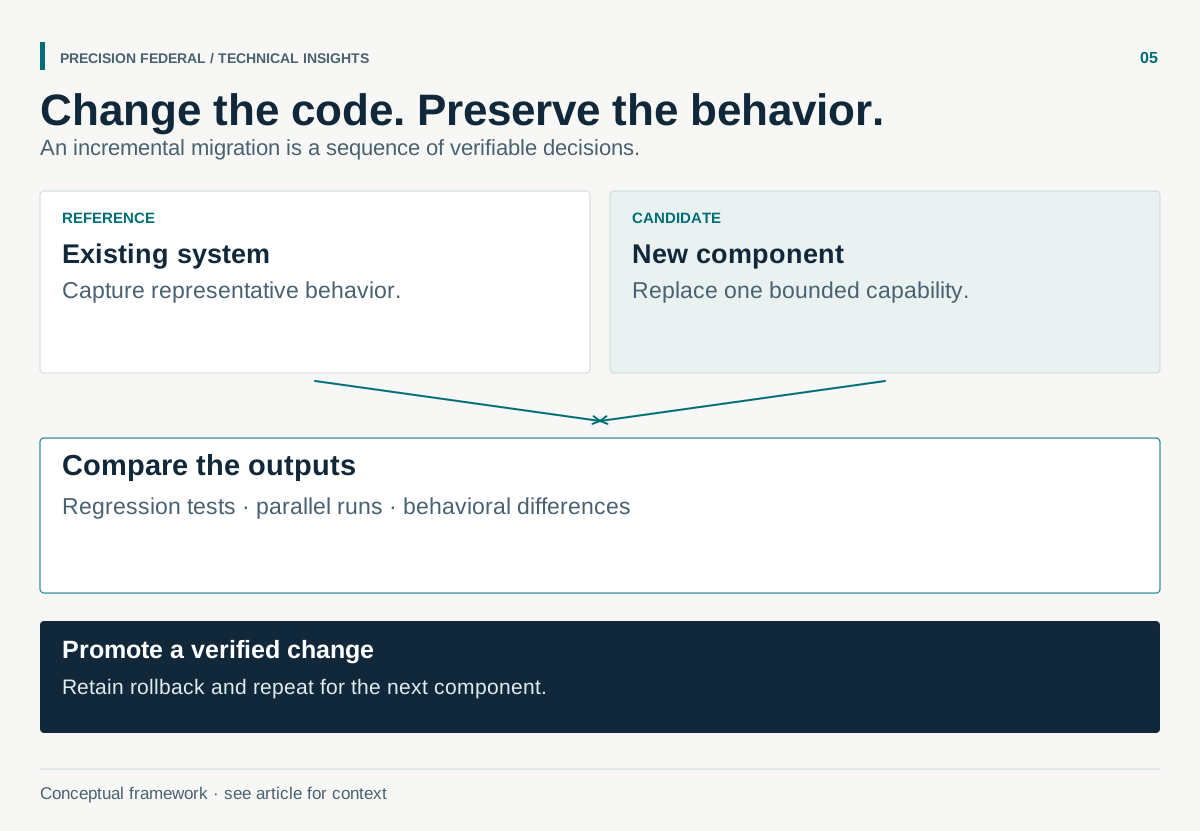
AI tooling supports each pattern. Code-translation suggestions at the strangler boundary — TransCoder-style and successor models — accelerate the boilerplate work of moving across language boundaries (COBOL to Java, Fortran to modern Python, VB6 to .NET) while leaving semantic verification to deterministic checks. Semantic equivalence checking for parallel runs is well covered in the verification literature, and behavioral-diff frameworks built on captured production traces are increasingly common. Automated documentation as the migration progresses — generated from the diff between the captured behavior and the new implementation — gives reviewers a running artifact of intent.
The methodology that scales is conservative on AI claims and aggressive on validation. The federal context adds Authority to Operate, FISMA control families, and FedRAMP boundary considerations to the picture; modernization that delivers a faster cadence of accredited releases is more valuable than modernization that delivers a faster cadence of unaccredited code.
Why this fits a software-first firm
Federal software firms can credibly take on modernization Phase I work because the deliverables are software: a tool, a methodology, a representative migration of a bounded subsystem, and a measured improvement on an operational metric (defect rate, mean time to remediate a vulnerability, time to onboard a new engineer). Phase I is the right size to demonstrate the methodology on a real but bounded scope; reviewers prefer narrow defensible deliverables to broad capability claims.
Phase II scales the methodology to additional subsystems with measurable improvements. The strongest Phase II proposals show the Phase I tool already running against a second subsystem with a credible plan for a third, plus a sustainment-account transition partner who already funds modernization activity. Phase III transitions through software-maintenance and modernization accounts that exist whether or not new modernization tooling is funded; the question is whether the SBIR-built methodology displaces enough manual effort to justify reallocation.
This is a subject area with a clear path to operational use. The agencies that fund modernization — every department with legacy systems, which is every department — are looking for partners who treat the work as engineering rather than as marketing. Public technical writing that demonstrates the team has read the literature is a useful credentialing signal, particularly for new entrants without a long government past performance record.
About this article
Precision Federal writes public technical commentary on problem classes adjacent to the programs our firm engages. The point is to demonstrate that the principal investigator has read the literature and respects the line between public technical thinking and proprietary or sensitive program content. We are a software-only SBIR firm, principal-investigator-led, and we ship under Phase I and Direct-to-Phase-II SOWs. If a public article like this one is useful to your work, we welcome the conversation.
Common questions on the public-record framing
What public AI-for-software-engineering tools are credible?
Code Llama, StarCoder, Ghidra, angr, Frama-C are public anchors. DARPA CHESS, AMP, and CGC have published lineage. The honest pattern is using AI for hypothesis generation and verifying with deterministic tools.
Why does test reconstruction matter more than code generation?
Many legacy systems lack the test coverage modern engineering practice expects. Reconstructing usable tests from operational behavior, ground-truth specs, and operator-derived acceptance criteria is the highest-leverage modernization activity.
How does incremental migration outperform big-bang rewrites?
Strangler pattern, anti-corruption layers, and parallel-run validation produce operational continuity. The literature is consistent: methods that scale are conservative on AI claims and aggressive on validation.
What does this article not cover?
Specific federal systems under modernization, specific incumbent contractors, or any Precision Federal modernization methodology.
Frequently asked questions
Big-bang rewrites concentrate risk into a single transition. Incremental migration — using strangler patterns, anti-corruption layers, and parallel-run validation — preserves operational behavior at every step, makes failures localized and reversible, and leaves room for the modernization plan itself to adapt as the team learns the legacy code base.
AI tooling is most reliable for hypothesis generation: summarization of unfamiliar code, candidate dependency edges, draft tests against captured behavior, and translation suggestions at strangler boundaries. The discipline is to verify those hypotheses with deterministic tools — symbolic execution, parallel runs, equivalence checks — before treating any AI output as authoritative.
Without a credible test suite, every other modernization activity has no objective signal that operational behavior has been preserved. Reconstructing tests early — from captured operational behavior, ground-truth specifications, and operator acceptance criteria — gives the rest of the program the regression safety net it needs to move quickly.
A bounded, representative migration of a single subsystem accompanied by reusable tooling and a methodology document. Phase I is for proving the methodology works on a real, scoped problem; Phase II scales the methodology across additional subsystems with measurable improvements on operational metrics.