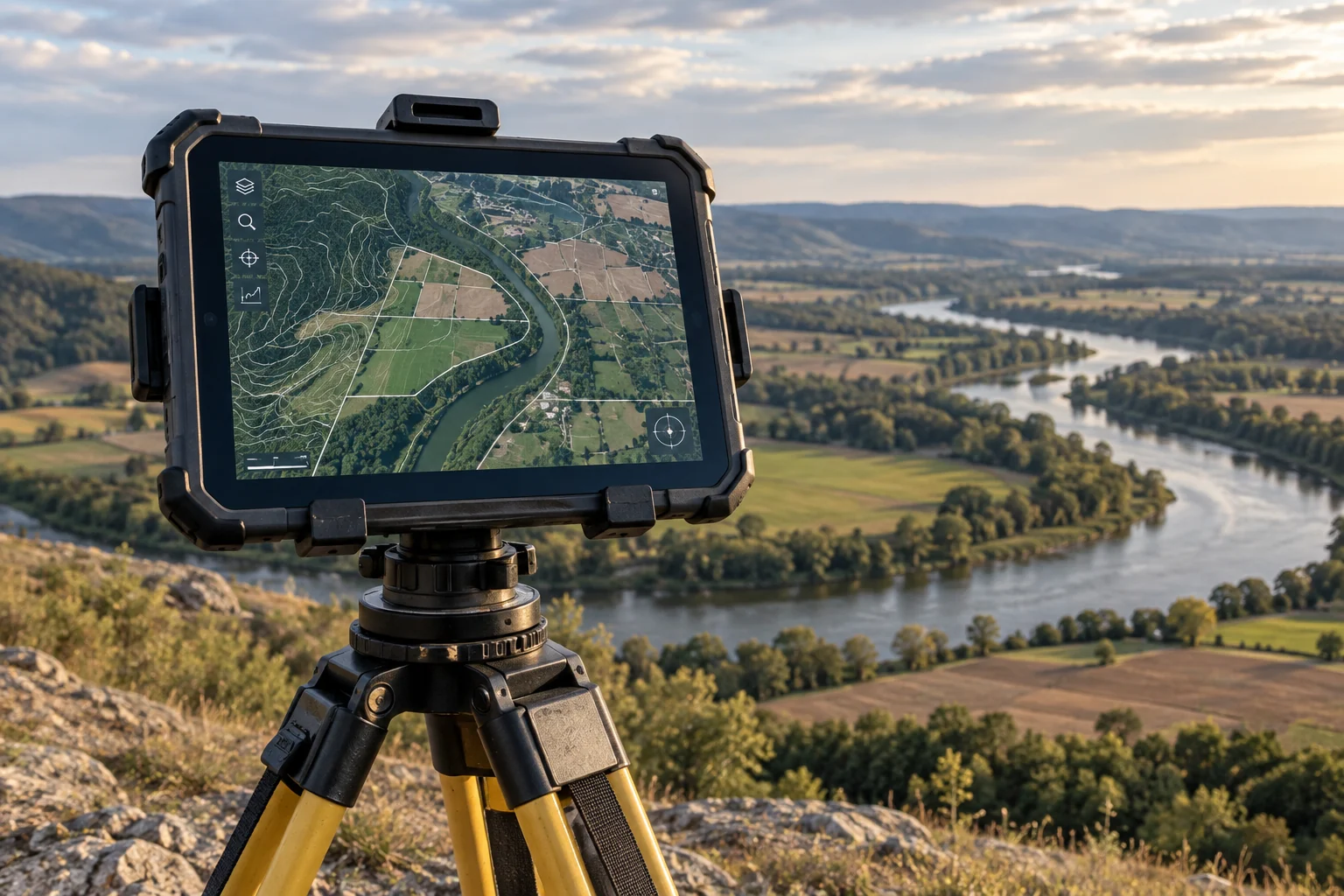
Federal geospatial work, up close
Geospatial is one of the few technology disciplines where the federal government is still the center of gravity. The National Geospatial-Intelligence Agency, U.S. Geological Survey, NOAA, the U.S. Census Bureau, the Department of Agriculture, the Department of the Interior, FEMA, and every armed service run enormous geospatial programs. The data is unique, the scale is enormous, and the operational consequences are real — a misclassified pixel can mean a missed wildfire, an undetected runway repair, or a FEMA disaster declaration that arrives a day late.
Precision Federal builds geospatial software for that reality. We are a SAM.gov registered small business (UEI Y2JVCZXT9HP5, CAGE 1AYQ0, NAICS 541512) focused on the intersection of geospatial data, machine learning, and mission-grade delivery. We ship production code, not demo notebooks.
What we deliver
Esri ArcGIS engineering
ArcGIS Enterprise, ArcGIS Online, ArcGIS Pro, ArcGIS Server, and the ArcGIS REST and Python APIs. Geoprocessing services, custom widgets, and embeddable web maps using the ArcGIS Maps SDK for JavaScript.
Open-source geostack
QGIS, PostGIS, GeoServer, GDAL, OGR, PROJ, GeoPandas, Shapely, Fiona, rasterio, xarray, and STAC. The open stack pairs beautifully with commercial Esri — not as a replacement but as a processing-grade complement.
Raster pipelines at scale
Landsat, Sentinel-1/2, NAIP, MODIS, Maxar, Planet, and USGS 3DEP LiDAR. Cloud Optimized GeoTIFFs, Zarr, and COG-backed STAC catalogs. Dask-distributed processing, Kubernetes job orchestration.
Geospatial machine learning
semantic segmentation, object detection, instance segmentation, time-series change detection, and foundation models (Segment Anything 2, Prithvi, Clay). PyTorch + torchgeo + Lightning. Evaluation on held-out federal AOIs, not leaderboard vanity.
Interactive mapping apps
Mapbox GL JS, MapLibre, deck.gl, Leaflet, and the ArcGIS JS API wrapped in React. 508-compliant map controls, keyboard-navigable legends, and alt-text for every generated image product.
Mobile field collection
Survey123, ArcGIS Field Maps, or custom React Native with offline tile caching, GPS trace recording, and federation back to a central enterprise portal.
Agency data integration
USGS Earth Explorer, NGA GEOINT services, NOAA ERDDAP, FEMA flood hazard layers, Census TIGER/Line, and BLS geographic crosswalks.
Why geospatial is different
A generalist full-stack engineer can build a perfectly good CRUD app and still ship something completely broken on a geospatial project. The reason: geospatial is one of the few domains where the data itself encodes physics. Projections, datums, and geoids are not cosmetic — they are the math that keeps Anchorage and Honolulu on the same planet. Raster bit-depth, no-data values, and compression are not incidental — they are the difference between a usable 100 GB scene and a 2 TB disaster.
We come in with the full stack of geospatial fluencies: coordinate systems (WGS84, NAD83(2011), state plane, UTM), datum transformations, vertical references (NAVD88, NAD83 ellipsoid), tiling schemes (XYZ, TMS, WMTS), service standards (WMS, WFS, WCS, WMTS, OGC API - Features/Tiles/Maps), and the difference between a raster a photo-interpreter actually wants and the one Matplotlib happily renders.
Federal agencies we target
Every federal agency runs geospatial. Our focus is on the programs where a small, high-signal contractor adds more value than a large-integrator team.
U.S. Geological Survey
3DEP LiDAR processing, National Map pipelines, streamgage data services. See our USGS page.
NGA
GEOINT services, unclassified Foundation GEOINT workflows, Maven-adjacent analytics. NGA geospatial page.
NOAA
satellite oceanography, hurricane imagery, coastal change detection. NOAA profile.
USDA
Cropland Data Layer, Forest Service fire mapping, NRCS soil survey. USDA profile.
FEMA
flood hazard layers, damage assessment imagery, disaster response dashboards. FEMA profile.
DoD components
Army Corps of Engineers levee and dam monitoring, Air Force installation mapping, Navy hydrography. DoD profile.
Reference architectures
1. Raster ML inference service
A containerized FastAPI service behind API Gateway. Tile requests come in as (x, y, z) or WKT polygons; the service reads from a COG-backed S3 bucket, runs a PyTorch segmentation model on a GPU worker, and returns a vector geometry result. Horizontally scaled via Kubernetes. Artifact lineage tracked in MLflow; every prediction tagged with model version, input scene ID, and cloud-cover percentage.
2. Federal ArcGIS Enterprise portal
ArcGIS Enterprise deployed in AWS GovCloud with a Federated Portal, Hosting Data Store, and GeoAnalytics Server. Content surfaces through a custom Experience Builder app with agency-specific branding. PKI / CAC authentication via a reverse-proxied SAML IdP. Administrative automation via the ArcGIS API for Python.
3. Change detection pipeline
Nightly Sentinel-2 ingest from AWS Registry of Open Data. A STAC catalog indexes each new scene. A Dask pipeline computes a 6-band stack of per-pixel differences against a rolling 12-month median, thresholds anomalies, and vectorizes the result. Output polygons land in PostGIS and surface as an ArcGIS Feature Service. Analysts get a morning email with the top 50 anomalies scored by area and cloud-free quality.
4. LiDAR classification and DEM production
USGS 3DEP tiles processed with PDAL and Entwine. Ground filtering, building extraction, and vegetation classification. Bare-earth DEM and Digital Surface Model produced at the agency's target resolution. Outputs delivered as COGs plus a STAC catalog for discovery.
Accessibility and 508 for maps
Maps are one of the hardest surfaces for Section 508 compliance. We take accessibility seriously, not as a checkbox. Our approach:
- Every map ships with a keyboard-navigable legend and a parallel data table view.
- Generated image products carry alt-text describing the symbology and extent.
- Color ramps respect colorblind-friendly palettes (viridis, cividis, and ColorBrewer-based diverging ramps) by default.
- Popups and feature details are rendered through the same accessible components used elsewhere in the app.
- For dashboards, a table-first view is always available as the authoritative representation.
Related resources
For a deeper look at federal geospatial modernization, see our geospatial modernization brief.
Security & compliance
We design for FedRAMP-inheritable deployment from day one. Encryption at rest (SSE-KMS, customer-managed), TLS 1.3 everywhere, audit logging to CloudWatch / CloudTrail with 1-year retention minimum. Imagery intermediate artifacts get lifecycle-policied and deleted on completion unless the contract says otherwise. For CUI, data never leaves GovCloud or Azure Government boundaries.